Wingspan compared with a person with arms outstretched.
Length
80–93 cm
Wingspan
1.2–1.35 m
Weight
1.1–2 kg
Social life
Gregarious: it breeds in colonies, often with herons and White Storks, and feeds in a group
Lifespan
Record of 30 years and 1 month in captivity according to AnAge; EURING lists a bird ringed in the Netherlands that lived 41 years and 6 months, a figure that is out of line
Conservation status
LC
NT
VU
EN
CR
EW
EX
Global (IUCN)
Least Concern
Spain
Vulnerable (VU) as a breeder and Least Concern (LC) as a winter visitor in the Red Book of the Birds of Spain; on the List of Wild Species under Special Protection
When to see it
Resident
Months of the year when it is present
J
F
M
A
M
J
J
A
S
O
N
D
In Iberia
yes
yes
yes
yes
yes
yes
yes
yes
yes
yes
yes
yes
Song or voice of the Eurasian Spoonbill
Outside the breeding colonies it is, in general, silent and only gives soft murmurs, almost inaudible. The recording, from a colony in Huelva, picks up the calls with which the chicks ask for food; the recordist warns that it was taken from very far away, so we have filtered it and raised the volume and it still sounds distant.
Chicks begging for foodEurasian Spoonbill
0:00 / 0:36
10 kHz5
The sonogram draws the sound: time runs from left to right, and the higher a trace sits, the higher the note.Recording by Joost van Bruggen, xeno-canto XC432229 (El Condado, Almonte, Huelva) (CC BY-SA 4.0).
Flight of the Eurasian Spoonbill
In flight it shows a slender silhouette because it carries its neck stretched out.
Flight typeOf slender silhouette, with the neck stretched out
It prefers shallow wetlands, generally coastal, such as marshes, deltas and estuaries, with bottoms of fine sand or mud and appreciable tidal changes.
In flight it shows a slender silhouette because it carries its neck stretched out.
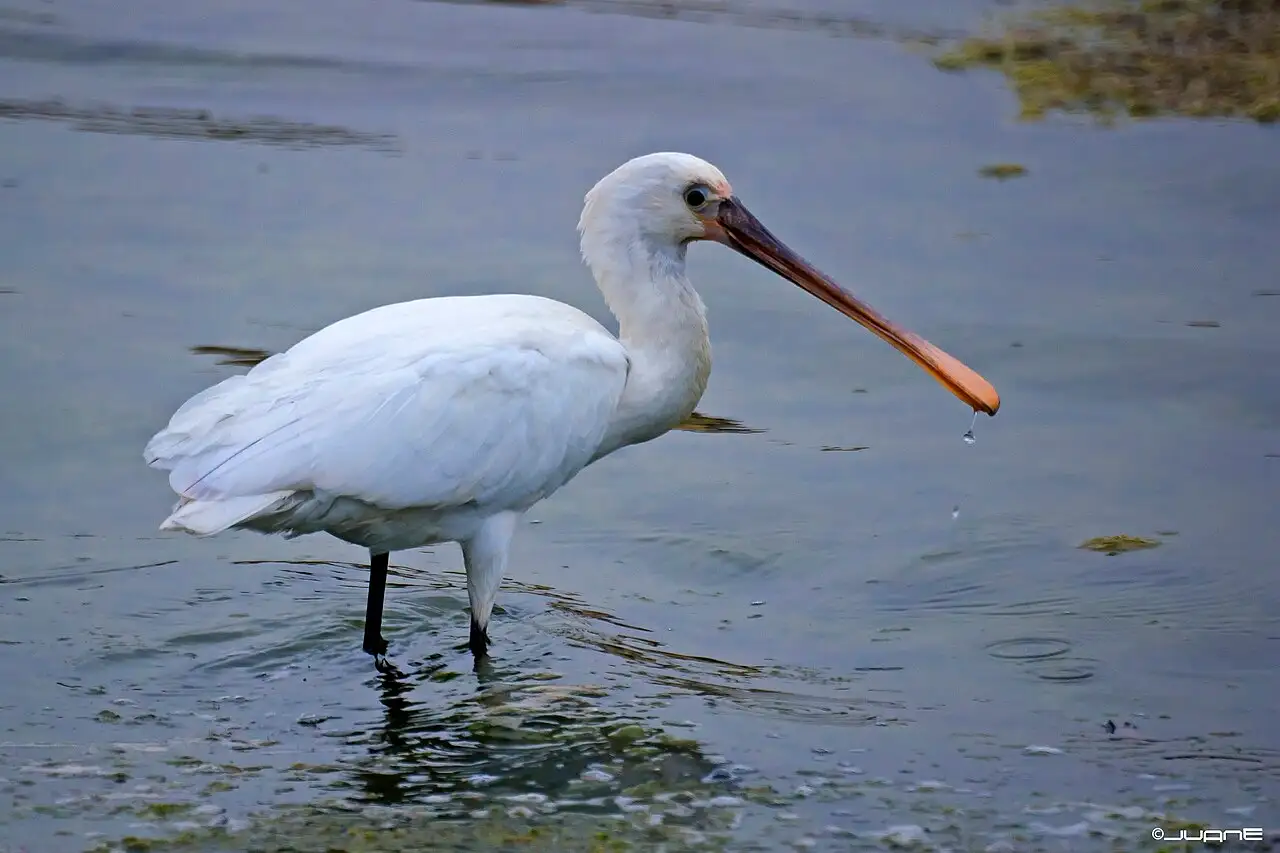
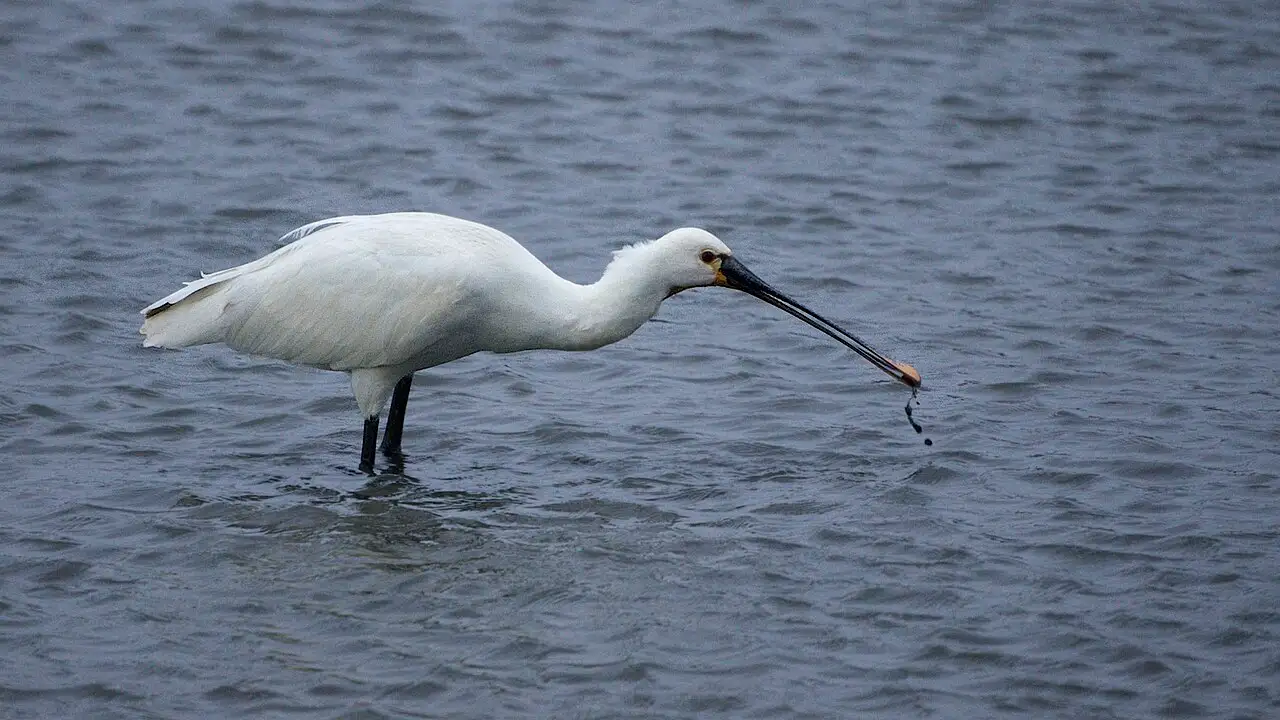
It feeds in a group, wading over the substrate while moving its head from side to side until it detects prey with the tip of its extremely sensitive bill.
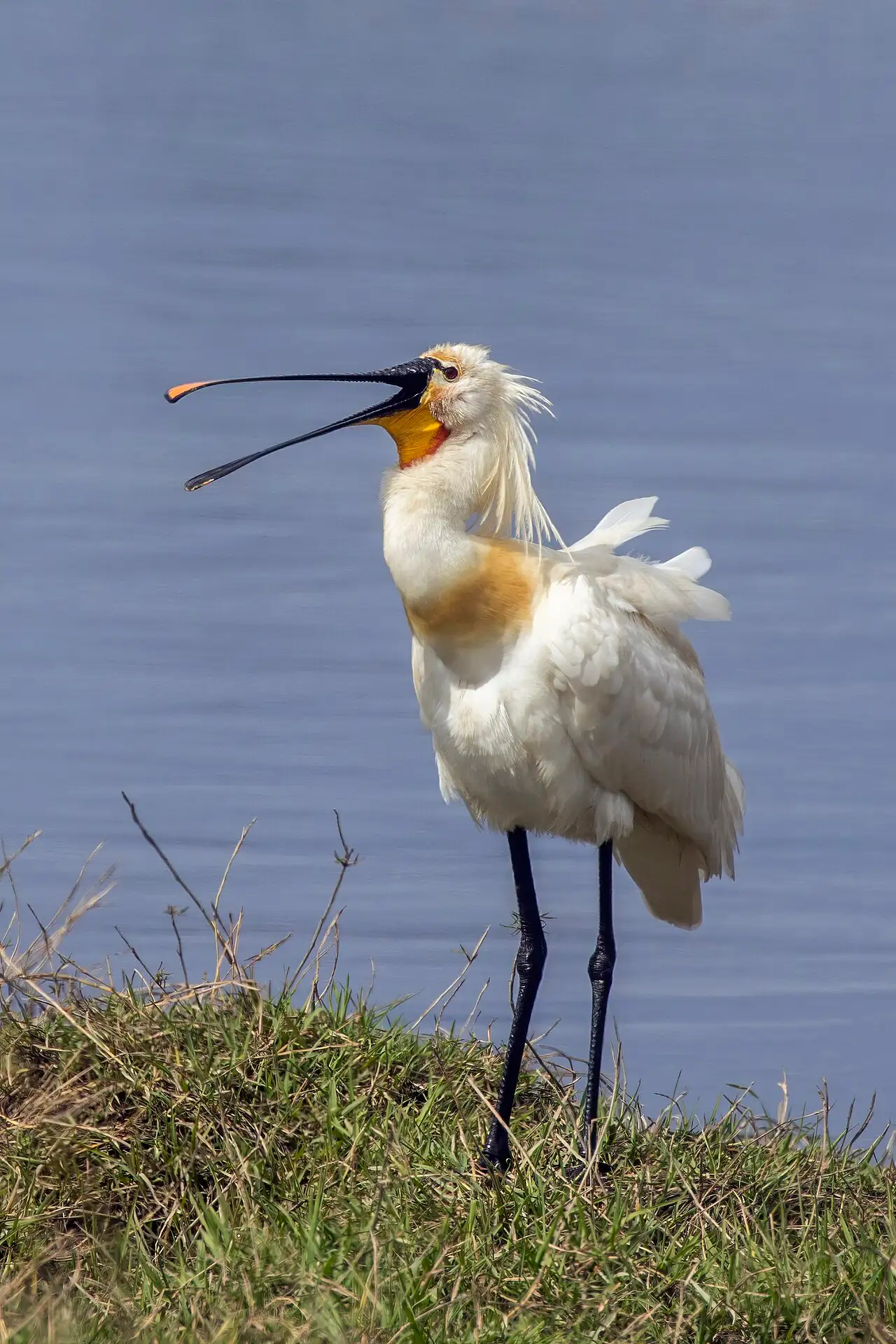
Eurasian Spoonbill in breeding plumage beside the water, with the nape crest, the yellowish breast collar and the bill openPhoto: Charles J. Sharp, CC BY-SA 4.0Photo 3 of 4
This is a wading bird unmistakable for its large size and its overall white colouring. Its peculiar bill stands out, long and flattened at the tip like a spoon, the feature that gave rise to its common name. During the breeding period, adults develop a crest of hanging feathers on the nape and a yellowish collar on the breast, and the yellow patch on the bill intensifies and becomes larger. In flight they show a slender silhouette because they carry the neck stretched out.
Adult
White plumage and long bill with the tip flattened like a spoon.
In the breeding season, crest of hanging feathers on the nape and yellowish collar.
Young bird
Completely white, with pinkish legs and bill.
The tips of the outermost primaries are black.
Habitat and distribution of the Eurasian Spoonbill
It is distributed across the Palearctic region, although in a fragmented way, from Europe to Japan, taking in North Africa, the Persian Gulf, India, Sri Lanka and southern China, although in many of these regions it appears only as a winter visitor. In Europe it nests only in the Netherlands, Spain and France and, in smaller numbers, in Portugal, Hungary, Austria, Denmark, Romania, Russia and Turkey.
In Spain it is distributed across western Andalusia (Doñana, the Bay of Cádiz and the Odiel marshes), the Extremaduran floodplains of the Guadiana and the Tagus and, more scattered, at different points in the western half of the Peninsula, such as the Tablas de Daimiel, in Ciudad Real, Villafáfila and the Ricobayo reservoir, in Zamora, La Nava, in Palencia, and some sites on the Cantabrian-Atlantic coast, such as the Guernica and Arosa estuaries and above all the Santoña marshes, through which birds from the French and Dutch colonies migrate on their way to Africa. It is the subspecies «leucorodia». It is rare in the Balearics and more regular, but scarce, in the Canaries.
It prefers shallow wetlands, generally coastal and saline, such as marshes, deltas and estuaries, with bottoms of fine sand or mud and appreciable tidal changes. It usually avoids very stagnant or very turbulent waters and lake environments with abundant submerged vegetation.
Most of the western European population migrates to the wetlands of Mauritania and Senegal to spend the winter, but a small proportion of the Iberian population only makes dispersive movements through wetlands near its colonies, so it is also seen in winter. Birds from central and eastern Europe winter in Tunisia and Sudan after passing through the wetlands of Italy and Greece.
Areas where it is regularly recorded since 2010Squares of about 25 km where it is recorded regularly (occasional passage records are left out). Data from GBIF.org (196,800 records, retrieved October 2026); outline from Natural Earth.
Etymology of the Eurasian Spoonbill
According to Wikipedia, Linnaeus described it in 1758 with the name it still bears today, «Platalea leucorodia». The genus «Platalea» is a Latin word meaning «broad» and alludes to the shape of the bill, and the epithet «leucorodia» comes from ancient Greek «leukerodios», «spoonbill», from «leukos», «white», and «erodios», «heron». In other languages it is called «becplaner comú» in Catalan, «cullereiro común» in Galician, «mokozabal zuria» in Basque and «Eurasian spoonbill» in English1.
Population of the Eurasian Spoonbill
The 2021 European Red List of Birds estimates the population of the Eurasian Spoonbill at between 23,800 and 36,300 mature individuals, with an increasing trend, above all in Denmark, Germany, France, Portugal and the Netherlands. In Spain an average of 1,437 pairs a year has been estimated between the last national census, in 2007, and 2018. Andalusia holds more than 90 % of the Spanish breeding population and between 40 and 60 % of the European one; Doñana is the site with the most pairs, around 62 % of the national total. Despite the long-term increase, since 2012 the worst breeding data of the 21st century have been recorded in Doñana, with a net reduction of 50 % in the breeding population. The wintering population has been estimated at some 1,866 birds, and is concentrated mainly in the provinces of Huelva, Seville and Cádiz, the Arosa estuary, the Santoña marshes and the Ebro delta.
Among its main threats stand out the overexploitation of groundwater at its main breeding sites, such as Doñana, climate change, the drying of lagoons, sea-level rise, human disturbance near the colonies, pollution by heavy metals and pesticides, eutrophication and the offshore wind farms installed on migratory corridors.
Nest of the Eurasian Spoonbill
It sets its nest on large trees, such as cork oaks, pines or eucalyptus, on small trees, such as tamarisks or willows, or at ground level on low marsh vegetation. It is a heap of branches, rushes and plant remains some 50 to 70 centimetres in diameter, and both the female and the male take part in building it.
Courtship and breeding of the Eurasian Spoonbill
It is a gregarious species that settles in the same colony for successive years, often in the company of herons and White Storks. The breeding period usually begins in April or May, although in favourable conditions it can start earlier. It makes a single clutch per season, of three or four white eggs with brown spots laid at three-day intervals, and may make a replacement one if the first fails. Both sexes incubate for 23–25 days and care for the chicks, which hatch covered in white down and will not be fully feathered until 45–50 days. The young, semi-nidicolous, become independent gradually and reach sexual maturity at three or four years.
Diet of the Eurasian Spoonbill
Its diet is made up of aquatic invertebrates, such as crustaceans, molluscs, annelids and aquatic insects and their larvae, and also amphibians or small fish. It feeds in a group, wading over the substrate while moving its head from side to side until it detects possible prey with the tip of its extremely sensitive bill.
Curious facts about the Eurasian Spoonbill
It is a wader unmistakable for its large size, its white colour and its habit of wading the shallow bottoms of wetlands while probing the mud with its flattened bill1. Spain holds some of the most important colonies in western Europe. Its longevity is out of line depending on the source: AnAge gives 30 years and 1 month in captivity and EURING lists a bird ringed in the Netherlands that lived 41 years and 6 months.
The Eurasian Spoonbill in Cabañeros
The habitat pages of this website do not mention it, and we have not found any other published source on it in the Park. GBIF.org records 19 observations of the Eurasian Spoonbill in Cabañeros and its surroundings.
Where to see the Eurasian Spoonbill in Cabañeros
In Cabañeros and its surroundings, throughout the year, in wetlands and on the shores of shallow water.
When
All year in Spain, although most of the European population migrates to Africa to spend the winter.
What time
By day, while it feeds in a group.
Where
In shallow wetlands, with bottoms of mud or fine sand.
What to look for
Look for the flattened spoon-shaped bill and the white plumage; young birds have pinkish legs and bill.
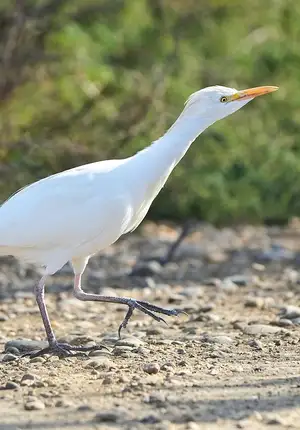
It is not clearly similar1. It is another large wader that frequents the same wetlands and belongs to the same order as the spoonbill (Pelecaniformes).
Photo: Donald Hobern from Copenhagen, Denmark, CC BY 2.0
Other birds
Birds related to the Eurasian Spoonbill or sharing its habitats in Cabañeros.






 Same family
 Same order
 Same order
 Same order
 Same season in the park
 Same season in the park
 Same season in the park
 Same season in the park






