Wingspan compared with a person with arms outstretched.
Length
21–23 cm
Wingspan
51–54 cm
Weight
153–224 g
Social life
Strictly sedentary; the female incubates alone and the male brings the prey to the nest
Lifespan
Record of 15 years and 4 months in the wild (a bird ringed in Germany)
Conservation status
LC
NT
VU
EN
CR
EW
EX
Global (IUCN)
Least Concern
Spain
Near Threatened (NT) in the Red Book of the Birds of Spain; on the List of Wild Species under Special Protection and not in the Spanish Catalogue of Threatened Species
When to see it
Resident
Months of the year when it is present
J
F
M
A
M
J
J
A
S
O
N
D
In Iberia
yes
yes
yes
yes
yes
yes
yes
yes
yes
yes
yes
yes
Song or voice of the Little Owl
It gives a great variety of sounds all year, by night and by day, but all tend to be very high with deep inflections that recall a mew. It often gives a penetrating, plaintive «kíu»; the alarm call is a quick, explosive, repetitive sequence, «chi-chi-chi-chi». The recording is from Kekerdom (Gelderland, Netherlands).
SongLittle Owl
0:00 / 0:16
10 kHz5
The sonogram draws the sound: time runs from left to right, and the higher a trace sits, the higher the note.Recording by Joost van Bruggen, Wikimedia Commons (CC BY-SA 4.0).
Flight of the Little Owl
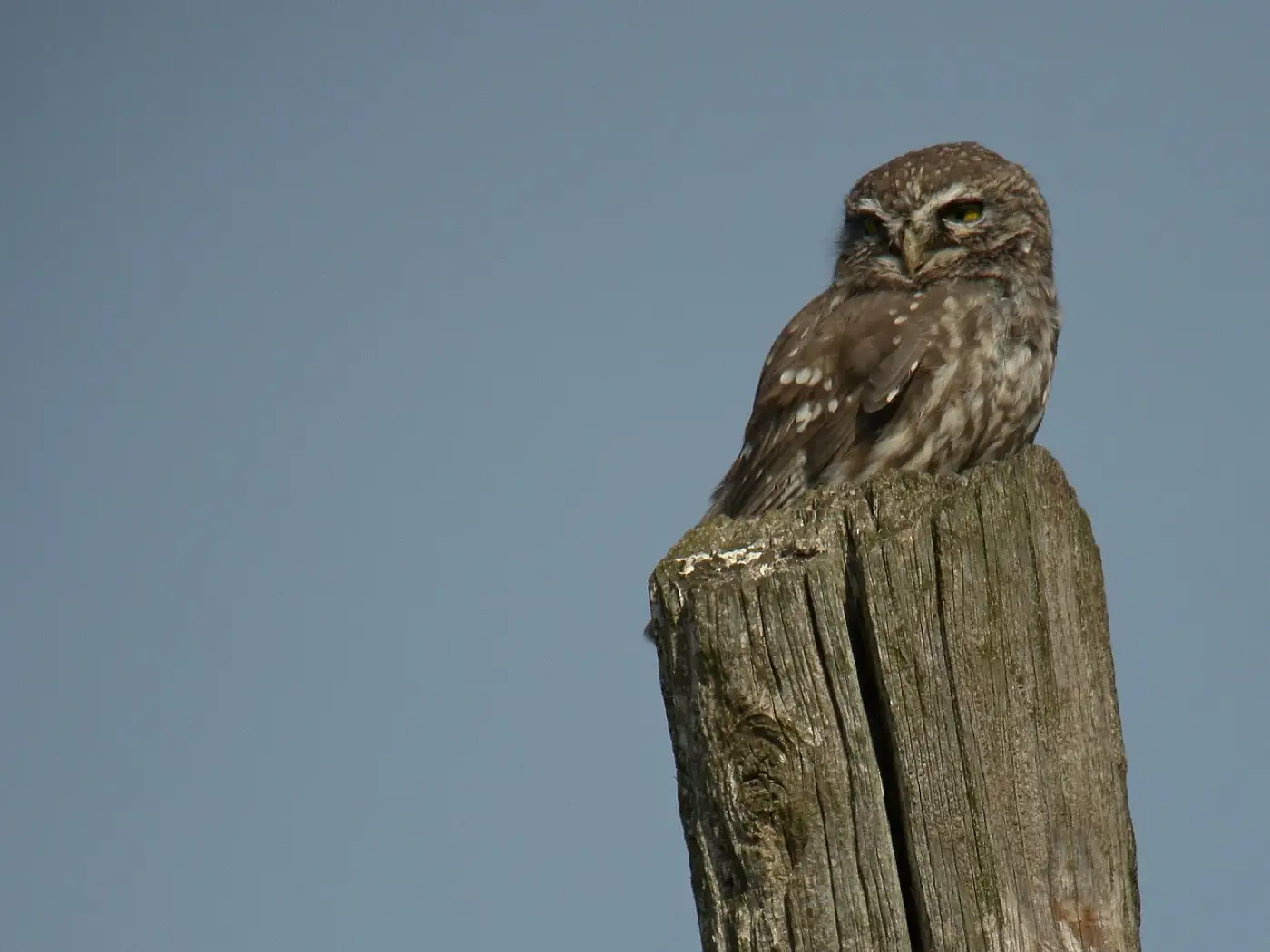
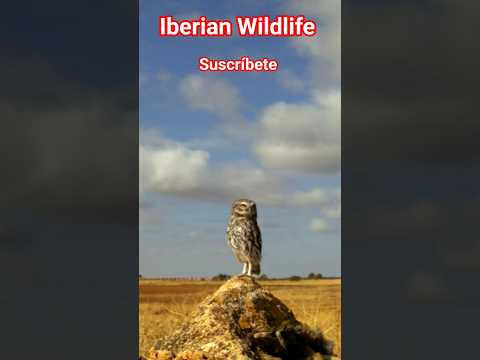
The flight is fast and markedly undulating. Being a bird of partly diurnal habits, it is very common to see its rounded silhouette on stumps, roofs or stones, even during the middle hours of the day.
Flight typeFast and markedly undulating
It leaves a pole, a stump or a roof, from where it was stalking its prey. It is a bird of partly diurnal habits.
Fast, markedly undulating flight, with short, rounded, barred wings and a short tail.
It lands on the ground or on another perch, and searches the terrain for insects and earthworms.
Photo gallery of the Little Owl
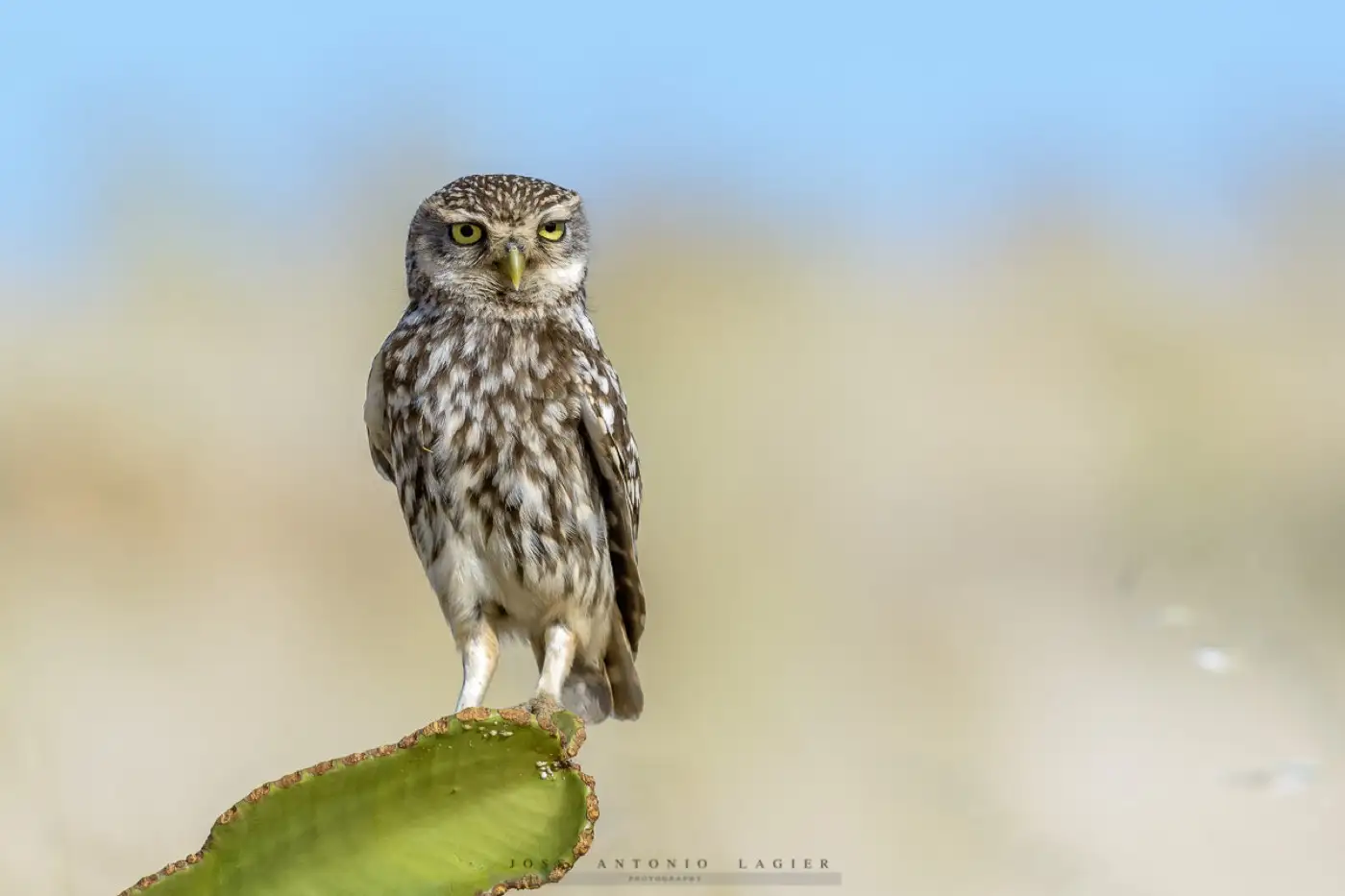
Little Owl perched on a prickly pear pad, from the front, with yellow eyes and white eyebrowsPhoto: José Antonio Lagier Martin, CC BY 3.0Photo 1 of 4
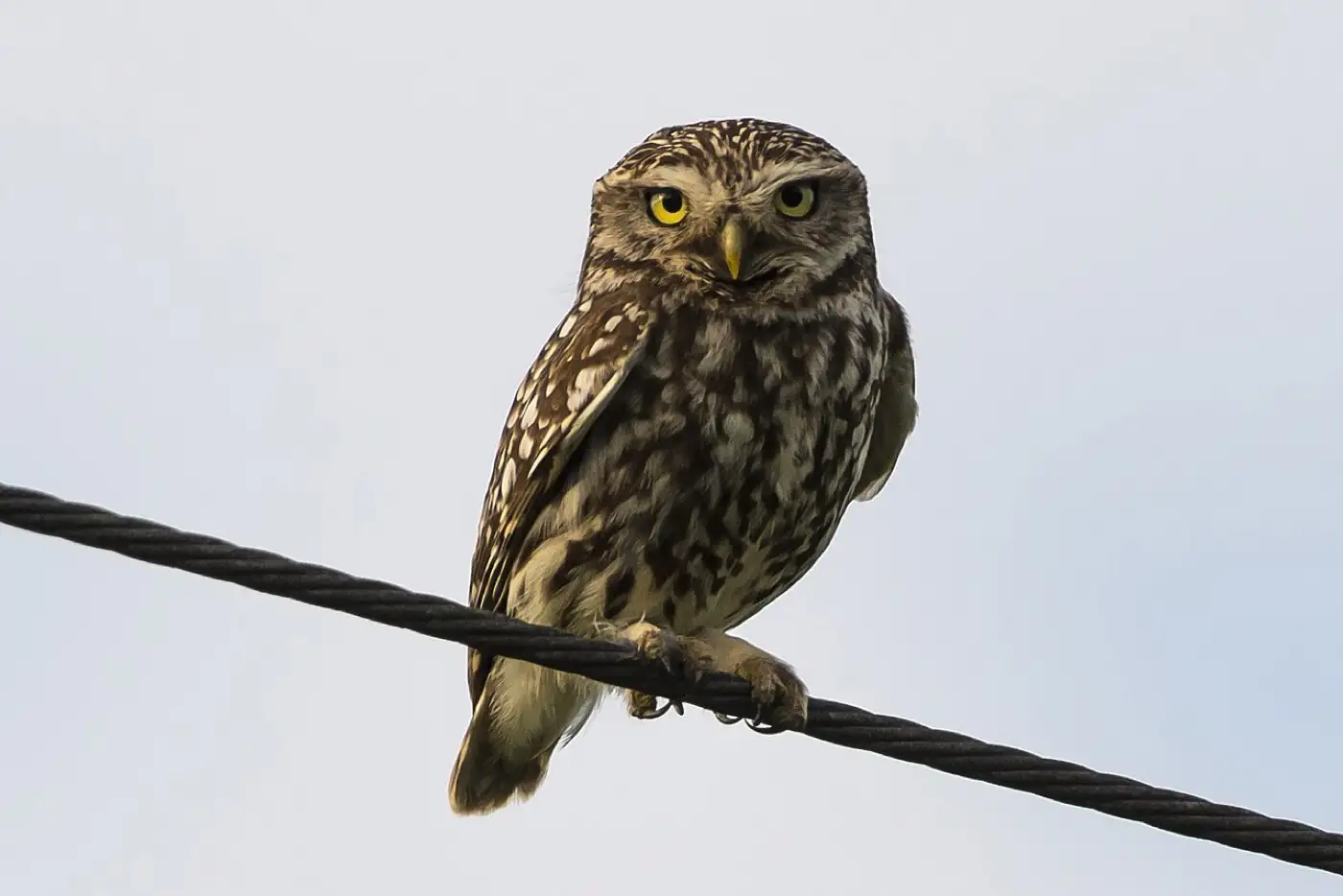
Little Owl perched on a wire, from the front, with spotted plumage and a serious gazePhoto: Sébastien FAILLON, CC BY 2.0Photo 2 of 4
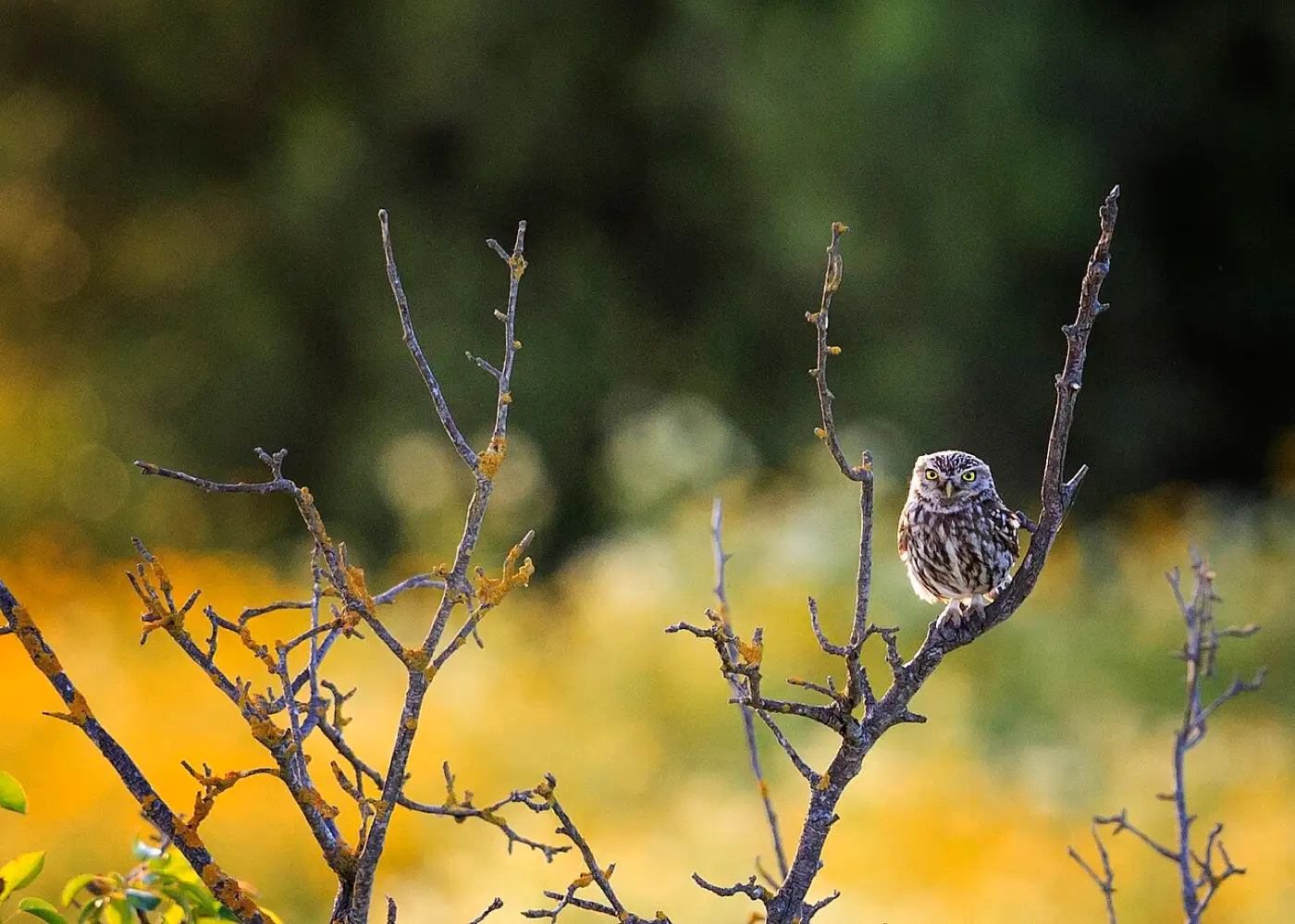
Tiny Little Owl at the top of a dry branch, with a background of yellow flowersPhoto: Elena García, CC BY-SA 3.0Photo 4 of 4
1 / 4
Identification of the Little Owl
The Little Owl is a small nocturnal raptor of stocky shape, characterised above all by a bulky, rounded head without head tufts. Brown and greyish tones predominate in its plumage, heavily spotted with white. The underparts are paler than the upperparts, although they also appear heavily spotted.
The broad head is adorned with fine white spots, and the feathers around the bill and the striking white eyebrows frame large yellow eyes with a surprised expression. The tail is short, like the wings, which tend to be rounded; both are abundantly barred with brownish bands.
Adult
Broad, rounded head, without tufts; yellow eyes and white eyebrows.
Brown and grey spotted with white; short, barred wings and tail.
Habitat and distribution of the Little Owl
It is a bird of Eurasian and North African distribution, ranging over practically the whole of Europe, apart from the most northerly areas, Ireland and Iceland, and over a good part of central Asia to eastern China and Korea, as well as the Middle East and the regions washed by the Red Sea, including almost the whole Arabian Peninsula. It has a large number of subspecies.
In Spain it is distributed as a breeder across practically the whole peninsular territory, although it avoids the great mountain systems, though sometimes it reaches a considerable altitude on favourable aspects. In the northern third of the Peninsula its populations are fragmentary and less abundant, and it is also rare in the Balearics. On the Peninsula and in the Balearics the subspecies «vidalii» breeds, and in Ceuta and Melilla the subspecies «glaux» appears. It is absent from the Canaries.
Undemanding in its choice of habitat, it readily settles in a great variety of environments, from riverside groves to urban parks, dehesas and copses, although the best densities are found in rather open spaces, above all in not too homogeneous farming landscapes, in which dry-farmed crops, olive groves, riverside groves, scattered trees and wasteland alternate. It is not uncommon for it to settle inside towns.
It is strictly sedentary throughout its range. Young birds do not travel long distances in their dispersal either: they settle no more than 30 kilometres from where they were born.
Areas where it is regularly recorded since 2010Squares of about 25 km where it is recorded regularly (occasional passage records are left out). Data from GBIF.org (125,096 records, retrieved October 2026); outline from Natural Earth.
Etymology of the Little Owl
«Athene» recalls the Greek goddess Athena, to whom the owl was a symbol of wisdom. «Noctua» is the Latin name of an owl consecrated to Minerva, the Roman Athena, and so means the same.
Population of the Little Owl
In the 2021 European Red List of Birds the European breeding population is estimated at between 1,150,000 and 2,140,000 mature individuals, with an unknown demographic trend. The Spanish population was calculated at some 40,000 pairs, according to the Atlas of Breeding Birds of Spain (2003). According to the SACRE programme, the trend is negative: between 1998 and 2018 a fall of 50 % of numbers is calculated, and the Noctua programme detects a decline of 24 % between 2006 and 2018. In Spain it reaches the highest densities in Europe, and it is the most abundant nocturnal raptor over a good part of the territory. Agricultural intensification explains its decline in the Mediterranean region, through the loss of nesting sites and the low availability of insects and small mammals. Road deaths, especially of young birds in July and August, are also a threat, and main roads can act as ecological traps, with perches and abundant prey but with noise and collisions.
Nest of the Little Owl
The nest is a slight hollow with no added material, always set in more or less spacious cavities, both natural (from hollow trunks to rabbit burrows) and artificial (dovecotes, stone heaps, abandoned houses).
Courtship and breeding of the Little Owl
A great deal of vocal activity announces the breeding period, which usually begins in late March or early April. The female lays two to five eggs and incubates them without her mate’s help for 25–30 days. The chicks usually hatch during May and are fed by both parents, although the male usually just brings the prey to the nest for the female to offer to the brood. At 30–35 days the chicks already fly, although they need food from their parents for some weeks more, until they reach their full hunting abilities.
Diet of the Little Owl
The diet varies markedly with local prey availability. In the southern regions, a good part is made up of invertebrates (crickets, beetles, grasshoppers, moths, earthworms), and as latitude rises the proportion of vertebrates increases, above all rodents. It has several perches in its territory from which it stalks its prey, although at other times it searches the ground for insects and earthworms.
Curious facts about the Little Owl
Its stocky silhouette cut out at dusk on a pole or a stone heap is still one of the most usual and characteristic images of Spanish farming environments. It reaches the highest densities in all of Europe in Spain. Its scientific name recalls Athena, the goddess of wisdom.
The Little Owl in Cabañeros
This website’s page on grasslands explains that during winter it feeds on the small mammals usual in the grasslands and scrub boundaries of Cabañeros (Algerian Mouse, Mediterranean pine vole, field mouse) and that, when March comes, it progressively opts for eating insects.
Where to see the Little Owl in Cabañeros
In the grasslands and scrub boundaries of Cabañeros.
When
All year round: it is strictly sedentary.
What time
At dusk and at dawn, but also by day, on poles, stumps, roofs or stones.
Where
In open spaces with crops, olive groves, riverside groves, scattered trees and wasteland, and in dehesas and copses.
What to look for
A tiny, stocky owl, with round head and yellow eyes, which stays staring.
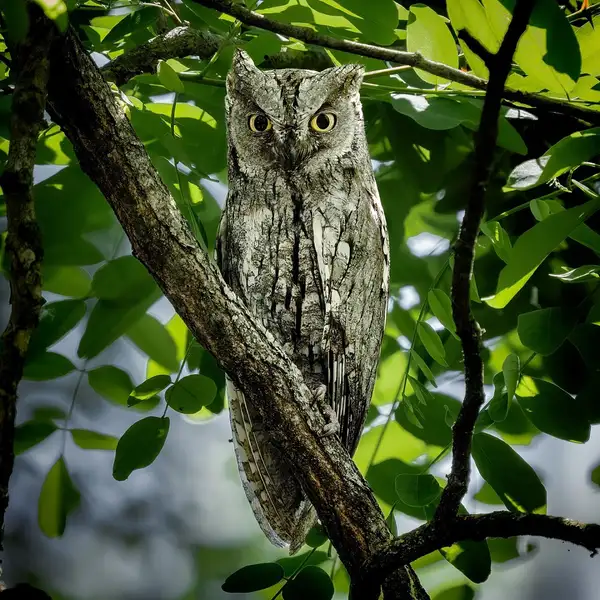
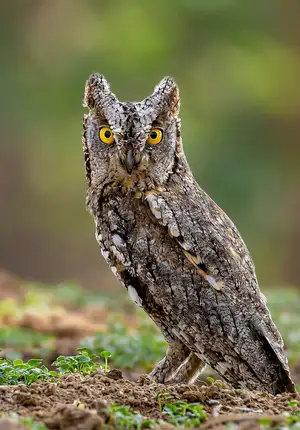
They are similar in appearance1. The Eurasian Scops Owl is small, with greyish or reddish-brown plumage with a complex pattern of speckles and bands, and has small head tufts, like false ears, which the Little Owl lacks.
Photo: Mike Duchstein, CC BY-SA 4.0
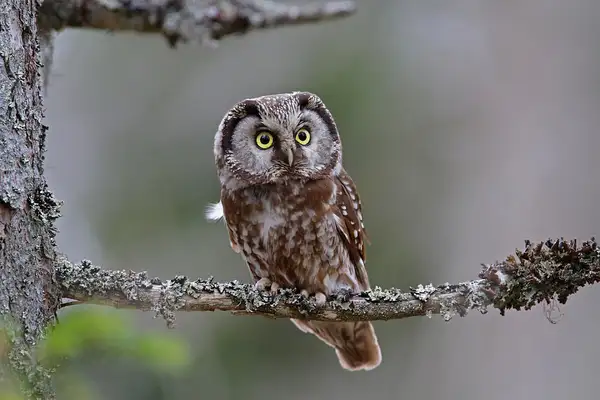
Boreal Owl
Aegolius funereus
How to tell them apart
The size of a Little Owl, but with a strikingly large head, flattened on top, and a face pattern that gives it a look of astonishment. Its plumage varies from brown to greyish.
Photo: Christoph Moning, CC BY 4.0
Other birds
Birds related to the Little Owl or sharing its habitats in Cabañeros.



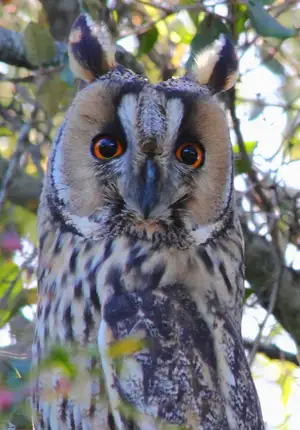 Same family
 Same family
 Same family
 Same family
 Also in grasslands and rañas
 Also in grasslands and rañas
 Also in grasslands and rañas
 Also in grasslands and rañas






