Wingspan compared with a person with arms outstretched.
Length
57–75 cm
Wingspan
1.4–1.88 m
Weight
1.2–2.5 kg
Social life
Reserved and solitary by nature; chicks hatch asynchronously and set up a feeding hierarchy from the start
Lifespan
Record of 27 years and 3 months in the wild according to EURING (a bird ringed in the Czech Republic); in captivity, AnAge gives up to 68 years
Conservation status
LC
NT
VU
EN
CR
EW
EX
Global (IUCN)
Least Concern
Spain
Least Concern (LC) as a breeder in the Red List of Birds of Spain; on the List of Wild Species under Special Protection, but not in the Spanish Catalogue of Threatened Species
When to see it
Resident
Months of the year when it is present
J
F
M
A
M
J
J
A
S
O
N
D
In Iberia
yes
yes
yes
yes
yes
yes
yes
yes
yes
yes
yes
yes
Breeding season
yes
yes
no
no
no
no
no
no
no
no
no
no
Song or voice of the Eurasian Eagle-Owl
Both males and females, the latter with a slightly higher voice, give a deep, low «buhuu» that can be heard at a great distance. In the breeding season pairs answer each other with a faster series of short notes that ends in the typical call: «bu-hu-hu-hu, buhuu». The recording is of a male and we have filtered it to remove the background noise.
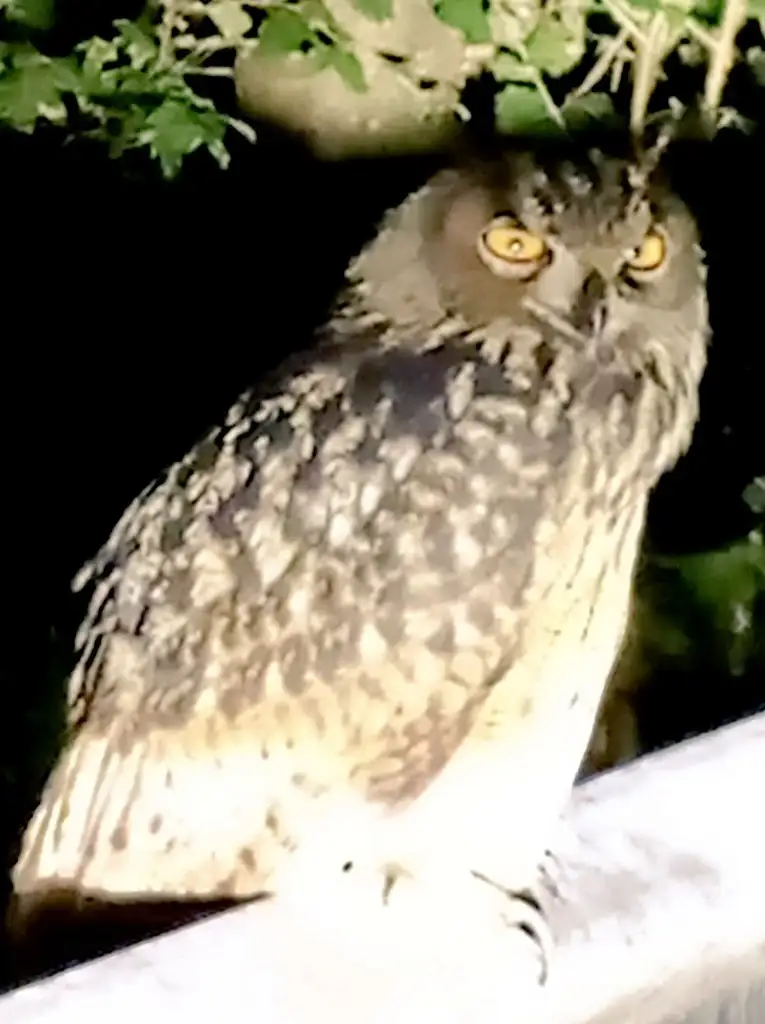
Eurasian Eagle-Owl perched at night on a railing, lit up, with streaked breast and orange eyesPhoto: Jose Angel Urquia Goitia, CC BY-SA 4.0Photo 4 of 4
1 / 4
Identification of the Eurasian Eagle-Owl
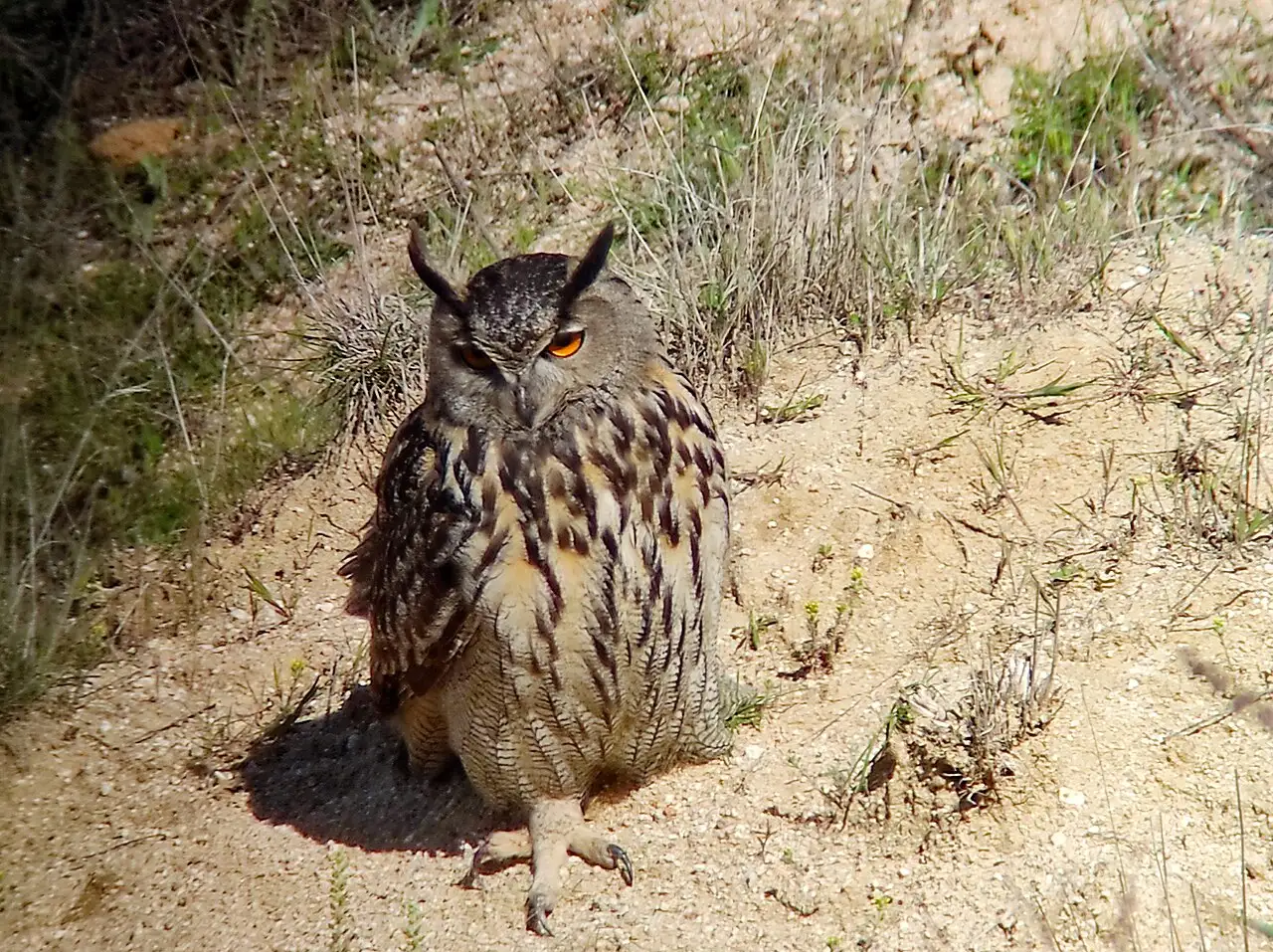
In the Eagle-Owl one recognises the features common to almost all owls, but its large size soon catches the eye, because it is the biggest owl of our fauna, as do its bulk, its powerful talons and a bulky head topped with long «ears», the ear tufts, in which lovely orange eyes of defiant expression stand out. Its plumage is very cryptic and tawny, brown and chestnut tones predominate: darker on the back, paler on the belly, which is studded with streaks and fine barring, and whitish on the throat. The female is somewhat larger than the male.
Adult
Large size, bulky, with long tufts on the head.
Orange eyes.
Dark brown back; paler belly, streaked and with fine barring; whitish throat.
Young bird
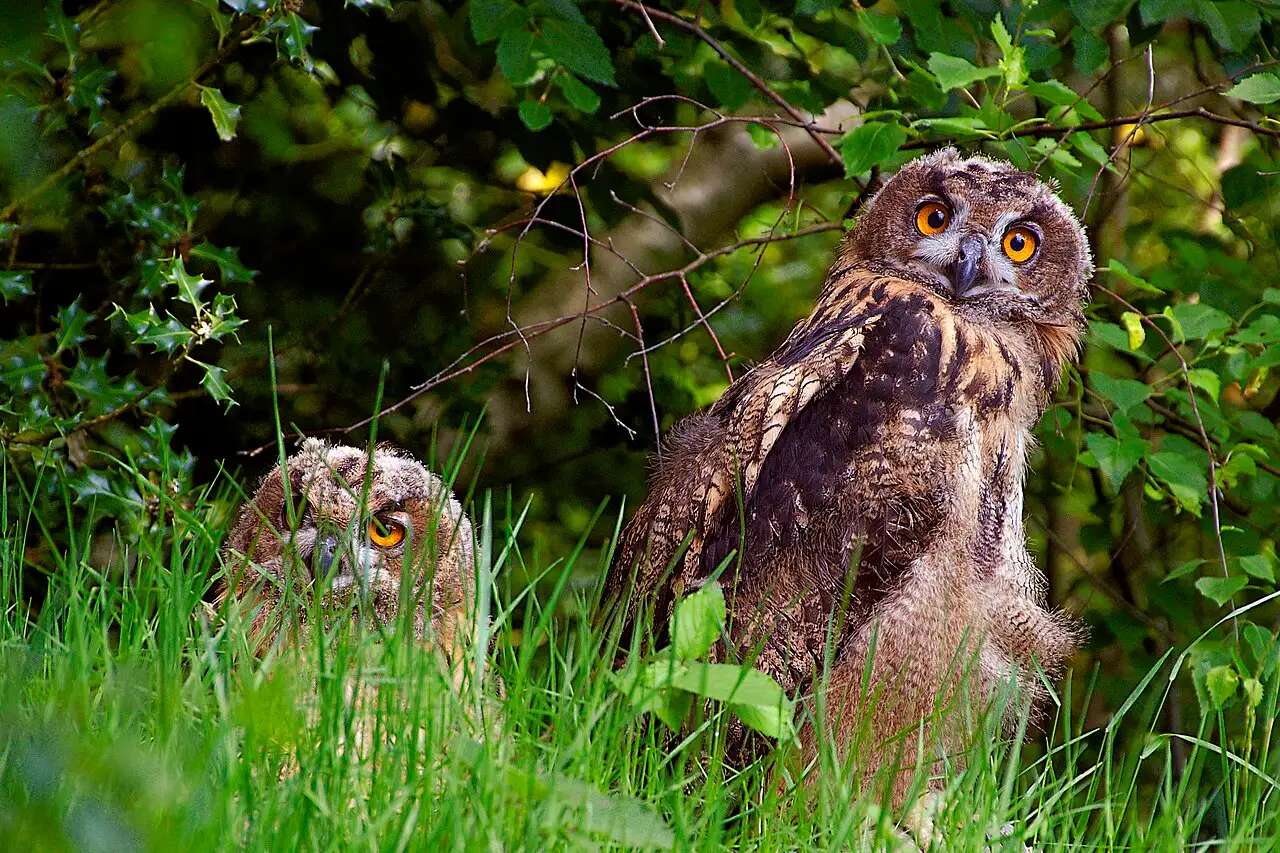
The chicks, covered in brown down, soon leave the nest to move around the surroundings, although they do not fly until two months old.
Habitat and distribution of the Eurasian Eagle-Owl
It is widely distributed across Europe, Asia and North Africa, although patchily in central Europe and at the edges of its range. Up to 10 subspecies are recognised, and the one that lives on the Iberian Peninsula is «hispanus», of paler, greyer colouring.
In Spain it is well spread across practically the whole Peninsula, although scarce or absent in the Cantabrian region, the north-west quadrant, the Pyrenean strip, the most intensively cultivated areas of the two Castiles and the Guadalquivir valley. It is not on the archipelagos or in Ceuta and Melilla.
It is an adaptable, undemanding species, able to occupy anything from closed forests to semi-deserts, coastal cliffs and tundras. In our country it usually chooses mountainous areas with abundant crags, river gorges, screes and rocky ravines, and is less frequent inside dense woods and on steppes. It prefers to settle where rabbits abound, but where they are lacking it can adapt, and it is increasingly seen in peri-urban surroundings.
It is resident throughout its range. Only the populations of north-eastern Europe and Siberia move up to 200 kilometres in the hardest winters, and young birds, on leaving the parental territory, rarely go further than 100 kilometres from where they were born.
Areas where it is regularly recorded since 2010Squares of about 25 km where it is recorded regularly (occasional passage records are left out). Data from GBIF.org (11,018 records, retrieved October 2026); outline from Natural Earth.
Etymology of the Eurasian Eagle-Owl
According to Wikipedia, «Bubo» is the Latin word for «owl». Linnaeus described it in 1758 in the genus «Strix», and the genus «Bubo», in which the species name is repeated, was introduced by André Duméril in 1805. In other languages it is called «duc eurasiàtic» in Catalan, «bufo real» in Galician, «hontz handia» in Basque and «Eurasian eagle-owl» in English1.
Population of the Eurasian Eagle-Owl
In the 2021 European Red List of Birds the European breeding population is estimated at between 37,100 and 59,500 mature individuals, with an increasing trend. On the Peninsula it appears at very uneven densities, and Extremadura, Andalusia, the central zone and the Levante are the regions with most birds. There are no reliable data for all of Spain, but a minimum population of more than 3,000 pairs is estimated, with a moderate general increase.
For decades it was harshly persecuted for the supposed damage it did to game. Today shooting and robbing have declined, but other threats have appeared, such as power lines, road traffic and changes in the countryside. Even so, its main problem is the collapse of rabbit populations through myxomatosis and rabbit haemorrhagic pneumonia.
Nest of the Eurasian Eagle-Owl
In our territory it chooses mainly hollows and ledges in rocky cliffs, although it also uses heaps of stones, hollow trunks or the ground itself. In wooded areas it frequently uses old nests of other raptors, and can breed in buildings, even inhabited ones, if they are near its hunting range. In any case, the nest is a slight hollow to which it adds no material at all.
Courtship and breeding of the Eurasian Eagle-Owl
Its courtship song is heard from autumn and intensifies through the winter. Normally in January or February, and sometimes earlier, it makes its single annual clutch, of two to four white eggs laid every two or three days; exceptionally, second clutches that were not replacements have been recorded. Only the female incubates, for 34–36 days, and as she starts with the first egg the chicks hatch asynchronously, which sets a feeding hierarchy from the beginning. Both parents feed them, although the female spends more time on feeding and caring for the brood. Like other owls, the chicks soon leave the nest to move around the surroundings, but do not fly until two months old, and the adults still feed them for another month before they disperse.
Diet of the Eurasian Eagle-Owl
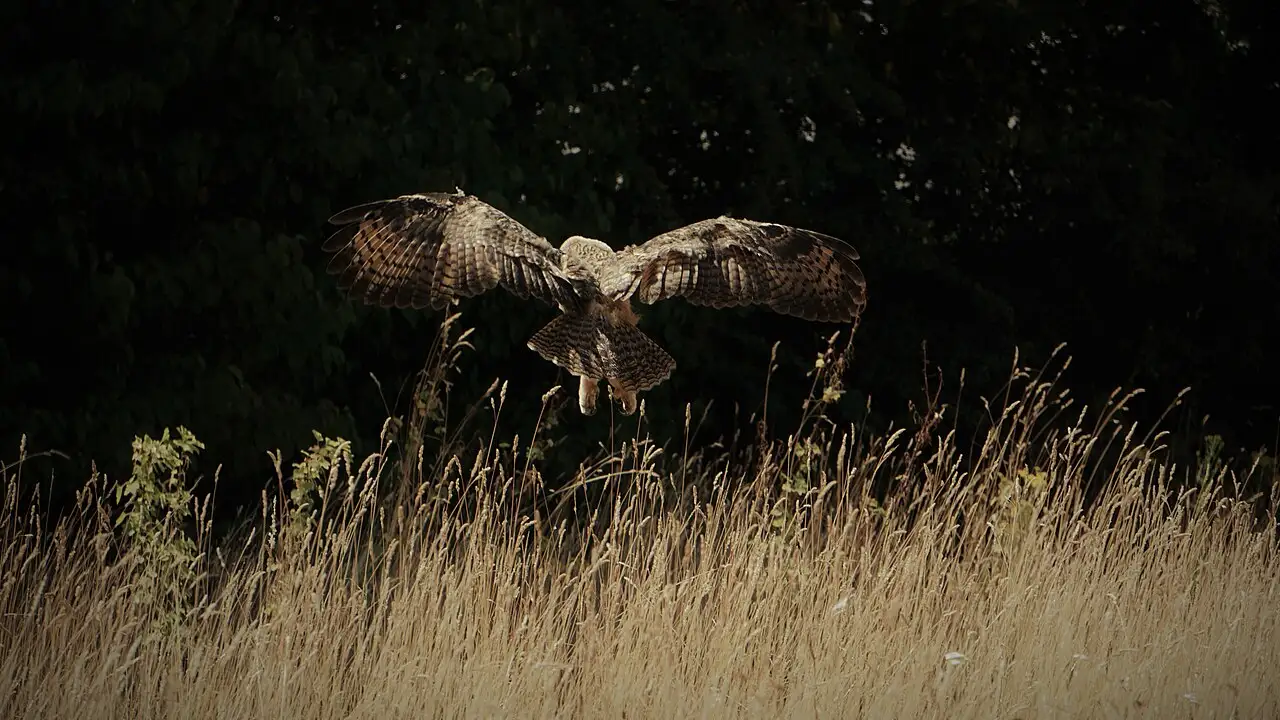
Wherever it lives it behaves as a relentless superpredator. In Spain its basic prey is the rabbit, but it can catch an enormous variety of vertebrates, from corvids and water birds to hedgehogs, cats or raptors, both diurnal and nocturnal. It is not unusual for it to take chicks of other raptors from their own nests: thus, besides eating, it eliminates potential competitors.
Curious facts about the Eurasian Eagle-Owl
For decades it was harshly persecuted for the supposed damage it did to game species, when it is a superb superpredator1. EURING lists an Eagle-Owl ringed in the Czech Republic that lived 27 years and 3 months, and AnAge cites birds that reached 68 years in captivity.
The Eurasian Eagle-Owl in Cabañeros
The habitat pages of this website do not mention it, but the Cabañeros National Park Newsletter for July–August 2023 tells that Park staff picked up an Eagle-Owl with an injured wing on an estate around Torre de Abraham, inside the National Park, and took it to the El Chaparrillo wildlife recovery centre. GBIF.org records 47 observations of the Eurasian Eagle-Owl in Cabañeros and its surroundings.
Where to see the Eurasian Eagle-Owl in Cabañeros
In Cabañeros and its surroundings, all year, on crags, cliffs and ravines.
When
All year; it is resident, and its courtship song is heard from autumn and above all in winter.
What time
At dusk and at night; it is easier to hear its «buhuu» than to see it.
Where
In mountainous areas with crags, river gorges, screes and rocky ravines, where rabbits abound.
What to look for
Look for its great size, the long tufts and the orange eyes; listen for its low «buhuu».



 Same family
 Same family
 Same family
 Same family
 Same order
 Same season in the park
 Same season in the park
 Same season in the park






