Wingspan compared with a person with arms outstretched.
Length
31–37 cm
Wingspan
86–98 cm
Weight
215–347 g
Social life
Solitary and withdrawn in the breeding season; in winter it tends to gather in communal roosts
Lifespan
Record of 27 years and 8 months in the wild according to AnAge; EURING lists a bird ringed in the Netherlands that lived 21 years and 10 months
Conservation status
LC
NT
VU
EN
CR
EW
EX
Global (IUCN)
Least Concern
Spain
Least Concern (LC) as a breeder in the Red List of Birds of Spain; on the List of Wild Species under Special Protection, but not in the Spanish Catalogue of Threatened Species
When to see it
Resident
Months of the year when it is present
J
F
M
A
M
J
J
A
S
O
N
D
In Iberia
yes
yes
yes
yes
yes
yes
yes
yes
yes
yes
yes
yes
Breeding season
no
no
yes
yes
yes
yes
no
no
no
no
no
no
Song or voice of the Long-eared Owl
The male’s song is a deep, melancholy hoot repeated every 2 or 2.5 seconds, similar to the Eagle-Owl’s but faster and less emphatic. The female has a higher, harsher, nasal song, and the alarm call is a rasping «ruack-ruack». The recording is of a male from Slovakia, at night and at some distance: the hoot is very low and we have filtered and amplified it to remove the background noise.
Male's songLong-eared Owl
0:00 / 0:25
10 kHz5
The sonogram draws the sound: time runs from left to right, and the higher a trace sits, the higher the note.Recording by Alexander Kurthy, xeno-canto XC108293 (Volovec, Eslovaquia) (CC BY-SA 4.0).
Flight of the Long-eared Owl
When it takes flight, undulating, calm and silent, it reveals its long, narrow wings, adapted to hunting along the edges and clearings of woodland.
Flight typeUndulating, calm and silent, on long, narrow wings
A strictly nocturnal hunter, it leaves its perch in a tree at nightfall; in winter it can gather with others at busy roosts.
Its flight is undulating, calm and silent, on long, narrow wings adapted to hunting along woodland edges and clearings.
Its basic diet is small mammals, such as voles and field mice, although it also hunts everything from small birds to young rabbits.
Photo gallery of the Long-eared Owl
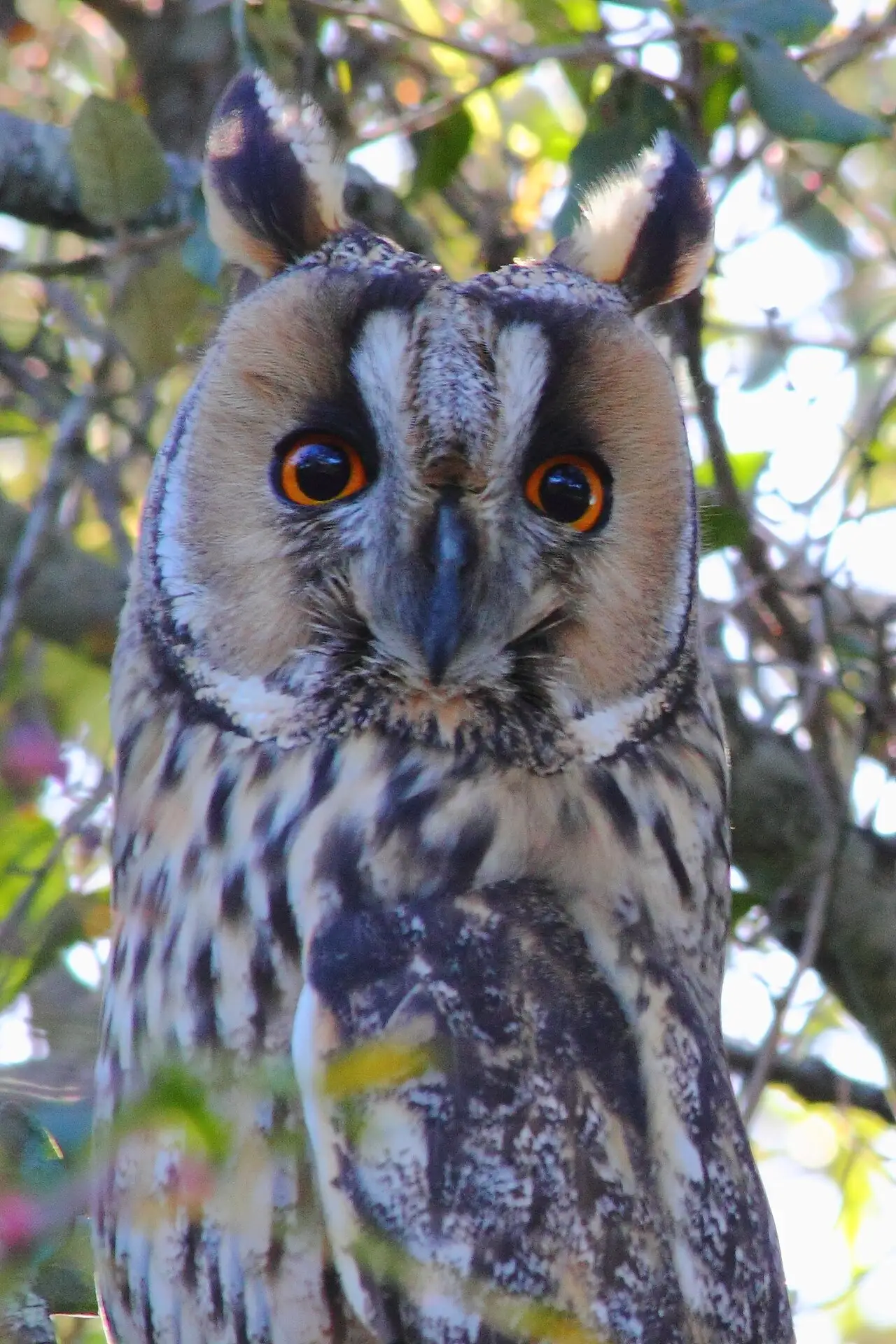
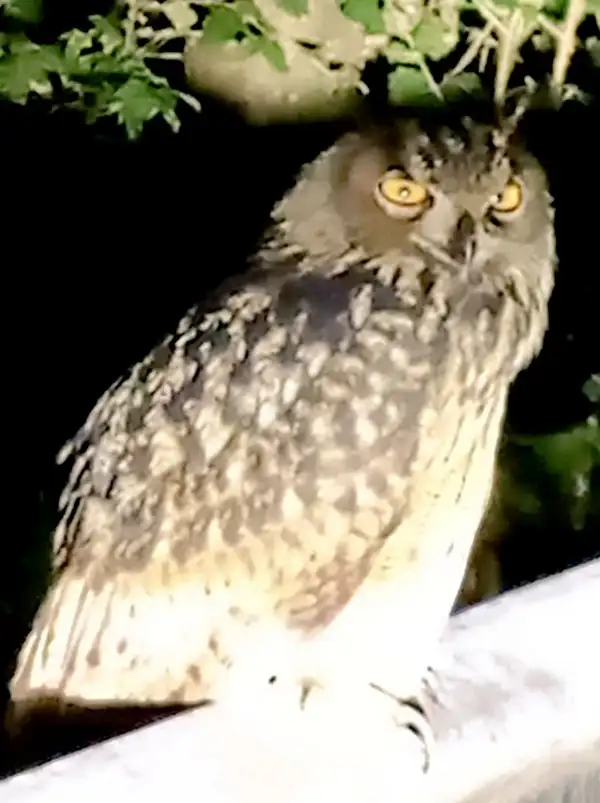
Long-eared Owl seen from the front among branches, with the long ear tufts raised and orange eyesPhoto: Luis nunes alberto, CC BY-SA 3.0Photo 1 of 4
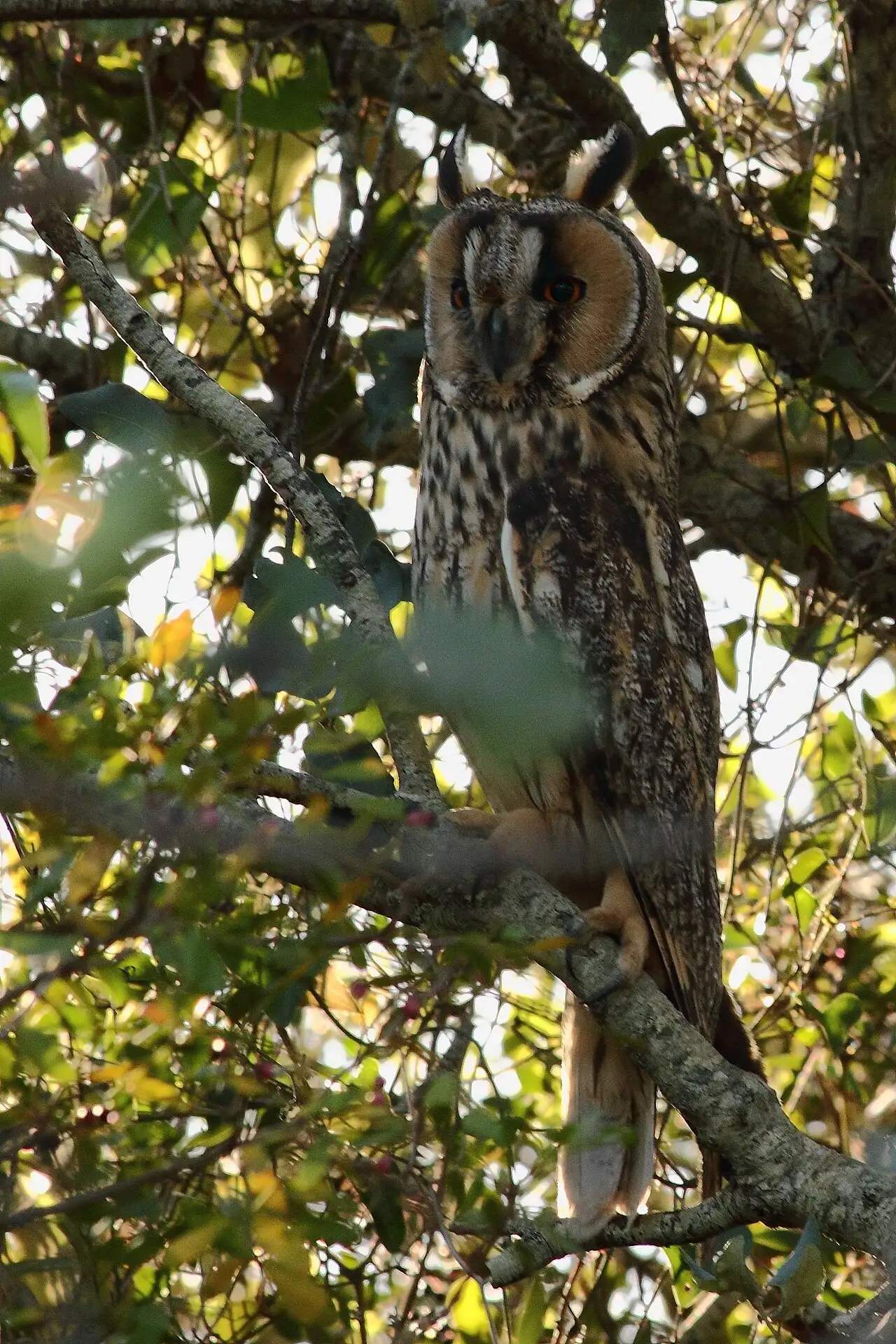
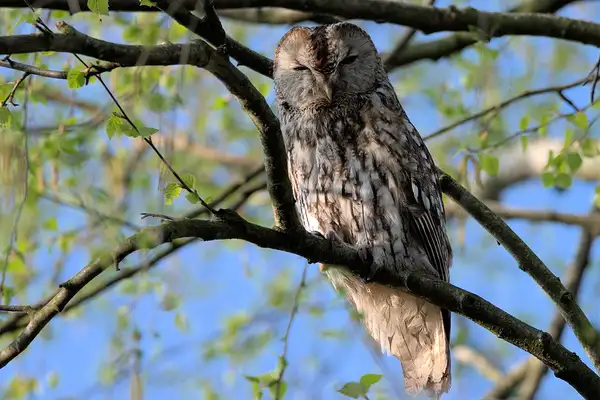
Long-eared Owl upright and camouflaged among the branches and leaves of a treePhoto: Luis nunes alberto, CC BY-SA 3.0Photo 2 of 4
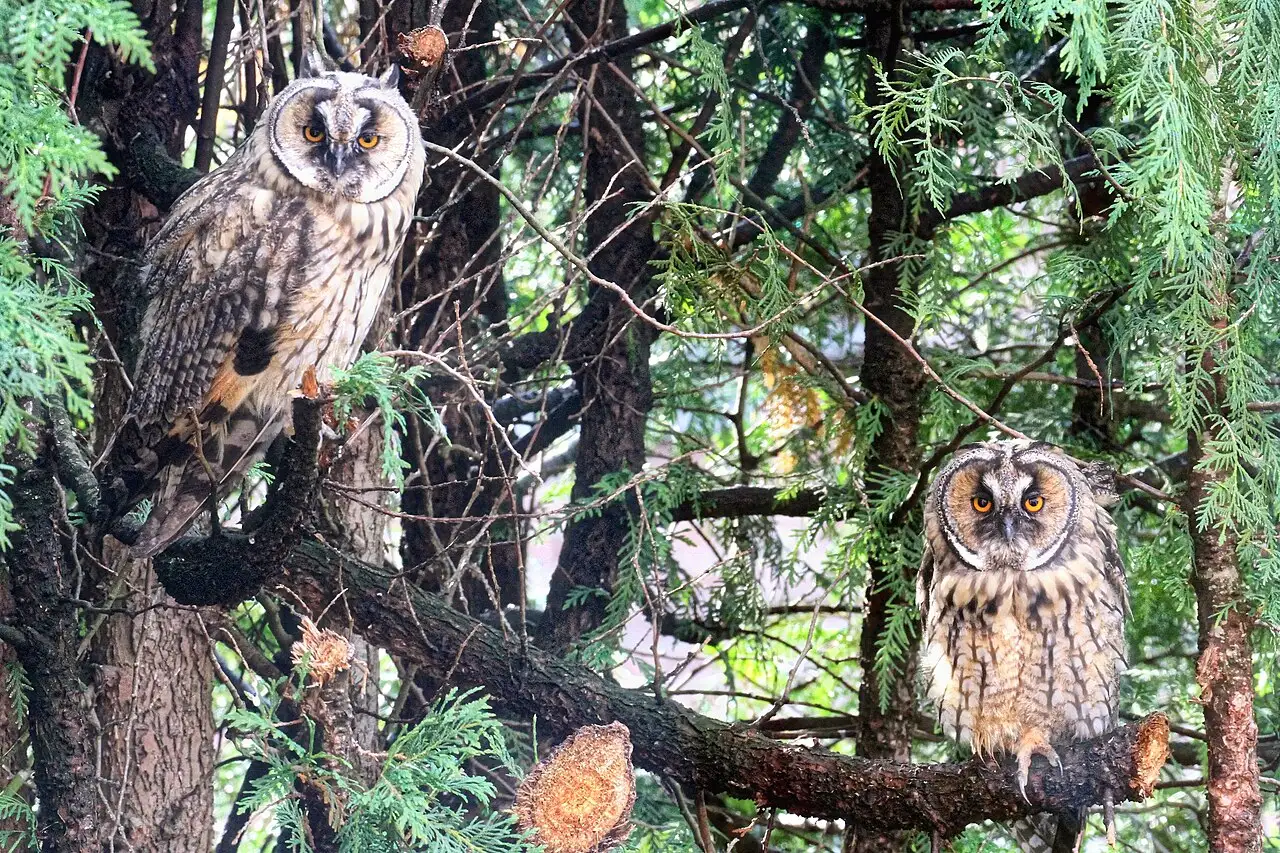
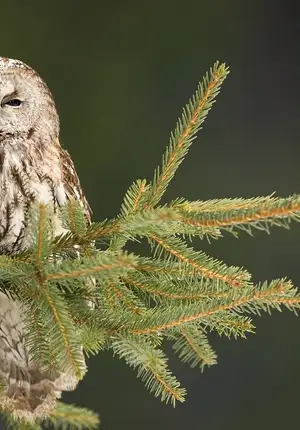
Two Long-eared Owls perched on the branches of a conifer, one from behind with streaked plumage and one from the frontPhoto: ThomasLendt, CC BY-SA 4.0Photo 3 of 4
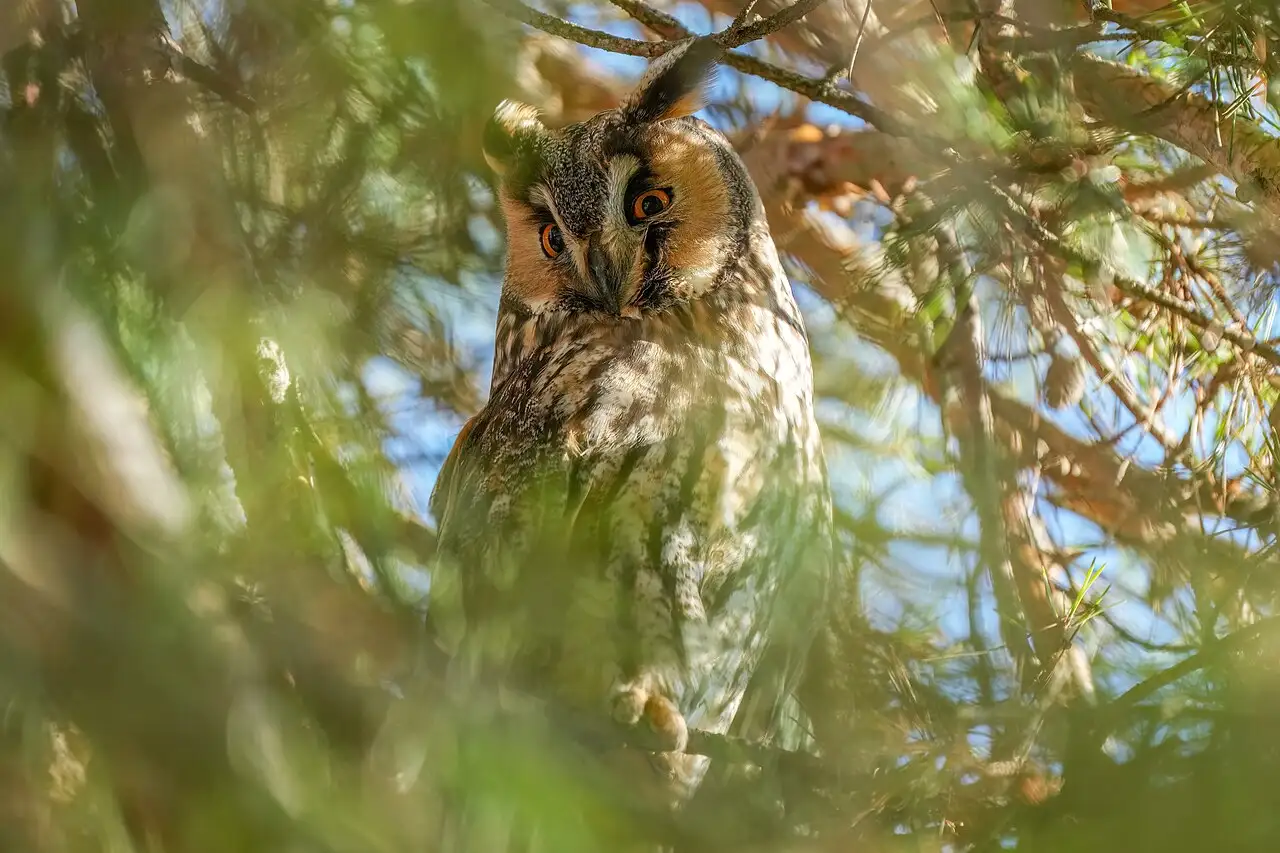
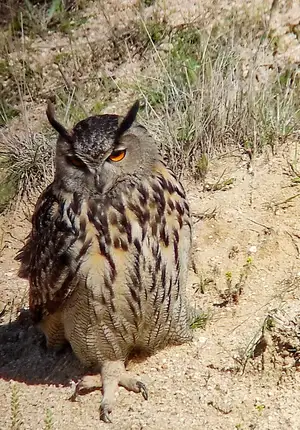
Long-eared Owl half-hidden behind foliage, with the ear tuft raised and tawny streaked plumagePhoto: Giles Laurent, CC BY-SA 4.0Photo 4 of 4
1 / 4
Identification of the Long-eared Owl
The Long-eared Owl is an owl of slender, elegant look. It wears a mottled plumage of ochre, tawny and reddish-brown tones, finely decorated with speckles and soft streaks that blend it into the wooded environment it frequents. Like other owls, it has a rounded head, but here it is topped with «ears», the ear tufts, particularly long and mobile, which serve both to break up the bird’s outline and to show excitement or fear. On the face a rim of white feathers in the shape of an X, framing the bill and the eyes, of a lovely orange colour, stands out strongly. When it takes flight, undulating, calm and silent, it reveals its long, narrow wings.
Adult
Ochre, tawny and reddish-brown plumage, with speckles and streaks.
Long, mobile ear tufts.
Orange eyes, framed by a rim of white feathers in the shape of an X.
Young bird
Plumage pattern very similar to the adult’s, but much less contrasting.
Habitat and distribution of the Long-eared Owl
It is distributed across vast regions of the northern hemisphere, from the boreal areas to the temperate regions of North America, Europe and Asia, as well as some Atlantic islands and North Africa. Several subspecies are recognised: on the Peninsula and in the Balearics the subspecies «otus» lives, and in the Canaries the endemic «canariensis».
In Spain it is widely distributed across the wooded areas of the whole Peninsula and the Balearics, although it is more abundant in Castilla y León, Madrid, the upper Ebro and some areas of Castilla-La Mancha and Andalusia, and is scarce towards the Cantabrian region, Galicia and the south-western quadrant. In the Canaries it is present on Gran Canaria, Tenerife, La Gomera, La Palma and El Hierro.
It depends closely on wooded formations to breed, but prefers areas with scattered trees, isolated copses and river groves, and if the wood is very extensive it settles beside clearings and edges. It has a special fondness for pine woods, even plantation ones, and occasionally becomes abundant inside towns.
In the northern half of its range it behaves as a migrant, while in the south it is resident or makes short-range movements. During winter we receive birds from high latitudes of Europe that, forgetting their solitary nature, gather in busy roosts; the volume of migrants and their movements depend greatly on the availability of food.
Areas where it is regularly recorded since 2010Squares of about 25 km where it is recorded regularly (occasional passage records are left out). Data from GBIF.org (12,247 records, retrieved October 2026); outline from Natural Earth.
Etymology of the Long-eared Owl
According to Wikipedia, Linnaeus described it in 1758 under the name «Strix otus», and Brisson introduced the genus «Asio» in 1760, a Latin word meaning «horned owl». The epithet «otus» comes from the Greek and alludes to a small eared owl. In other languages it is called «mussol banyut» in Catalan, «bufo pequeno» in Galician, «hontz ertaina» in Basque and «long-eared owl» in English1.
Population of the Long-eared Owl
In the 2021 European Red List of Birds the European breeding population is estimated at between 624,000 and 1,030,000 mature individuals, with an unknown trend. The data for Spain point to a minimum of 3,321 pairs (Atlas of Breeding Birds of Spain, 2003), although its difficulty of detection and its extremely withdrawn nature suggest that this figure is considerably underestimated. For the same reasons the trend is unknown.
The peninsular and Balearic populations do not have serious conservation problems, but they are affected by deforestation and changes in traditional land uses. The concentration of birds at roosts in winter makes them sensitive to illegal hunting, and road kills and robbing are frequent. The situation of the Canary subspecies is not well known, although it is abundant and adapts well to heavily humanised environments.
Nest of the Long-eared Owl
To lay its eggs it almost always chooses an old corvid nest, particularly a magpie’s, to which it rarely adds any material. Sometimes it settles in tree hollows, in human constructions and even on the ground.
Courtship and breeding of the Long-eared Owl
The breeding period begins in many places before winter ends, and already in February the scant vocal signs that show pairs forming are heard. Laying takes place between March and June, depending on the region, and consists of three to six white eggs that the female incubates for 25–30 days. The male brings prey to his mate and from time to time takes over incubation for short periods. As she starts incubating when the first egg is laid, the chicks hatch in stages. At about 20 days old they begin to disperse around the nest, long before having full plumage, and at two months they are already able to catch their first prey.
Diet of the Long-eared Owl
It is a strictly nocturnal hunter, able to hunt, even in the worst light conditions, a great variety of small and medium-sized vertebrates, from small birds to young rabbits. Its basic diet, with considerable geographic variation, centres on small mammals: voles, field mice, rats and others. Occasionally it also catches large insects, reptiles and amphibians.
Curious facts about the Long-eared Owl
It is the quietest and most withdrawn of our owls and also one of the least well known1. Although it has a considerable range of vocalisations, for most of the year it shows an extremely stealthy character. AnAge gives a maximum longevity of 27 years and 8 months, and EURING lists a bird ringed in the Netherlands that lived 21 years and 10 months.
The Long-eared Owl in Cabañeros
The habitat pages of this website do not mention it, and we have not found any other published source on it in the Park. GBIF.org records 23 observations of the Long-eared Owl in Cabañeros and its surroundings.
Where to see the Long-eared Owl in Cabañeros
In Cabañeros and its surroundings, all year, in copses, pine woods and groves beside open ground.
When
All year; it is resident, and in winter birds arrive from the north and gather at roosts.
What time
At dusk and at night; it is a strictly nocturnal hunter and very hard to see.
Where
In scattered trees, copses, river groves and pine woods, beside clearings and edges.
What to look for
Look for the long tufts and the orange eyes; listen for its deep hoot every 2 or 2.5 seconds.





 Same family
 Same family
 Same family
 Same family
 Same order
 Same season in the park
 Same season in the park
 Same season in the park






