Wingspan compared with a person with arms outstretched.
Length
19–21 cm
Wingspan
47–54 cm
Weight
90–95 g
Social life
Outside the breeding season it is mainly solitary and nocturnal; when breeding, the territorial pair may sing a duet and the male asserts the territory with his voice (oiseaux.net)
Lifespan
Record of 13 years in the wild according to EURING (a bird ringed in Italy and found dead); a very high figure compared with AnAge's 6.9 years and oiseaux.net's 6
Conservation status
LC
NT
VU
EN
CR
EW
EX
Global (IUCN)
Least Concern
Spain
Vulnerable (VU) in the 2021 Red Book of the Birds of Spain; on the List of Wild Species under Special Protection, but not in the Spanish Catalogue of Threatened Species
When to see it
Summer visitor
Months of the year when it is present
J
F
M
A
M
J
J
A
S
O
N
D
In Iberia
no
no
yes
yes
yes
yes
yes
yes
yes
no
no
no
Breeding season
no
no
no
yes
yes
yes
yes
no
no
no
no
no
Song or voice of the Eurasian Scops Owl
The song of the Eurasian Scops Owl is a characteristic flute-like «tiuu», repeated regularly at intervals of about 2 seconds. In spring the vocal displays can last several hours, but after laying they decrease markedly. The female gives a song similar to the male’s, although somewhat higher.
SongEurasian Scops Owl
0:00 / 0:17
10 kHz5
The sonogram draws the sound: time runs from left to right, and the higher a trace sits, the higher the note.Recording by Jochem Verweij, xeno-canto XC791833 (Países Bajos) (CC BY-SA 4.0).
Flight of the Eurasian Scops Owl
It is a discreet, reserved owl that goes unnoticed thanks to the camouflage of its plumage; occasionally it chases bats and large insects in flight.
Flight typeNocturnal, after large insects
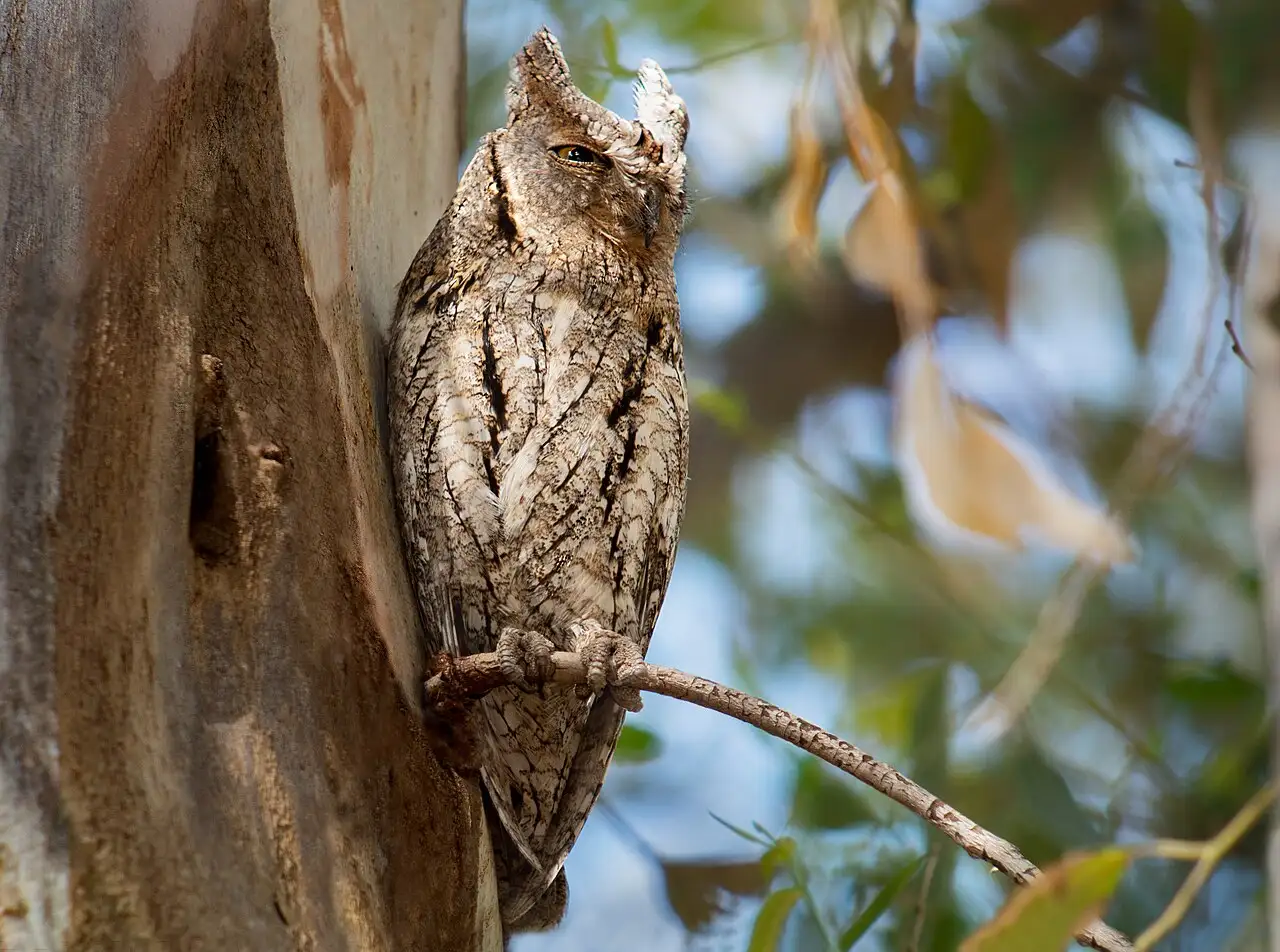
It spends the day motionless on a branch, camouflaged by its plumage, and leaves the tree at nightfall; its song, a fluty «tiuu», is repeated every two seconds.
It lives on large invertebrates, such as moths, crickets and grasshoppers; occasionally it chases bats and large insects in flight.
It lands in a tree in a dehesa, a riverside wood or a park, where it sings again for hours in spring.
Photo gallery of the Eurasian Scops Owl
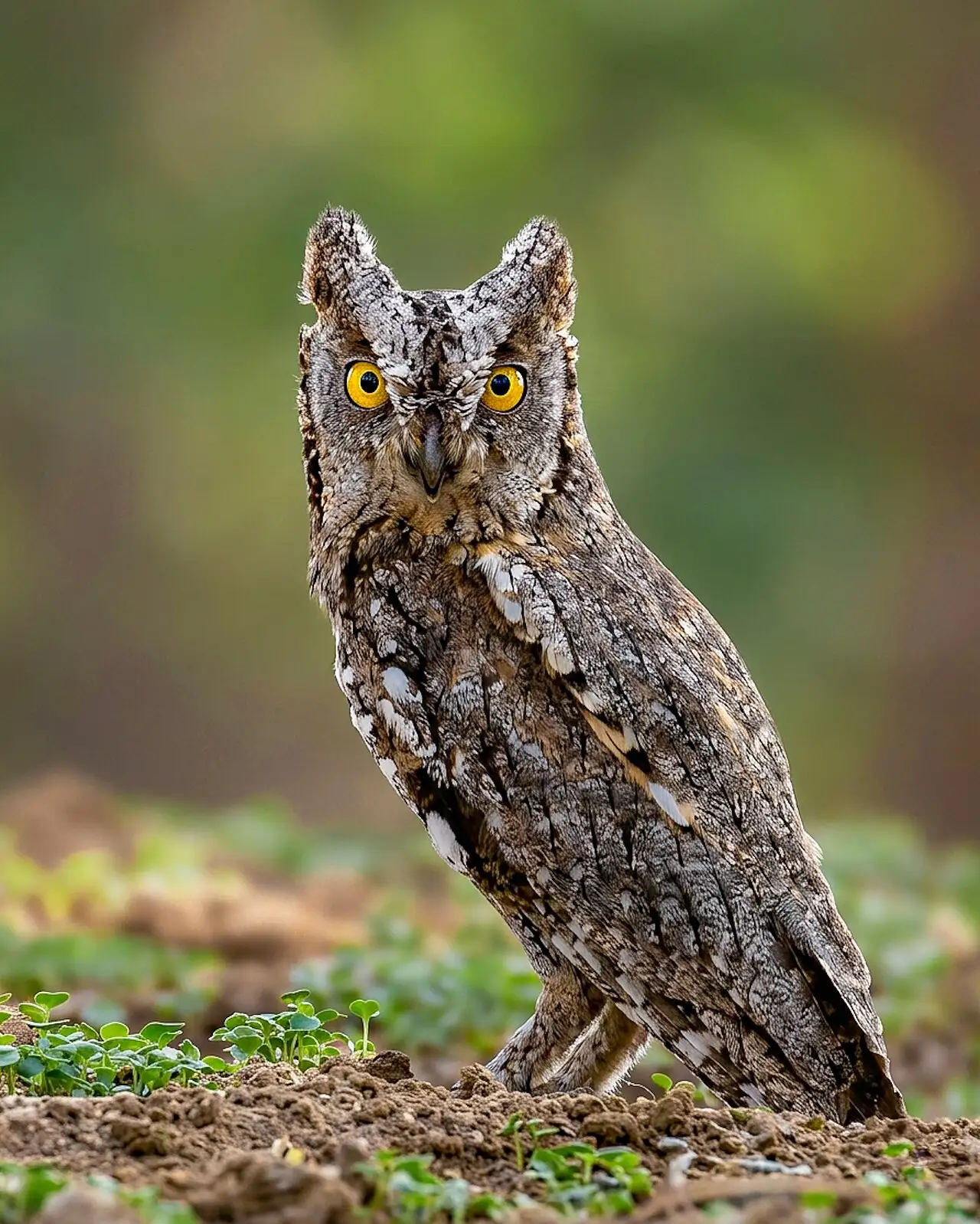
Eurasian Scops Owl standing on the ground, seen from the front, with yellow eyes, small ear tufts and speckled grey plumagePhoto: BirderSajan, CC BY-SA 4.0Photo 1 of 4
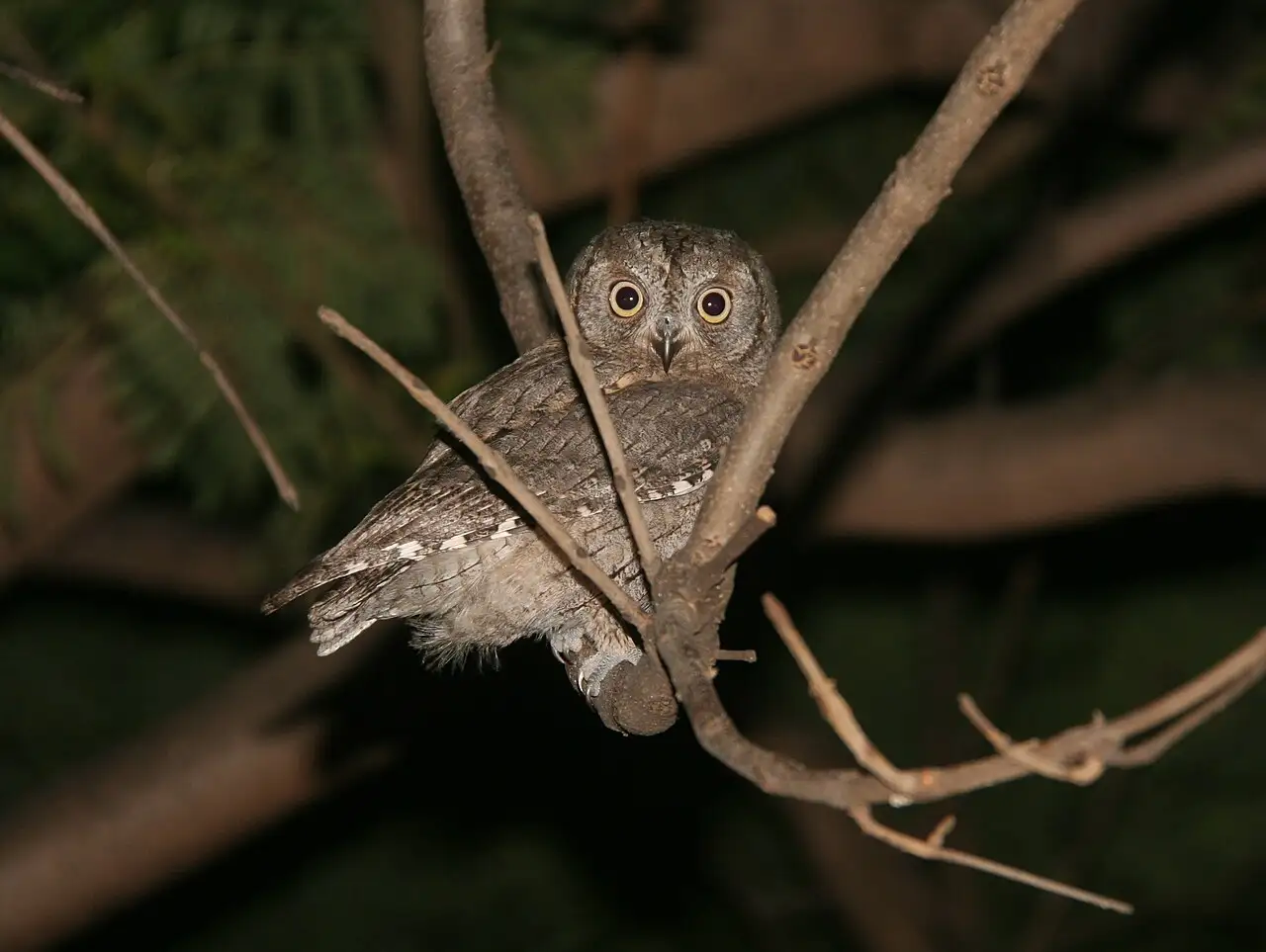
The Eurasian Scops Owl is characterised, besides its small size, by greyish or reddish-brown plumage, with a complex pattern of speckles, bars and vermiculations in different tones, which lets it go completely unnoticed when resting on tree branches. Its camouflage is increased by the small ear tufts, like false «ears», that break up the roundness of its head. The eyes are a bright yellow.
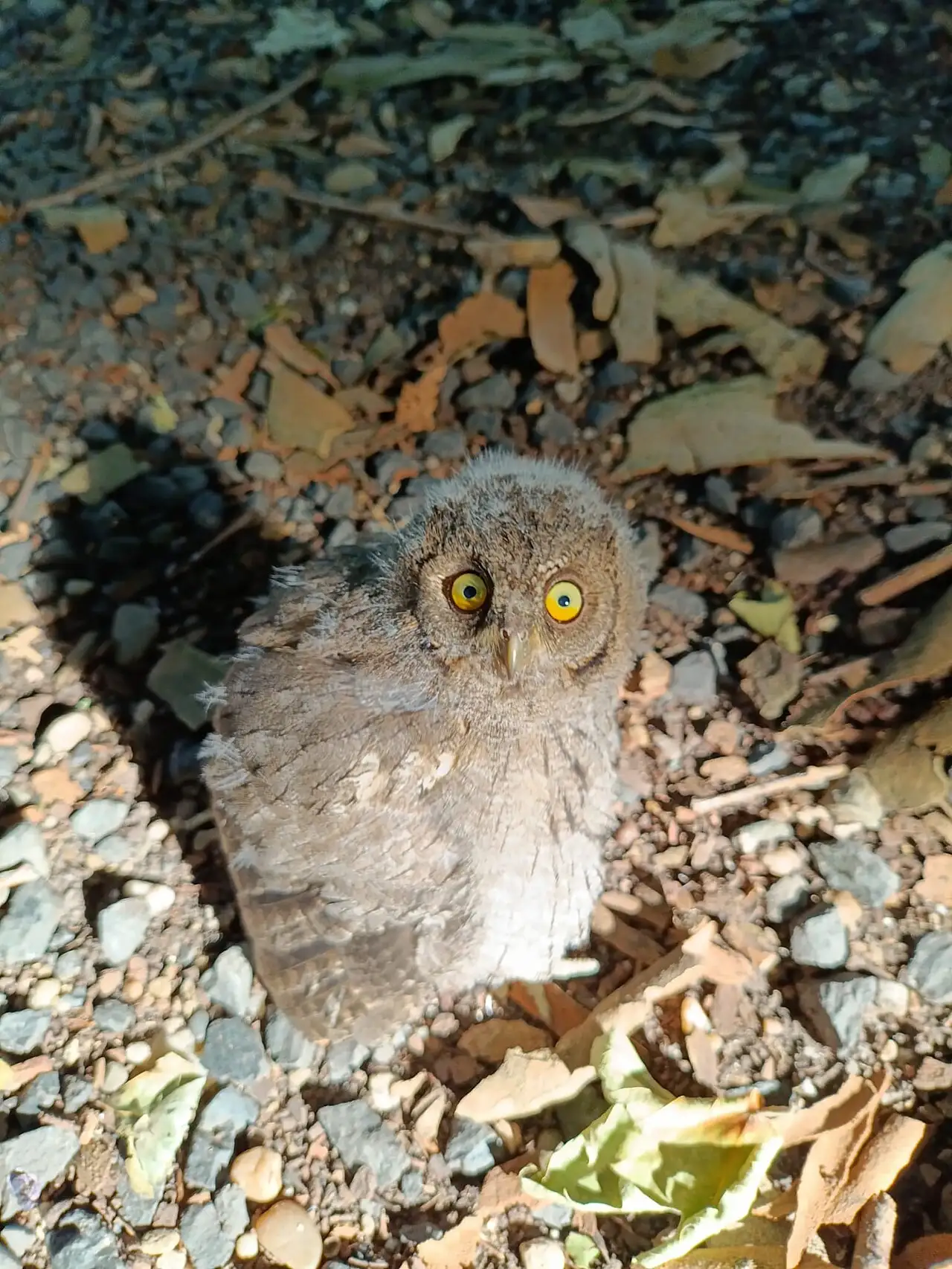
The two sexes differ in body measurements (females are larger), although plumage differences are fairly subtle. Young birds show plumage very similar to the adults’.
Adult
Greyish or reddish-brown plumage, with speckles, bars and vermiculations.
Small ear tufts and bright yellow eyes.
Females somewhat larger than males.
Habitat and distribution of the Eurasian Scops Owl
It is distributed across a good part of the temperate regions of Eurasia and North Africa, preferably in Mediterranean countries, as far as Mongolia and China. It is very scarce in central Europe, although it occasionally reaches the shores of the Baltic. Several subspecies are recognised: the Spanish breeding population belongs to «mallorcae» and the winter visitors to «scops», present in the rest of Europe.
It is widely distributed across all of Iberia, the Balearics and Ceuta, but not in Melilla or the Canaries. Although it is abundant in much of the regions, it becomes scarcer towards the north-west, and is absent from much of Galicia, Asturias and León, as well as from high mountain areas and very arid zones.
Woodland by nature, it preferably selects not-very-dense wooded formations, such as dehesas, fruit orchards, riverside woods and parks, as well as oak woods and open pine woods, from sea level to a little over 1,000 metres.
Although it is basically a trans-Saharan migrant, part of the European population, that of the warmest areas, behaves as resident. In the southernmost countries it is common to find resident birds in urban or peri-urban areas; in Spain, a high percentage of the birds in the Mediterranean and southern regions. Some birds from the rest of Europe also come to winter. It has been suggested that climate change could be behind this change of habits. The post-breeding migration begins in August, and the return to the breeding territories takes place in March or April.
Areas where it is regularly recorded since 2010Squares of about 25 km where it is recorded regularly (occasional passage records are left out). Data from GBIF.org (19,743 records, retrieved October 2026); outline from Natural Earth.
Etymology of the Eurasian Scops Owl
According to Wikipedia, the genus name, «Otus», comes from Latin and means «eared owl», and the epithet «scops» comes from the ancient Greek «skōps», a small eared owl. In other languages it is called «xot eurasiàtic» in Catalan, «moucho de orellas europeo» in Galician, «apo-hontza» in Basque and «Eurasian scops owl» in English1.
Population of the Eurasian Scops Owl
The European population is estimated at about 447,000–749,000 Scops Owls (2021 European Red List of Birds). In Spain there are no specific national-scale censuses that allow a real estimate. The Noctua monitoring programme shows that the species suffered a decline of 32.4 % between 2006 and 2018, and also a marked contraction of its range, of about 20 % in that period.
The main conservation problems stem from habitat alteration and the use of pesticides: the transformation of the rural landscape, with the loss of river groves and old trees, changes in crops, urban expansion and the widespread use of toxic substances in agriculture. Other threats are road kills, competition with invasive species such as the Rose-ringed Parakeet for nesting cavities and climate change, which would be reducing the arthropods available as food, above all for the chicks. It is recommended to keep the traditional farming landscape, river groves and agroforestry mosaics, conserve old trees, control pesticides and invasive species, and monitor the population1.
Nest of the Eurasian Scops Owl
It shows a marked preference for laying its eggs in hollows, such as woodpecker nests, holes in walls and banks and even human constructions. Sometimes it settles in old corvid nests, and readily accepts nest boxes.
Courtship and breeding of the Eurasian Scops Owl
The breeding season varies considerably from region to region, but in Spain it usually runs between April and July. The clutch consists of three to seven white eggs, laid at intervals of one to three days, which only the female incubates. During the chicks’ first weeks of life, the female tends the brood while the male gets prey; when the chicks are about three weeks old, the female joins her mate in the search for food.
Diet of the Eurasian Scops Owl
Its diet is based mainly on sizeable invertebrates, such as moths, crickets and grasshoppers, although sometimes it catches small vertebrates, such as rodents, reptiles and small birds. Occasionally it chases bats and large insects in flight.
Curious facts about the Eurasian Scops Owl
It is the smallest of our owls and, although it usually goes unnoticed, it is easy to detect by its song. According to EURING, the ringed bird that lived longest, in Italy, reached 13 years, a figure at odds with AnAge’s 6.9 years and oiseaux.net’s 6.
The Eurasian Scops Owl in Cabañeros
The habitat pages of this website do not mention it. GBIF.org records 98 observations of the Eurasian Scops Owl in Cabañeros and its surroundings.
Where to see the Eurasian Scops Owl in Cabañeros
In Cabañeros and its surroundings, from March to September.
When
From March to September: it returns in March or April and the post-breeding migration begins in August; some are resident in the south.
What time
At night, in spring, when it sings for hours; by day it is almost invisible.
Where
In dehesas, riverside woods, parks and not-very-dense woodland.
What to look for
Listen for its flute-like «tiuu» every two seconds and look for the ear tufts and the yellow eyes.



 Same family
 Same family
 Same family
 Same family
 Same season in the park
 Same season in the park
 Same season in the park
 Same season in the park






