Wingspan compared with a person with arms outstretched.
Length
37–43 cm
Wingspan
81–96 cm
Weight
365–587 g
Social life
Very faithful to its territory; after breeding the family stays together two or three months, until the young disperse at the end of summer
Lifespan
Record of 23 years and 5 months in the wild according to EURING (a bird ringed in Great Britain and Ireland); AnAge gives 22.4 years
Conservation status
LC
NT
VU
EN
CR
EW
EX
Global (IUCN)
Least Concern
Spain
Least Concern (LC) as a breeder in the Red List of Birds of Spain; on the List of Wild Species under Special Protection, but not in the Spanish Catalogue of Threatened Species
When to see it
Resident
Months of the year when it is present
J
F
M
A
M
J
J
A
S
O
N
D
In Iberia
yes
yes
yes
yes
yes
yes
yes
yes
yes
yes
yes
yes
Song or voice of the Tawny Owl
Its most characteristic sound is a plaintive hoot, like a guffaw, with repeated series of long notes alternating with shorter ones: «houuuuu, ho, ho, ho, houuuuu». The female sings in a similar way, but less insistently and sustainedly. The contact call is a repeated, shrill «ku-wik», similar to the alarm call, a «kuuá» that ends abruptly.
SongTawny Owl
0:00 / 0:33
10 kHz5
The sonogram draws the sound: time runs from left to right, and the higher a trace sits, the higher the note.Recording by Marie-Lan Taÿ Pamart, xeno-canto XC496671 (Puy-de-Dôme, Francia) (CC BY-SA 4.0).
Flight of the Tawny Owl
According to Wikipedia, it flies with long glides on its rounded wings, with less undulation and fewer flaps than other Eurasian owls, and normally at greater height. Its flight is rather heavy and slow, especially on take-off.
Flight typeLong glides on rounded wings; heavy and slow
It is a raptor fundamentally of woodland and strictly nocturnal, tied to old trees, in woods, dehesas, riverside groves and parks.
It flies with long glides on its rounded wings, with fewer undulations and fewer flaps than other owls; its flight is rather heavy and slow.
A generalist predator, it prefers small mammals, such as voles, mice, rats and dormice, but hunts everything from rabbits to large invertebrates.
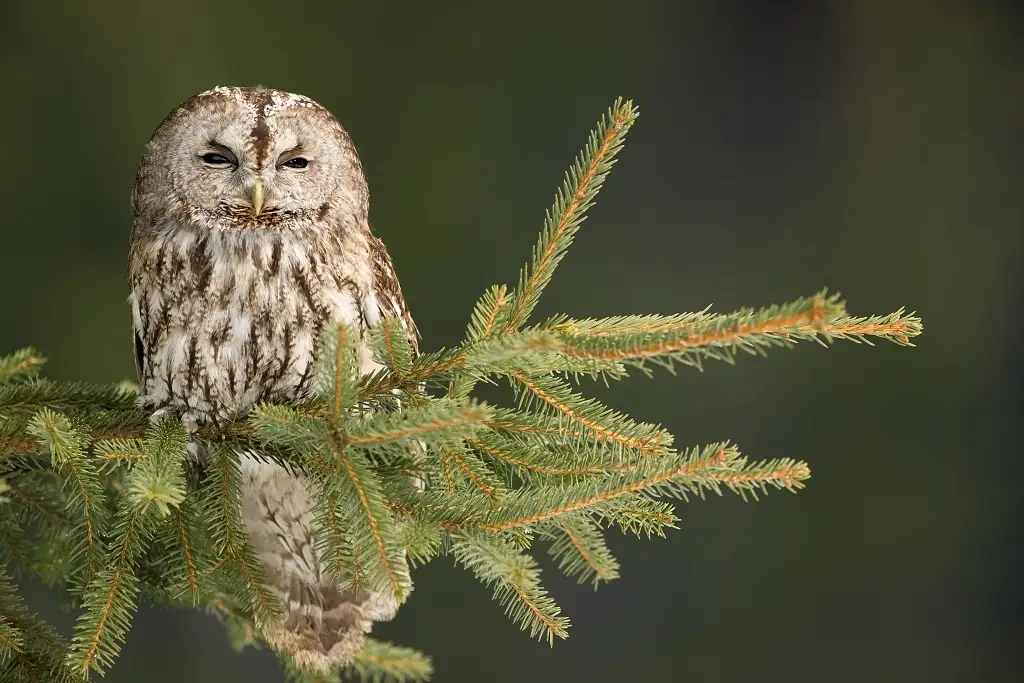
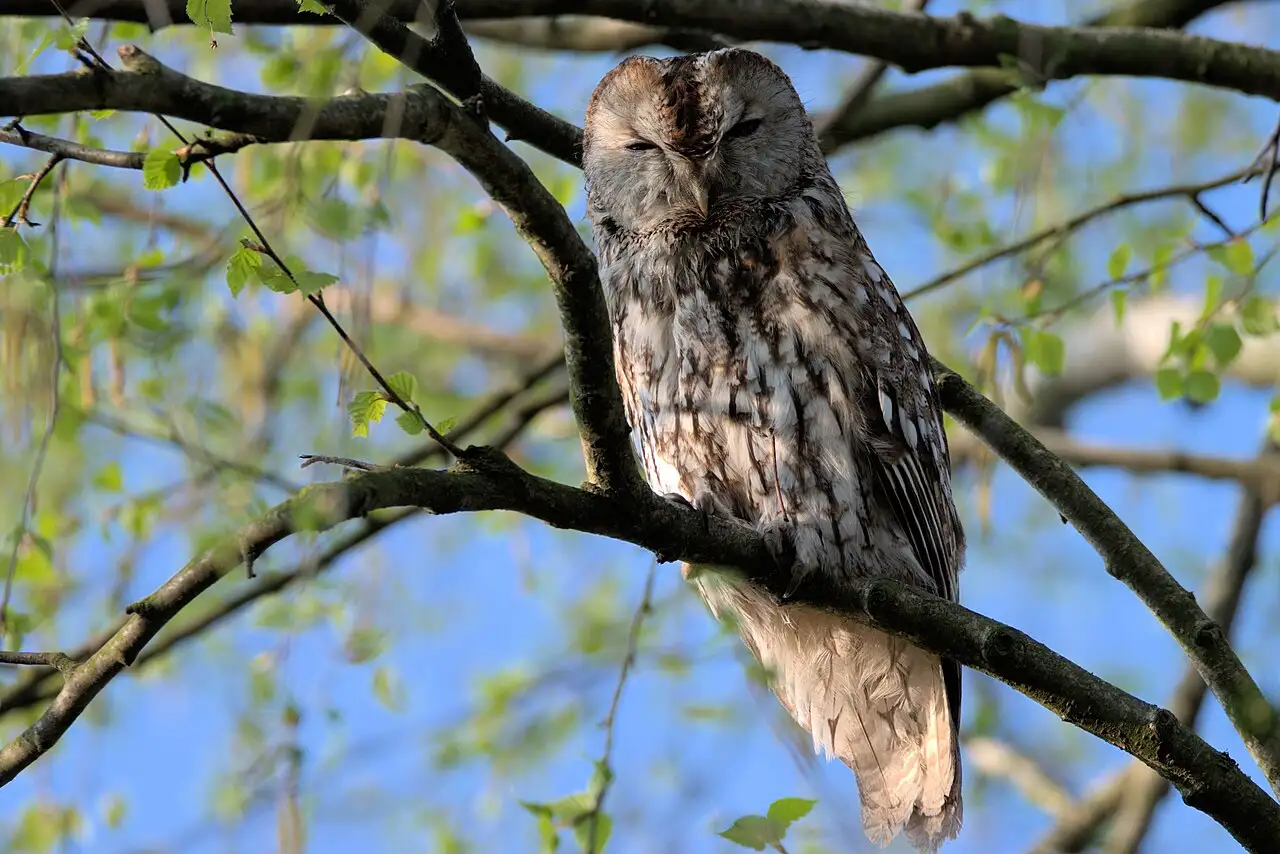
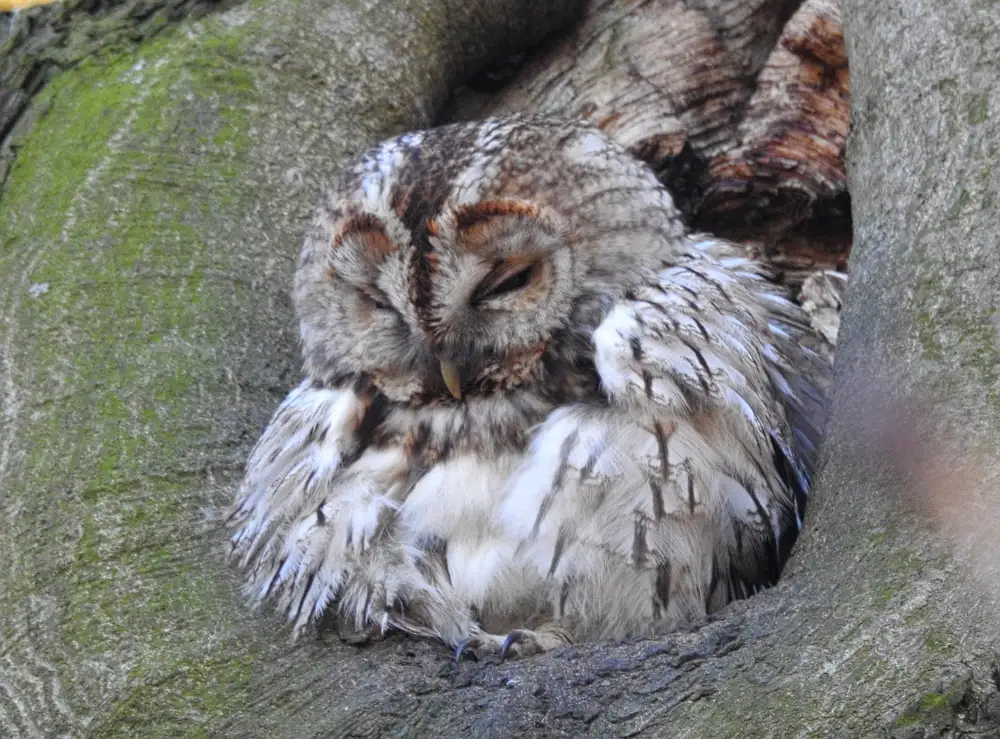
The Tawny Owl has a bulky head in which huge, globular black eyes stand out. That, together with the lack of head tufts, the «ears», and its stocky, sturdy look, makes it easy to tell from the rest of our owls. Its plumage is extraordinarily mimetic and very variable in colour, because there are grey, reddish and brown birds, but the pattern is always a complex mix of speckles, barring and vermiculations that imitate tree bark perfectly. The face is whitish, greyish or reddish, with two whitish stripes like «eyebrows». According to Wikipedia, the female is quite a bit larger than the male.
Adult
Large, round head, without tufts, with black eyes.
Grey, reddish or brown plumage, with speckles, barring and vermiculations.
Pale face with two whitish «eyebrows».
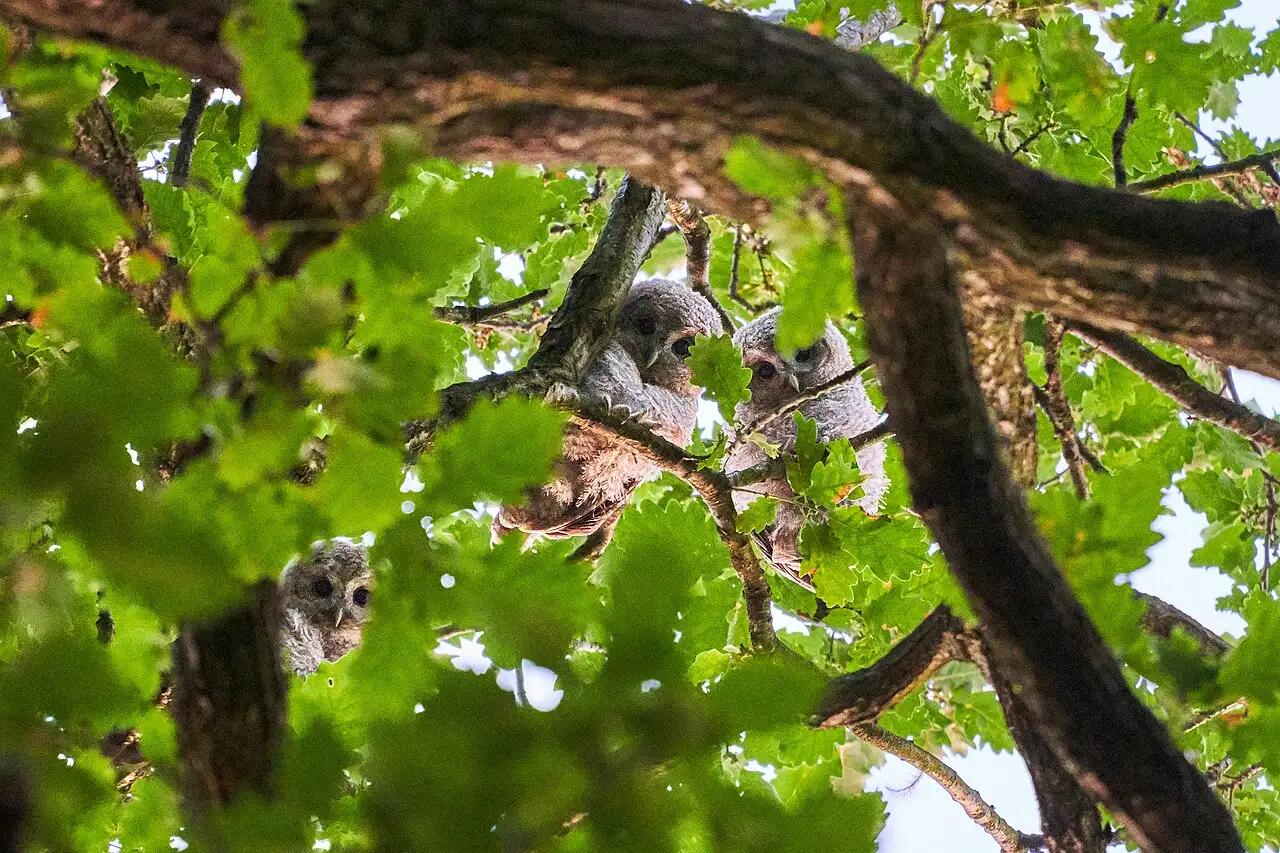
Young bird
A few weeks after hatching the chicks already walk on the branches near the nest, and fly at a little over a month.
Habitat and distribution of the Tawny Owl
It occupies most of Europe, except Ireland, Iceland and northern Scandinavia, the less arid areas of North Africa and, towards the east, Asia Minor, Iran and southern Siberia, with populations in southern China and Korea. Several subspecies are recognised: on the Peninsula «sylvatica» lives, and in Ceuta and Melilla, «mauritanica».
It is an eminently woodland and strictly nocturnal species, spread across the whole Peninsula at very variable densities. It is much commoner in the north and in well-wooded areas, and scarce or absent on heavily deforested plains and in the most arid environments. In Ceuta and Melilla it is a scarce resident, and it is not in the Canaries or the Balearics.
Although it is a woodland owl, its great adaptability lets it live anywhere from the most closed woods to dehesas, and from river groves to urban parks, as long as there are old trees. It is not unusual either for it to settle on cliffs and sandy banks or in constructions such as irrigation ditches, country houses, farm sheds or ruins.
It is strictly resident and very faithful to its haunts. Young birds do not go far either: they disperse within a radius of no more than 20 kilometres of where they were born.
Areas where it is regularly recorded since 2010Squares of about 25 km where it is recorded regularly (occasional passage records are left out). Data from GBIF.org (44,399 records, retrieved October 2026); outline from Natural Earth.
Etymology of the Tawny Owl
According to Wikipedia, the scientific name comes from the Greek «strix», «owl», and the Italian «allocco», the name of the Tawny Owl in that language, which in turn comes from the Latin «ulucus». Linnaeus described it in 1758 under the name it keeps. In other languages it is called «gamarús comú» in Catalan, «avelaiona común» in Galician, «urubi arrunta» in Basque and «tawny owl» in English1.
Population of the Tawny Owl
In the 2021 European Red List of Birds the European breeding population is estimated at between 1,260,000 and 1,870,000 mature individuals, with a stable trend. In Spain a minimum of 39,000 individuals was estimated in 2003, a figure to be taken with caution because of the counting methods and the time elapsed; there are no recent data for the whole country. The Noctua programme (2019) indicates that, despite notable ups and downs from one year to the next, the trend is stable.
Its great adaptability and lack of specialisation make it little sensitive to habitat alteration. Even so, felling or a shortage of old trees can limit its populations, and road kills, power lines and poisoning with agricultural products or rat poison cause many losses, above all among young birds.
Nest of the Tawny Owl
It is chosen and prepared by the female: a simple hollow, without any material, which because of its cave-dwelling habits she sets in all kinds of cavities, although the most usual nests are in old trees. If these are lacking, it takes hollows in buildings, small caves in rocky cliffs and old nests of other birds.
Courtship and breeding of the Tawny Owl
It has a fairly early breeding season, beginning in December or January. Clutches are usually laid from February and are of two to five eggs, which the female incubates for 28–30 days from the first. A few weeks later the chicks already wander around the nest, and at a little over a month make their first flights. The family stays together two or three months more, until the young disperse at the end of summer.
Diet of the Tawny Owl
It is a generalist, undemanding predator that adapts to what its territory offers according to the season and the abundance of each prey: at each moment it uses the most accessible, thanks to how well it knows its ground. It shows a marked preference for small mammals, such as voles, mice, rats or dormice, but eats anything from rabbits to large invertebrates, as well as birds of all kinds, reptiles and amphibians.
Curious facts about the Tawny Owl
Its plumage imitates tree bark perfectly1. EURING lists a Tawny Owl ringed in Great Britain and Ireland that lived 23 years and 5 months.
The Tawny Owl in Cabañeros
The habitat pages of this website do not mention it, and we have not found any other published source on it in the Park. GBIF.org records 42 observations of the Tawny Owl in Cabañeros and its surroundings.
Where to see the Tawny Owl in Cabañeros
In Cabañeros and its surroundings, all year, in woods, dehesas and groves with old trees.
When
All year; it is resident, and its breeding season begins in December or January.
What time
At night: it is strictly nocturnal, and is much easier to hear than to see.
Where
In woods, dehesas, river groves and parks with old trees.
What to look for
Listen for its hoot «houuuuu, ho, ho, ho, houuuuu»; look for the round head without «ears» and the black eyes.




 Same family
 Same family
 Same family
 Same family
 Same order
 Same season in the park
 Same season in the park
 Same season in the park






