Wingspan compared with a person with arms outstretched.
Length
40–45 cm
Wingspan
1.05–1.15 m
Weight
830 g
Social life
Gregarious and very terrestrial; the male takes no part in rearing after fertilising the female, who looks after the chicks alone
Lifespan
More than 21 years maximum recorded age (oiseaux.net)
Conservation status
LC
NT
VU
EN
CR
EW
EX
Global (IUCN)
Near Threatened
Spain
Endangered (EN) in the 2021 Red Book of the Birds of Spain and Vulnerable (VU) in the Spanish Catalogue of Threatened Species
When to see it
Resident
Months of the year when it is present
J
F
M
A
M
J
J
A
S
O
N
D
In Iberia
yes
yes
yes
yes
yes
yes
yes
yes
yes
yes
yes
yes
Song or voice of the Little Bustard
It is a particularly silent bird, although during the breeding season the male gives a characteristic «prreet», short and dry, which he repeats constantly while performing a little jump.
Male's songLittle Bustard
0:00 / 0:27
10 kHz5
The sonogram draws the sound: time runs from left to right, and the higher a trace sits, the higher the note.Recording by AviCanto, Wikimedia Commons (Vídeo de YouTube, con atribución).
Flight of the Little Bustard
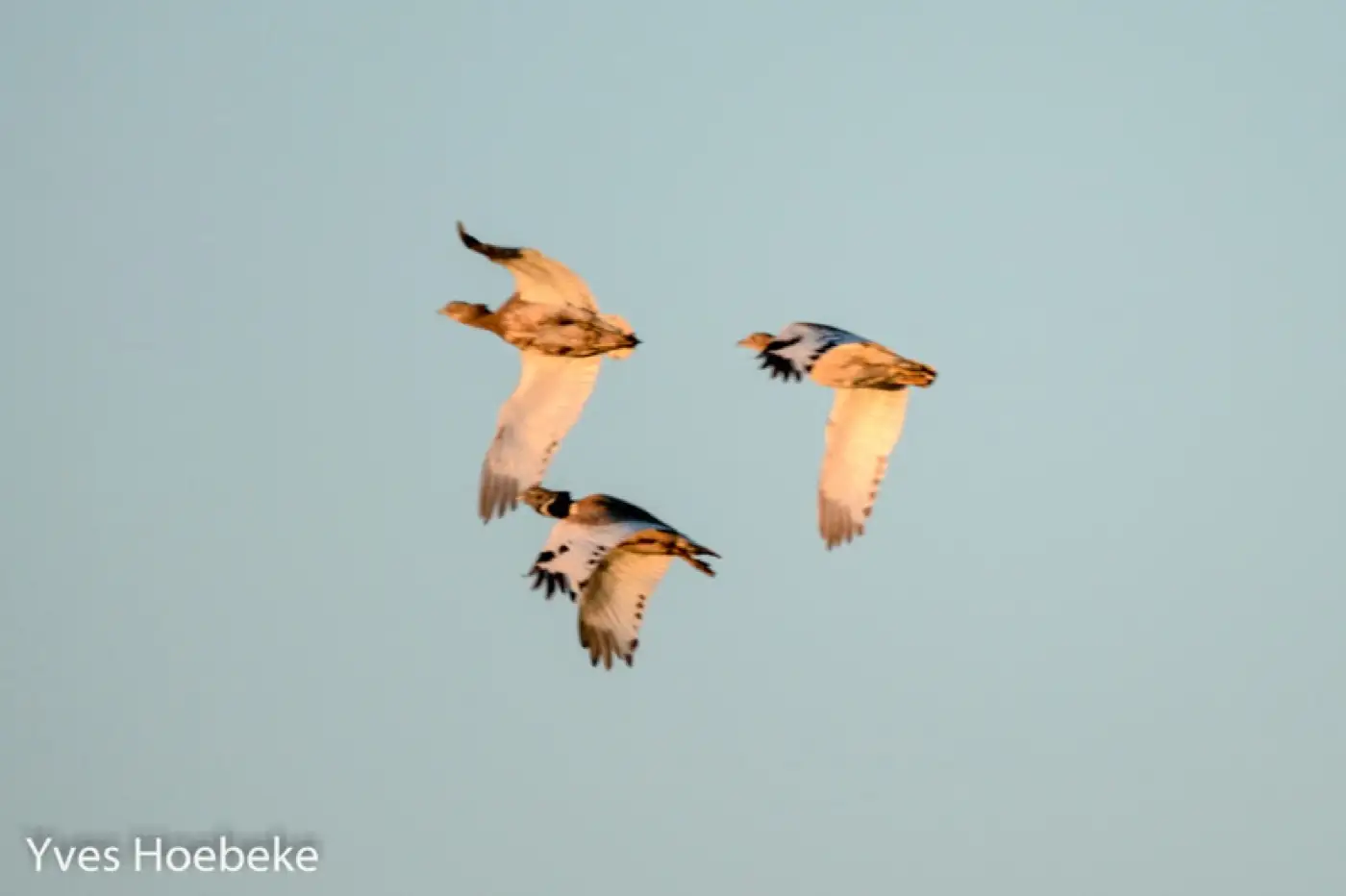
The flight is relatively fast and very distinctive, both for the characteristic wing movements and for the striking whistle it produces, from which the bird’s Spanish name comes, caused by the shorter length of the fourth primary. When a Little Bustard is watched in flight, the pattern on the upper side of its wings is very visible, with a wide white band standing out vividly.
Flight typeRelatively fast, with a whistle from the fourth primary
It is very terrestrial and gregarious: it is usually seen walking over cereal or fallow land, until it takes flight.
A relatively fast and very distinctive flight, for the wing movements and for the striking hiss it produces, caused by the shorter length of the fourth primary; a wide white band is seen on the upper side of the wings.
It perches on cereal crops, fallows or alfalfa fields, where in winter it forms roosts.
Photo gallery of the Little Bustard
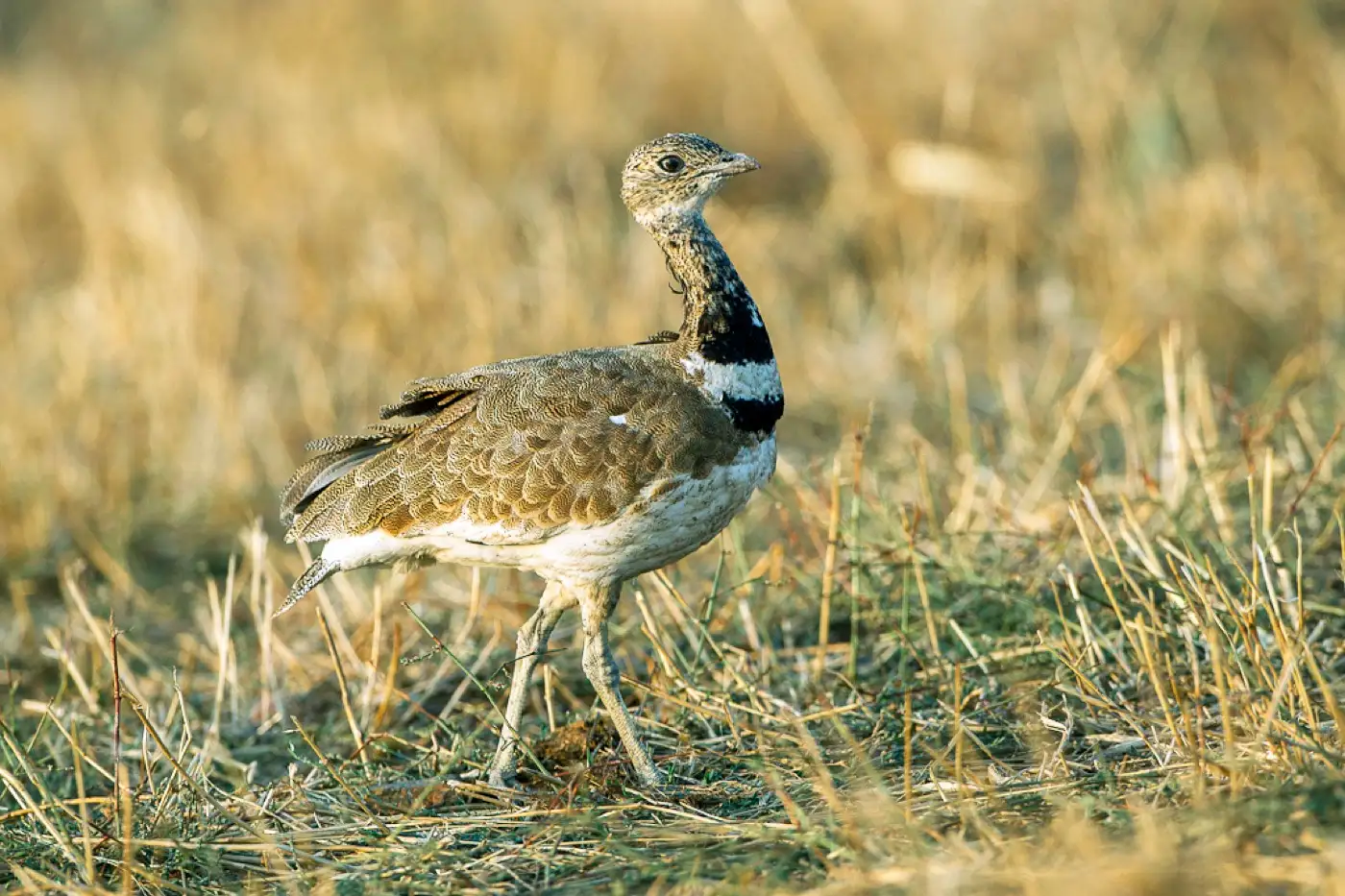
Male Little Bustard walking over the stubble at Castuera (Badajoz), with dark neck and black-and-white collarPhoto: Francesco Veronesi, CC BY-SA 2.0Photo 1 of 4
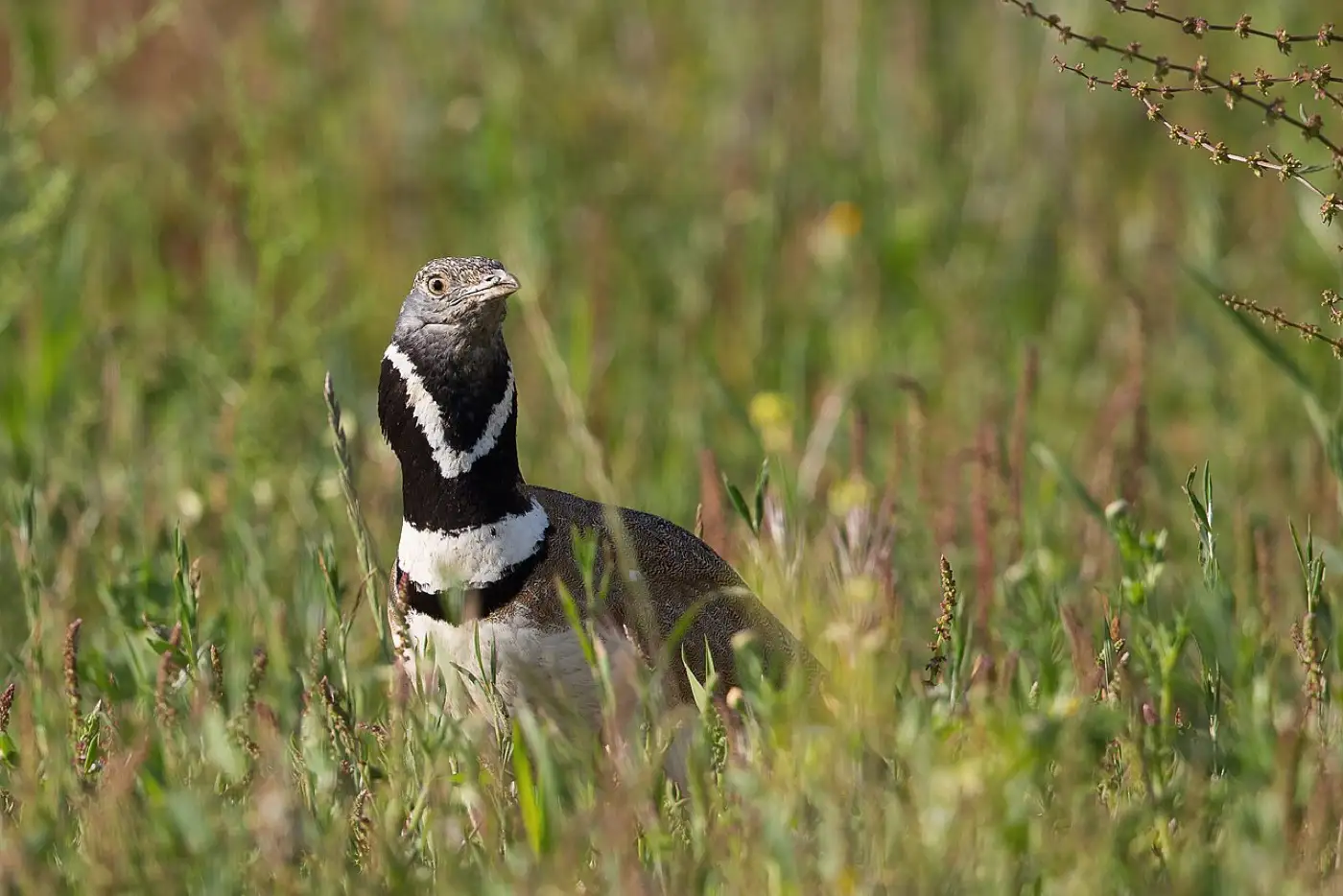
Breeding male Little Bustard in the grass, with black neck, white collar and the two breast bandsPhoto: Pierre Dalous, CC BY-SA 3.0Photo 3 of 4
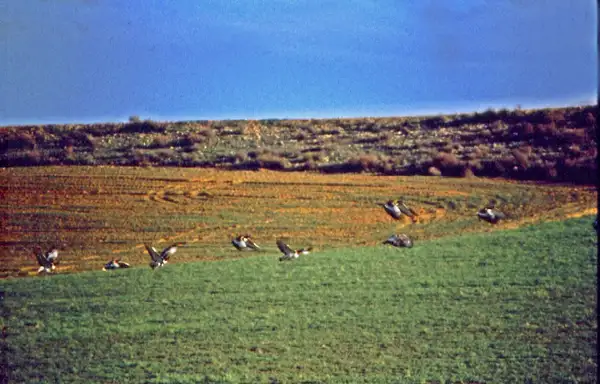
Three Little Bustards in flight against the sky, with the wide white band of the wings clearly visiblePhoto: yves hoebeke, CC BY-SA 2.0Photo 4 of 4
1 / 4
Identification of the Little Bustard
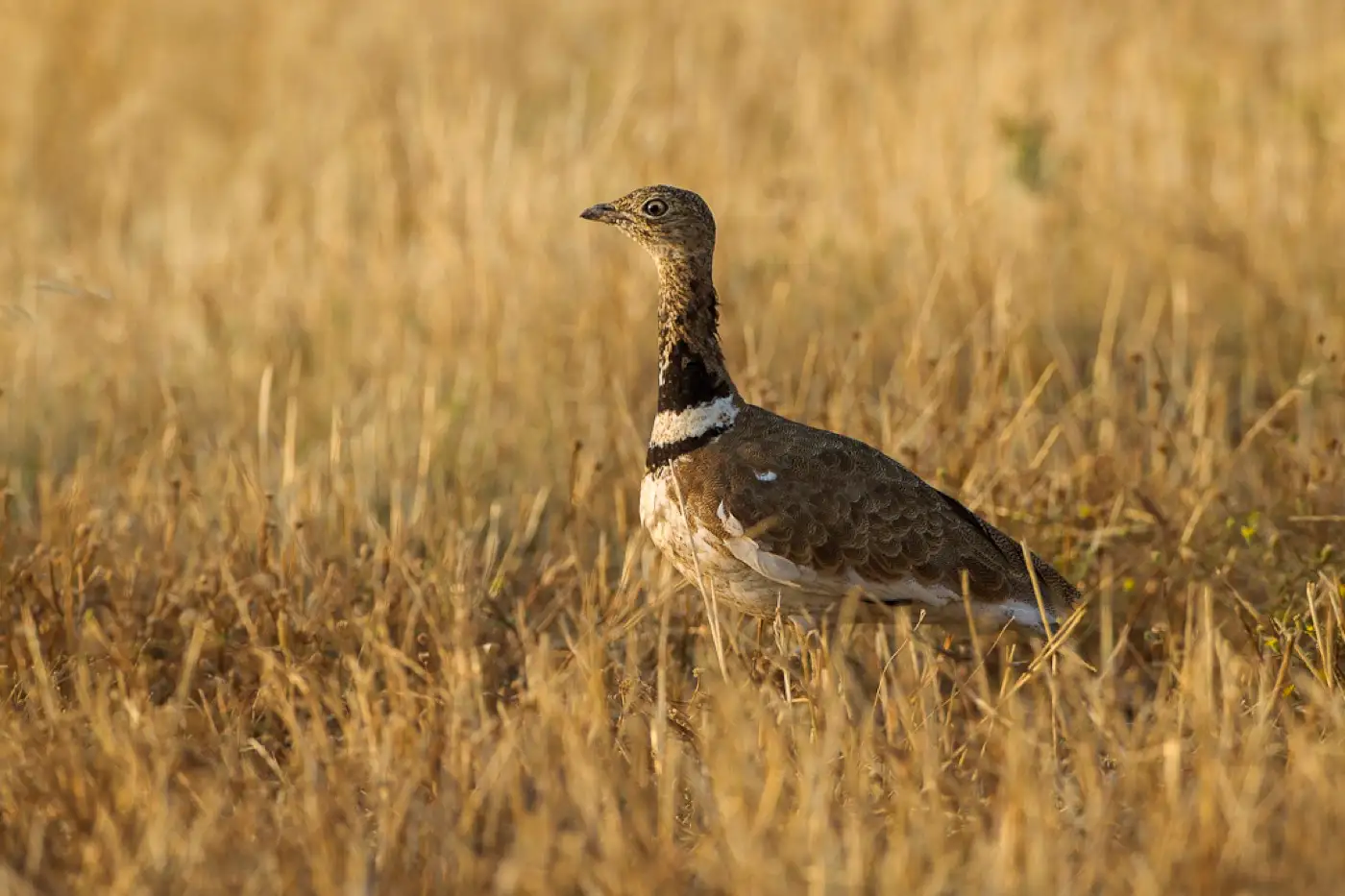
The Little Bustard is a gregarious, very terrestrial species that shares with its relative the Great Bustard many adaptive features, such as the cryptic plumage, the strong, three-toed legs built for walking, and a mixed diet. Although there are no marked differences between the sexes in size, the male’s plumage during the breeding period is clearly different from the female’s: he acquires an intense black colouring on the neck, separated from the greyish head by a white collar. Below the large dark patch on the breast two concentric bands appear, the first white and the second black.
Outside the breeding season it is harder to tell the sexes apart, as both have brownish plumage finely barred on the back and white underparts. The juvenile is quite similar to the adults.
Breeding male
Black neck, separated from the greyish head by a white collar.
Two concentric bands, white and black, below the large dark breast patch.
Female, non-breeding birds and young
Brownish plumage, finely barred on the back, and white underparts.
Habitat and distribution of the Little Bustard
It is a species of Palearctic distribution, extending in a rather fragmented way from the Iberian Peninsula and North Africa to China. The main breeding stronghold is on the Peninsula, followed by those of Kazakhstan and Russia. No subspecies are recognised.
In Spain it occurs only on the mainland, and occupies above all open regions of Castilla-La Mancha, Madrid and Extremadura, with smaller, scattered populations in Castilla y León, the Ebro valley and Andalusia. It is wholly residual in Murcia and Galicia and absent from the Cantabrian strip, the Levante and both archipelagos. In winter it concentrates above all on the southern Meseta, Extremadura and the Guadalquivir valley, and in smaller numbers in the Duero and Ebro valleys, where residents gather with populations arriving mainly from Portugal and France.
It occupies above all open farming habitats, dominated by dry cereal crops or extensive pastures, and benefits from traditional systems with some landscape variety (legumes, fallows, wasteland, field margins). Outside the breeding season it tends to concentrate in areas with alfalfa crops or certain fallows, where it forms roosts.
Although it is resident on the Peninsula, it is prone to seasonal movements of some size, and in winter it partly leaves the northernmost breeding areas and concentrates further south.
Areas where it is regularly recorded since 2010Squares of about 25 km where it is recorded regularly (occasional passage records are left out). Data from GBIF.org (12,786 records, retrieved October 2026); outline from Natural Earth.
Etymology of the Little Bustard
«Tetrax» is, according to Wikipedia, a Latin word for an unidentified game bird. The Spanish name, «sisón», comes from the hiss its wings make in flight.
Population of the Little Bustard
According to the 2021 European Red List of Birds, the European population is estimated at 194,000–280,000 individuals, and the Spanish one, the most important on the continent, was once put at 100,000–200,000 breeding males in the mid-1990s. At present, according to the Third Atlas of Breeding Birds in Spain, there are between 30,000 and 60,000 breeding males. Everything points to a clearly declining trend, especially in La Rioja, Navarre, Catalonia and Extremadura. The main problems stem from the deep transformation of the farming landscapes it needs to breed and winter: agricultural intensification, the spread of irrigation, short-cycle cereals, the disappearance of fallows, the growth of olive groves at the expense of legumes and cereals, the removal of field margins and wasteland and the use of pesticides; to this are added livestock pressure, urbanisation, infrastructure, predation and illegal hunting.
Nest of the Little Bustard
The eggs are laid in a small hollow in the ground, lined with a few grasses.
Courtship and breeding of the Little Bustard
The breeding cycle begins at the end of March with the arrival of the males in their territories; the display takes place throughout April. The males, at densities of 4 to 10 birds per square kilometre, choose clearly visible margins, crops and fallows, which they do not necessarily occupy from one season to the next, and perform a showy dance that attracts the females. Once fertilised, the male largely takes no further part in rearing, which falls entirely to the female. The clutch consists of three or four dark olive eggs, heavily spotted, incubated for 20–22 days. The chicks hatch with very camouflaged down and can feed themselves and move about with ease; at about a month old they reach full development, although they stay with the female until the post-breeding groups form.
Diet of the Little Bustard
The diet varies greatly with the season: in spring and summer it is decidedly insectivorous, although it also includes food of plant origin; in autumn and winter it becomes more vegetarian and consumes huge quantities of seeds and shoots, above all of different legumes.
Curious facts about the Little Bustard
It once spread over wide regions of the Peninsula. Today it is seen mainly on the southern Meseta and in Extremadura. Its Spanish name recalls the hiss of its wings in flight, and not its song.
The Little Bustard in Cabañeros
The grassland page of this website cites it among the birds that in winter, on the grasslands and the raña of Cabañeros, are seed-eating and plant-eating and form «very notable flocks», together with the Calandra Lark.
Where to see the Little Bustard in Cabañeros
On the grasslands and the raña of Cabañeros, above all in winter.
When
All year; in winter it forms flocks on the grasslands.
What time
Throughout the day; in flight, the hiss of its wings gives it away.
Where
In dry cereal crops, extensive pastures, fallows and alfalfa fields.
What to look for
A brownish steppe bird, with a white band on the wings in flight and, in the breeding male, a black-and-white collar.
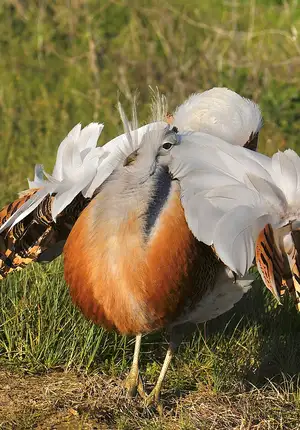
They are similar in appearance1. The Great Bustard is an unmistakable bird, enormous, very bulky and heavy, in slightly reddish and golden browns; the male, much bigger than the female, can approach 18 kg.
Photo: Fernando Benito Álvarez, CC BY-SA 2.5
Other birds
Birds related to the Little Bustard or sharing its habitats in Cabañeros.



 Same family
 Also in grasslands and rañas
 Also in grasslands and rañas
 Also in grasslands and rañas
 Also in grasslands and rañas
 Also in grasslands and rañas
 Also in grasslands and rañas
 Also in grasslands and rañas





