Did you know the European Bee-eater wins over females by giving them insects? Maybe you should do the same. I mean take the trouble one day to cook a good dinner, not hand over the flies you swat at home…
Typical trills, deep, throaty and liquid: «gruc» or «grriuc». It gives them out non-stop and almost always in flight, so you hear it long before you see it.
CallEuropean Bee-eater
0:00 / 0:11
10 kHz5
The sonogram draws the sound: time runs from left to right, and the higher a trace sits, the higher the note.
Flight of the European Bee-eater
Stiff wings as it rises with quick flaps. Then it slows down, circles and glides. To catch prey it flaps and glides with its wings flat. It watches from a perch and darts after every insect that passes, wings pointed and the two tail needles clearly visible.
Flight typeHunts on the wing
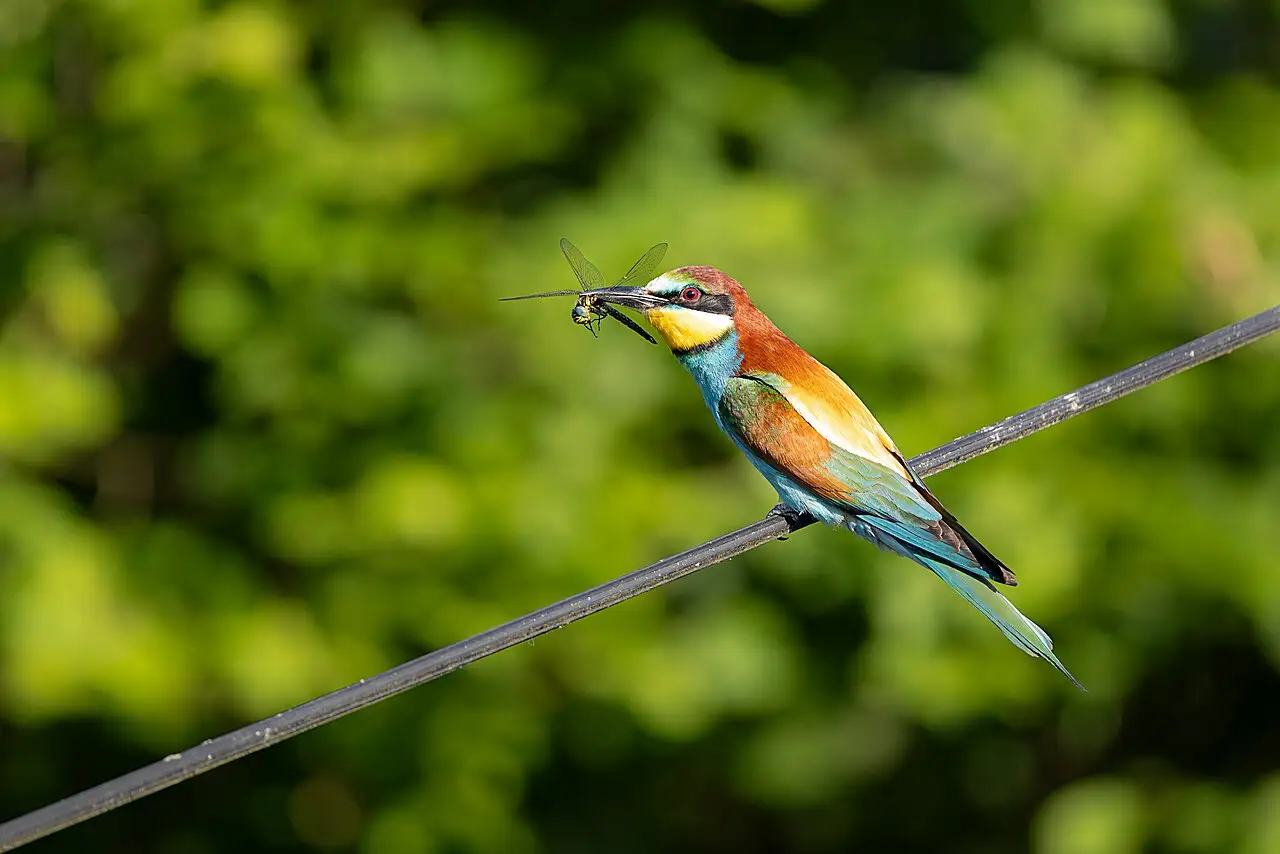
It keeps watch from the top of a branch or a wire. As soon as an insect passes, it launches itself with quick wingbeats and then glides with its wings straight.
It turns suddenly, opens its bill and catches it in the air. It manoeuvres with its pointed wings and the two needles of its tail.
It returns to the same perch, bangs the insect against the branch to remove the sting and swallows it.
Photo gallery of the European Bee-eater
Bee-eater perched on a wire with a dragonfly in its bill, its usual hunting posePhoto: Thomas Heins, CC BY 4.0Photo 1 of 4
Bee-eater with wings open: the cinnamon coverts and greenish flight feathers showPhoto: Giles Laurent, CC BY-SA 4.0Photo 2 of 4
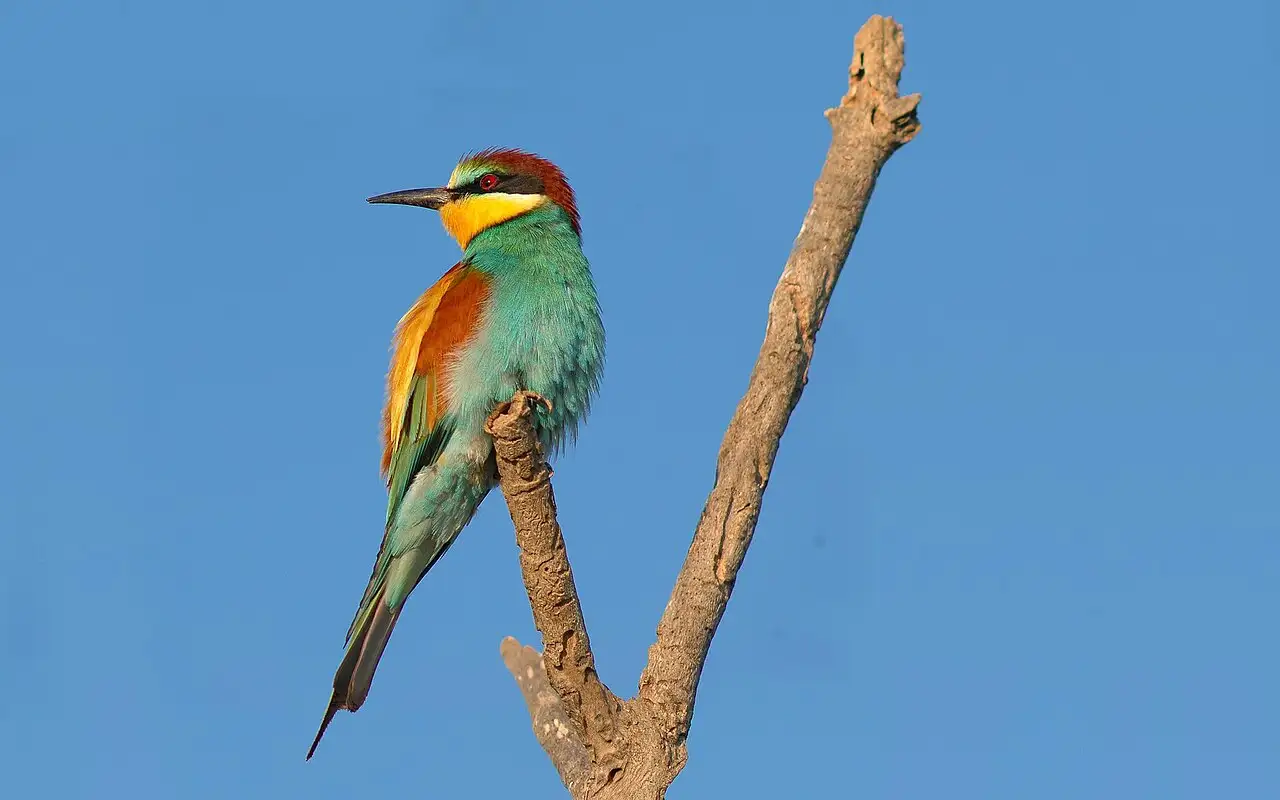
Bee-eater seen from behind and from the side on a dead branch, with chestnut nape and blue-green bellyPhoto: Trebol-a, CC BY 3.0Photo 4 of 4
1 / 4
Identification of the European Bee-eater
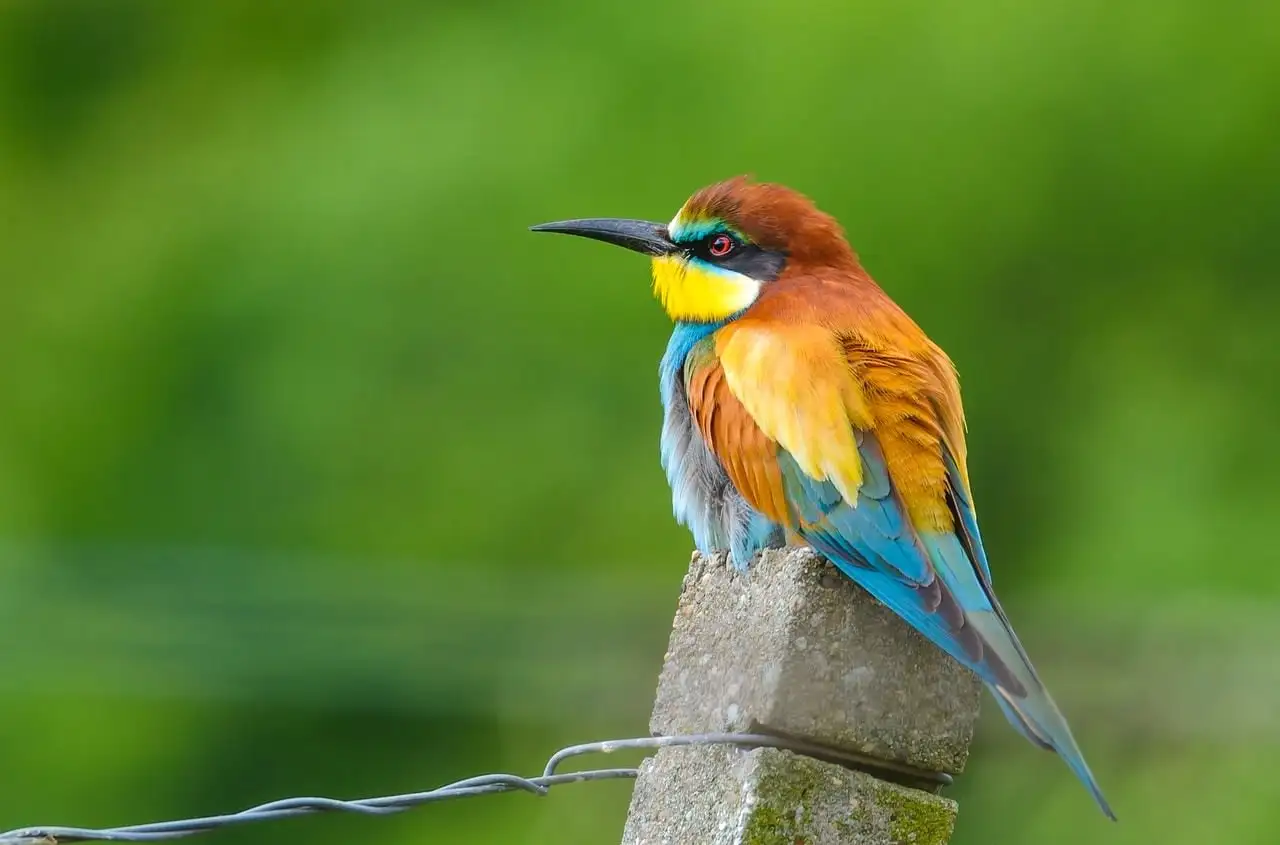
It is one of the most colourful birds in Europe.
Its body is blue-green up to the throat, which is yellow.
The crown is dark, and both the back and the wings show brown or reddish tones, greener in juveniles.
The shoulder area is golden.
Its tail is long, with the two central feathers very prominent and a central tip that sticks out.
Long, pointed bill.
Dark wings with a bronze patch.
We can identify it without seeing it by its calls.
It usually perches on wires, and sometimes while driving we can see it beside roads.
It can be seen feeding near its breeding colonies.
Habitat and distribution of the European Bee-eater
It breeds in southern and eastern Europe, and in northern and central France and the Alps in summer. It avoids high mountains and tends to settle in warm, open areas with trees or shrubs, such as farmland. It is a rare visitor further north in spring and summer. It spends the winter in tropical Africa and returns to the peninsula between March and April.
In Spain it breeds almost everywhere, with more presence in the south and west. It looks for banks, sandy cuttings and river edges to dig its colony, and open country with scattered trees, rockrose scrub or crops where it can hunt.
Areas where it is regularly recorded since 2010Squares of about 25 km where it is recorded regularly (occasional passage records are left out). Data from GBIF.org (259,970 records, retrieved October 2026); outline from Natural Earth.
Etymology of the European Bee-eater
The scientific name is one of the clearest among our birdlife. «Merops» is the Greek word «μέροψ», already used for the bee-eater in Antiquity; and «apiaster» comes from the Latin «apis», bee, with a suffix that indicates resemblance: something like «the one that looks like bees», or better, «the one of the bees». In Spanish the name is just as obvious: abejaruco, from abeja (bee) plus the suffix «-aruco». And bees are indeed its main course.
Population of the European Bee-eater
It is an abundant species, classed as Least Concern. In Spain it is estimated at around 2.6 million birds 1, but that figure is a sharp drop from the almost six million counted in 2004–2006, and the disappearance of large breeding colonies has been recorded, with very marked regional differences.
Nest of the European Bee-eater
They usually nest in colonies that last for decades. Pairs dig burrows in vertical sandy banks where they set up the nest. The tunnel can be 50 to 200 cm deep and digging it takes them ten to fourteen days, during which they remove up to ten kilos of earth and wear down as much as a third of the bill.
Courtship and breeding of the European Bee-eater
It breeds in colonies. In the first half of May the males come into breeding condition and start courting the female by treating her to insects. Laying begins in mid-May. A clutch of 4 to 7 eggs, and only one a year. Both parents incubate them and after about 20 days they hatch. At three weeks the young leave the hole to discover the outside world. A week later, they take flight.
Diet of the European Bee-eater
Its diet is based on bees and wasps, and it seems immune to their stings, although before swallowing its prey it pulls out the sting. It catches them in flight and beats them against the perch branch to squeeze out the venom. It also eats hornets, dragonflies and other flying insects.
Curious facts about the European Bee-eater
This African hunter wins females over through the palate. The bee-eater catches bees and wasps and then serves them –stingless– to its mate. And you, how long is it since you cooked dinner for your partner?
Like birds of prey, it also brings up the hard remains it cannot digest as pellets, such as beetle wing cases and insect legs.
The European Bee-eater in Cabañeros
It arrives in Cabañeros at the end of March. In mid-April the large pre-nuptial gatherings begin. Post-nuptial gatherings and the migration passage run from August to the end of September.
It usually breeds in small earthen cliffs along streams and in the ditches of roads and tracks. Also in holes dug in the ground.
Where to see the European Bee-eater in Cabañeros
It prefers holm oak woods and rockrose scrub in the foothills, where it can eat hymenopterans (bees, wasps and so on). We also find it on the raña hunting orthopterans such as grasshoppers or crickets, behaviour similar to that of the African savannas.
When
From the end of March to September. The best dates are April and May, with the pre-nuptial gatherings, and August and September, during the migration passage.
What time
Morning and mid-afternoon, when there are more insects in the air. You hear it long before you see it.
Where
On the earthen cliffs of streams, the ditches of tracks and paths, and in the holm oak woods and rockrose scrub of the foothills. Also on the raña, on wires and dead branches.
What to look for
A slender bird perched high on a branch or wire, which darts out to catch an insect in the air and returns to the same spot, with a call that never stops.
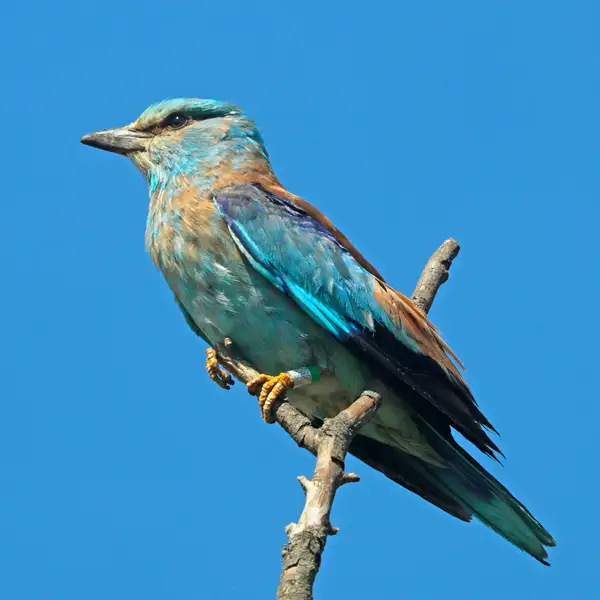
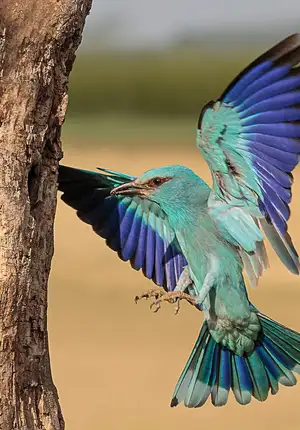
Much bigger and sturdier, turquoise blue with a cinnamon-brown back. Short, thick bill, and no yellow throat. It perches on wires and posts, like the bee-eater.







 Also in dehesas (wood pasture)
 Also in dehesas (wood pasture)
 Also in dehesas (wood pasture)
 Also in dehesas (wood pasture)
 Also in dehesas (wood pasture)
 Also in dehesas (wood pasture)
 Also in dehesas (wood pasture)
 Also in dehesas (wood pasture)






