In winter it forms large flocks, which gather at dusk on riverbanks and lagoons under the shelter of the reedbed
Lifespan
Record of 18 years and 4 months according to EURING (a bird ringed in Germany and shot); AnAge gives up to 17.7 years
Conservation status
LC
NT
VU
EN
CR
EW
EX
Global (IUCN)
Least Concern
Spain
Least Concern (LC) as a breeder in the Red Book of the Birds of Spain; it is on neither the List of Wild Species under Special Protection nor the Spanish Catalogue of Threatened Species
When to see it
Winter visitor
Months of the year when it is present
J
F
M
A
M
J
J
A
S
O
N
D
In Iberia
yes
yes
yes
yes
yes
yes
yes
yes
yes
yes
yes
yes
Breeding season
no
no
yes
yes
yes
yes
yes
yes
no
no
no
no
Song or voice of the Song Thrush
It often gives as a call a thin sound, like a high, soft «zit». The alarm call is a nervous, strident «chuc-chu-chu-chuc», while the song, melodious, includes repetitive sequences of two different, warbling, flute-like notes.
SongSong Thrush
0:00 / 0:17
10 kHz5
The sonogram draws the sound: time runs from left to right, and the higher a trace sits, the higher the note.Recording by Jonn Leffmann, Wikimedia Commons («Taltrast», Suecia) (CC BY 3.0).
Flight of the Song Thrush
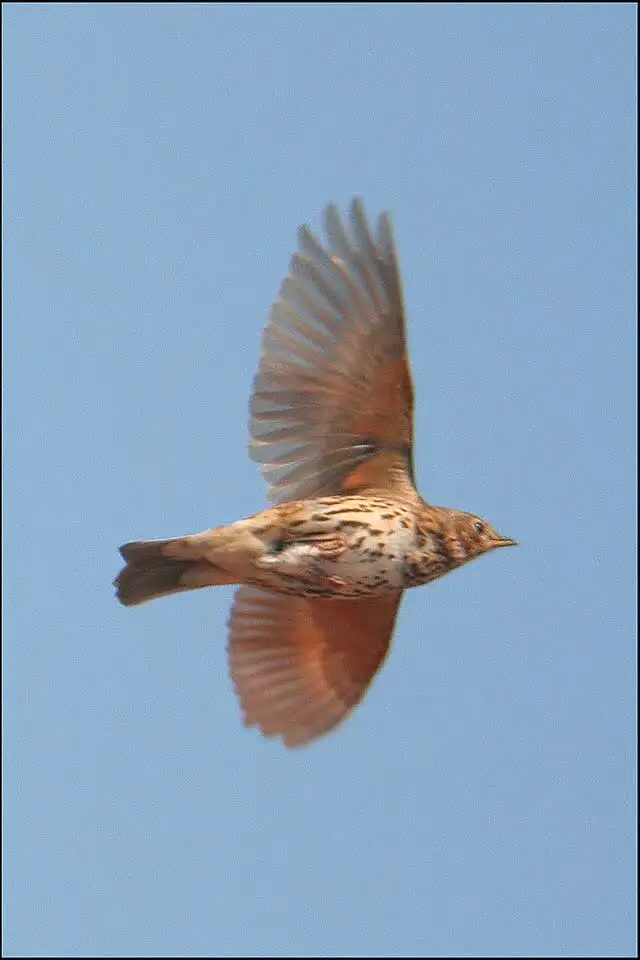
Its flight, fast and a little jerky, shows the characteristic rusty colouring of the axillary region, which makes it easy to tell from other thrushes.
Flight typeFast and a little jerky, with the rusty axillaries in view
It usually moves on the ground, and perches at the top of shrubs and trees to sing.
Its flight, fast and a little jerky, shows the characteristic rusty colouring of the axillary region, which makes it easy to tell from other thrushes.
It shows a fondness for snails, whose shells it breaks on a stone or a branch; in autumn and winter it also eats fruit, berries and seeds.
Photo gallery of the Song Thrush
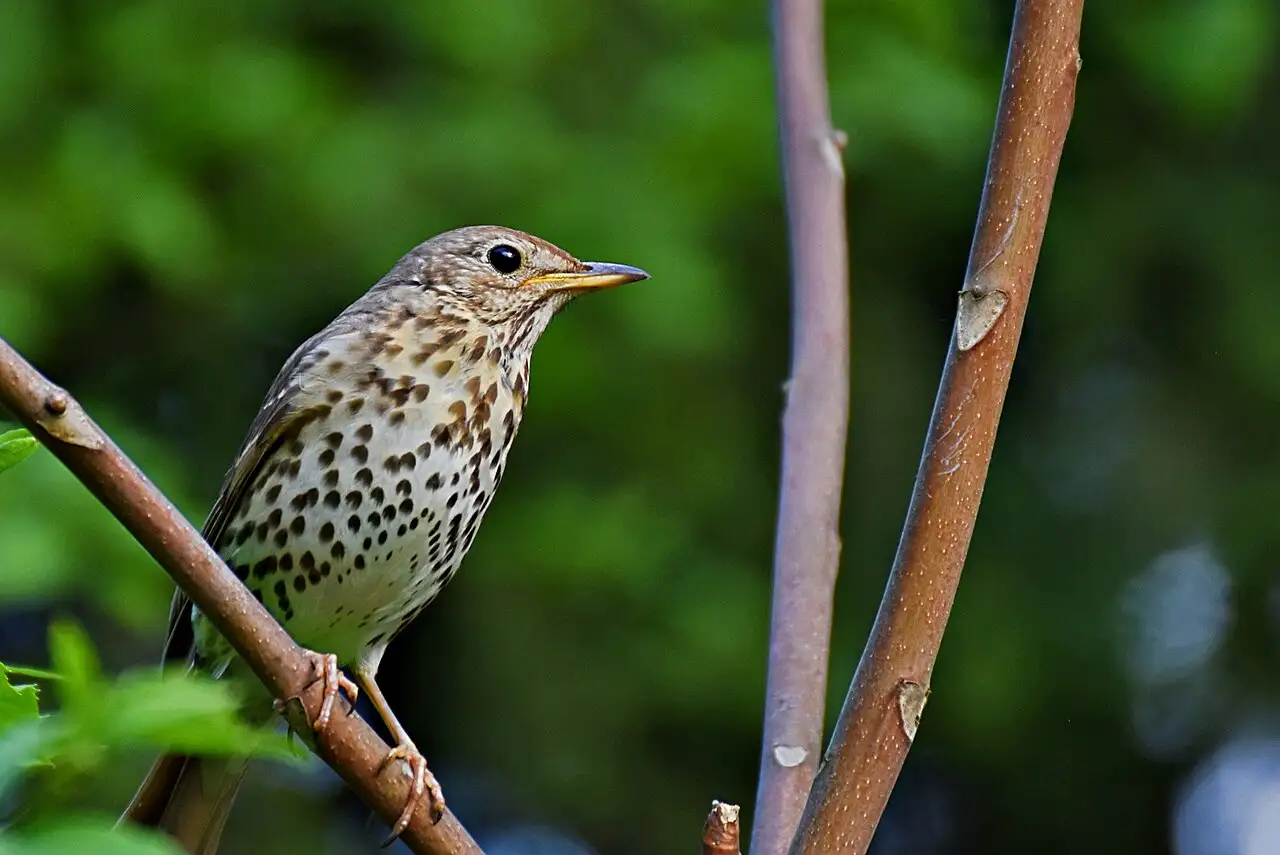
Song Thrush perched on a thin branch, in profile, with whitish breast covered in dark spots and warm brown backPhoto: Simon Chinnery, CC BY-SA 4.0Photo 1 of 4
Song Thrush in flight seen from the side, with open wings and the rusty axillary region against the blue skyPhoto: Mark Kilner, CC BY-SA 2.0Photo 2 of 4
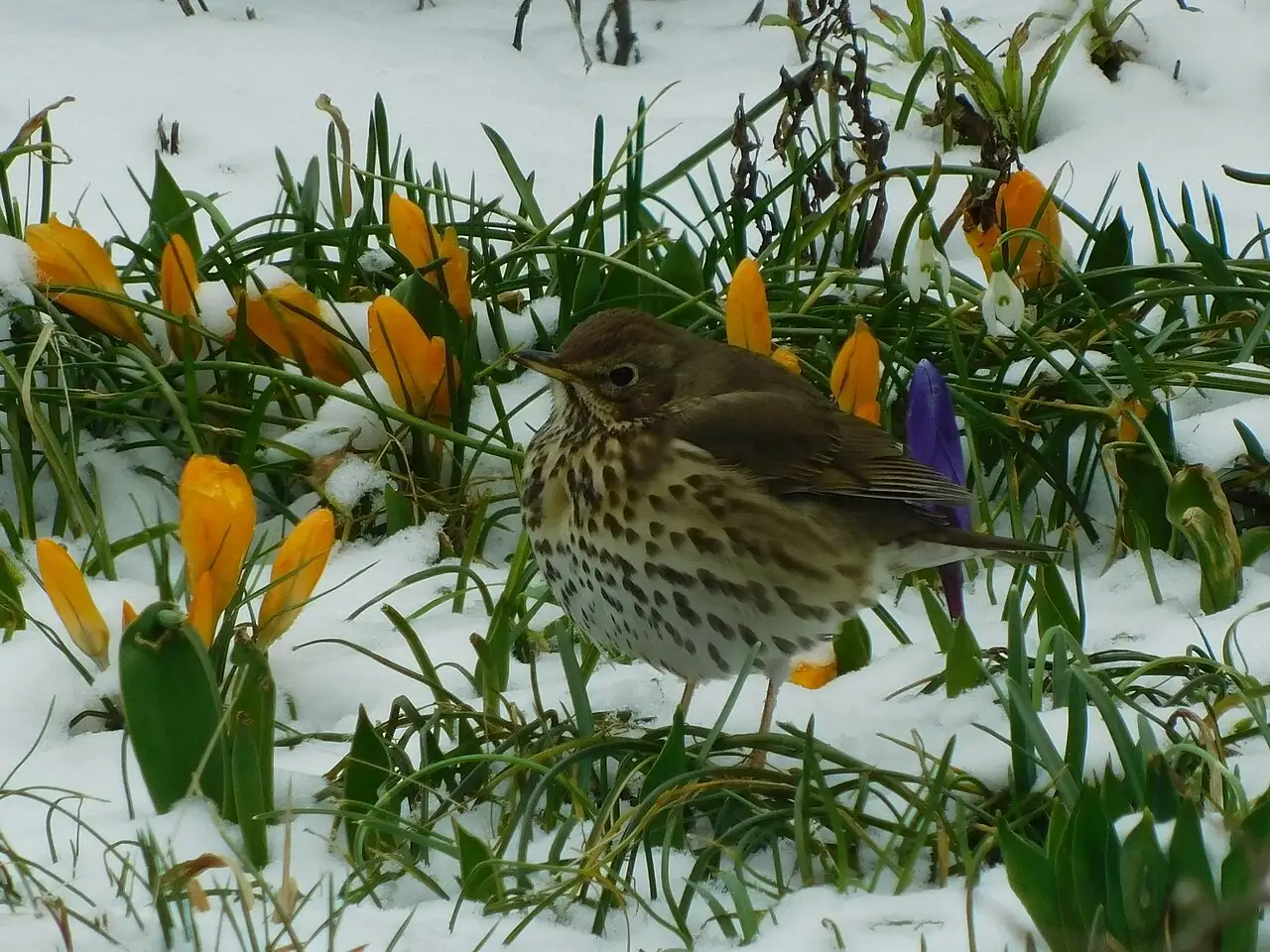
Song Thrush among yellow crocuses and snow, with spotted breast and brown backPhoto: AK-Bino, CC BY-SA 4.0Photo 3 of 4
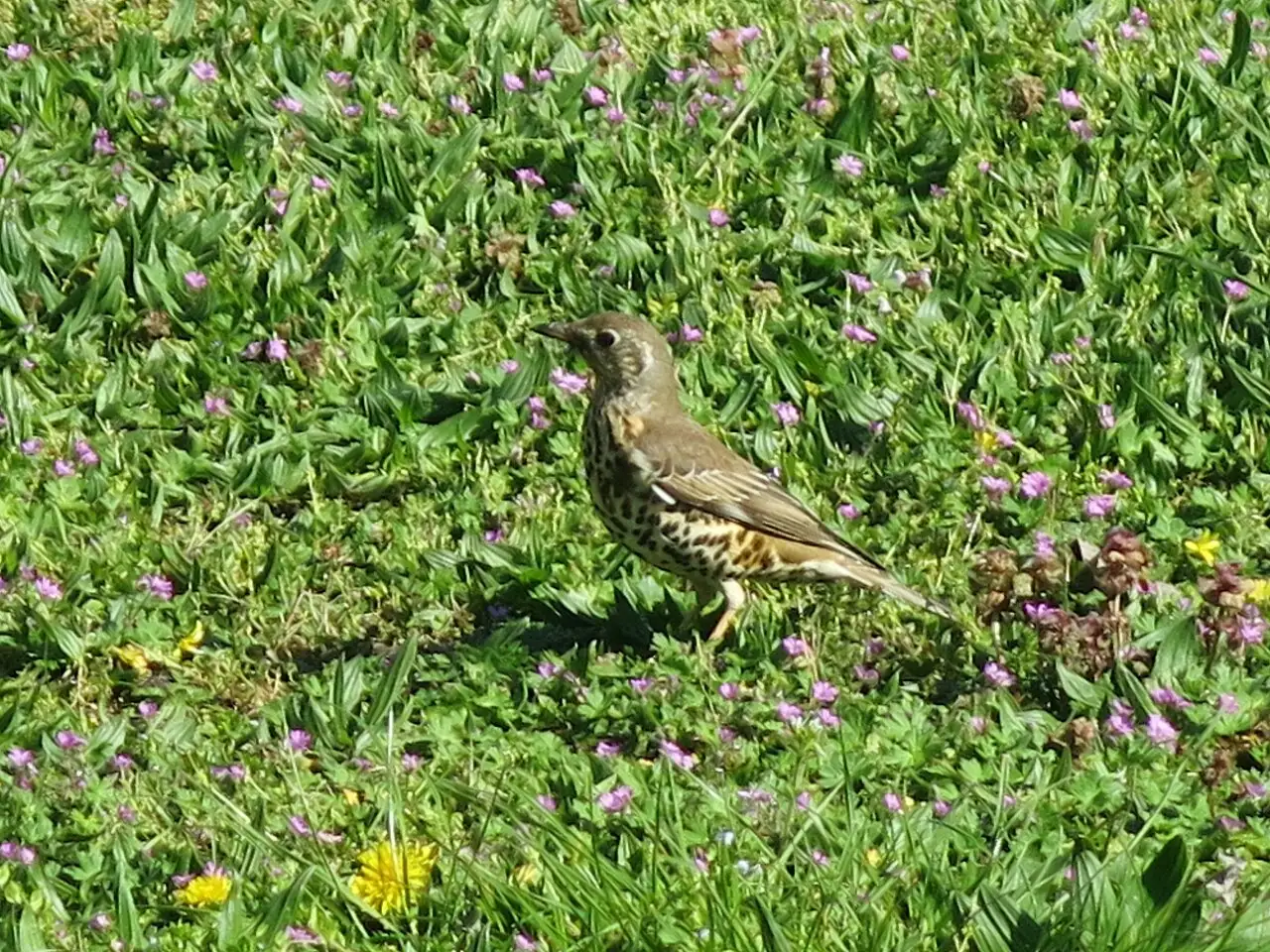
Song Thrush walking on the grass, with spotted breast and upright headPhoto: Tangopaso, Public domainPhoto 4 of 4
1 / 4
Identification of the Song Thrush
The Song Thrush is a medium-sized bird, with the upperparts a somewhat warmer brown than the Mistle Thrush’s. The underparts are pale, whitish on the belly and yellowish ochre on the breast, and are profusely studded with wedge-shaped spots that, on the neck, line up to form a fine moustachial stripe. It usually moves on the ground, although it perches at the top of shrubs and trees to sing. In flight it shows the characteristic rusty colouring of its axillary region, which makes it easy to tell from other thrushes.
Adult
Back a warmer brown than the Mistle Thrush’s.
Yellowish-ochre breast and whitish belly, with wedge-shaped spots.
Rusty-coloured axillary region.
Habitat and distribution of the Song Thrush
It spreads across much of Europe and the northern half of Asia, from which it is absent only in some alpine or very cold regions. Further south it becomes rarer and less evenly distributed in the breeding season, and in winter it becomes a fairly common bird in the warmest regions of the continent. Of the several subspecies, «philomelos» is the best spread across Europe, including the Iberian Peninsula.
The Spanish breeding populations settle preferably in places with a mild, damp climate: they are distributed fairly evenly across the whole northern third, more sparsely across the main ranges of the centre and are very rare in the south. The wintering ones, by contrast, spread across the whole Peninsula and concentrate above all in the south and east. It is absent as a breeder from the Canaries, the Balearics, Ceuta and Melilla, but occupies those areas in winter.
During breeding it occupies dense woodland, above all of conifers or deciduous trees, with abundant undergrowth, from sea level to 1,500 metres. In winter it is less selective and frequents much more open forest areas, shrub formations and crop fields. In the northern third of Spain high concentrations are found in woods with plenty of holly, while in the rest of the country they can be very numerous in olive groves; large flocks are also recorded in mastic thickets, juniper woods and juniper scrub.
The populations of eastern and northern Europe are partly or wholly migratory, and Spain hosts a good number of winter visitors that begin to arrive in September from numerous European countries, according to scientific ringing: Sweden, Norway, Finland, Belgium, Czechia, Poland, the United Kingdom or Ireland, among others. The Iberian breeding populations are sedentary or make short movements in the unfavourable season. A good part of those that appear in autumn continue to North Africa: they cross the Mediterranean between September and November and return to Europe in February, March and April.
Areas where it is regularly recorded since 2010Squares of about 25 km where it is recorded regularly (occasional passage records are left out). Data from GBIF.org (319,017 records, retrieved October 2026); outline from Natural Earth.
Etymology of the Song Thrush
According to Wikipedia, «Turdus» is the Latin word for «thrush», and the epithet «philomelos» alludes to Philomela, a figure of Greek mythology whose tongue was cut out and who was turned into a songbird; her name comes from the Ancient Greek «phílos» («lover») and «mélos» («song»). In other languages it is called «tord comú» in Catalan, «tordo común» in Galician, «birigarro arrunta» in Basque and «song thrush» in English1.
Population of the Song Thrush
In the 2021 European Red List of Birds the European breeding population is estimated at between 47,300,000 and 77,900,000 mature individuals, with a stable trend. A population of 870,000 birds is calculated for Spain, up to 90% of it concentrated in the northern third, with a clearly positive trend in recent years, above all in Mediterranean and mountain areas. It has suffered heavy hunting pressure in the past, both for the table and for export in tins, as well as egg collecting; today hunting is much less common and it no longer suffers the capture methods (birdlime, parany, rib traps) that are now illegal. The most affected are the winter visitors that come in large numbers in the hunting season. Being adaptable, undemanding, omnivorous and prolific, and nesting successfully even in parks and gardens, it has recovered well.
Nest of the Song Thrush
The nest is built by the female, who usually places it in the fork of a tree or shrub, on a rocky ledge sheltered by vegetation or even on the ground. She uses roots, grasses and twigs, which she weaves into a firm, compact cup, reinforced with mud and lined inside with softer materials.
Courtship and breeding of the Song Thrush
The breeding period is long: it may begin at the end of February or early March and end, in the latest pairs, at the end of August or early September, although it usually starts in April. The clutch consists of three to five pale blue, heavily speckled eggs, generally incubated by the female for 10–17 days. The chicks hatch in May or June and are fed by both parents for 11–17 days; afterwards they depend on the parents a few more days until they feed themselves. Pairs commonly lay two or three clutches, and exceptionally even four.
Diet of the Song Thrush
It eats a great variety of invertebrates, but shows a special fondness for snails, whose shells it breaks on a stone or a branch. In autumn and winter its diet becomes more vegetarian and includes fruits, berries and seeds of all kinds, wild and cultivated. On the Peninsula it prefers the fruits of hollies, olives, junipers, savins and mastic trees.
Curious facts about the Song Thrush
One of the most characteristic images of the Mediterranean winter is the large flocks of Song Thrushes bustling about olive groves or riverside groves and gathering at dusk on riverbanks and lagoons under the shelter of the reedbed1. EURING lists a bird ringed in Germany and shot that lived 18 years and 4 months.
The Song Thrush in Cabañeros
The habitat pages of this website do not mention it. GBIF.org records 70 observations of the Song Thrush in Cabañeros and its surroundings.
Where to see the Song Thrush in Cabañeros
In Cabañeros and its surroundings, above all in winter, among olive groves, riverside groves and scrub.
When
In autumn and winter: winter visitors begin to arrive in September.
What time
In good light and at dusk, when they gather on riverbanks and lagoons.
Where
In olive groves, riverside groves, mastic thickets, juniper woods and juniper scrub; on the ground, and on top of trees and shrubs to sing.
What to look for
Look for the spotted breast with wedge-shaped spots and, in flight, the rusty axillaries.



 Same family
 Same family
 Same family
 Also in sclerophyllous woodland
 Also in sclerophyllous woodland
 Also in sclerophyllous woodland
 Also in sclerophyllous woodland
 Also in sclerophyllous woodland






