Sedentary and restless; it can make two clutches a year and, on some occasions, up to three
Lifespan
Record of 6 years and 3 months in the wild (a bird ringed in Spain)
Conservation status
LC
NT
VU
EN
CR
EW
EX
Global (IUCN)
Least Concern
Spain
Endangered (EN) in the 2021 Red Book of the Birds of Spain; on the List of Wild Species under Special Protection
When to see it
Resident
Months of the year when it is present
J
F
M
A
M
J
J
A
S
O
N
D
In Iberia
yes
yes
yes
yes
yes
yes
yes
yes
yes
yes
yes
yes
Breeding season
no
no
no
yes
yes
yes
yes
no
no
no
no
no
Song or voice of the Dartford Warbler
Very similar to that of other warblers, it consists of a quick combination of musical phrases with harsher, grating ones, which it gives both perched on a bush and in flight. The call is a distinctive «tchieer-tchieer», repeated insistently.
SongDartford Warbler
0:00 / 0:24
10 kHz5
The sonogram draws the sound: time runs from left to right, and the higher a trace sits, the higher the note.Recording by AviCanto, Wikimedia Commons (Vídeo de YouTube, con atribución).
Flight of the Dartford Warbler
It is a very restless bird that moves among shrubs and scrub in short, low flights, which it makes while often flicking its tail. It usually holds its long tail raised.
Flight typeShort, low flights between bushes, flicking the tail
It leaves the rockrose or heather cautiously and discreetly, with a dry, harsh call, «tchieer-tchieer».
Short, low flight from bush to bush, flicking the tail, which it usually holds raised.
It slips into another thicket, where it moves restlessly among the branches and, sometimes, sings perched or in flight.
Photo gallery of the Dartford Warbler
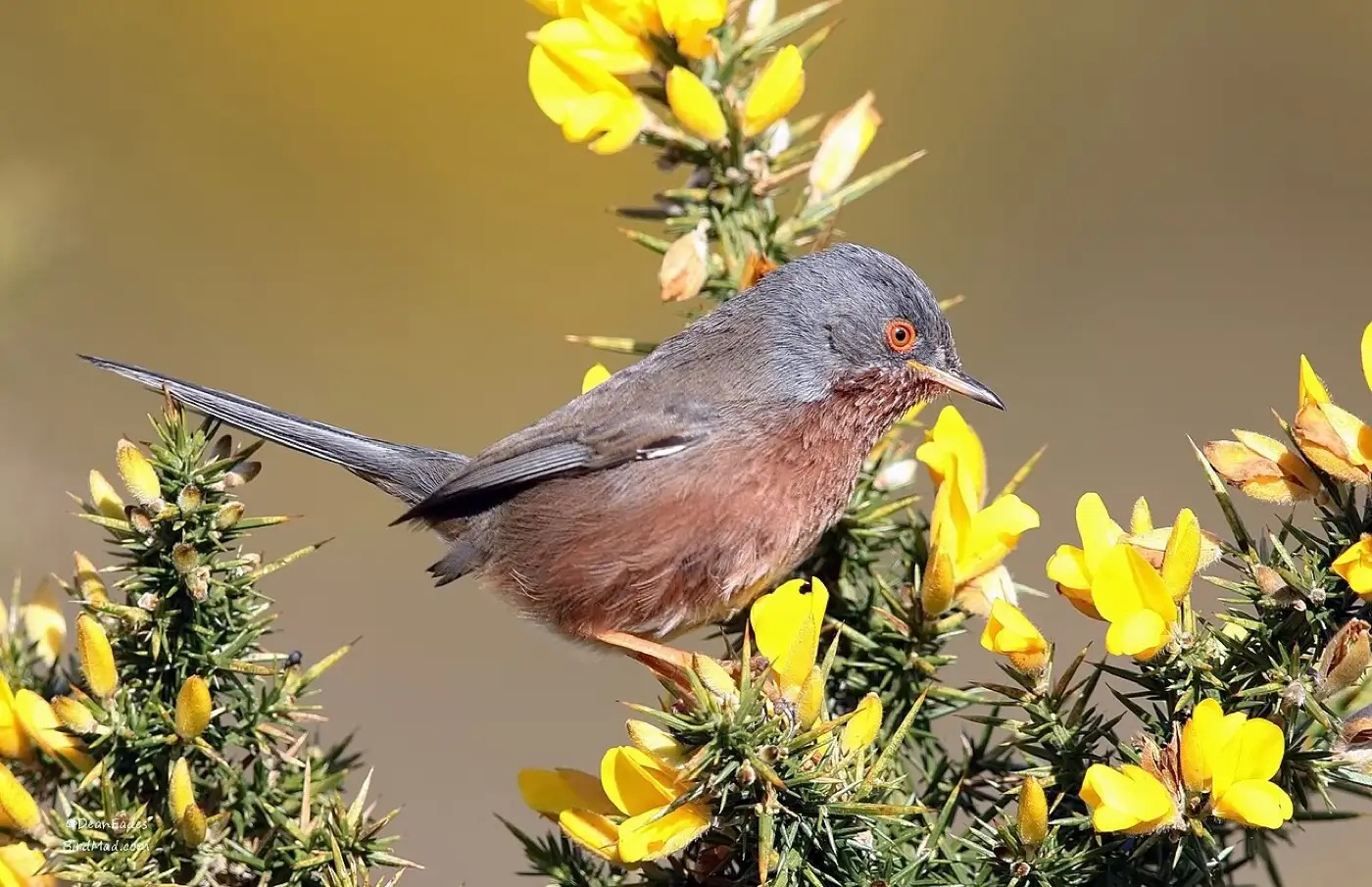
Male Dartford Warbler on a flowering gorse, with long tail raised and wine-coloured breastPhoto: Dean Eades BirdMad, CC BY-SA 4.0Photo 1 of 4
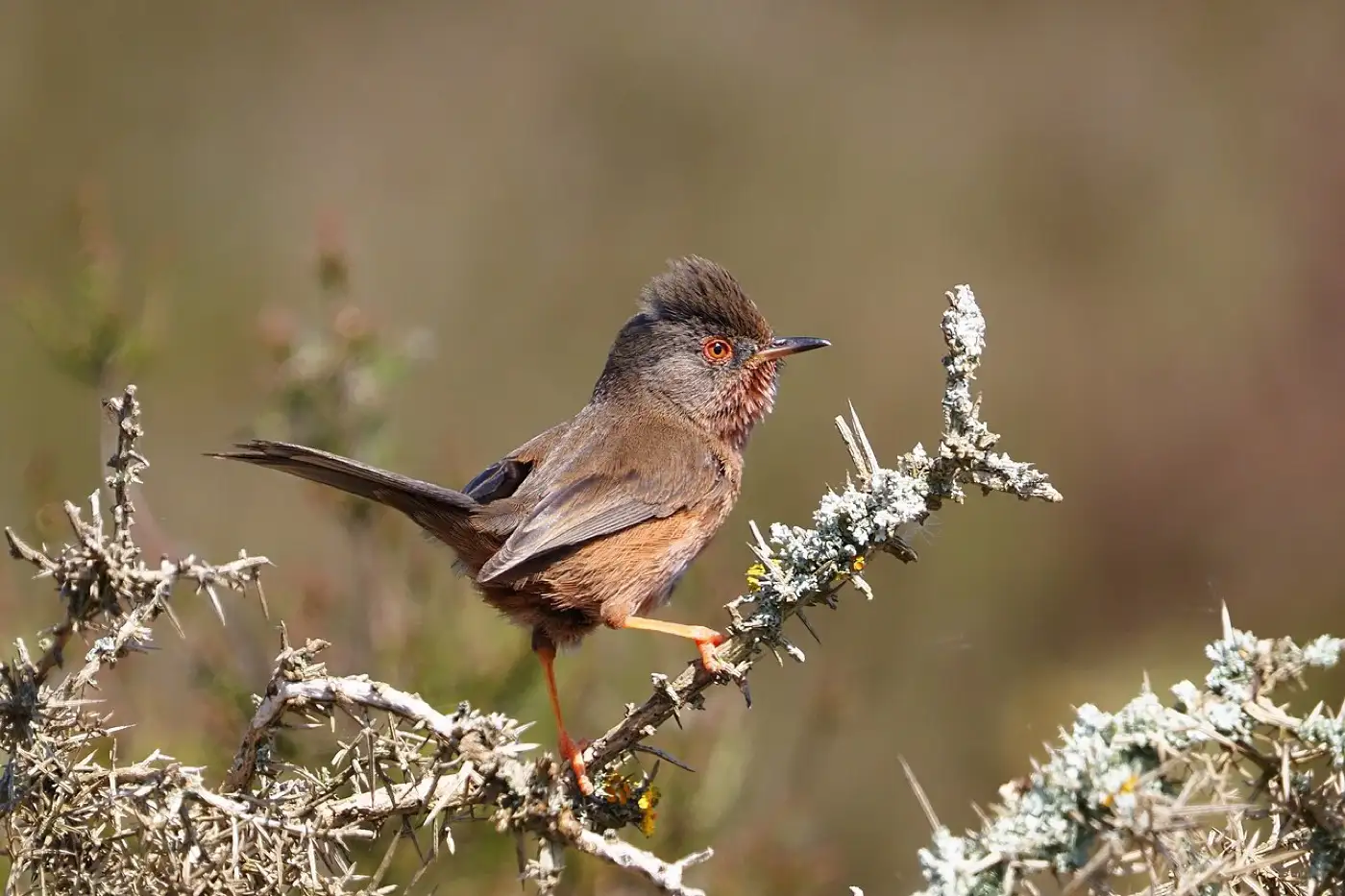
Female Dartford Warbler, browner, on a thorny branch covered in lichensPhoto: Vcebollada, CC BY-SA 4.0Photo 2 of 4
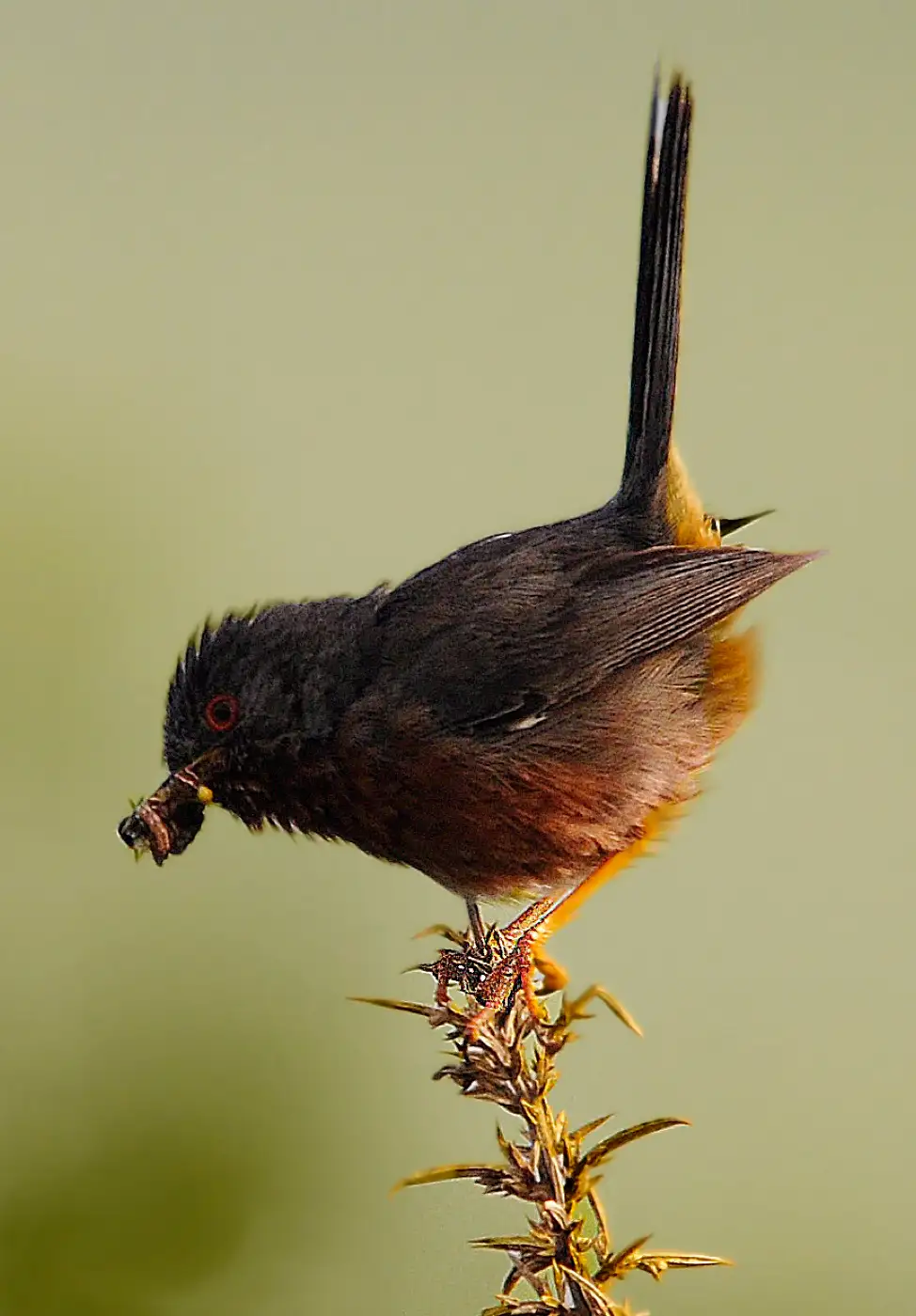
Dartford Warbler with slate-grey back on a thorny shrub, with reddish eye-ringPhoto: Jose Ramón, CC BY 3.0Photo 4 of 4
1 / 4
Identification of the Dartford Warbler
The Dartford Warbler, dark overall and long-tailed (which it usually holds raised), is one of the smallest warblers. It has a slaty-grey back and wine-coloured underparts, with white flecks on the throat. Other identifying features are the reddish eye-ring and the orange legs.
Females are browner on the back and less intense in colour overall. Young birds show more subdued tones and a brownish breast.
Male
Slaty-grey back and wine-coloured underparts, with white flecks on the throat.
Reddish eye-ring, orange legs and long tail.
Female and young bird
Female browner on the back and less intense in colour.
Young bird in subdued tones, with a brownish breast.
Habitat and distribution of the Dartford Warbler
On a world scale, its distribution is confined to the western Palearctic. It is present in south-west Europe (the Iberian Peninsula, western France, Italy and southern United Kingdom) and in north-west Africa (Morocco, Algeria and Tunisia). Several subspecies are recognised. It is now named «Curruca undata», because the genus Sylvia has been split1.
In Spain it is widely distributed across the whole Peninsula, Ceuta and the Balearics (north of Mallorca, Formentera and Menorca), an archipelago where its expansion has been detected in recent decades. It is absent from the Canaries, Melilla and wide inland areas of the Peninsula (the Guadalquivir valley, the northern and southern sub-plateaus, the Ebro depression and the dehesa and steppe areas of Extremadura and dry-farmed La Mancha), as well as from the Pyrenean summits. Three subspecies occur in Spain: «undata», in the north-east and the Balearics; «dartfordiensis», in the north-west; and «toni», in the centre and south of the Peninsula.
It occupies mainly areas of scrub and open woodland. The largest numbers of birds are found in Mediterranean scrub formations with rockroses, strawberry trees, mock privets and the like, and, to a lesser extent, in mountain scrub (heaths, broom). It is distributed from sea level to 2,000 metres altitude (in the Central System).
It is a sedentary species, although it makes dispersive movements both in altitude and in latitude. It makes winter movements of some scale towards the warmer sectors of the centre and south of the Peninsula, the Balearics and North Africa; some birds, above all young ones and some of the adults, tend to leave the more northerly latitudes. These movements are detected in autumn (between September and November) and in spring (between February and April).
Areas where it is regularly recorded since 2010Squares of about 25 km where it is recorded regularly (occasional passage records are left out). Data from GBIF.org (47,891 records, retrieved October 2026); outline from Natural Earth.
Etymology of the Dartford Warbler
«Undata» comes from medieval Latin «undatus», «with wavy markings». The Spanish name, on the other hand, speaks of its long tail: «rabilarga». The English «Dartford warbler» recalls Dartford, in Kent (England), near where the specimens it was described from in 1776 were obtained.
Population of the Dartford Warbler
The 2021 European Red List of Birds estimates a European population of some 1.75 million birds. However, according to studies by each autonomous community, the III Atlas of Breeding Birds in Spain estimates a national breeding population of some 2.84 million individuals. The communities with the largest presence are Castilla y León, which holds 21 %, Castilla-La Mancha, with 15 %, and Andalusia, with 13 %; Aragon, Extremadura and Catalonia hold another 25 %. According to the SACRE programme, the breeding population has suffered a fall of roughly 60 % in Spain between 1998 and 2018, and the SACIN programme notes a 40 % fall in the wintering population between 2008 and 2018. There are two main threats: habitat fragmentation and loss, through clearance and herbicides, urban development, increasingly frequent fires and reforestation with non-native species, and climate change, which brings rises in temperature and changes in rainfall that affect the insects it feeds on.
Nest of the Dartford Warbler
The nest is built by both parents in dense vegetation, hidden in the foliage. It is a small cup of grasses and fine branches lined with feathers.
Courtship and breeding of the Dartford Warbler
The breeding season runs from late April to July. The clutch consists of three to six whitish, grey or greenish eggs, with variable speckling, which both adults incubate for 12–14 days. The chicks, fed by both parents, make their first flights at 12–14 days and become independent 10 to 15 days after leaving the nest. It can make two clutches a year and, on some occasions, even three.
Diet of the Dartford Warbler
It feeds almost exclusively on invertebrates: larvae and adults of dragonflies, grasshoppers, Lepidoptera, flies, beetles or arachnids. Occasionally it may eat small fruits and seeds, above all in autumn and winter.
Curious facts about the Dartford Warbler
It is one of the smallest of the warblers, and often makes itself noticed more by its hurried song or its dry, harsh call than by its looks. Its decline is very steep: in Spain the Red Book of the Birds now classifies it as «Endangered».
The Dartford Warbler in Cabañeros
This website’s page on scrublands cites it as one of the three species of warblers that make up 80 % of the scrub bird community of Cabañeros, together with the Western Subalpine Warbler and the Sardinian Warbler.
Where to see the Dartford Warbler in Cabañeros
In the scrublands of Cabañeros, among rockroses, heaths and strawberry trees.
When
All year round: it is sedentary, although it makes winter movements.
What time
Throughout the day; it is heard before it is seen.
Where
In Mediterranean scrub of rockroses, strawberry trees and mock privets, and in mountain heaths and broom.
What to look for
A dark little bird with a long, raised tail, which darts low between the bushes.
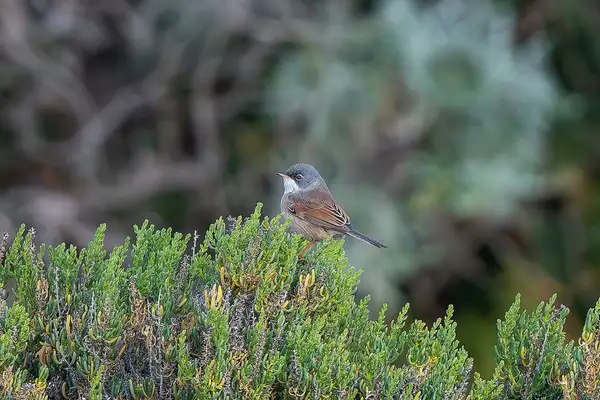
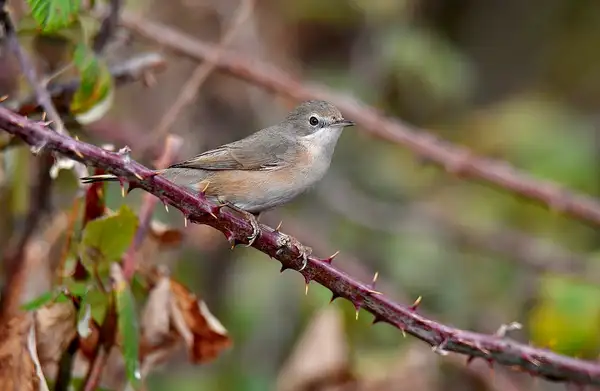
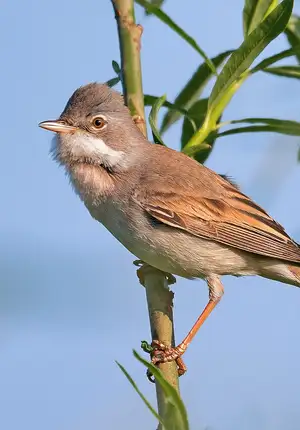
They are similar in song1. It is a small version of the Common Whitethroat, with redder, shorter wings and a contrasting grey head, with white throat and eye-ring.
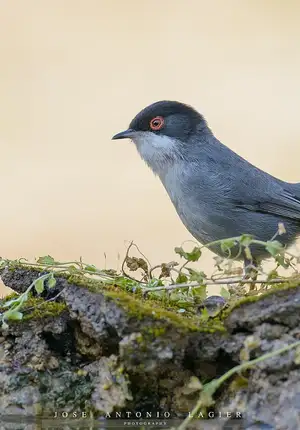
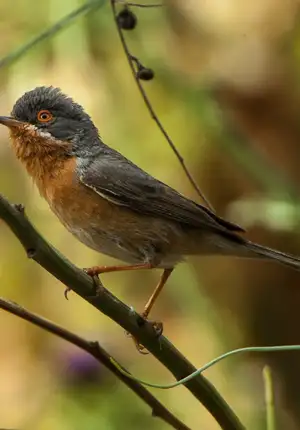
It is like it in appearance and in song. The male has slate-grey upperparts, with white moustache and rufous underparts, and white outer tail feathers. Both have a red eye-ring.
Photo: Luiz Lapa from Oeiras, Portugal, CC BY 2.0
Other birds
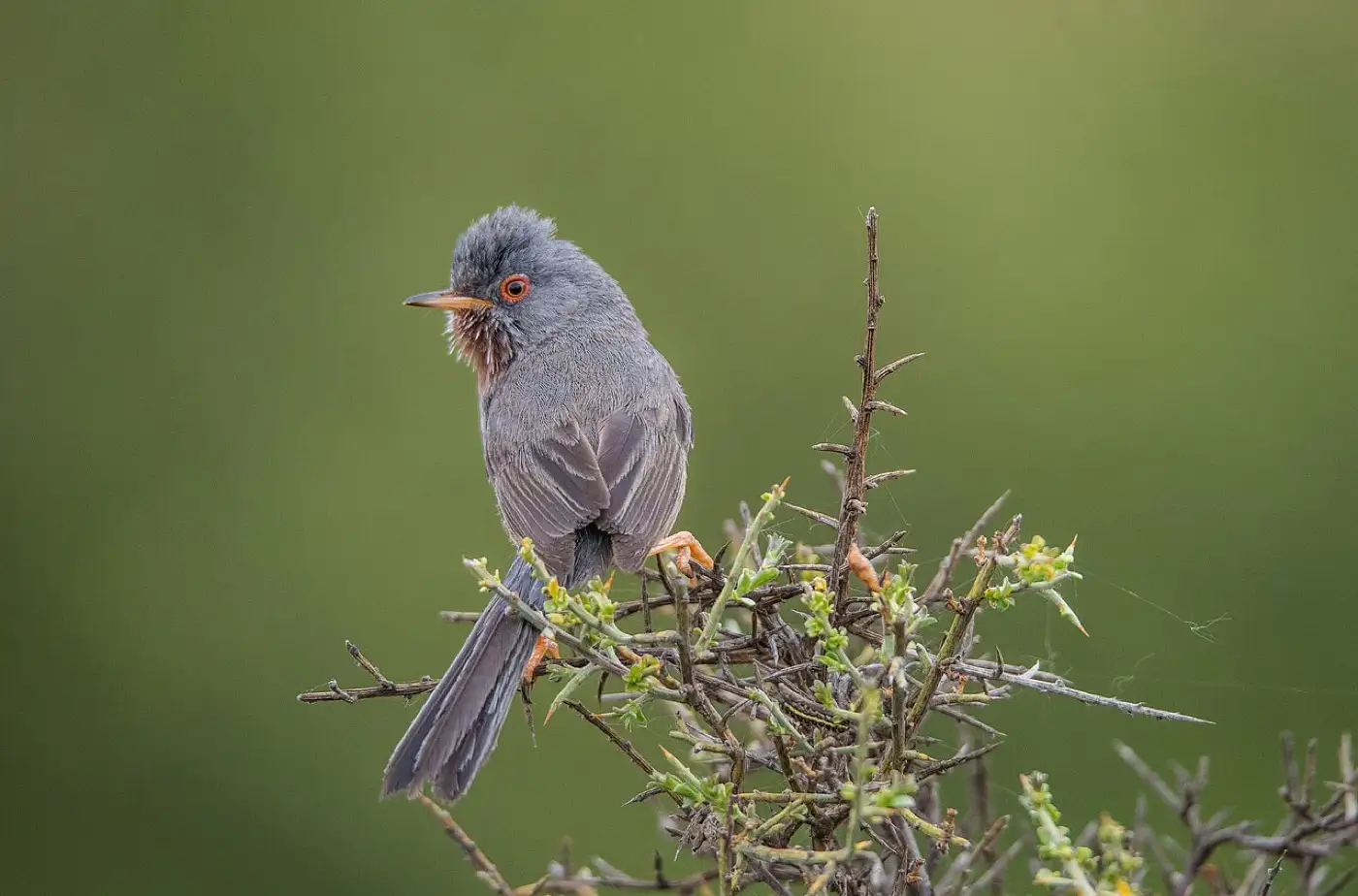
Birds related to the Dartford Warbler or sharing its habitats in Cabañeros.



 Same family
 Same family
 Same family
 Same family
 Also in scrubland
 Also in scrubland
 Also in scrubland
 Also in scrubland






