Wingspan compared with a person with arms outstretched.
Length
31–39 cm
Wingspan
55–55 cm
Weight
210–400 g
Social life
Gregarious by habit, more marked outside the breeding season; usually seen in groups, generally larger than in the Black-bellied Sandgrouse
Lifespan
At least 10 years
Conservation status
LC
NT
VU
EN
CR
EW
EX
Global (IUCN)
Least Concern
Spain
Vulnerable (VU) in the 2021 Red Book of the Birds of Spain and in the National Catalogue of Threatened Species
When to see it
Resident
Months of the year when it is present
J
F
M
A
M
J
J
A
S
O
N
D
In Iberia
yes
yes
yes
yes
yes
yes
yes
yes
yes
yes
yes
yes
Breeding season
no
no
no
yes
yes
yes
yes
yes
no
no
no
no
Song or voice of the Pin-tailed Sandgrouse
Its voice is very distinctive: a harsh croak, «kataa…, kata…» and «gaaa…, gaaa…», which may recall the Western Jackdaw’s call1. The recording (flight call, with the noise of the wings) is by Esperanza Poveda and was made at La Serena (near Helechal), Badajoz, Extremadura (xeno-canto XC1153984, quality A). It lasts 9 seconds and is a trimmed section of the original, without repeating or lengthening, from which we have removed the bass below 300 Hz, reduced the background noise and adjusted the volume; neither pitch nor speed has been changed.
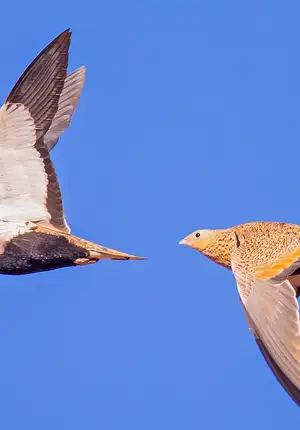
Its flight is powerful and fast, and shows the pointed wings, white and black underneath. Although in Spain it is usually counted among the resident birds, it is likely that it makes large, little-known movements within the Peninsula: winter increases in population have been described on the southern plateau and in Doñana1.
Flight typePowerful and fast, with pointed wings
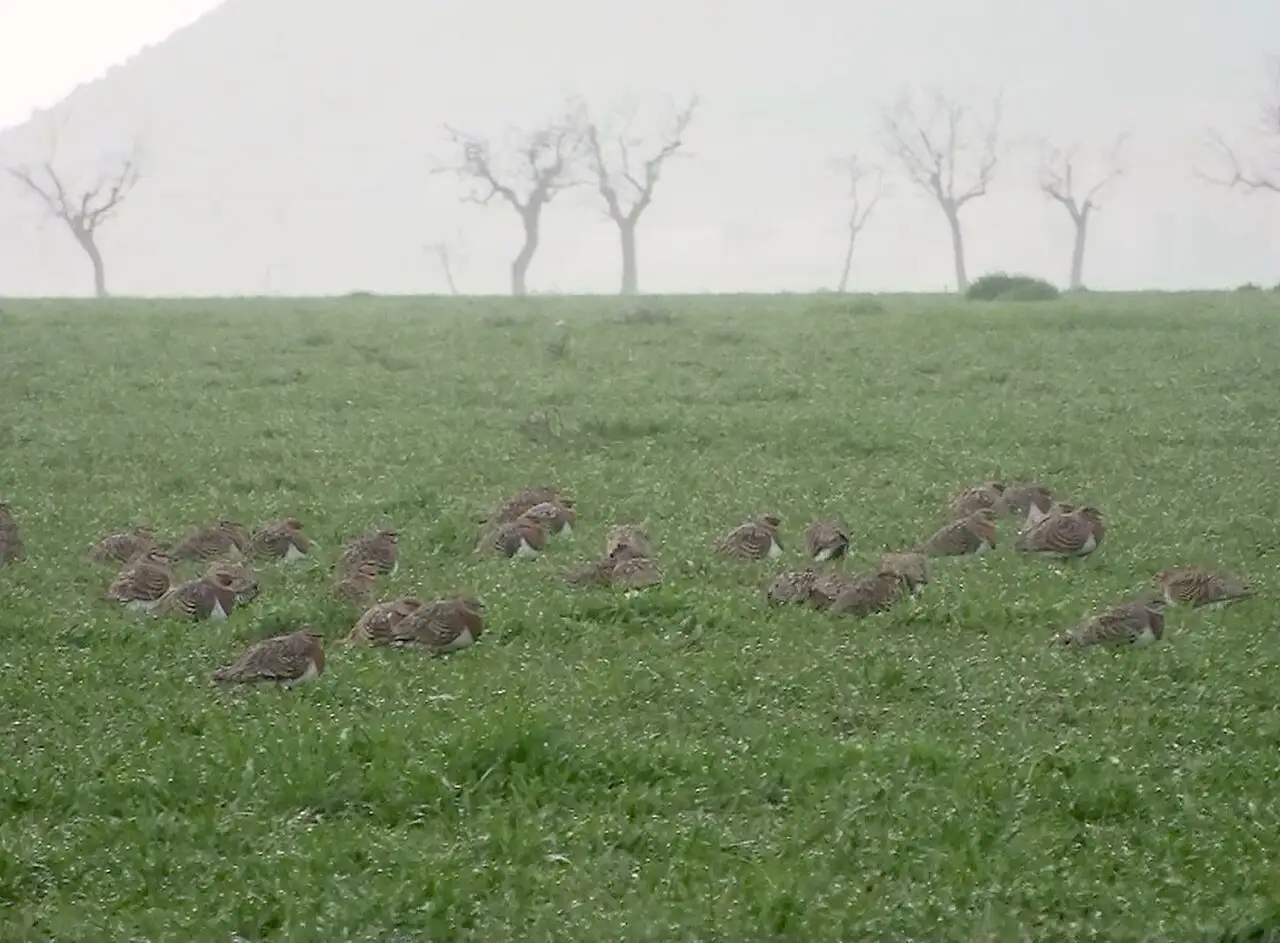
It is gregarious by habit, more marked outside the breeding season, and is usually seen in groups, generally larger than in the Black-bellied Sandgrouse.
Its flight is powerful and fast, and shows the pointed wings, white and black underneath.
Its voice is a harsh croak, «kataa…, kata…» and «gaaa…, gaaa…», which may recall the Western Jackdaw's call.
Photo gallery of the Pin-tailed Sandgrouse
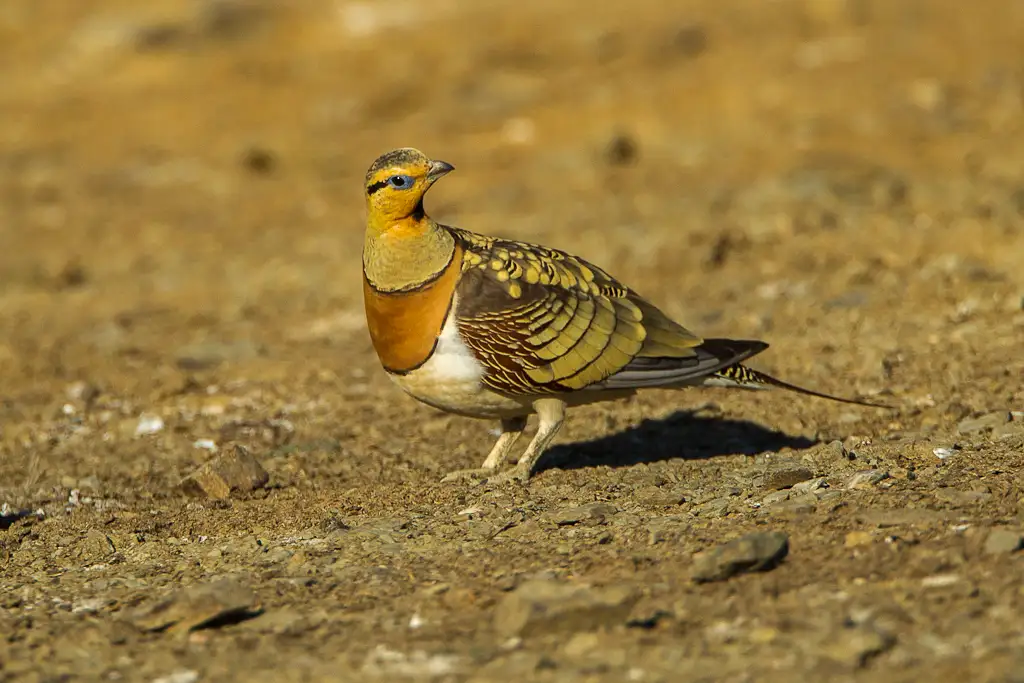
Male Pin-tailed Sandgrouse in profile on stony ground, with orange face, black throat, chestnut-red breast and long, pointed tailPhoto: Francesco Veronesi from Italy, CC BY-SA 2.0Photo 1 of 4
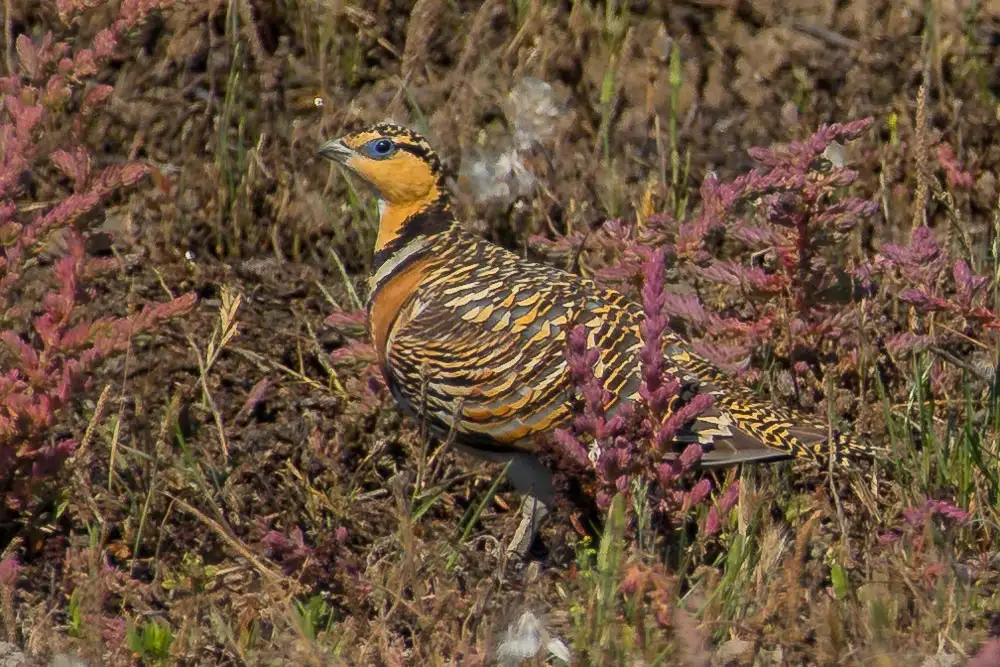
Female Pin-tailed Sandgrouse among reddish bushes, with orange throat and the black bands on the neck and breastPhoto: Pterocles, CC BY-SA 4.0Photo 3 of 4
Flock of Pin-tailed Sandgrouse perched in a green crop, with leafless almond trees in the background, on a foggy morningPhoto: BirdingInSpain, CC BY-SA 3.0Photo 4 of 4
1 / 4
Identification of the Pin-tailed Sandgrouse
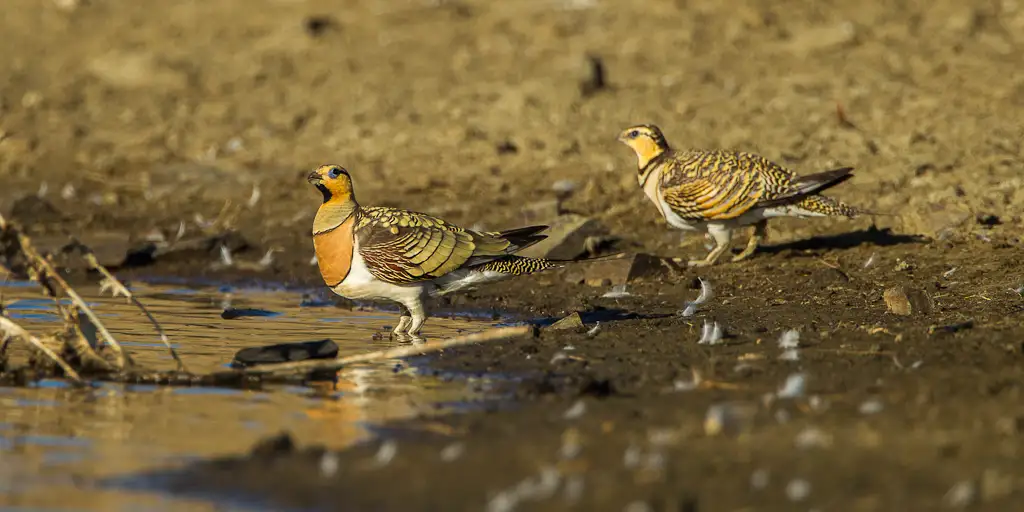
The Pin-tailed Sandgrouse is a ground-living bird, compact, stocky and of camouflage colours. The male shows a contrasting head, with orange face, dark eye ringed in blue and black eye-stripe and throat. He has the neck and nape a greenish orange and the chestnut-red breast, framed by two black bands, of which the lower marks off the strikingly white belly. The back shows golden ocelli that are lost in winter, and on the folded wings there are metallic green speculums with dark edges. The tail is very pointed, vermiculated above, like the rump, and white with a black subterminal band below. The bill and legs, with short toes, are grey, and the front of the tarsus is feathered in white. It differs from the Black-bellied Sandgrouse by its smaller size, its white belly and its tail with very long central feathers. The female is very similar, but less showy: the underparts are similar to the male’s, but she has a white throat and three black bands on the neck and breast, and the upperparts are more vermiculated, with blue areas in the back ocelli. Young birds are a paler, less contrasting version of the adults of each sex.
Male
Orange face, eye with blue ring, black eye-stripe and throat.
Chestnut-red breast between two black bands and white belly; very pointed tail.
Female
Less showy, with white throat and three black bands on the neck and breast.
Back more vermiculated, with blue areas in the ocelli.
Habitat and distribution of the Pin-tailed Sandgrouse
It extends across the arid belt that runs through the Iberian Peninsula, southern France, the Maghreb, the Near East and the Middle East as far as Kazakhstan. It has two recognised subspecies: a European one, present on the Peninsula and in France, and another, longer-tailed, in the Maghreb and Asia, whose easternmost populations are migratory.
In Spain it breeds in 23 provinces, grouped in five cores: the northern plateau, the Ebro valley, Extremadura, the southern plateau and the Guadalquivir marshes1. On the Peninsula the form «alchata» appears, which is accidental in the Canaries.
It is tied all year round to semi-arid zones, steppes and extensive dry-farmed crops. It prefers plains with mosaics of dry-farmed land, fallows, dry grasslands and wasteland, and avoids sown crops, scrub of some height and scattered trees. It usually sets its nest in pasture and fallow areas and, in winter, may mix in with the flocks of Little Bustards that occupy legume sowings, above all alfalfa. It breeds from sea level to 1,000 metres on the northern plateau, and needs accessible, open drinking sites near the breeding areas.
It is usually counted among the resident birds, but it probably makes large movements within the Peninsula: winter increases have been described on the southern plateau and in Doñana, where birds of unknown origin, perhaps from more northerly areas, come and stay until May.
Areas where it is regularly recorded since 2010Squares of about 25 km where it is recorded regularly (occasional passage records are left out). Data from GBIF.org (7,418 records, retrieved October 2026); outline from Natural Earth.
Etymology of the Pin-tailed Sandgrouse
According to Wikipedia, Linnaeus described it in 1766 with the name «Tetrao alchata». In other languages it is called «ganga eurasiàtica» in Catalan, «cortizol ibérico» in Galician, «ganga azpizuria» in Basque and «pin-tailed sandgrouse» in English1. We have not found a source explaining the origin of the Spanish name, so we do not venture one.
Population of the Pin-tailed Sandgrouse
The 2021 European Red List of Birds estimates some 16,000 individuals in Europe, with a stable trend. In Spain, in 2019 some 7,700 birds were estimated in the breeding period, of which more than 60 % would be on the southern plateau. The Spanish population fell by 19 % between 2005 and 2019, with a sharp decline in population and range in all the Spanish cores1.
The main threat, by far, is habitat loss through the deep changes in the rural and farming environment: agricultural intensification, reduction of field boundaries and fallows, reforestation of farmland and the increase in olive groves and irrigation. To it are added the advance of urbanisation and infrastructure, such as roads, power lines, solar panels and wind farms, excessive use of pesticides, illegal hunting and a high livestock load. It is proposed to reorient agricultural policy towards agri-environment programmes that reduce pesticides and livestock load, diversify the landscape and limit irrigation, monitor infrastructure in the most sensitive areas and draw up recovery plans1.
Nest of the Pin-tailed Sandgrouse
The clutch is laid in a small hollow in the ground, generally sheltered by a bush or a rock.
Courtship and breeding of the Pin-tailed Sandgrouse
The breeding period runs from April to August, and can extend to October. It makes a clutch of three eggs, most often in June. As predation affects 60 % of the eggs, replacement clutches are usual, which can last until August. The eggs are very cryptic, with a greenish-ochre background and numerous dark spots. Incubation lasts about 20 days and is done by both sexes: the male at night and in the morning, the female the rest of the day. The chicks are camouflaged and leave the nest soon after hatching, to follow the parents and feed themselves. At three or four weeks they make short flights, but do not fly well until two months, when they reach adult size. Until then the parents bring them water, because the breast feathers can absorb the liquid.
Diet of the Pin-tailed Sandgrouse
Its diet, almost exclusively seed-eating, is made up above all of small seeds of herbaceous plants, preferably legumes, of which it sometimes eats the leaves. In general it eats more cultivated grain in summer and more wild seeds in winter. That diet requires regular drinking, above all in hot periods, and so it goes to drinking sites at least twice a day: two or three hours after dawn and one or two hours before sunset.
Curious facts about the Pin-tailed Sandgrouse
The chicks receive water from the parents, who carry it in their breast feathers1. It is a long-lived bird, with at least 10 years of life, and low reproductive rates1. In winter it may mix in with the flocks of Little Bustards that occupy alfalfa sowings.
The Pin-tailed Sandgrouse in Cabañeros
The habitat pages of this website do not mention it, but it does appear in the bird list of the «Visitor guide to Cabañeros National Park» (OAPN, page 104). That list vouches for its presence in the Park, not that it breeds there. GBIF.org records 6 observations of the Pin-tailed Sandgrouse in Cabañeros and its surroundings. More than 60 % of the Spanish population is placed on the southern plateau, without specifying localities1. Of those observations, 3 fall within the Park boundary (according to OpenStreetMap); the rest are from the surroundings.
Where to see the Pin-tailed Sandgrouse in Cabañeros
In Cabañeros and its surroundings, on rare occasions, on fallows, dry grasslands and wasteland of the plains.
When
Present all year in Spain; breeding runs from April to August.
What time
By day, beside drinking sites: two or three hours after dawn and one or two before sunset.
Where
On semi-arid dry-farmed plains, fallows, dry grasslands and wasteland.
What to look for
Look for the white belly and the pointed tail; listen for the harsh croak, «kataa…, kata…».
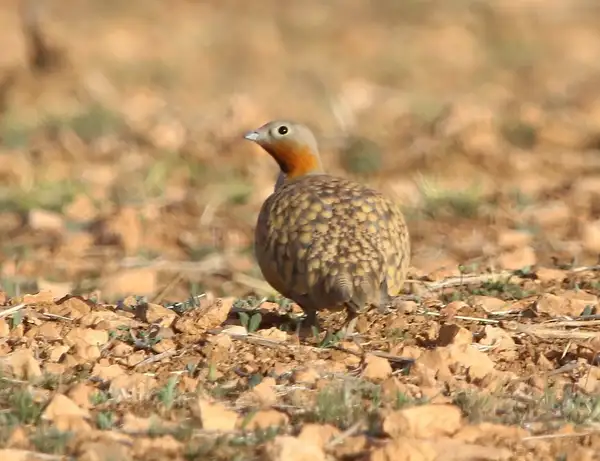
It is similar in physical appearance1. The Pin-tailed Sandgrouse is told from it by its smaller size, its white belly and its tail with very long central feathers.
Photo: mourad-harzallah, CC BY 4.0
Other birds
Birds related to the Pin-tailed Sandgrouse or sharing its habitats in Cabañeros.



 Same family
 Same season in the park
 Same season in the park
 Same season in the park
 Same season in the park
 Same season in the park
 Same season in the park
 Same season in the park





