Wingspan compared with a person with arms outstretched.
Length
24–28 cm
Wingspan
52–59 cm
Weight
68.5 g
Social life
Discreet and nocturnal; little is known of its breeding, because it almost always goes unnoticed
Lifespan
Record of 13 years and 3 months in the wild according to EURING (a bird ringed in Spain); AnAge gives 13.2 years
Conservation status
LC
NT
VU
EN
CR
EW
EX
Global (IUCN)
Near Threatened
Spain
Vulnerable (VU) in the 2021 Red Book of the Birds of Spain; on the List of Wild Species under Special Protection, but not in the Spanish Catalogue of Threatened Species
When to see it
Summer visitor
Months of the year when it is present
J
F
M
A
M
J
J
A
S
O
N
D
In Iberia
no
no
no
yes
yes
yes
yes
yes
yes
yes
no
no
Breeding season
no
no
no
no
yes
yes
yes
no
no
no
no
no
Song or voice of the Red-necked Nightjar
Its characteristic sound is a two-syllable song, very loud, repetitive and heard at a great distance, like a «kiotoc-kiotoc-kiotoc» that sounds almost electronic. The female gives a hoarse «tsche-tsche-tsche». The recording is from an August night around Doñana.
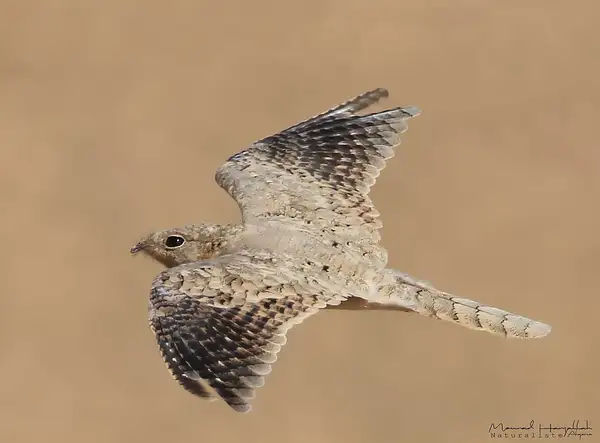
Its flight is erratic, as if hazy, at times with deep wingbeats that it alternates with frequent glides in which it holds its wings in a «V». It beats its wings silently, one of its adaptations for hunting insects in the air.
Flight typeErratic and hazy, with deep wingbeats and glides with wings in a «V»
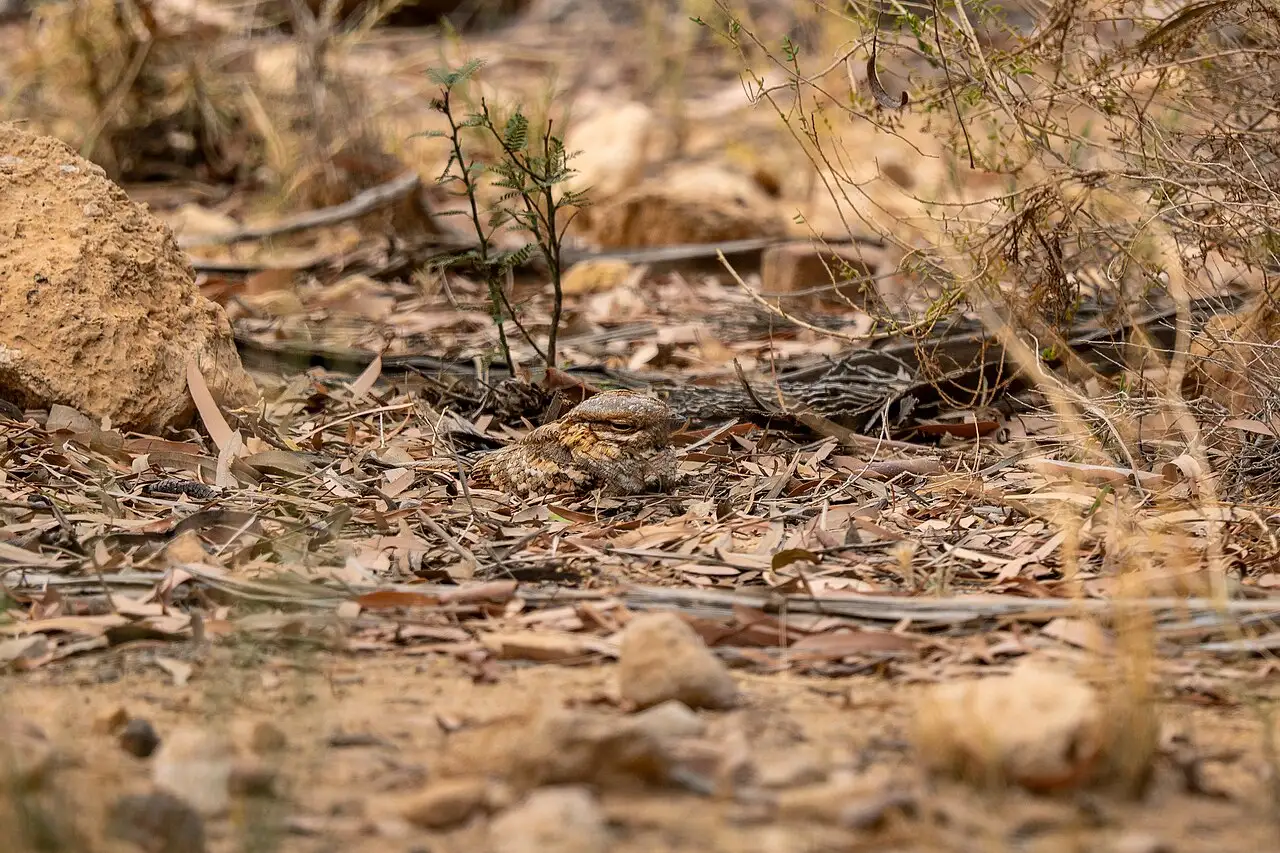
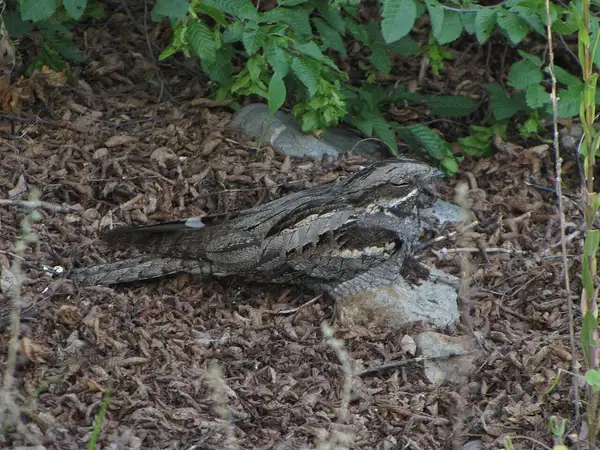
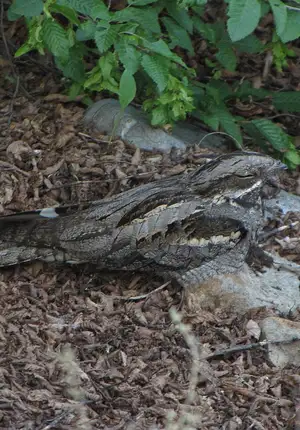
Active at dusk and through the night, it spends the day motionless among the leaf litter or on a branch, invisible thanks to its plumage.
Its flight is erratic, almost vaporous, with deep wingbeats alternating with frequent glides with the wings in a «V».
It hunts flying invertebrates, above all moths, which it catches with its enormous mouth.
Photo gallery of the Red-necked Nightjar
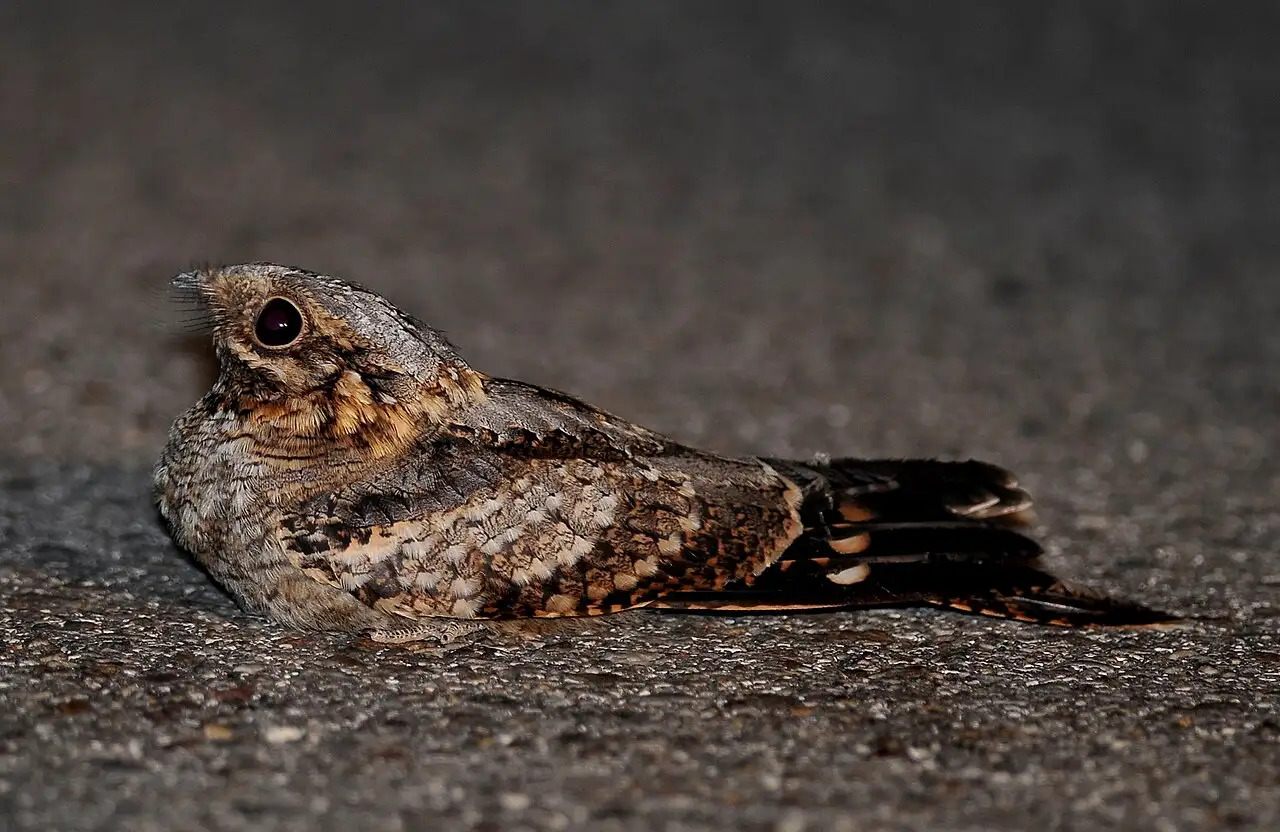
Red-necked Nightjar perched on a track at night, with cryptic brown and grey plumage, rusty collar and big dark eyePhoto: Olivença, CC BY-SA 3.0Photo 1 of 4
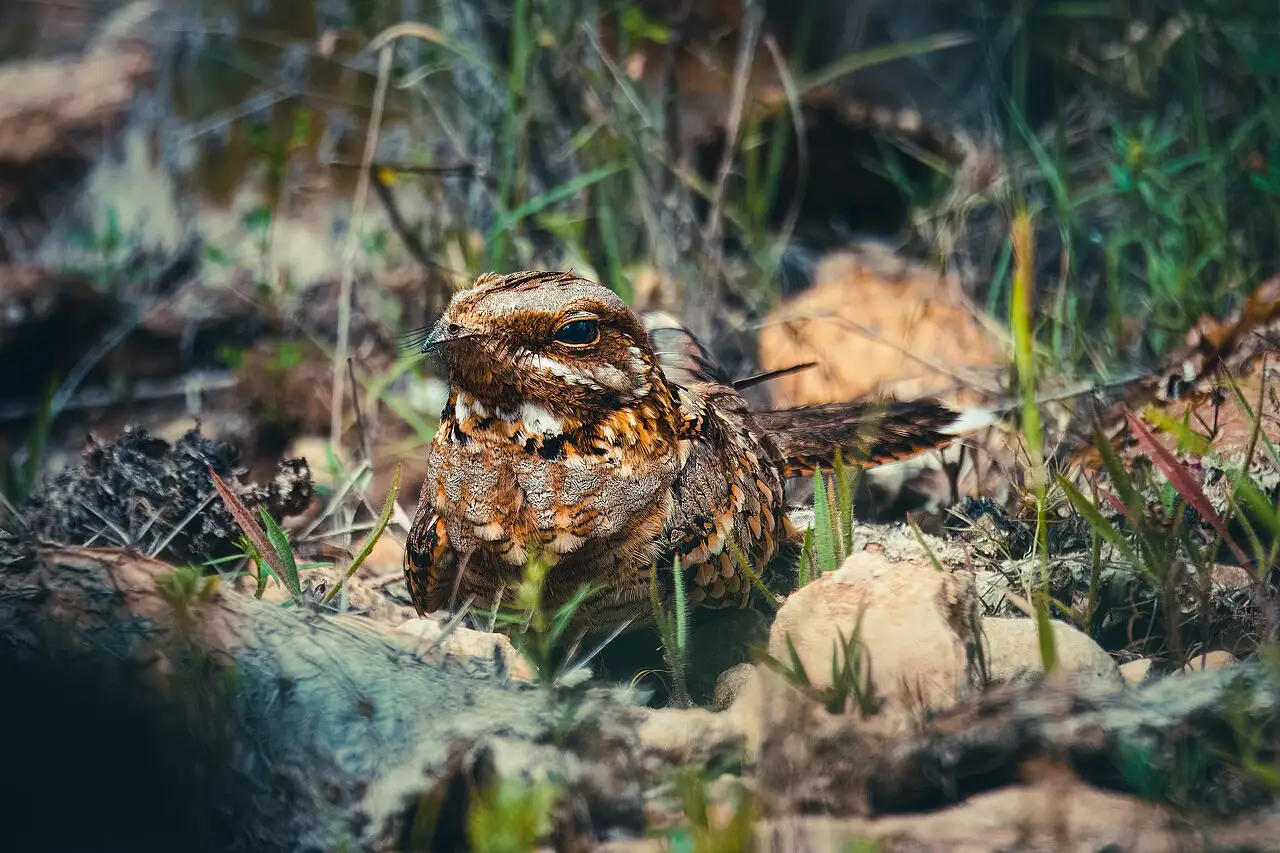
Red-necked Nightjar lying on the ground among grasses and stones, with brown and ochre plumage that camouflages itPhoto: Slim Alileche, CC BY-SA 4.0Photo 2 of 4
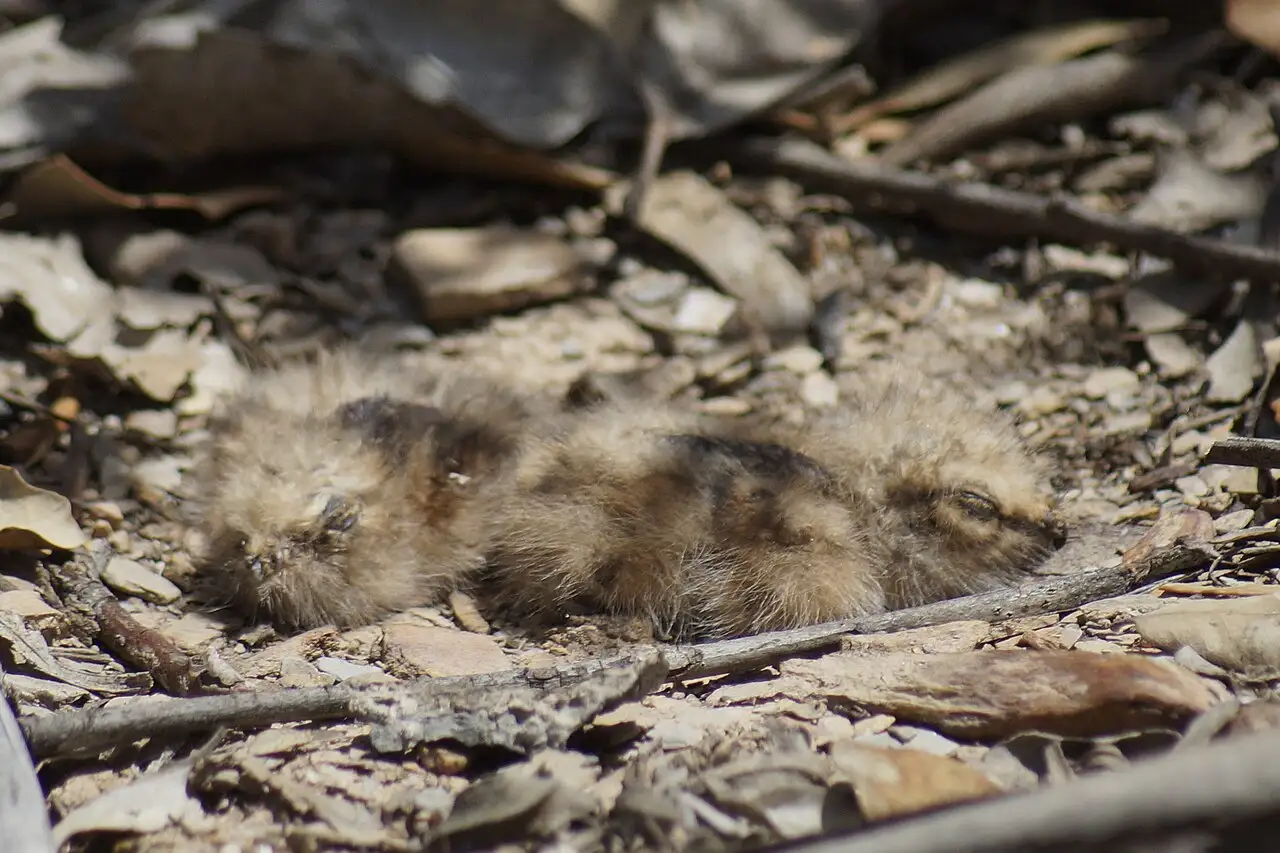
Two Red-necked Nightjar chicks covered in down among the leaf litter and twigs on the groundPhoto: Andre Heuzer, CC BY-SA 4.0Photo 3 of 4
Red-necked Nightjar almost invisible lying on a ground of earth, dry leaves and twigsPhoto: Slim Alileche, CC BY-SA 4.0Photo 4 of 4
1 / 4
Identification of the Red-necked Nightjar
It is the largest European representative of the genus «Caprimulgus» and, like all nightjars, wears an extraordinarily mimetic plumage that lets it go completely unnoticed when it perches among leaf litter or on a tree branch. One feature for recognising it is the rusty band that crosses the throat and breast like a collar. The wings and tail are long and carry striking white spots at the end, which are only seen in flight and are more evident in the male. It also has other adaptations for hunting insects on the wing: silent wings, a large mouth to catch them in the air, enormous dark eyes and tactile bristles around the bill.
Adult
Cryptic brown, grey and ochre plumage.
Rusty collar on the throat and breast.
White spots on the wings and tail, more evident in the male.
Habitat and distribution of the Red-necked Nightjar
It lives on the Iberian Peninsula and in the Maghreb, and two subspecies are recognised; in Spain «ruficollis» breeds, which also occupies some points of North Africa.
It is a summer visitor on the Peninsula, where it occupies mainly the centre, south and east, and reaches the Ebro valley. It is scarce or entirely absent in the northern half and in mountain regions. It is in Melilla and occasionally in the Canaries, and is absent from the Balearics and Ceuta.
It prefers not very rugged regions of moderate altitude, which do not usually exceed 800 metres, generally warm and dry, with open or somewhat wooded areas where crops, wasteland, copses, scrub and river plains alternate, without caring about the dominant tree: stone pine woods, holm oak woods or savin woods.
It is strictly migratory. Its routes and winter quarters are little known: it is known to cross the Strait of Gibraltar in September and October and that European birds winter south and south-west of the African breeding area. It returns between mid-April and May.
Areas where it is regularly recorded since 2010Squares of about 25 km where it is recorded regularly (occasional passage records are left out). Data from GBIF.org (11,374 records, retrieved October 2026); outline from Natural Earth.
Etymology of the Red-necked Nightjar
According to Wikipedia, «Caprimulgus» comes from the Latin «capra», «goat», and «mulgere», «to milk», from an old myth that said these birds suckled from goats. The epithet «ruficollis» joins the Latin «rufus», «red», and «collum», «neck». It is also known as «chotacabras cuellirrojo»; in other languages it is «siboc» in Catalan, «avenoiteira de caluga vermella» in Galician, «zata lepagorria» in Basque and «red-necked nightjar» in English1.
Population of the Red-necked Nightjar
According to the 2021 European Red List of Birds, the population would be around 202,000–270,000 birds, with a decreasing trend, and the IUCN considers it Near Threatened worldwide. The last estimate in Spain, from 1994, gave about 100,000–130,000 pairs; since then, the Noctua programme indicates a fall of 30.2 % between 2006 and 2018, and studies in Doñana and the Community of Madrid give similar declines. Because of that decline, the 2021 Red Book of the Birds of Spain considers it Vulnerable.
It suffers many road kills from its habit of perching on roads and tracks. It is also affected by habitat loss through agricultural changes and urban and energy infrastructure, the destruction of nests by stubble burning and livestock trampling, the increase of opportunistic predators such as rats and cats and insecticides, which reduce its food and can poison it.
Nest of the Red-necked Nightjar
The nest is a simple hollow in the ground, often protected by some shrub.
Courtship and breeding of the Red-necked Nightjar
Because of its discreet habits little is known of its breeding. The breeding period begins soon after arrival from Africa, around May, and lasts until July. The female normally lays two smooth, glossy eggs, cream or whitish. It is thought that, if necessary, she can move the eggs or chicks to another place, but there are hardly any data on incubation, chick feeding or second clutches.
Diet of the Red-necked Nightjar
It is active at dusk and during the night, when it hunts flying invertebrates, above all moths, which it catches with its enormous mouth. Now and then it hunts grasshoppers or beetles on the ground.
Curious facts about the Red-necked Nightjar
It is an enigmatic and very little-known bird1. What can be heard well is its song, a «kiotoc» that sounds apparently electronic1. EURING lists a nightjar ringed in Spain that lived 13 years and 3 months.
The Red-necked Nightjar in Cabañeros
The habitat pages of this website do not mention it, and we have not found any other published source on it in the Park. GBIF.org records 38 observations of the Red-necked Nightjar in Cabañeros and its surroundings.
Where to see the Red-necked Nightjar in Cabañeros
In Cabañeros and its surroundings, from April to October, in open areas with scrub, pine woods and holm oak woods.
When
From April to October: it is a summer visitor, and breeds from May to July.
What time
At dusk and at night: that is when it hunts and sings.
Where
In warm, dry areas, open or somewhat wooded, with crops, wasteland, scrub and pine woods; sometimes perched on tracks.
What to look for
Listen for its repeated «kiotoc-kiotoc»; look for the white spots on the wings and tail when it flies.



 Same family
 Same order
 Same order
 Same season in the park
 Same season in the park
 Same season in the park
 Same season in the park
 Same season in the park





