In Spain it breeds in isolation; in Africa, colonies do not usually exceed 20 nests
Lifespan
Record of 9 years in the wild according to EURING (a bird ringed in Spain and later checked)
Conservation status
LC
NT
VU
EN
CR
EW
EX
Global (IUCN)
Least Concern
Spain
Near Threatened (NT) in the 2021 Red Book of the Birds of Spain; it is on the List of Wild Species under Special Protection, but not in the Spanish Catalogue of Threatened Species
When to see it
Summer visitor
Months of the year when it is present
J
F
M
A
M
J
J
A
S
O
N
D
In Iberia
no
no
no
no
yes
yes
yes
yes
yes
yes
no
no
Breeding season
no
no
no
no
yes
yes
yes
yes
yes
yes
no
no
Song or voice of the White-rumped Swift
It has a typical swift voice, but of low intensity and given infrequently. Its commonest song is a guttural trill that is said to recall that of a bat. The recording is short, about nine seconds, and comes from the YouTube channel Aves Córdoba; there are no free recordings on xeno-canto.
SongWhite-rumped Swift
0:00 / 0:09
10 kHz5
The sonogram draws the sound: time runs from left to right, and the higher a trace sits, the higher the note.Recording by Aves Córdoba, Canal de YouTube «Aves Córdoba», vídeo «Vencejo cafre» (Vídeo de YouTube, con atribución).
Flight of the White-rumped Swift
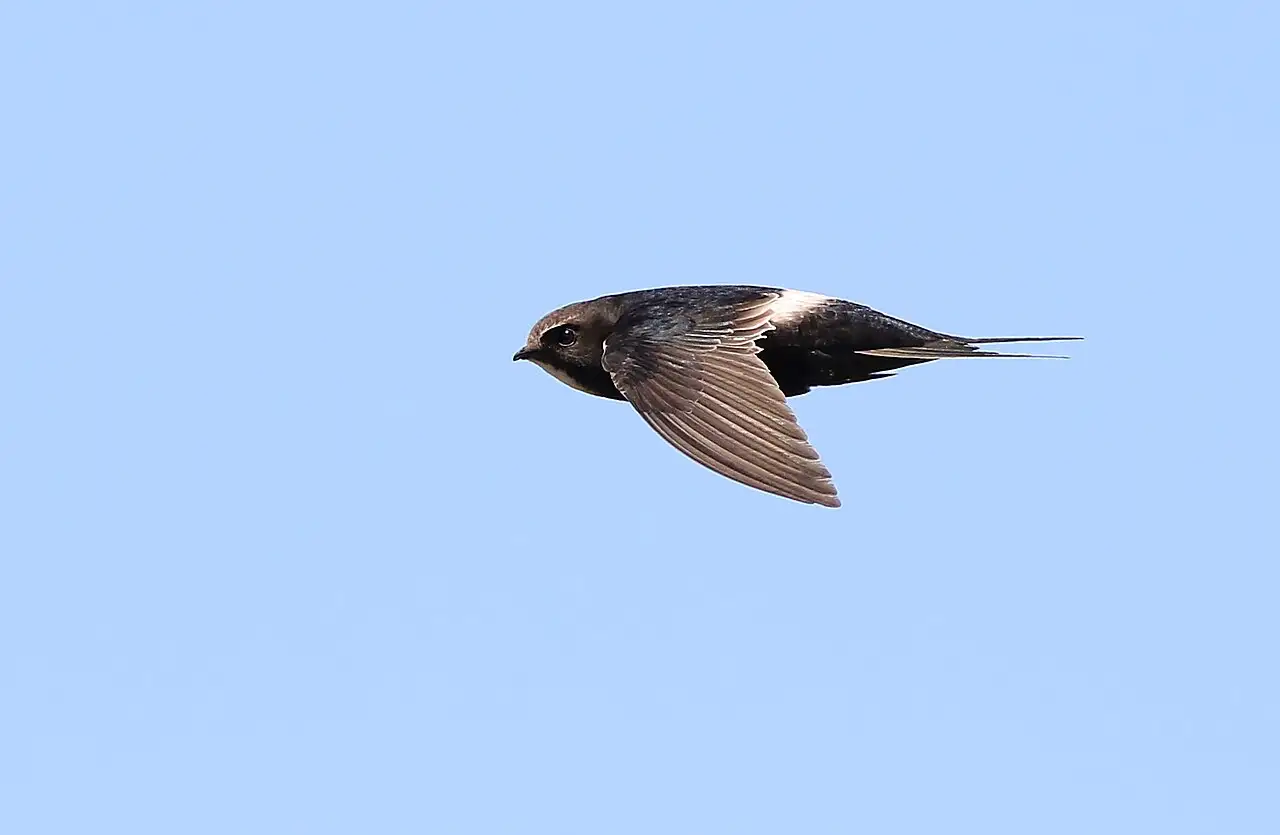
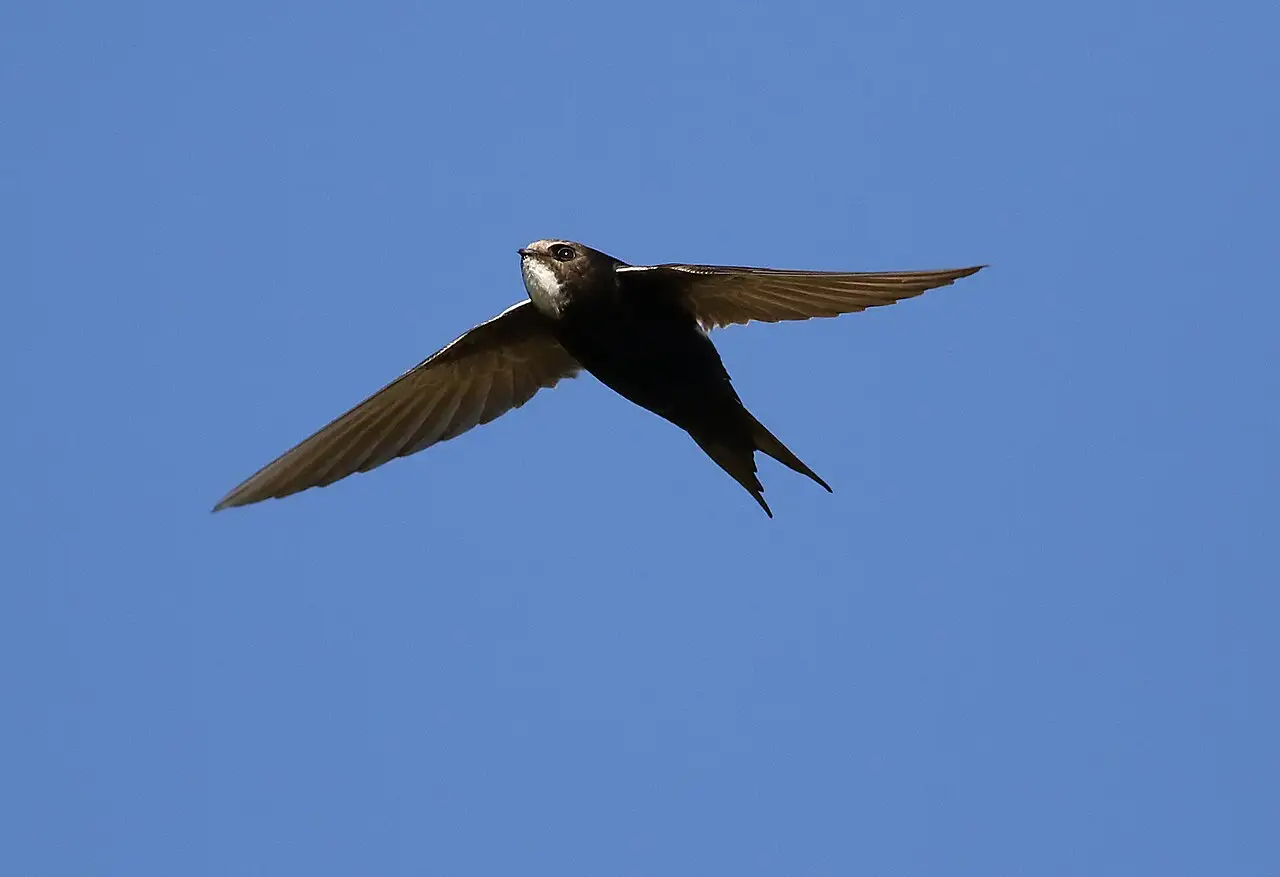
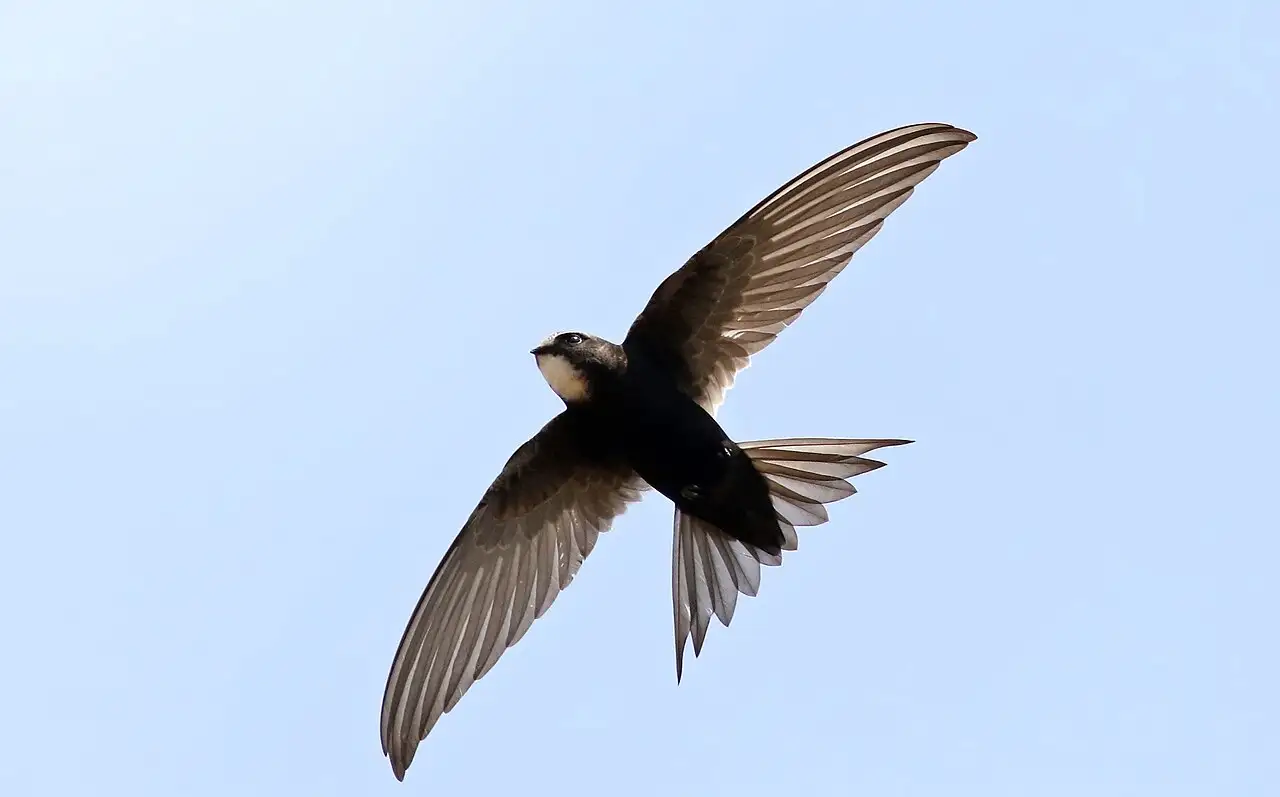
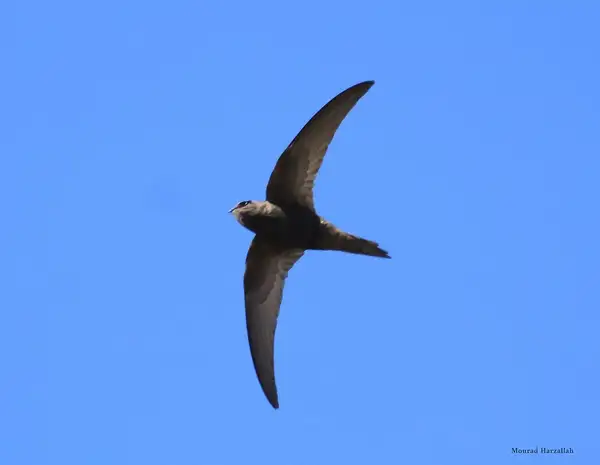
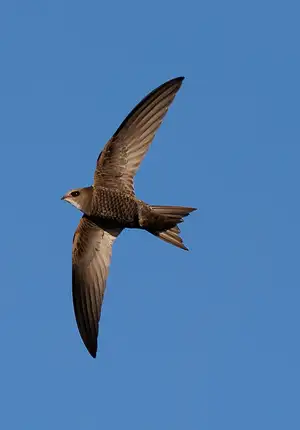
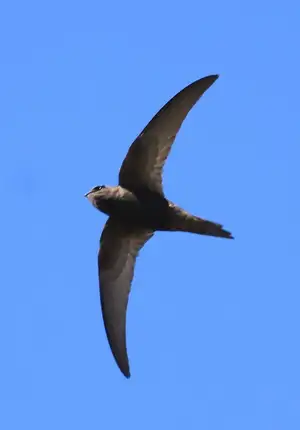
Its silhouette is that of a crossbow, with a deeply forked tail and narrow, proportionally very long wings, which it usually holds straight in flight.
Flight typeWith long, narrow wings, which it usually holds straight in flight
It breeds almost exclusively in nests taken over from the Red-rumped Swallow, in rugged areas of ranges, river cliffs and under bridges.
A specialised insectivore, it feeds on aerial plankton, made up of small flying insects.
It has a crossbow-shaped silhouette, with a deeply forked tail and narrow, very long wings, which it usually holds straight in flight.
Photo gallery of the White-rumped Swift
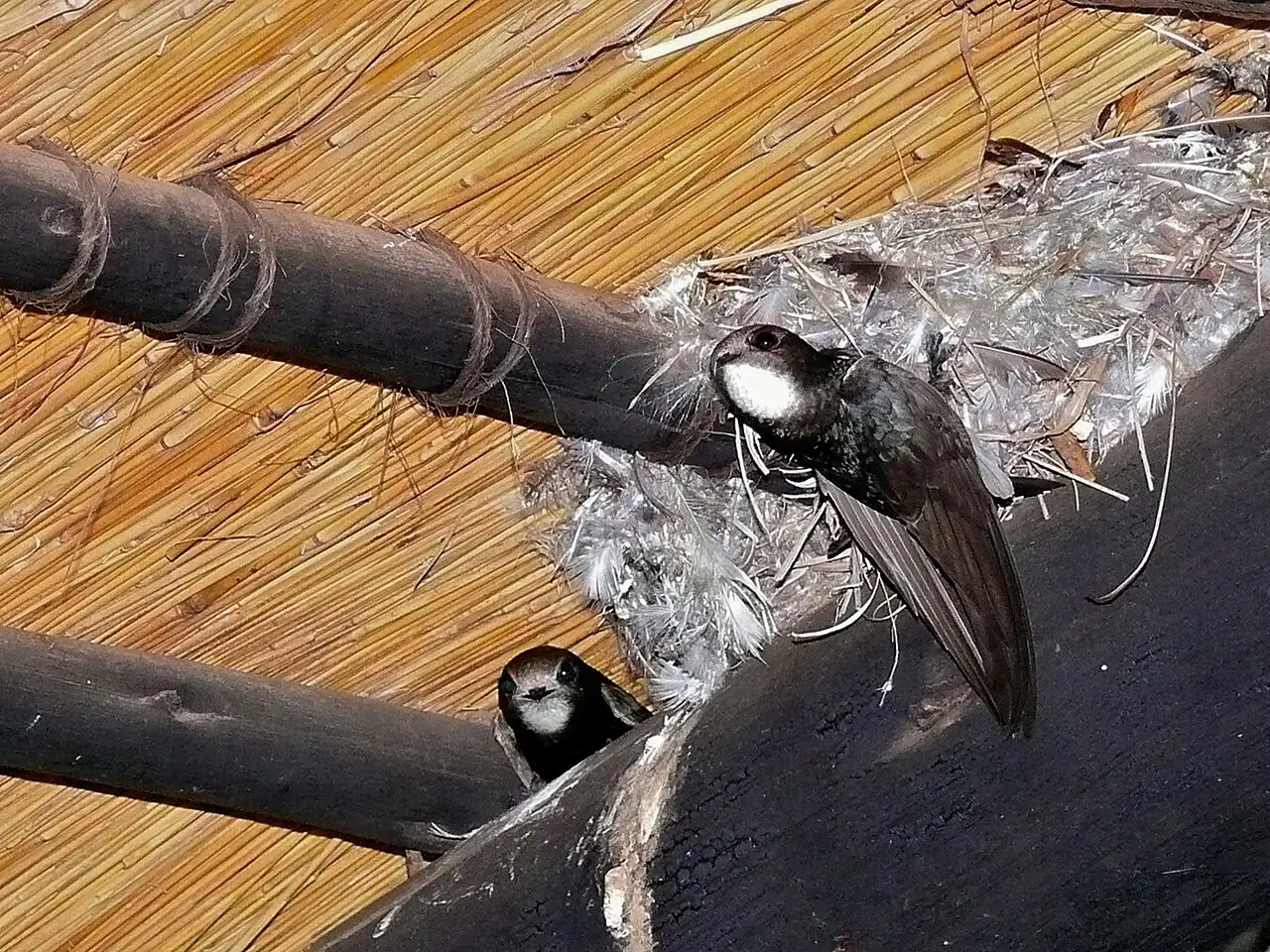
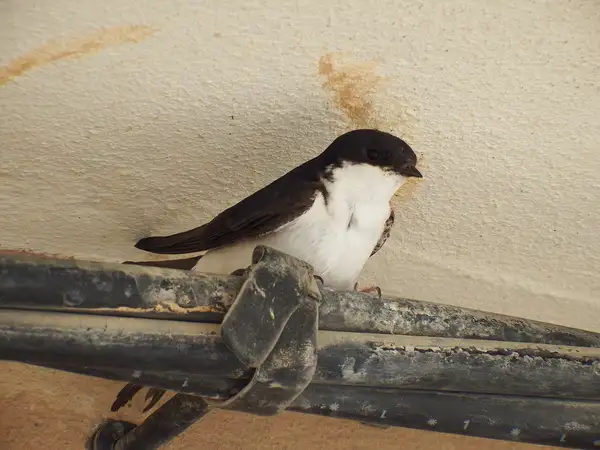
White-rumped Swift clinging to a nest under a thatched roof, with white throat and black plumagePhoto: Bernard DUPONT from FRANCE, CC BY-SA 2.0Photo 1 of 4
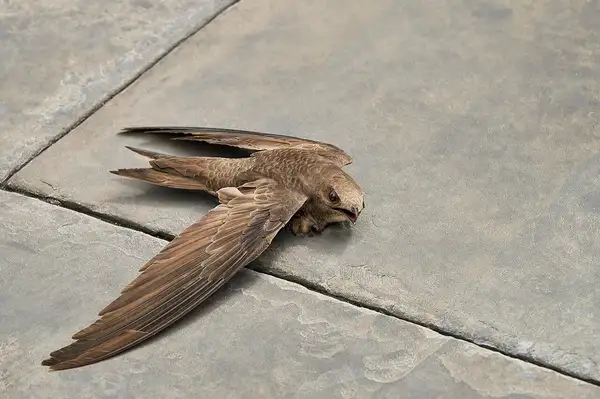
The White-rumped Swift is small and has the silhouette of a crossbow, with a deeply forked tail and narrow, proportionally very long wings, which it usually holds straight in flight. It has a short, flat bill with a very wide mouth, very short legs and small feet with strong claws, with all four toes pointing forwards. Its colouring is uniformly black, except the throat and a narrow band on the rump, which are white and sharp-edged. Other details, visible only from very close, are a white line on the rear inner part of the wings, at the tip of the secondaries, and the forehead and eyebrows in a greyish tone. It differs from the similar Little Swift in that the latter has no fork in the tail, has a larger rump patch, a paler overall tone and shorter wings. Both sexes are alike.
Adult
Uniform black, with the throat and a narrow band on the rump white.
Deeply forked tail and long, narrow wings.
Young bird
Very like the adult, with small white edges on the feathers.
Habitat and distribution of the White-rumped Swift
As a breeder it occupies almost all of Africa south of the Sahara, except the deserts and the equatorial rainforests, and has recently colonised southern Morocco and the south of the Iberian Peninsula. No subspecies are recognised.
It is strictly a summer visitor in Spain, very localised in the Iberian south-west quadrant, as far as Zamora, with a more important centre in the Cádiz ranges and adjacent areas, where the first records in our country were made, around 1964. It does not breed in the archipelagos or the North African territories. The known range probably underestimates reality, because it is hard to detect.
It breeds in rugged areas of coastal and inland ranges, on river cliffs and under bridges, and depends on the presence of nests of hirundines, above all of the Red-rumped Swallow, which it takes over. It is associated with warm, humid areas of high insolation, with plenty of crags and near watercourses.
It is resident over most of its breeding range, except in southern Africa, Morocco and the Peninsula. Where the Iberian birds winter is entirely unknown. It makes wandering movements in all seasons, and has been recorded as far as Norway and Finland. It is in Spain between May and the end of October, although there are observations between February and December, and migrates through the Strait in two waves: in August, with the young of the first clutch, and in September and October, with the rest.
Areas where it is regularly recorded since 2010Squares of about 25 km where it is recorded regularly (occasional passage records are left out). Data from GBIF.org (1,574 records, retrieved October 2026); outline from Natural Earth.
Etymology of the White-rumped Swift
According to Wikipedia, Martin Lichtenstein described it in 1823. It is a swift that looks like a House Martin, though it is not related to it: the similarities between swifts and swallows are due to convergent evolution. In other languages it is called «falciot cuablanc africà» in Catalan, «cirrio cafre» in Galician, «sorbeltz ipurzuria» in Basque and «white-rumped swift» in English1.
Population of the White-rumped Swift
The European population is restricted to the south of Spain, where it began to breed at the start of the second half of the 20th century, as in Morocco. In the 2021 European Red List of Birds the European breeding population is estimated at between 500 and 700 mature individuals, with an unknown trend. In Spain the estimates are imprecise: in 1997 30–100 pairs were estimated and in 2002 between 100 and 150; in Extremadura, 100–200 pairs between 2015 and 2019. Because of its low detectability, the real figures may be somewhat higher, and the general trend is positive. Its very small population may be limited to about 150 pairs, with its northern limit in the province of Cáceres and very thinly spread over ten provinces of the Iberian south-west1.
The main threat is the reduction of food resources, caused above all by the use of pesticides in rural areas and by climate change.
Nest of the White-rumped Swift
It breeds in the nests of other birds, which in our country are those of the Red-rumped Swallow, except for two cases in House Martin nests. Some studies in Cádiz show that it drives the swallows out of their nests, even those with eggs and chicks.
Courtship and breeding of the White-rumped Swift
The breeding season runs between May and October and it lays two clutches a year. In Spain it breeds in isolation: the shortest distance between nests is 250 metres and the highest known density is nine nests within a 3-kilometre radius, in Cádiz. It lays two or three white eggs in May, which it incubates for 21 days. The chicks fly at 40–50 days, and then it lays the second clutch.
Diet of the White-rumped Swift
It is an insectivore specialised in catching aerial plankton, made up of small flying insects.
Curious facts about the White-rumped Swift
It is a swift of sub-Saharan origin, seen in Spain for the first time in 19641. Two years later its breeding was confirmed in Cádiz1. Its expansion has been very slow, and the recent colonisation by the Little Swift calls for extra care when identifying white-rumped swifts. EURING lists a White-rumped Swift ringed in Spain that lived 9 years.
The White-rumped Swift in Cabañeros
The habitat pages of this website do not mention it, and we have found no other published source about it in the Park, although its northern limit is placed in the province of Cáceres and ten provinces of the Iberian south-west are spoken of1. GBIF.org records 10 observations of the White-rumped Swift in Cabañeros and its surroundings.
Where to see the White-rumped Swift in Cabañeros
In Cabañeros and its surroundings, from May to October, near bridges, crags and Red-rumped Swallow colonies.
When
From May to the end of October: it is strictly a summer visitor.
What time
By day, hunting insects in flight.
Where
Near river cliffs and bridges, where the Red-rumped Swallow nests, whose nests it takes over.
What to look for
Look for the white throat and the white band on the rump, and look carefully so as not to confuse it with other swifts.



 Same family
 Same family
 Same family
 Same order
 Same order
 Same season in the park
 Same season in the park
 Same season in the park





