Wingspan compared with a person with arms outstretched.
Length
24–28 cm
Wingspan
52–59 cm
Weight
63–88 g
Social life
Nocturnal habits; it often perches on roads and tracks
Lifespan
Record of 11.9 years in the wild according to AnAge; EURING lists a bird ringed in Great Britain that lived 13 years
Conservation status
LC
NT
VU
EN
CR
EW
EX
Global (IUCN)
Least Concern
Spain
Least Concern (LC) as a breeder in the Red Book of the Birds of Spain; on the List of Wild Species under Special Protection, but not in the Spanish Catalogue of Threatened Species
When to see it
Summer visitor
Months of the year when it is present
J
F
M
A
M
J
J
A
S
O
N
D
In Iberia
no
no
no
yes
yes
yes
yes
no
yes
yes
no
no
Breeding season
no
no
no
no
no
yes
yes
yes
no
no
no
no
Song or voice of the European Nightjar
The male’s song is a constant churring, audible at considerable distance, a «rrurrrrrurrrurr» like the distant purr of an engine; the call in the breeding season is a «kruit», and a dry click is often heard too as the wings clap together1. The recording (song) is by Jacobo Ramil Millarengo and was made at Punta dos Espiños, Carreirón, Arousa, Galicia (xeno-canto XC812037, quality A). It lasts 9 seconds and is a trimmed section of the original, without repeating or lengthening, from which we have removed the bass below 200 Hz, reduced the background noise and adjusted the volume; neither pitch nor speed has been changed.
The flight is erratic, with some spasmodic hovers and glides with the wings in a «V». It is a strictly migratory bird: the post-breeding migration runs from September to October and arrival at the breeding territories is around April. Winter records on eBird (2021) show some observations in Cameroon, Senegal and Spain.
Flight typeErratic, with spasmodic hovers and glides with wings in a «V»
It is a nocturnal bird, with excellent qualities for hunting insects at night, which it catches in flight or by launching itself from a perch.
The flight is erratic, with some jerky hovering and glides with the wings in a «V».
The male's song is a constant rattle, audible at a considerable distance, like the distant purr of an engine; sometimes he also claps his wings.
Photo gallery of the European Nightjar
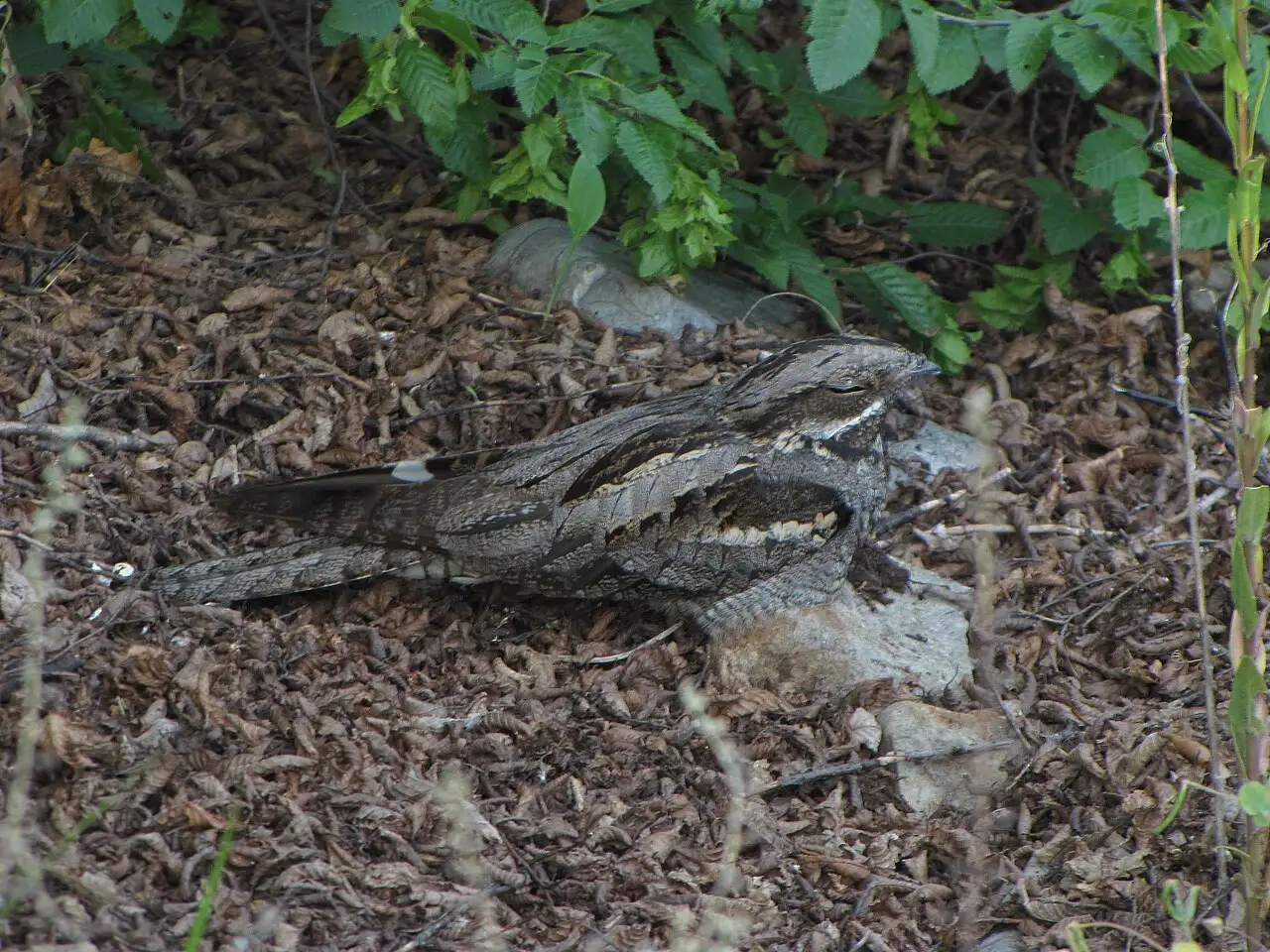
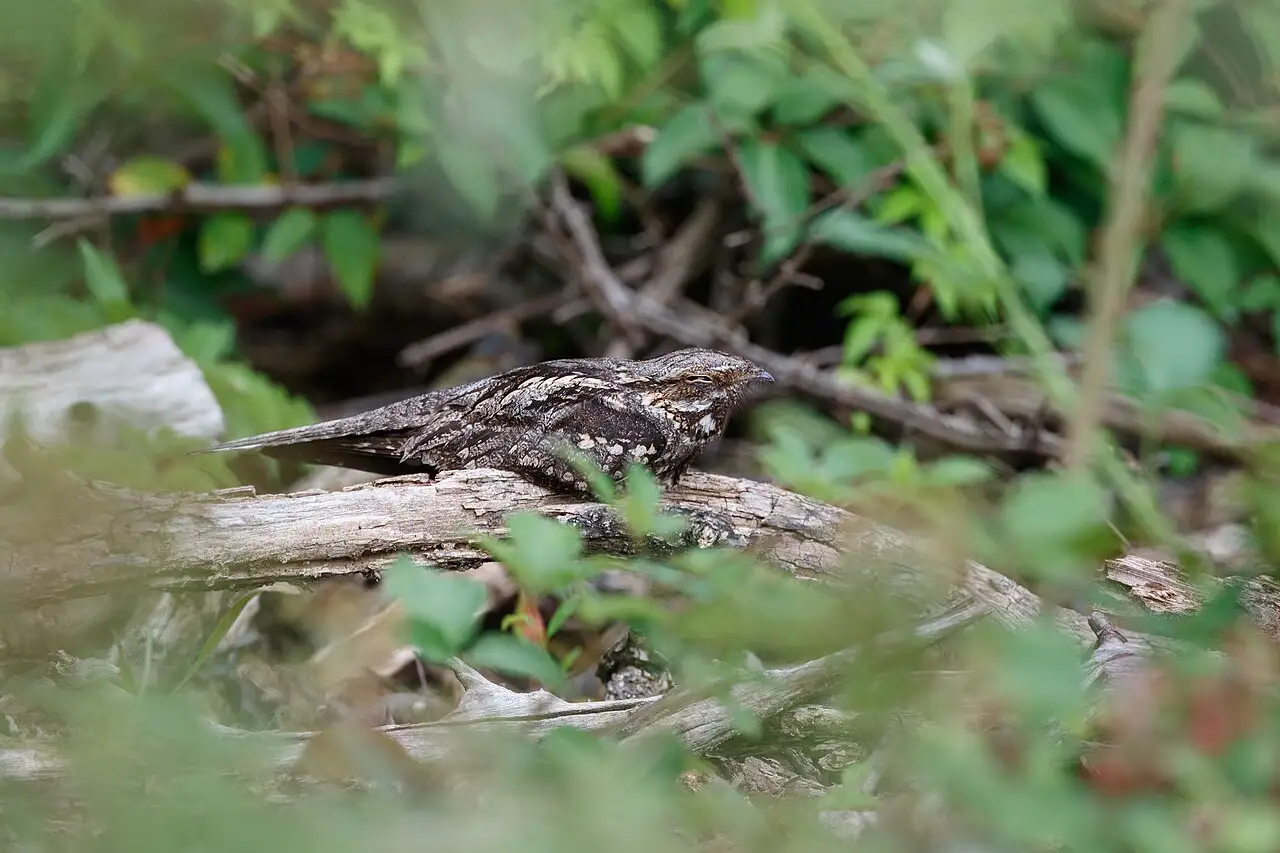
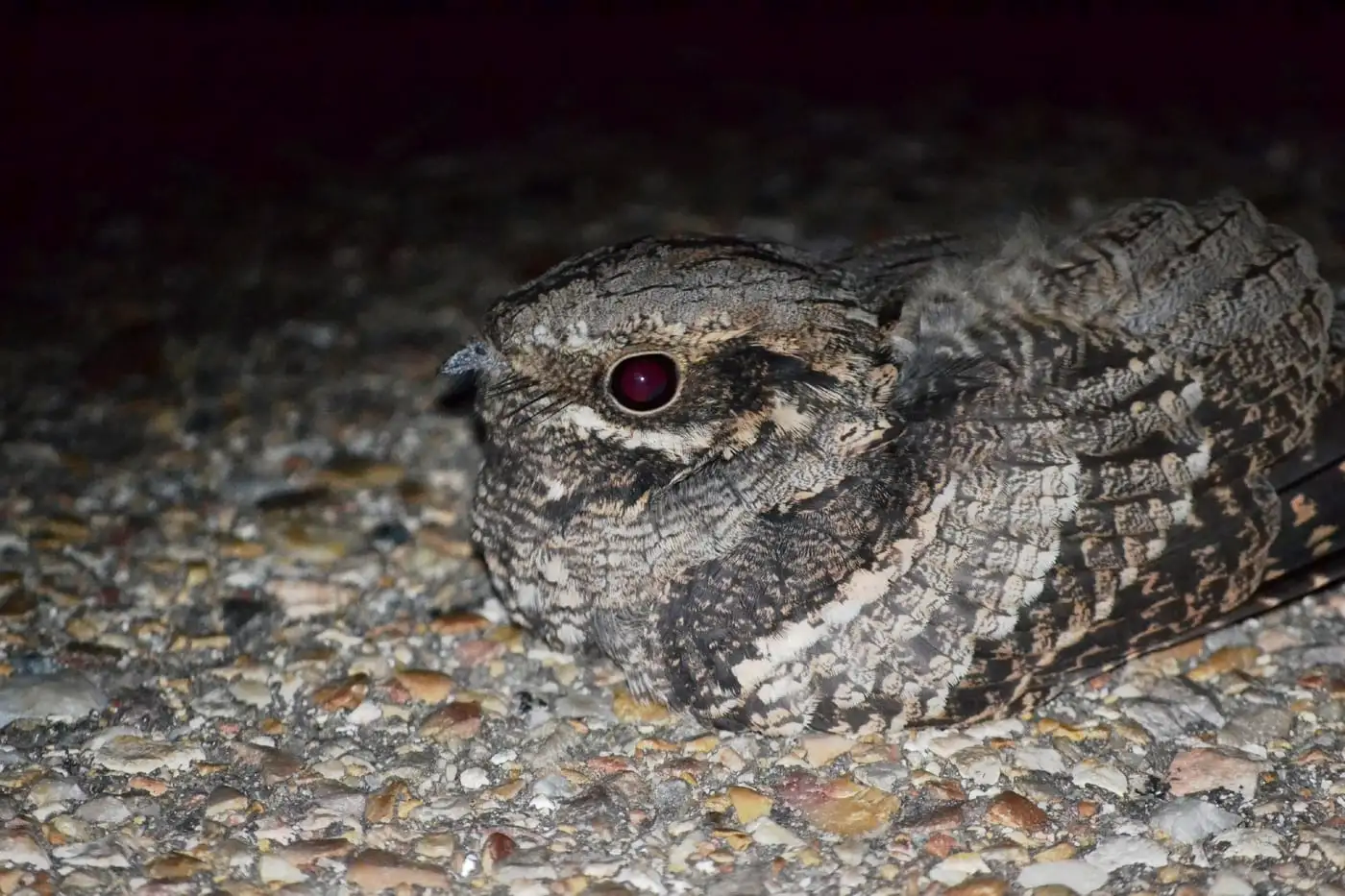
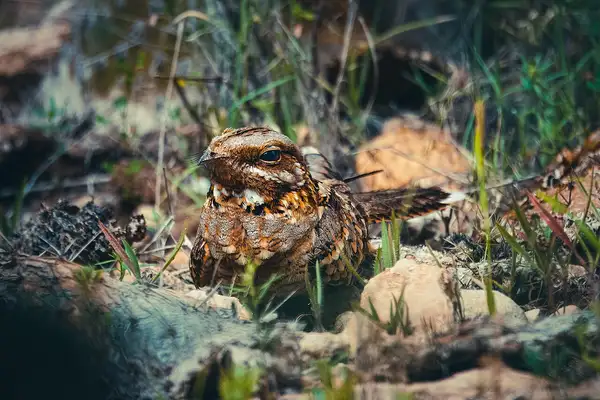
European Nightjar perched on leaf litter, almost invisible thanks to its greyish plumage mottled with brown, ochre-white and blackPhoto: Ivan Medenica, CC BY-SA 4.0Photo 1 of 5
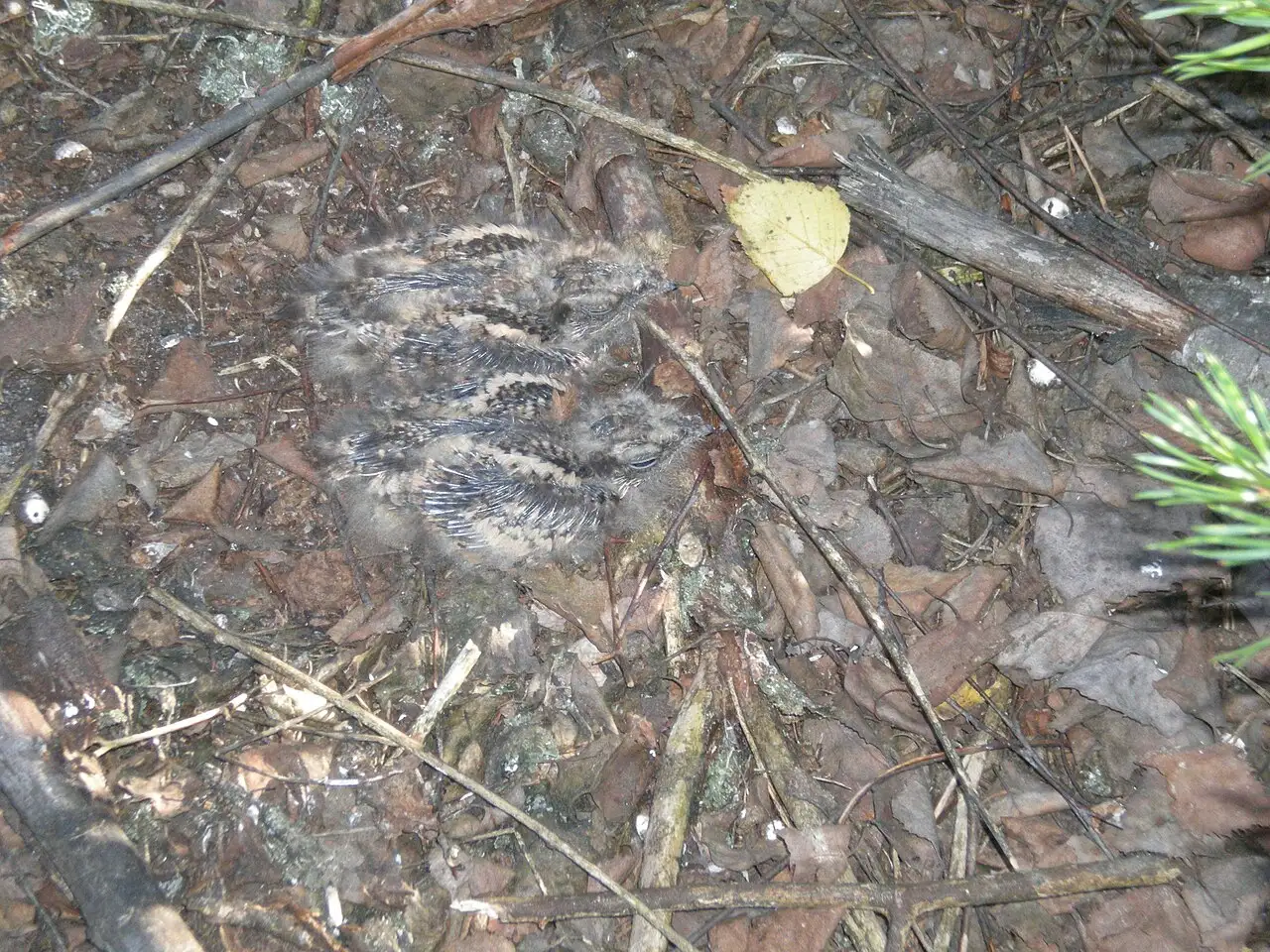
Two European Nightjar chicks on the leaf litter, covered in down mottled with brown and creamPhoto: Aorg1961, CC BY-SA 4.0Photo 3 of 5
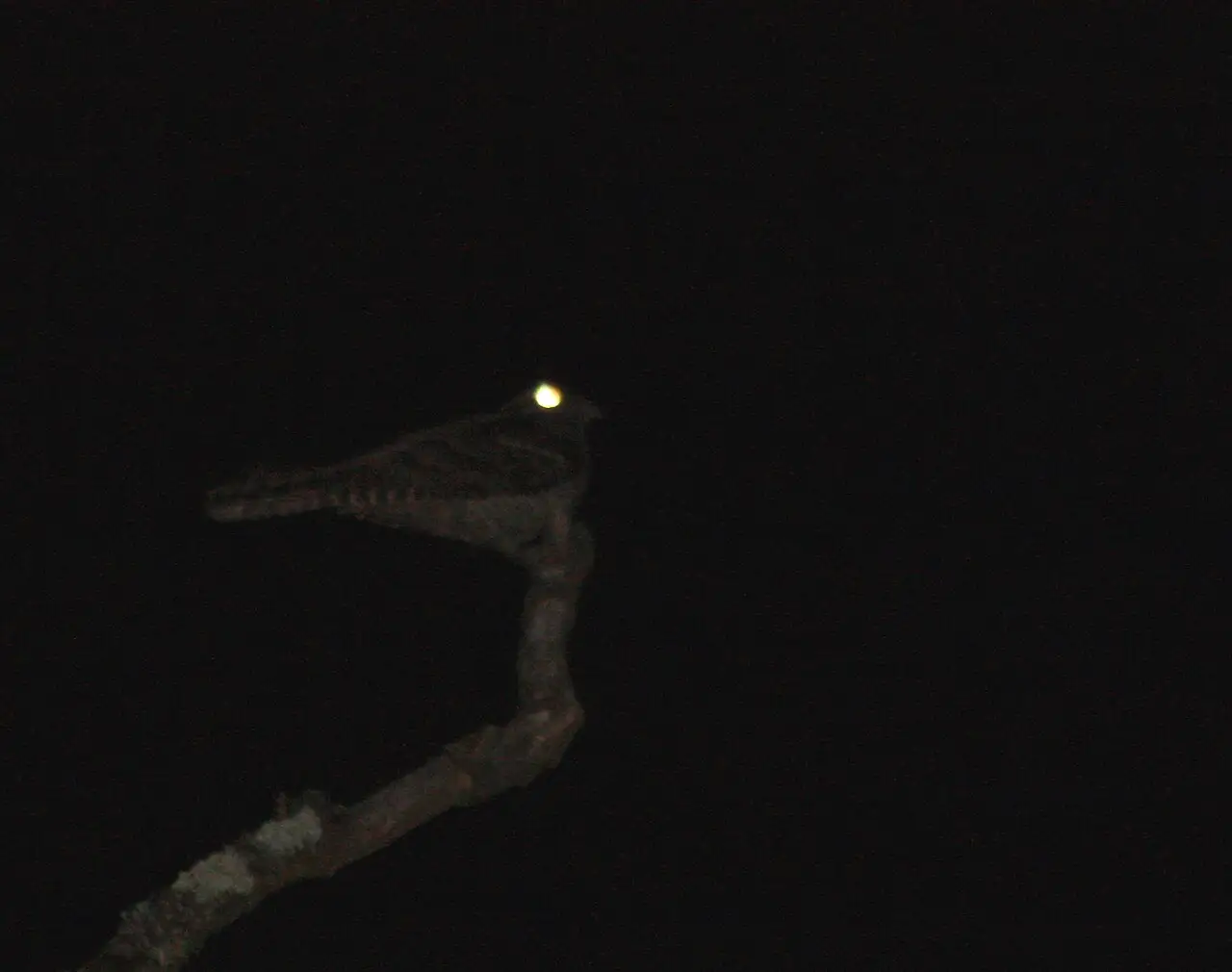
European Nightjar perched at night on a branch, lit by a torch, with shining eyePhoto: sébastien bertru, CC BY-SA 2.0Photo 4 of 5
European Nightjar perched at night on the ground, with mottled plumage and big eye (Segovia)Photo: Guillerme Mioño Pazos, CC BY-NC 4.0Photo 5 of 5
1 / 5
Identification of the European Nightjar
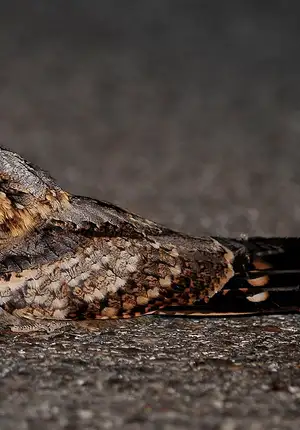
Somewhat smaller than the Red-necked Nightjar, it differs from it by its clearly greyish colouring, profusely mottled with brown, ochre-white and black, and by the shorter length of wings and tail. Only the male wears white spots on the flight feathers and the sides of the throat, although both sexes show a whitish band over the wing coverts and a dark area at shoulder level. The flight is erratic, with some spasmodic hovers and glides with the wings in a «V».
Adult
Grey, mottled with brown, ochre-white and black; wings and tail shorter than in the Red-necked.
Whitish band over the wing coverts and dark area at the shoulders.
Male
White spots on the flight feathers and the sides of the throat.
Habitat and distribution of the European Nightjar
It is a species widely distributed across much of Europe, where it reaches southern Scandinavia, central Asia and a narrow strip of North Africa. It has several subspecies, and in Spain the subspecies «meridionalis» lives.
It is a strictly summer-visiting nightjar in Spain, distributed mainly across the regions not occupied by the Red-necked Nightjar, so that it is more frequent in the northern half and in the mountain regions of the south, such as the Betic and Penibetic ranges, although there are recent records from the Guadalquivir valley and the south-east1. It breeds in the Balearics and Ceuta, where it is scarce.
It prefers open areas with scattered trees or woodland edges. In the north of the Peninsula it coincides with holm oak dehesas and oak woods, ash woods or mixed woods, and also appears in open or recently planted pine woods with clearings, and on moors, steppes and scrub, generally in elevated areas, even above 1,000 metres.
It is a strictly migratory species throughout its range, and European populations winter in tropical latitudes of Africa.
Areas where it is regularly recorded since 2010Squares of about 25 km where it is recorded regularly (occasional passage records are left out). Data from GBIF.org (21,203 records, retrieved October 2026); outline from Natural Earth.
Etymology of the European Nightjar
According to Wikipedia, «Caprimulgus» comes from the Latin «capra», «goat», and «mulgere», «to milk», and alludes to an old legend according to which nightjars suckle from goats; «europaeus» is Latin for «European». It is also known as «chotacabras europeo»; in other languages it is «enganyapastors europeu» in Catalan, «avenoiteira cincenta» in Galician, «zata arrunta» in Basque and «European nightjar» in English1.
Population of the European Nightjar
In the 2021 European Red List of Birds, the European breeding population is estimated at between 1,190,000 and 2,220,000 mature individuals, with an unknown trend. In Spain about 82,000–112,000 pairs are estimated, and the Noctua programme data 1 show stability between 2006 and 2018, with important oscillations from one year to the next.
Among the main culprits for the European decline are habitat degradation and the excessive use of pesticides, caused above all by the intensification of agriculture from 19701. Road kills are also an important cause of mortality, because these birds often perch on roads and tracks. It is proposed to keep open areas with mosaic landscapes, encourage extensive agriculture in dehesas and on the periphery of woods and limit pesticides1.
Nest of the European Nightjar
The nest is directly in a slight hollow in the ground, usually sheltered by a bush or a trunk.
Courtship and breeding of the European Nightjar
The breeding period usually begins in June and ends in August. The female lays two eggs, rarely three, white or creamy. It is not unusual for her to make a second clutch, even before the feeding of the first brood has finished. Incubation is done mainly by the female, whom the male sometimes relieves, and the eggs hatch at 17–20 days, because incubation starts with the laying of the first egg. Both parents feed the chicks for about 16–18 days, although the female makes more effort during the first 13 and then leaves the work to the male to start the second clutch.
Diet of the European Nightjar
Its diet is mainly nocturnal insects, such as moths and beetles, which it catches in flight or by darting from a perch. Occasionally it feeds on the ground when grasshoppers, beetles and other invertebrates are abundant.
Curious facts about the European Nightjar
It is a bird of nocturnal habits endowed with excellent qualities for hunting insects at night, whose Iberian distribution does not overlap with that of its close relative, the Red-necked Nightjar1. Its longevity record at EURING, 13 years in Great Britain, exceeds AnAge’s 11.9 years.
The European Nightjar in Cabañeros
The habitat pages of this website do not mention it, but it does appear in the bird list of the «Visitor guide to Cabañeros National Park» (OAPN, page 105). That list vouches for its presence in the Park, not for breeding there. GBIF.org records 6 observations of the European Nightjar in Cabañeros and its surroundings. In the north of the Peninsula it coincides with holm oak dehesas1. In the southern half it is limited to mountain regions, without specifying sites1. Only one of those observations falls within the Park boundary (according to OpenStreetMap); the rest are from the surroundings.
Where to see the European Nightjar in Cabañeros
In Cabañeros and its surroundings, in spring and summer, at dusk, in scrub clearings and the edges of dehesas.
When
Present from April to October; it migrates in September and October.
What time
At dusk and at night; by day it sleeps camouflaged on the ground.
Where
In open areas with scattered trees, woodland edges, holm oak dehesas, open pine woods and scrub.
What to look for
Look for the male's white spots in flight; listen for the continuous churring, «rrurrrrrurrrurr».



 Same family
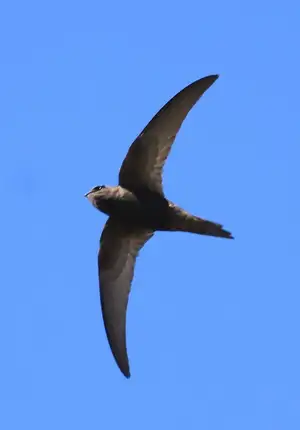 Same order
 Same order
 Same season in the park
 Same season in the park
 Same season in the park
 Same season in the park
 Same season in the park






