Almost always colonial, with nests very close together, sometimes only a metre apart; very faithful to its mate and nest
Lifespan
Record of 21 years and 1 month in the wild (a bird ringed in Sweden and found sick in cold weather)
Conservation status
LC
NT
VU
EN
CR
EW
EX
Global (IUCN)
Least Concern
Spain
Vulnerable (VU) in the 2021 Red Book of the Birds of Spain and included in the List of Wild Species under Special Protection, but not in the Spanish Catalogue of Threatened Species
When to see it
Summer visitor
Months of the year when it is present
J
F
M
A
M
J
J
A
S
O
N
D
In Iberia
no
no
no
yes
yes
yes
yes
yes
yes
no
no
no
Breeding season
no
no
no
no
yes
yes
yes
no
no
no
no
no
Song or voice of the Common Swift
It has a characteristic voice. While flying, above all on the evenings of the warmest months, it repeatedly gives a brief, monotonous, high scream. Male and female utter different sounds, «suiií» the females and «sriií» the males, which when given together make up the typical song of the species. The voice is important to tell it from the Pallid Swift.
CallCommon Swift
0:00 / 0:19
10 kHz5
The sonogram draws the sound: time runs from left to right, and the higher a trace sits, the higher the note.Recording by Jugrü, Wikimedia Commons (CC BY-SA 3.0).
Flight of the Common Swift
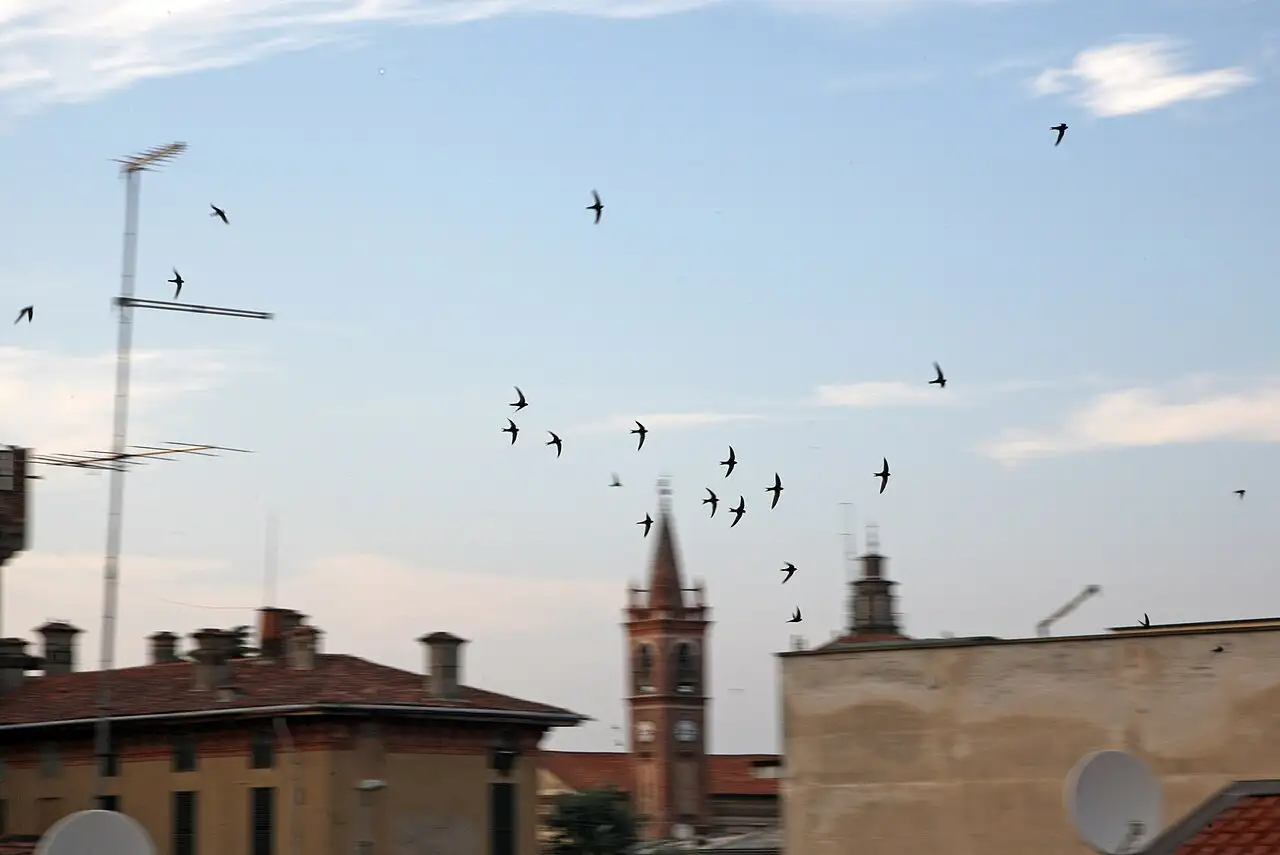
It is usually found in urban centres, flying tirelessly at great speed. It spends most of its life in the air and is only seen perched when entering or leaving the nest; it sleeps both in the nest and in flight.
Flight typeTireless and at great speed, in a group
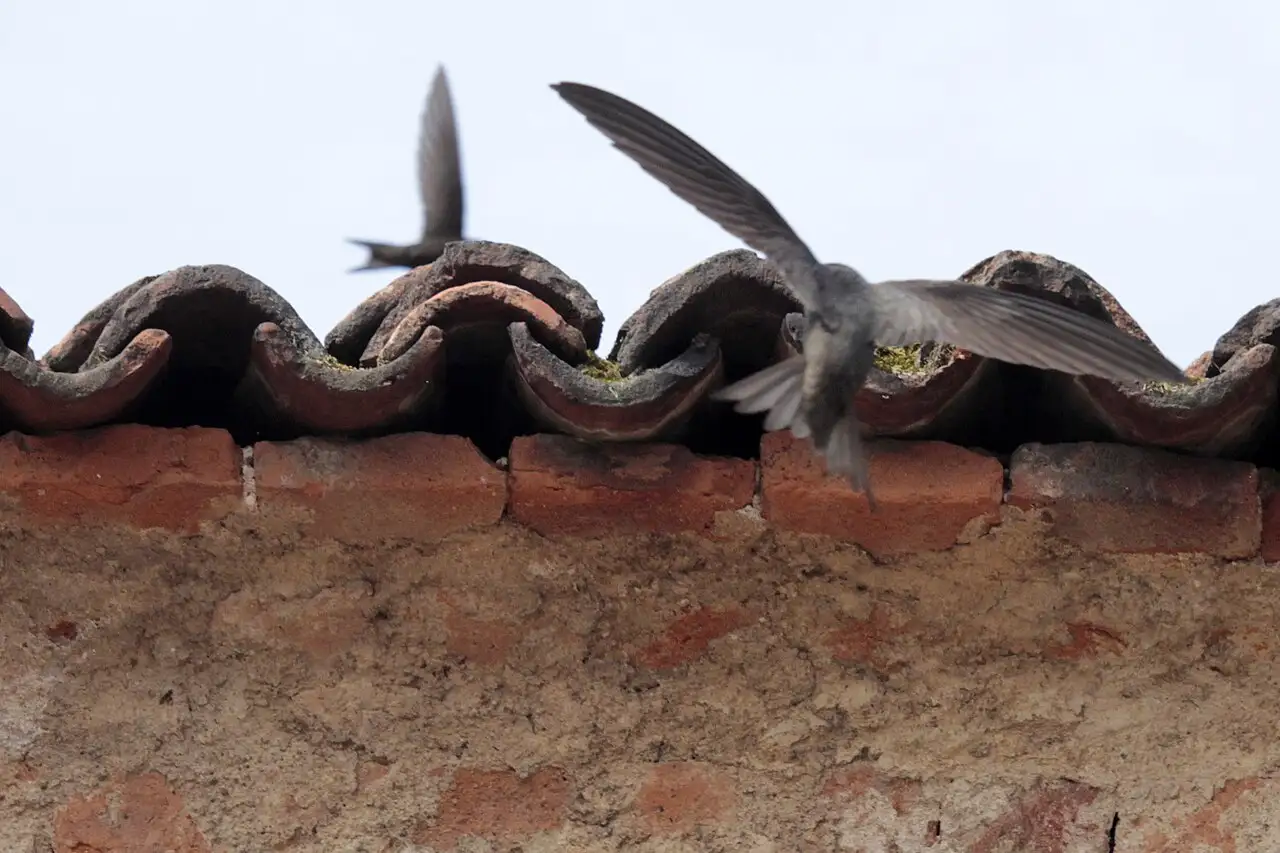
It is only seen perched when entering or leaving the nest, almost always in a hole in a building, and launches into the air with a brief, high scream.
It flies tirelessly and at great speed, in a group, with its mouth open like a butterfly net, to catch small flying insects, the aerial plankton. It drinks in flight.
It spends most of its life in the air: it sleeps both in the nest and in flight, and even mates on the wing.
Photo gallery of the Common Swift
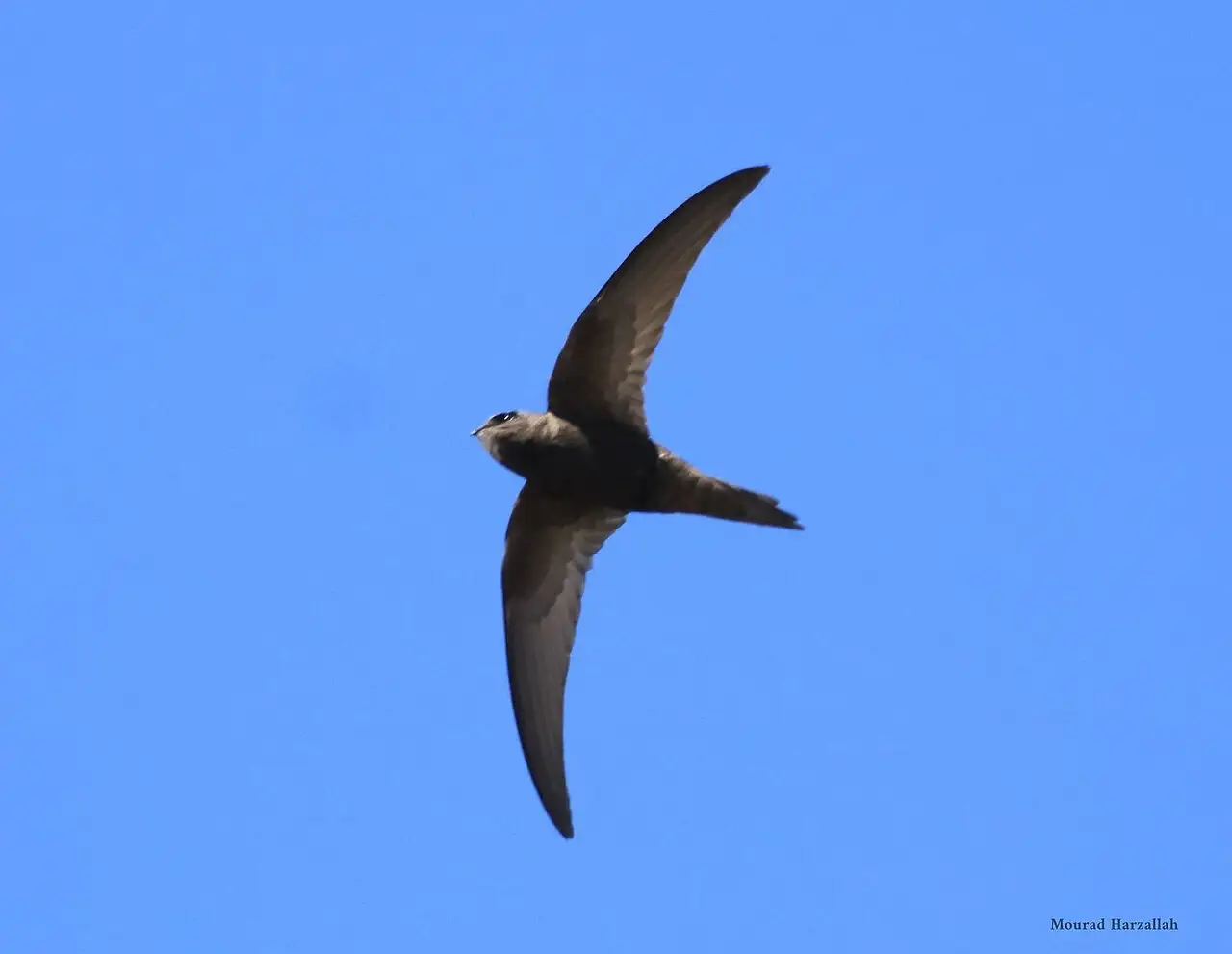
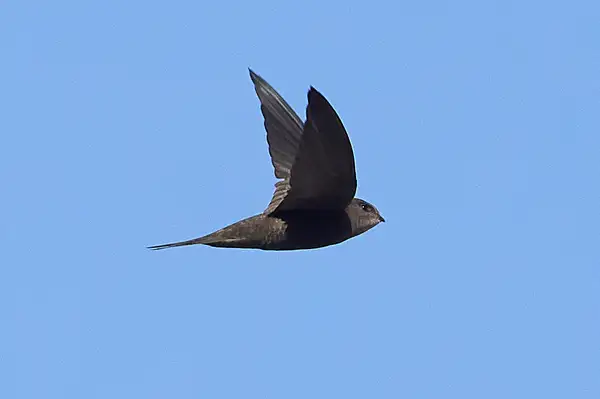
Common Swift in flight seen from below, with long, narrow sickle-shaped wings and a short, forked tail, against the blue skyPhoto: mourad-harzallah, CC BY 4.0Photo 1 of 4
Flock of Common Swifts flying over the rooftops and bell tower of a villagePhoto: Marrabbio2, CC BY 4.0Photo 2 of 4
Common Swift clinging to the edge of a tiled eave, with open wingsPhoto: Marrabbio2, CC BY 4.0Photo 3 of 4
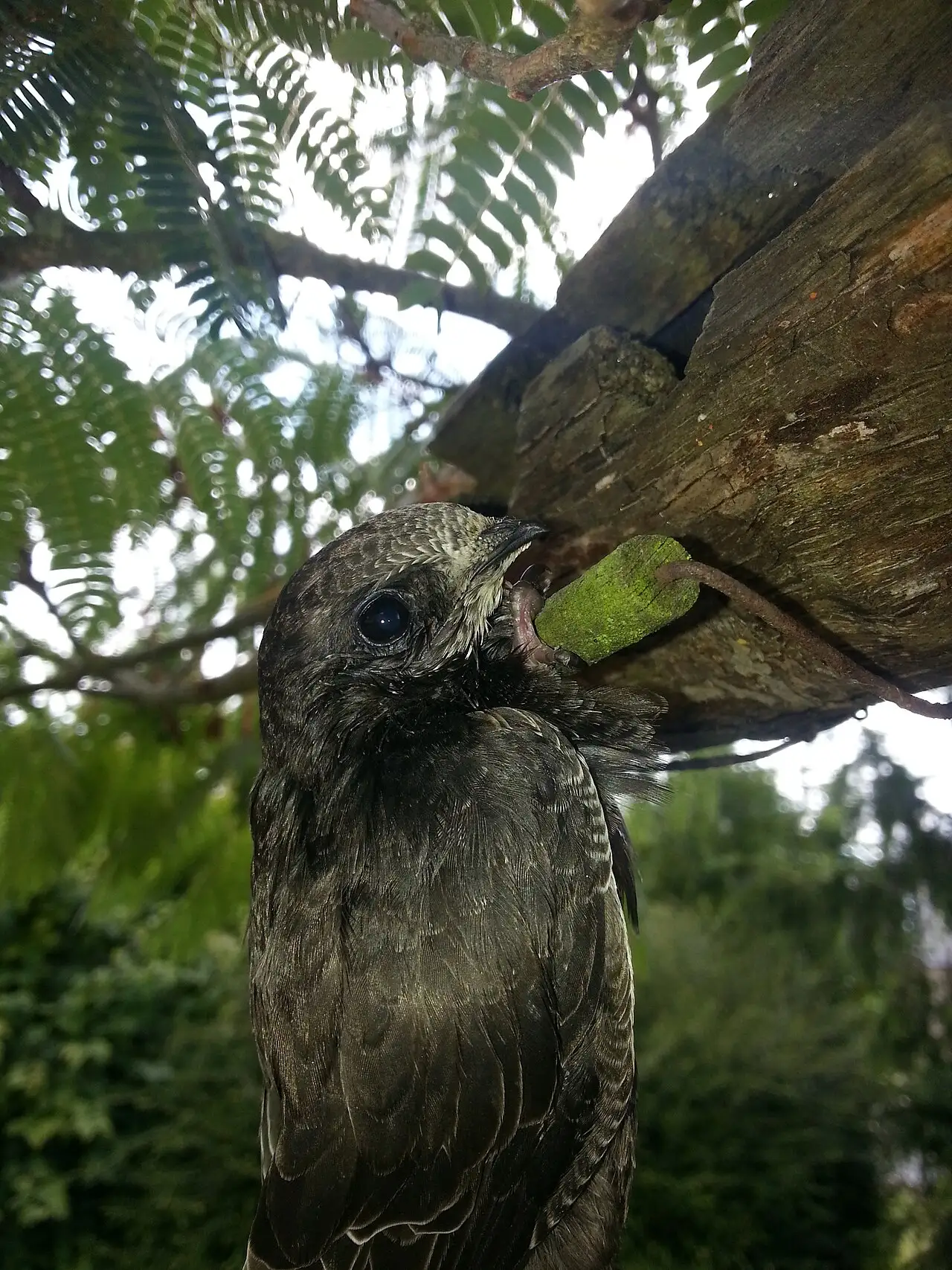
Common Swift clinging to a wooden beam, head-on, with its toes pointing forwardsPhoto: Finch, CC BY-SA 4.0Photo 4 of 4
1 / 4
Identification of the Common Swift
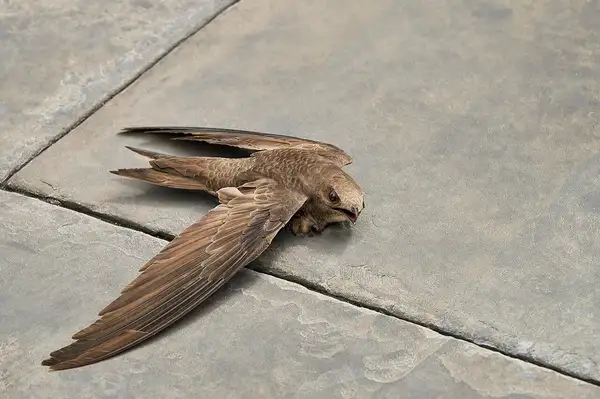
The Common Swift has a crossbow-shaped silhouette, with a short, forked tail and long, narrow wings. It has a short, flat bill with a very wide mouth, feathered and extremely short legs, which prevent it from perching on the ground, and small feet with strong claws, with all four toes pointing forwards. It shows uniform dark brown colouring, almost black, except on the throat, which is white; the underside of the wings is somewhat paler. In autumn, with its worn plumage, it is somewhat lighter. Both sexes are alike.
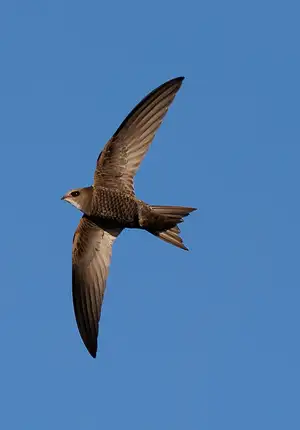
Juveniles are very like the adults, though a little darker and with a scaly look, from the small white edges of the feathers. It is almost always seen in flight and in a group, and light conditions, background and distance determine its appearance, so it can often be confused with the Pallid Swift.
Adult
Dark brown, almost black, with white throat.
Long, narrow wings, short, forked tail.
Young bird
A slightly darker tone and a scaly look, from the white edges of the feathers.
Habitat and distribution of the Common Swift
As a breeder it occupies almost the whole Palearctic, except the Sahara and the northern and eastern extremes of Asia. It winters in Africa south of the equator. It is very common throughout its breeding range and is the only swift present in most of Europe. Two subspecies have been described: «apus», in the western half of the range, which is the one in Spain, and «pekinensis», in the eastern half.
It occupies the whole Peninsula, the Balearics, Ceuta and Melilla, where it is widely distributed, and in a very localised way at least four islands of the Canary archipelago.
Its specialisation in the air makes it independent of habitat, except when nesting: it occupies all the habitats of the Palearctic, from desert to tundra and from sea level to high mountains. It is undemanding and only requires areas with flying insects, water and holes in which to place the nest, although it is more numerous in warm, dry areas. In Spain it nests almost exclusively in human structures, above all buildings, and the size of the colonies is usually related to that of the town.
It is a summer visitor to Spain and a long-distance migrant, with wintering areas in southern Africa, although there are occasional records in midwinter. It can fly up to 1,000 kilometres in a single day. It starts to return from mid-March, but the colonies are occupied well into April and in May, depending on latitude. It leaves almost all the colonies at the end of July, and in August flocks are seen outside urban areas, with records continuing into September, possibly of northern birds on migration. Passage through the Strait of Gibraltar takes place in March–May and August–September, peaking in the latter month. Swifts seen in urban areas in February–March and September–October are usually Pallid Swifts.
Areas where it is regularly recorded since 2010Squares of about 25 km where it is recorded regularly (occasional passage records are left out). Data from GBIF.org (380,125 records, retrieved October 2026); outline from Natural Earth.
Etymology of the Common Swift
According to Wikipedia, «apus» is the Latin word for «swift», and derives from the Ancient Greek «a» («without») and «pous» («foot»), because they were believed to be swallows without legs. In other languages it is called «falciot negre» in Catalan, «cirrio común» in Galician, «sorbeltz arrunta» in Basque and «common swift» in English1.
Population of the Common Swift
According to the 2021 European Red List of Birds, the population is estimated at some 32.2 to 56.7 million mature individuals. Although the European one has been stable in the long term, in the short term it shows a negative trend, above all in the United Kingdom, Germany, Sweden or Russia. In Spain the censuses have been very complex, as it is one of the commonest birds, and the estimates are very different: a 2008 study with data from the SACRE programme gave almost 33 million swifts, while the Third Atlas of Breeding Birds estimates only 4.17 million. Castilla-La Mancha is the region with the largest share of the national total, followed by Castilla y León, Catalonia, Andalusia and Aragón, and the highest densities are in towns and cities. The Spanish population has a declining trend in the long and the short term, with a decline of 40% between 1998 and 2018, sharper in the Mediterranean area and the south; that of the mountain areas seems stable.
Among the main threats are the loss of nesting sites (demolitions and destruction of holes, new buildings, its fidelity to the sites it has chosen and building work in the middle of the breeding season that destroys whole colonies), intensive farming and pesticides, which reduce the insects it feeds on, and climate change, which affects the underground larvae of many insects and makes it harder for the young to survive. It is proposed to include it in the Spanish Catalogue of Threatened Species as «Vulnerable», to avoid work on buildings with nests, to put up nest boxes and to reduce pesticides1.
Nest of the Common Swift
The nest, always inside a hole, is a cup 10–12 centimetres across, made of plant matter and feathers glued together with saliva. It is usually placed in holes in buildings in urban centres; in small numbers it also nests on crags, banks and in tree holes, at least of pines and palms. It is almost always colonial, with nests very close together, sometimes only a metre apart.
Courtship and breeding of the Common Swift
Most pairs begin breeding in May and extend the breeding period until July, when the chicks fly. It lays a single clutch a year. It mates both in flight and inside the nest. It shows great fidelity to its mate and usually returns to the same nest each year. The usual clutch is two or three white eggs, although it can range from one to four. Both sexes incubate for 20 days and feed the chicks about 10 times a day until they fly, at 40–45 days. In bad weather, the parents leave the breeding area and leave the chicks alone, which survive up to a week without eating thanks to stored fat and a slowing of the metabolism, a state of torpor. It reaches sexual maturity at two years.
Diet of the Common Swift
It is a specialist in catching small flying insects, the so-called aerial plankton, which it gets by sweeping the air in flight with its mouth open, like a butterfly net. It avoids stinging insects and those of some size, with a maximum of about 12 millimetres. More than 500 different prey have been described in Europe; the most prominent in Spain are hymenopterans (above all ants), bugs, flies, mosquitoes and neuropterans (antlions). It drinks in flight.
Curious facts about the Common Swift
Swifts represent the extreme adaptation of birds to aerial life: their whole life cycle can take place in flight, except nesting. It is the only European swift that lives in relatively cold areas, and its chicks can enter a state of torpor similar to hibernation to get through adverse weather. In 2021 SEO/BirdLife named it Bird of the Year. Records of at least 21 years of age are cited1; EURING lists 21 years and 1 month, and AnAge, 21.1 years.
The Common Swift in Cabañeros
The habitat pages of this website do not mention it. GBIF.org records 141 observations of the Common Swift in Cabañeros and its surroundings.
Where to see the Common Swift in Cabañeros
In Cabañeros and its surroundings, from April to September.
When
From April to September: it returns from mid-March and leaves the colonies at the end of July, with records into September.
What time
In good light and, above all, on the evenings of the warm months, when it screams in flight.
Where
In the sky over towns and cities, above rooftops and near water, where it drinks in flight.
What to look for
Look for the crossbow silhouette, the almost black colour and the white throat; to separate it from the Pallid Swift, listen to its voice.
It is similar in song and appearance1: they are often confused, depending on light, background and distance. The voice is important to tell them apart.



 Same family
 Same family
 Same family
 Same order
 Same order
 Same season in the park
 Same season in the park
 Same season in the park





