Wingspan compared with a person with arms outstretched.
Length
30–32 cm
Wingspan
66–73 cm
Weight
140 g
Social life
Both adults incubate; both care for the chicks, although feeding is done mostly by the female
Lifespan
Record of 10 years and 11 months in the wild (a bird ringed in Hungary)
Conservation status
LC
NT
VU
EN
CR
EW
EX
Global (IUCN)
Least Concern
Spain
Endangered (EN) in the 2021 Red Book of the Birds of Spain; on the List of Wild Species under Special Protection, but not in the Spanish Catalogue of Threatened Species
When to see it
Summer visitor
Months of the year when it is present
J
F
M
A
M
J
J
A
S
O
N
D
In Iberia
no
no
no
yes
yes
yes
yes
yes
yes
yes
no
no
Song or voice of the European Roller
The Spanish name of this bird, «carraca» (a wooden rattle), refers to the characteristic sound of its call, a low «rak-cra-cra-cra», like a wooden rattle.
CallEuropean Roller
0:00 / 0:26
10 kHz5
The sonogram draws the sound: time runs from left to right, and the higher a trace sits, the higher the note.Recording by AviCanto, Wikimedia Commons (Vídeo de YouTube, con atribución).
Flight of the European Roller
It is a migratory species: in Spain it arrives between April and May, and the post-breeding migration begins in August or September. It is a typical trans-Saharan migrant, with its wintering area in much of tropical Africa.
Flight typeFrom a perch after large insects
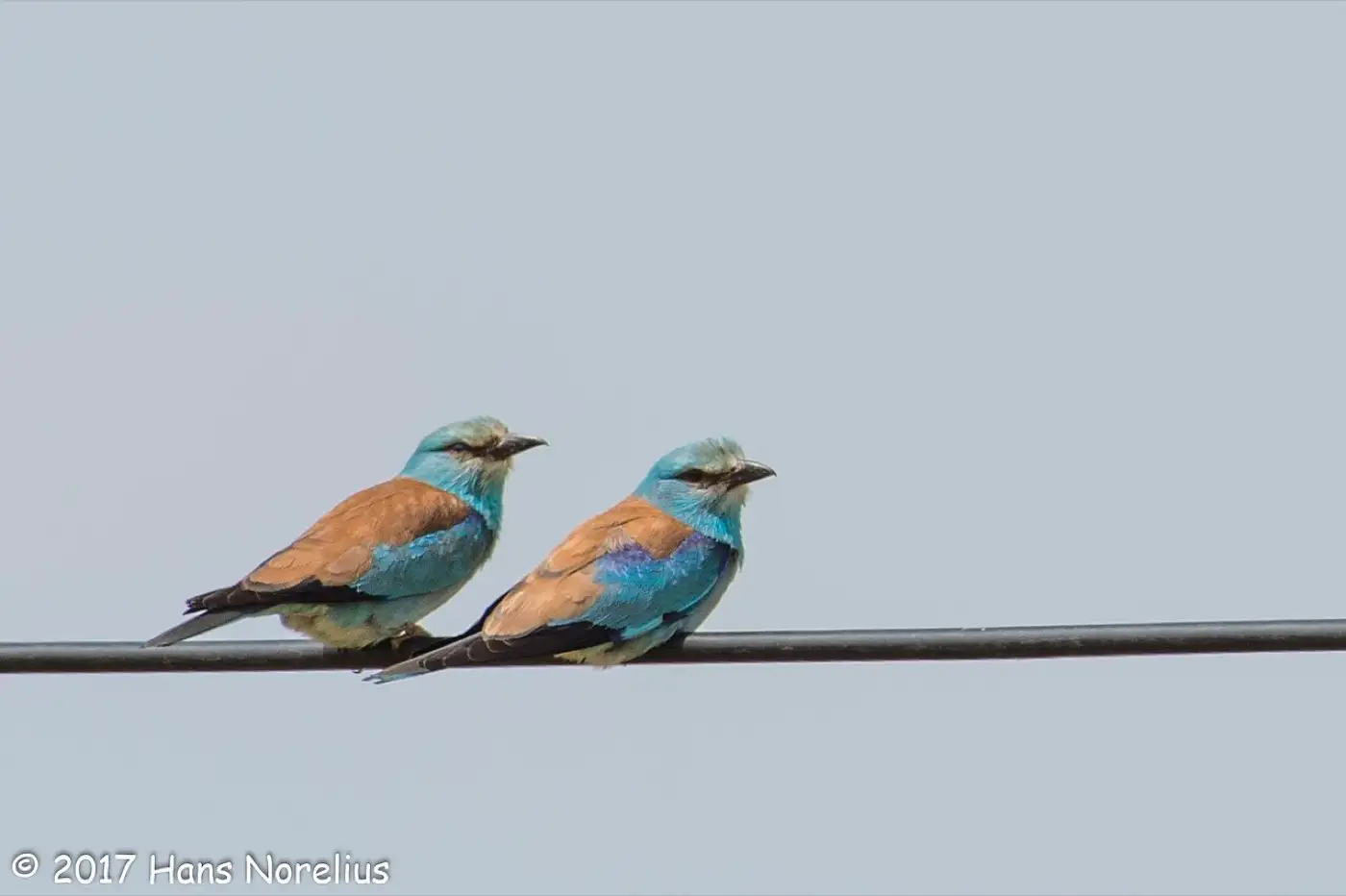
It launches itself from a high branch, a wire or a pole in an open landscape with scattered trees, in search of large insects.
It catches beetles and dragonflies in flight, or comes down to the ground to catch grasshoppers, crickets and centipedes; sometimes it kills a small lizard or a mouse with its strong bill.
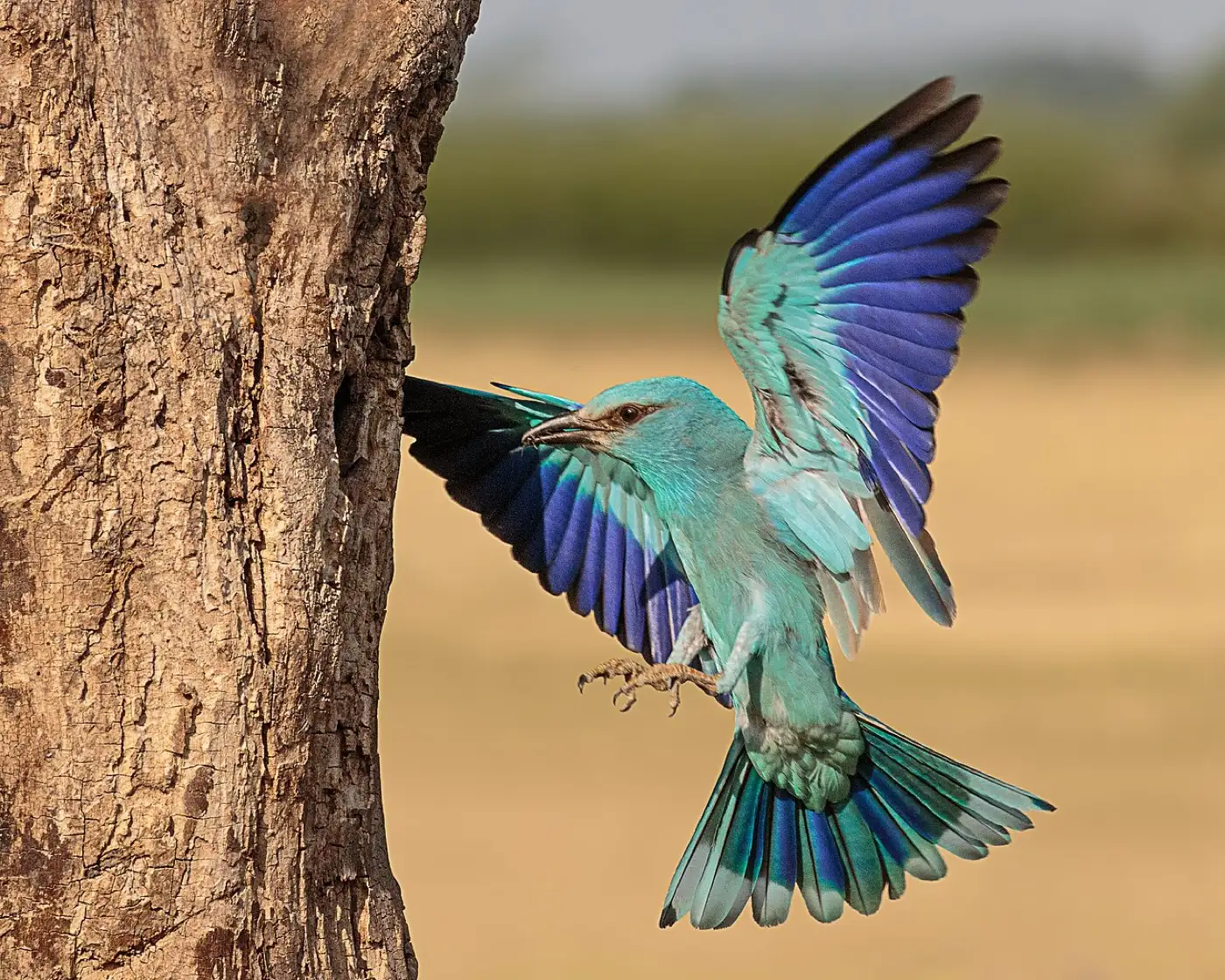
It returns to the perch, from where the blue of the wings can be seen, or to the hole in the old tree where it nests.
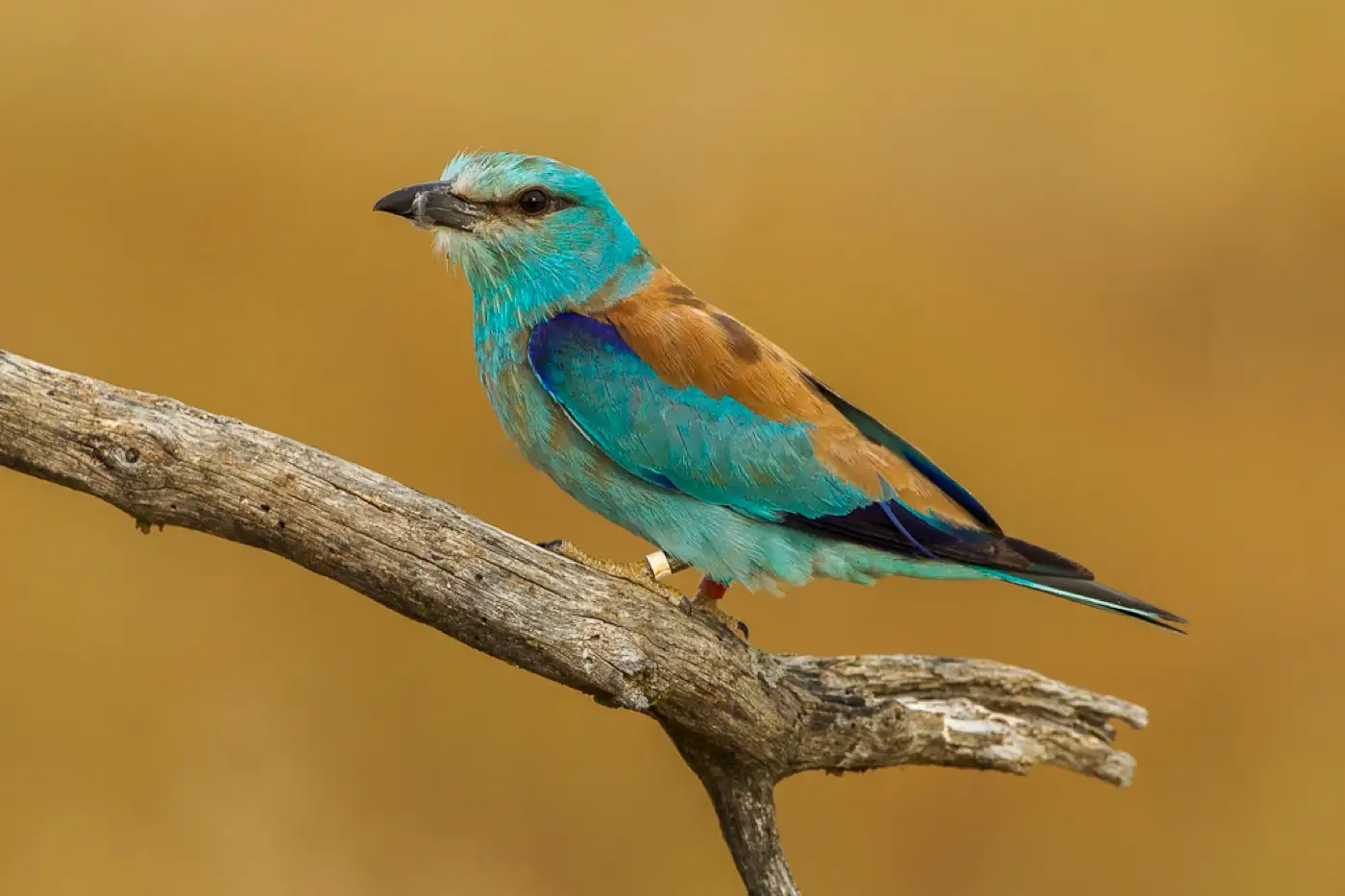
European Roller perched on a dry branch at Castuera (Badajoz), with chestnut back, turquoise head and blue wingsPhoto: Francesco Veronesi from Italy, CC BY-SA 2.0Photo 2 of 4
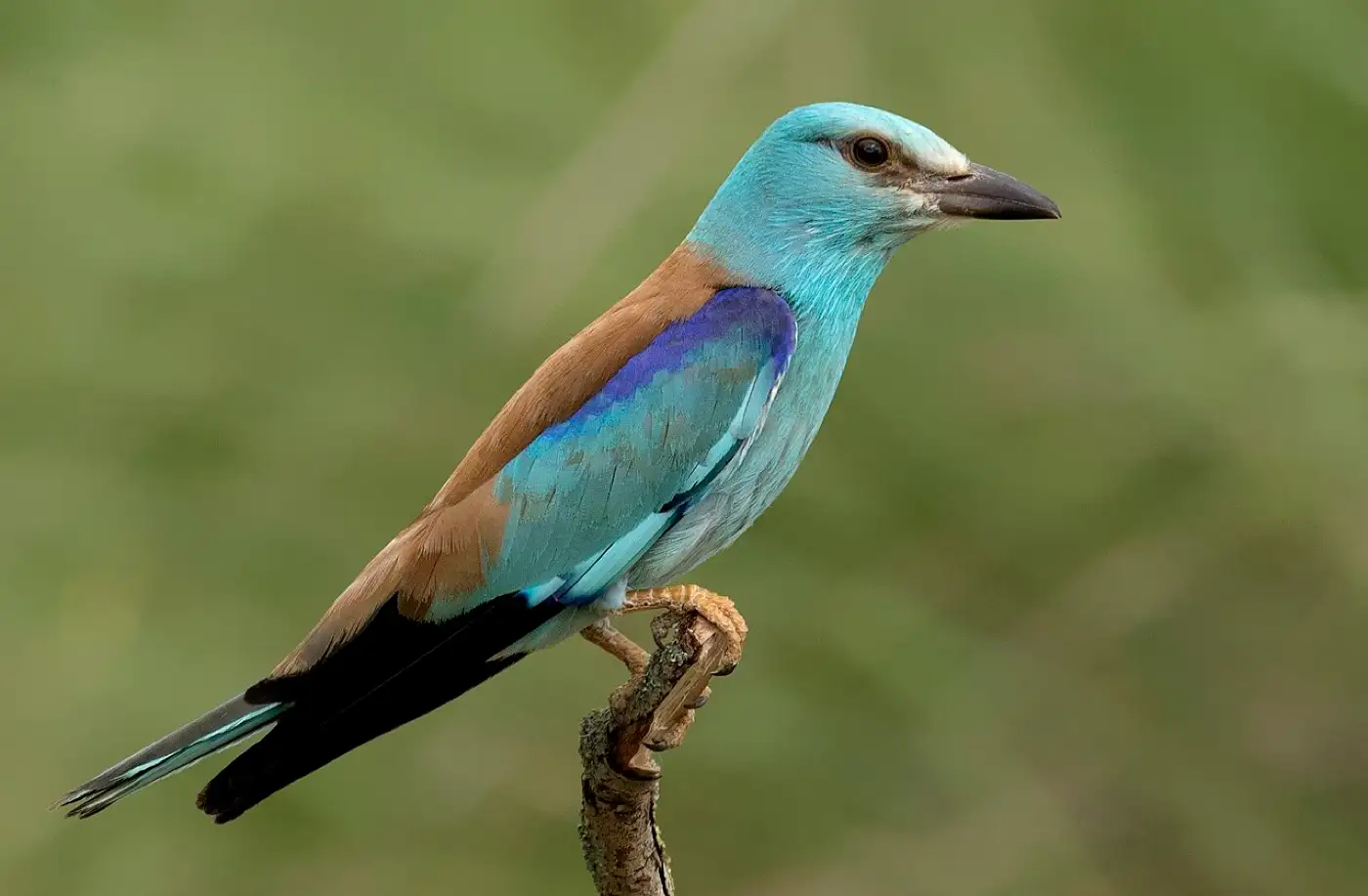
European Roller in profile on a pole, with reddish-chestnut back, indigo wing and long tailPhoto: Zeynel Cebeci, CC BY-SA 4.0Photo 4 of 4
1 / 4
Identification of the European Roller
The European Roller is a bird of unmistakable appearance. It wears spectacular colours, in which different ranges of blue predominate, from the blue-green of the head to the indigo of the central tail feathers or the rump. In contrast, the back has a reddish-chestnut tone. The pattern of the two sexes is similar and becomes showier in the breeding season. Young birds have a colour pattern similar to the adults’, but in duller tones.
Adult
Blue-green head, central tail feathers and rump indigo.
Reddish-chestnut back.
Young bird
Pattern similar to the adult’s, in duller tones.
Habitat and distribution of the European Roller
When breeding it spreads across the temperate and Mediterranean strip of the Palaearctic region, from north-west Africa to the west of the Himalayas. After breeding it moves to the tropical regions of Asia and Africa. It has several subspecies, and «garrulus» is the one that inhabits the Peninsula.
In Spain, its presence is quite fragmentary. On the Peninsula, the Iberian System divides two large areas of occupation: a core in southern Huesca, Lleida and Tarragona, and a more southerly distribution through the south of Castilla y León, Madrid, Extremadura, Castilla-La Mancha, inland Andalusia, the region of Murcia and southern Valencia. It is absent from both archipelagos and from the North African territories.
It prefers rather open areas, with crops, farmland, livestock pastures and scattered trees: it usually settles in dehesas, thinned pine and cork oak woods, groves near cultivated areas and mosaic farming landscapes. It is scarce or absent in very arid or treeless regions and inside dense woods. Its abundance seems related to the existence of suitable nesting places.
The European subspecies is a typical trans-Saharan migrant, with its wintering area in much of tropical Africa. The post-breeding migration begins in August or September, and the first birds appear in Spain in April and May.
Areas where it is regularly recorded since 2010Squares of about 25 km where it is recorded regularly (occasional passage records are left out). Data from GBIF.org (14,670 records, retrieved October 2026); outline from Natural Earth.
Etymology of the European Roller
«Coracias» comes from the Greek «korakías», the name of a species of corvid, perhaps the Red-billed Chough. «Garrulus» is the Latin for «chatterer», from its call. The Spanish name, «carraca», imitates that sound, like a wooden rattle.
Population of the European Roller
The 2021 European Red List of Birds estimates a population of about 102,000–208,000 European Rollers, with a decreasing trend. In Spain it is hard to know its trend exactly, because there are no overall censuses, but in some regions striking declines have been detected and the general feeling is of a considerable thinning out. In Madrid it was found in 2016 that it had disappeared from 26 UTM squares compared with its distribution 25 years earlier; in Extremadura, the occupied squares fell from 180 in 1990 to 36 in 2019; and in the Hoya de Guadix (Granada) it has disappeared as a breeder in just 10 years. The main problem is habitat loss through agricultural intensification, crop changes, the disappearance of tree-lined boundaries and the deterioration of the rural buildings where it nests; the mass use of insecticides affects the availability of prey; and there are accidents on power lines, road kills and shooting in the African wintering areas.
Nest of the European Roller
It has cave-dwelling habits and chooses a great variety of sites: hollows in old trees, human constructions, holes in sandy banks, old woodpecker nests and even nest boxes.
Courtship and breeding of the European Roller
Laying, which usually takes place in June, consists of three to five white eggs, incubated for 17–20 days by both adults. The chicks hatch asynchronously, because incubation starts after the first egg is laid. Both members of the pair care for the brood, although feeding is done mostly by the female. The young leave the nest 25 to 30 days after hatching, and the adults keep feeding them for four or five weeks more.
Diet of the European Roller
Its diet is basically insectivorous: it catches a great variety of flying invertebrates (beetles, dragonflies), as well as other large terrestrial invertebrates, such as grasshoppers, crickets and centipedes. Occasionally it eats small vertebrates, such as lizards, snakes and mice, which it kills with its stout bill.
Curious facts about the European Roller
Its most characteristic feature is its colourful plumage in blue and chestnut tones. It was SEO/BirdLife’s Bird of the Year 2012. Its decline is worrying across much of Europe and in the Iberian populations.
The European Roller in Cabañeros
This website’s page on dehesas lists it among the species of the breeding birdlife of the dehesas of Cabañeros, and notes that it breeds «in the scarce hollows of the trees».
Where to see the European Roller in Cabañeros
In the dehesas of Cabañeros, in the hollows of old trees.
When
From April to October: it arrives between April and May and leaves in August or September.
What time
Throughout the day, perched on wires, branches and posts.
Where
In dehesas, thinned pine and cork oak woods and farmland with scattered trees.
What to look for
A turquoise and indigo bird, with a chestnut back, that watches from on high.
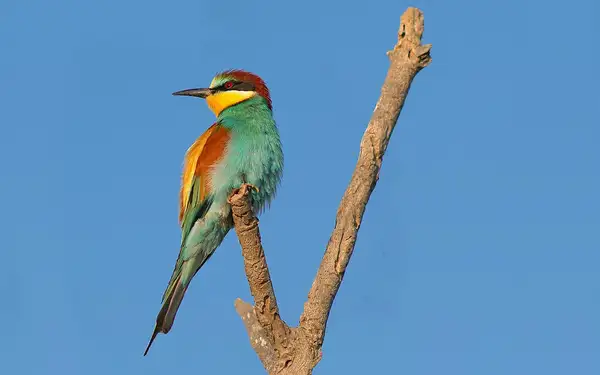
They are not confused, but share colouring, habitat and insect-eating habits: the raña and dehesas of the park. The bee-eater, the size of a Song Thrush, has a long, curved bill, chestnut back and yellow throat.
Photo: Trebol-a, CC BY 3.0
Other birds
Birds related to the European Roller or sharing its habitats in Cabañeros.



 Also in dehesas (wood pasture)
 Also in dehesas (wood pasture)
 Also in dehesas (wood pasture)
 Also in dehesas (wood pasture)
 Also in dehesas (wood pasture)
 Also in dehesas (wood pasture)
 Also in dehesas (wood pasture)
 Also in dehesas (wood pasture)






