Resident on the Peninsula; it often makes a second clutch per season
Lifespan
Record of 7 years and 11 months in the wild (a bird ringed in Spain)
Conservation status
LC
NT
VU
EN
CR
EW
EX
Global (IUCN)
Least Concern
Spain
Least Concern (LC) in the Red Book of the Birds of Spain; included in the List of Wild Species under Special Protection and not in the Spanish Catalogue of Threatened Species
When to see it
Resident
Months of the year when it is present
J
F
M
A
M
J
J
A
S
O
N
D
In Iberia
yes
yes
yes
yes
yes
yes
yes
yes
yes
yes
yes
yes
Breeding season
no
no
no
yes
yes
yes
yes
no
no
no
no
no
Song or voice of the Rock Bunting
As a call it often gives soft, somewhat prolonged whistles, «tsi». In spring, the male delivers from the top of a shrub or a rock a clear, fairly elaborate and varied trill, which begins haltingly, then speeds up and is embellished with marked changes of rhythm. The recording is from Monfragüe (Cáceres).
SongRock Bunting
0:00 / 0:19
10 kHz5
The sonogram draws the sound: time runs from left to right, and the higher a trace sits, the higher the note.Recording by Tanguy Loïs, Wikimedia Commons (CC BY-SA 4.0).
Flight of the Rock Bunting
It is a fairly large, bulky bunting, with relatively short wings and a long tail. On the Peninsula it makes almost no altitudinal movements in the unfavourable season.
Flight typeUndulating and short, between bushes and rocks
It leaves the stony slope, where it picks seeds from the ground and low vegetation and, in spring and summer, insects and other invertebrates.
Short flight, from one shrub or rock to another, with the long tail and relatively short wings.
It perches on a shrub or a rock, from where the male delivers in spring his clear trill, which begins haltingly and speeds up.
Photo gallery of the Rock Bunting
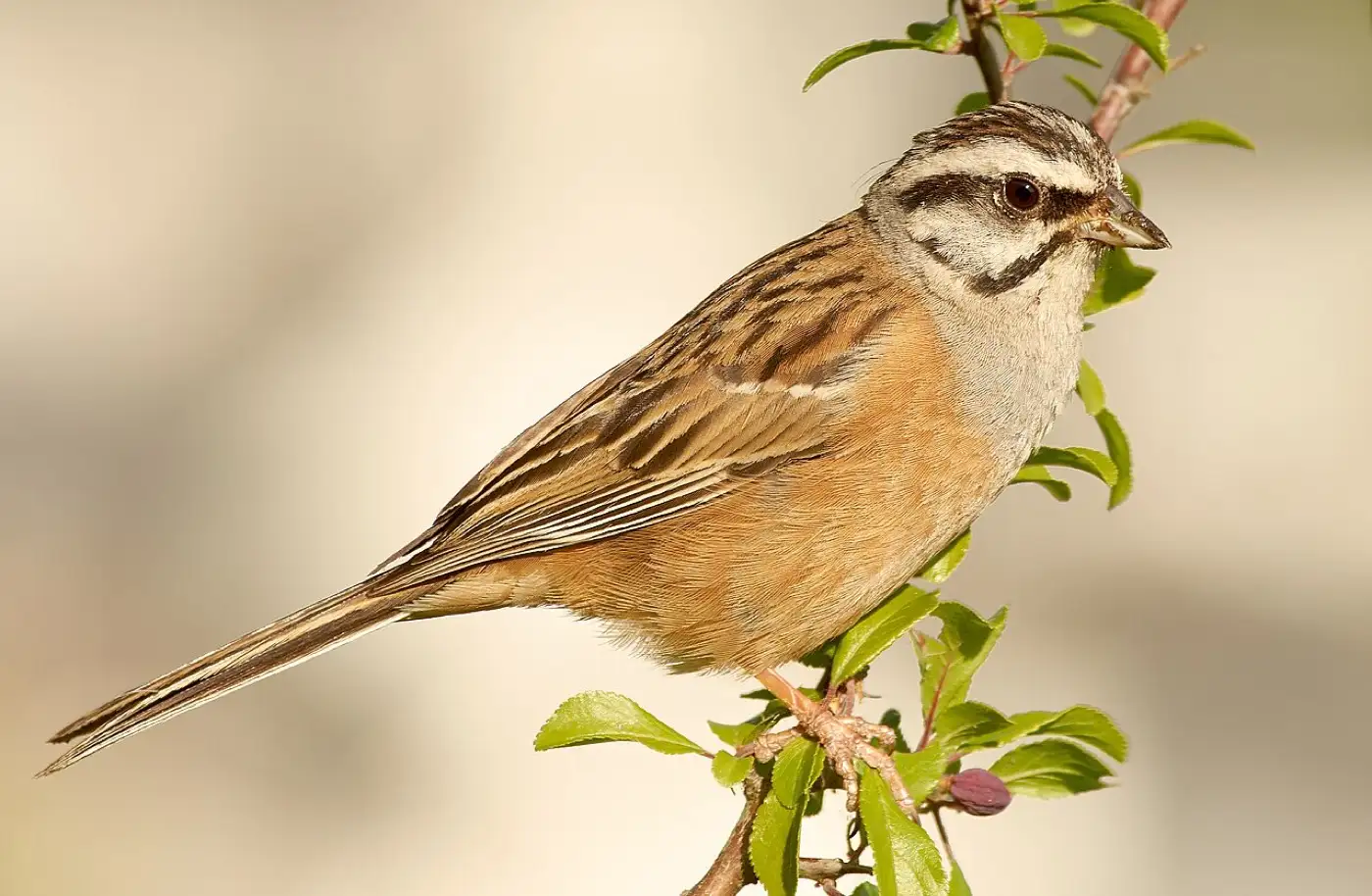
Rock Bunting in profile on a leafy branch, with the dark stripes on the head and orange breastPhoto: Hobbyfotowiki, CC0Photo 1 of 4
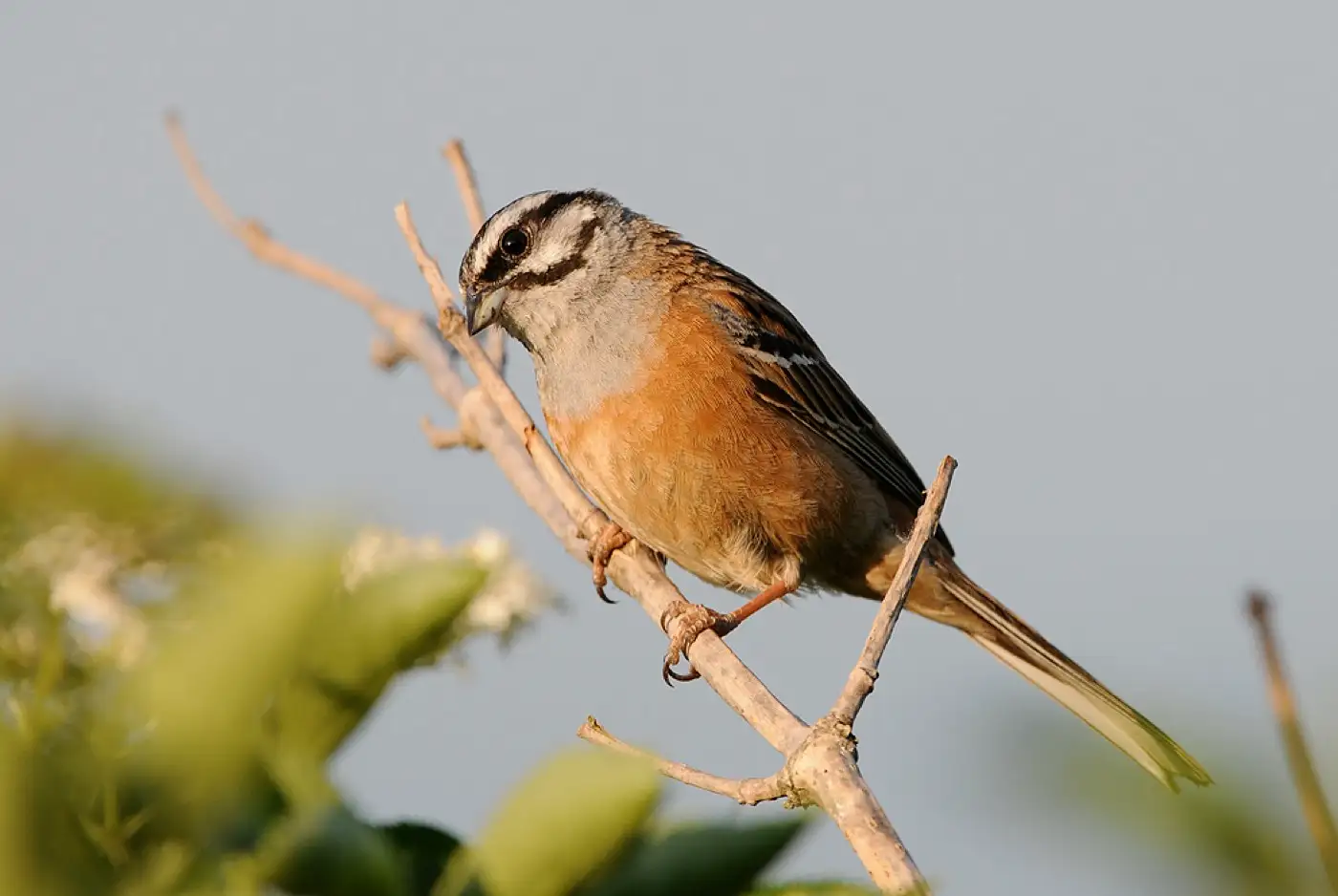
Rock Bunting perched on a dry branch, with long tail and orange breastPhoto: Ján Svetlík, CC BY-SA 2.0Photo 2 of 4
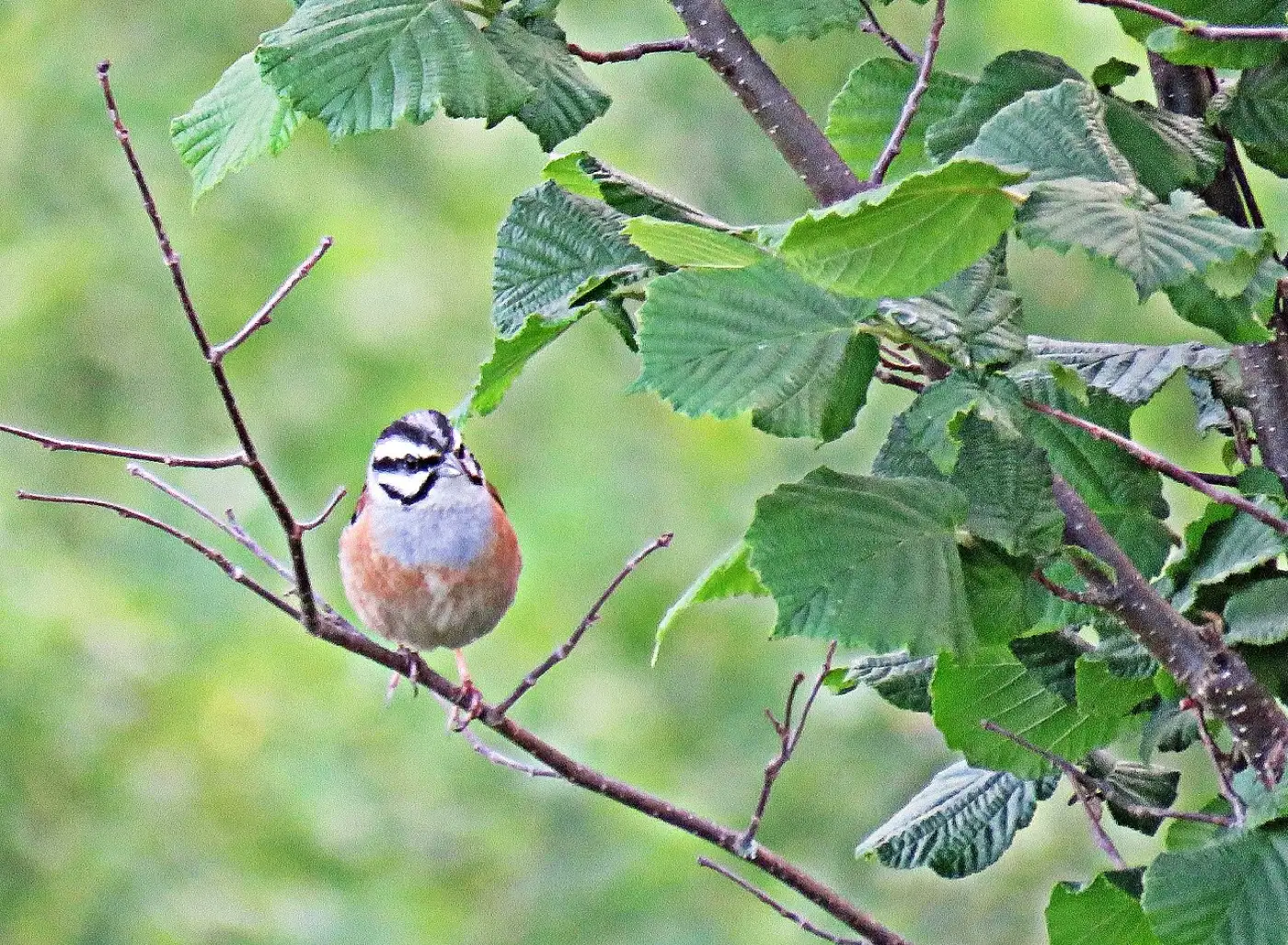
Male Rock Bunting among the leaves of a hazel, with grey head streaked with blackPhoto: Marcial Gijon, CC BY-SA 4.0Photo 3 of 4
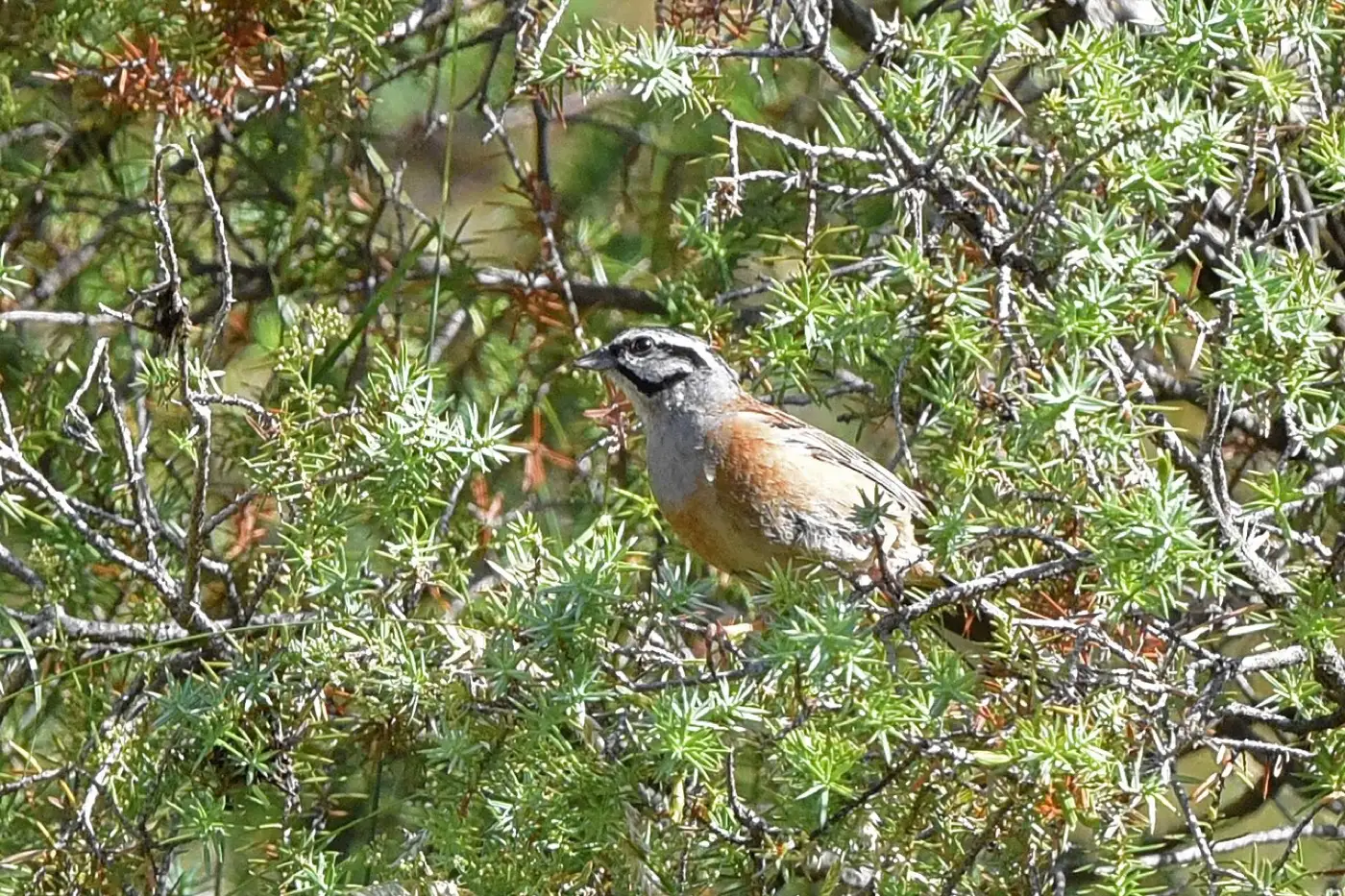
Rock Bunting among the branches of a juniper, with the dark stripes on the head and orange breastPhoto: Pierre-Marie Epiney, CC BY-SA 2.0Photo 4 of 4
1 / 4
Identification of the Rock Bunting
This is a fairly large, bulky bunting, with relatively short wings and a long tail, which wears on its head three characteristic dark stripes. The head, neck, nape and upper breast are greyish, while the rest of the body shows brown or rufous tones.
Outside the breeding season, males resemble females and immatures, although in the breeding period their colouring becomes brighter, with abundant orange tones on the breast and belly.
Adult
Grey head with three dark stripes; neck, nape and upper breast grey.
Rest of the body brown or rufous, more orange on breast and belly in the breeding season.
Young bird
Brownish plumage, heavily streaked on the breast.
Ochre-brown head, without side bands.
Habitat and distribution of the Rock Bunting
It is distributed across the temperate region of Eurasia and North Africa, although in a somewhat fragmented way, since it selects mainly mountain environments. Several subspecies are known.
In Spain it settles in more varied environments than in the rest of Europe, although it prefers mountain systems and broken areas of some altitude, so it is absent from the central parts of both plateaus, the Ebro and Guadalquivir depressions and certain coastal sites. It is absent from the Balearics and the Canaries, but present in Ceuta and Melilla. Two subspecies live in Spain: «cia», in the northern half, and «africana», in the mountainous regions of the south, Ceuta and Melilla.
It selects sunny sides of rocky hillsides and mountains, ravines, woodland clearings (above all of conifers), areas with shrubs and young trees, cultivated terraces and vineyards, and reaches high altitude in the zone of Spanish broom and other high-mountain scrub formations with low, scattered pines. In winter it comes down to riverside groves, open woodland and cultivated areas in search of food, and even enters parks and gardens. In Europe it seems to tend to use mountain areas for breeding, then come down to more sheltered zones or set off on migration to the Mediterranean countries in winter; on the Peninsula, however, the populations behave as residents.
Areas where it is regularly recorded since 2010Squares of about 25 km where it is recorded regularly (occasional passage records are left out). Data from GBIF.org (51,639 records, retrieved October 2026); outline from Natural Earth.
Etymology of the Rock Bunting
«Emberiza» comes from Old High German «Embritz», the name of a bunting. «Cia» comes from the local Italian name for this bird, which in turn comes from «zirlare», «to chirp».
Population of the Rock Bunting
In the 2021 European Red List of Birds the European breeding population is estimated at between 3,880,000 and 8,580,000 mature individuals, with a decreasing trend. The Spanish population was put at around 2,000,000 individuals between 2008 and 2014, with the largest populations in Castilla y León, Andalusia, Castilla-La Mancha, Aragon, Catalonia and Galicia, and its trend between 2008 and 2018 seems stable. The most recent data seem to indicate a slight recovery in recent years. For the moment it does not seem to have major conservation problems, given its adaptability to more or less open or scrubby environments and to stages of recovering woodland; nevertheless, agricultural intensification works against these habitats, by transforming sparsely wooded valleys and other low and mid-mountain areas.
Nest of the Rock Bunting
The nest is generally placed near the ground, usually inside a dense, thorny shrub or tree, or in a gap in a wall among thick vegetation. It is an untidy cup of plant materials, which the female builds alone.
Courtship and breeding of the Rock Bunting
The breeding period usually begins in late April and ends in early July. The clutch is of three to six greyish or whitish eggs, with abundant irregular streaks, which the female incubates for 12–14 days. The chicks stay in the nest for 10 to 14 days, tended by both parents, and after leaving it they are still fed by their parents for a couple of weeks more, until they are independent. There is often a second clutch per season.
Diet of the Rock Bunting
It eats mainly grass seeds, as well as buds, shoots and assorted fruit. In spring and summer it adds a great variety of insects and other invertebrates, which it picks from the ground and low vegetation. As in other mostly seed-eating birds, the chicks are fed on invertebrates.
Curious facts about the Rock Bunting
In the breeding season the male sings from the top of a shrub or a rock. It is told from the other buntings by the three dark stripes on the head against a grey background. In Europe it comes down from the mountains in winter, and on the Peninsula it is resident.
The Rock Bunting in Cabañeros
This website’s page on deciduous woodland cites it among the species that live at lower density in those woods of Cabañeros, together with the Great Spotted Woodpecker, the Common Blackbird, the Eurasian Nuthatch, the Short-toed Treecreeper, the Hawfinch and the Eurasian Jay.
Where to see the Rock Bunting in Cabañeros
In the deciduous woods of Cabañeros, although at lower density than other woodland birds.
When
All year: it is resident.
What time
Throughout the day; in spring, the male sings from the top of a shrub or a rock.
Where
On stony, sunny slopes with scattered scrub and in woodland clearings; in winter it comes down to riverside groves and cultivated areas.
What to look for
A large, long-tailed bunting, with a grey head with three dark stripes and a reddish-brown body.
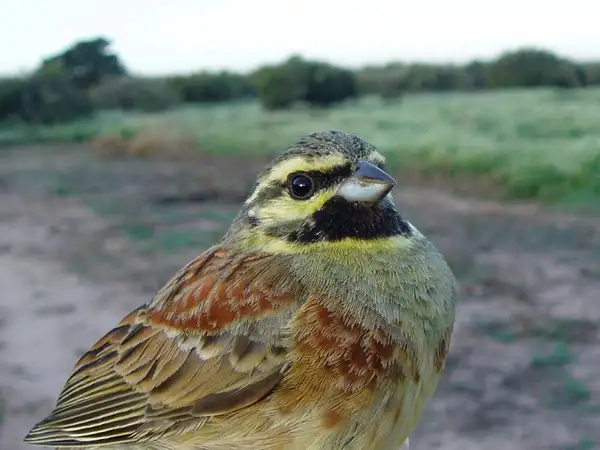
They are similar in appearance1. The Cirl Bunting is somewhat smaller and shorter-tailed, and the male has a black bib on the throat, a black mask and an olive-grey breast band.
Photo: Ximo, CC BY 3.0
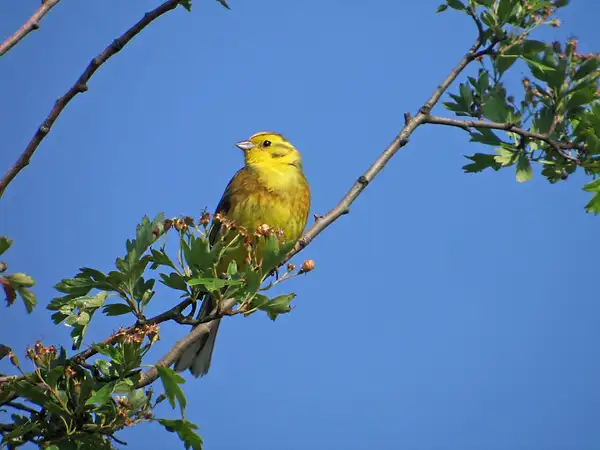
Yellowhammer
Emberiza citrinella
How to tell them apart
The Yellowhammer, with yellow head and underparts, lacks the Rock Bunting’s grey head with three dark stripes and orange breast.
Photo: F.branswyck, CC BY-SA 4.0
Other birds
Birds related to the Rock Bunting or sharing its habitats in Cabañeros.



 Same family
 Same family
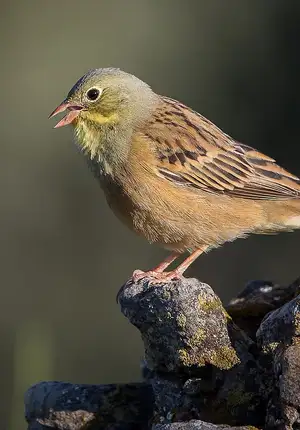 Same family
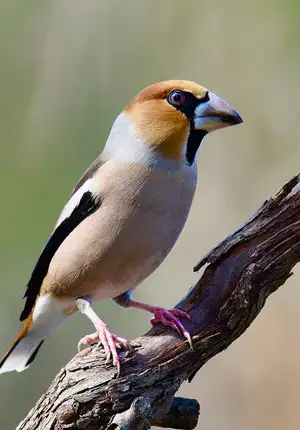 Also in deciduous woodland
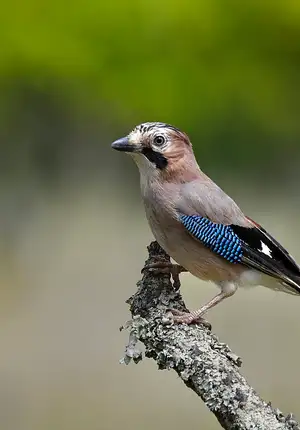 Also in deciduous woodland
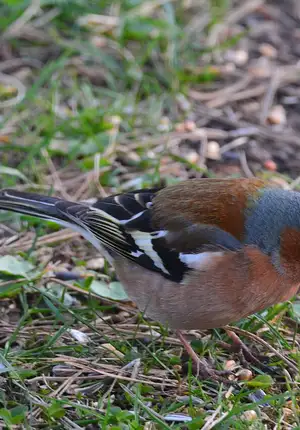 Also in deciduous woodland
 Also in deciduous woodland
 Also in deciduous woodland






