Wingspan compared with a person with arms outstretched.
Length
36–38 cm
Wingspan
70–80 cm
Weight
0.6–1.2 kg
Social life
Gregarious: it forms large flocks in winter; when breeding, paired birds are very territorial and exclusive
Lifespan
Record of 23 years and 1 month according to EURING (a bird ringed in the Netherlands and found in poor condition, which was released); AnAge gives up to 20.6 years
Conservation status
LC
NT
VU
EN
CR
EW
EX
Global (IUCN)
Least Concern
Spain
Least Concern (LC) in the Red Book of the Birds of Spain; not on the List of Wild Species under Special Protection or in the Spanish Catalogue of Threatened Species
When to see it
Resident
Months of the year when it is present
J
F
M
A
M
J
J
A
S
O
N
D
In Iberia
yes
yes
yes
yes
yes
yes
yes
yes
yes
yes
yes
yes
Song or voice of the Eurasian Coot
It is a fairly noisy bird that gives different calls, in particular a high, brief «quiuc»; it also makes several two-syllable cries and a sharp, explosive «squic».
CallEurasian Coot
0:00 / 0:26
10 kHz5
The sonogram draws the sound: time runs from left to right, and the higher a trace sits, the higher the note.Recording by Marie-Lan Taÿ Pamart, xeno-canto XC519436 (Meaux, Francia) (CC BY-SA 4.0).
Flight of the Eurasian Coot
Its plumage is practically black, and on the wing the white tips of the secondary flight feathers stand out.
Flight typeLow, with the white tips of the secondaries in view
It usually favours open, calm waters of relative depth, with muddy shores and dense stands of marsh vegetation in which it hides and nests.
Its plumage is practically black, apart from the flanks and underparts, which are somewhat greyish, and the tips of the secondary flight feathers, which are white.
It is a gregarious bird that forms large flocks during the winter; when breeding begins, paired birds leave the groups to settle among the riverside vegetation.
Photo gallery of the Eurasian Coot
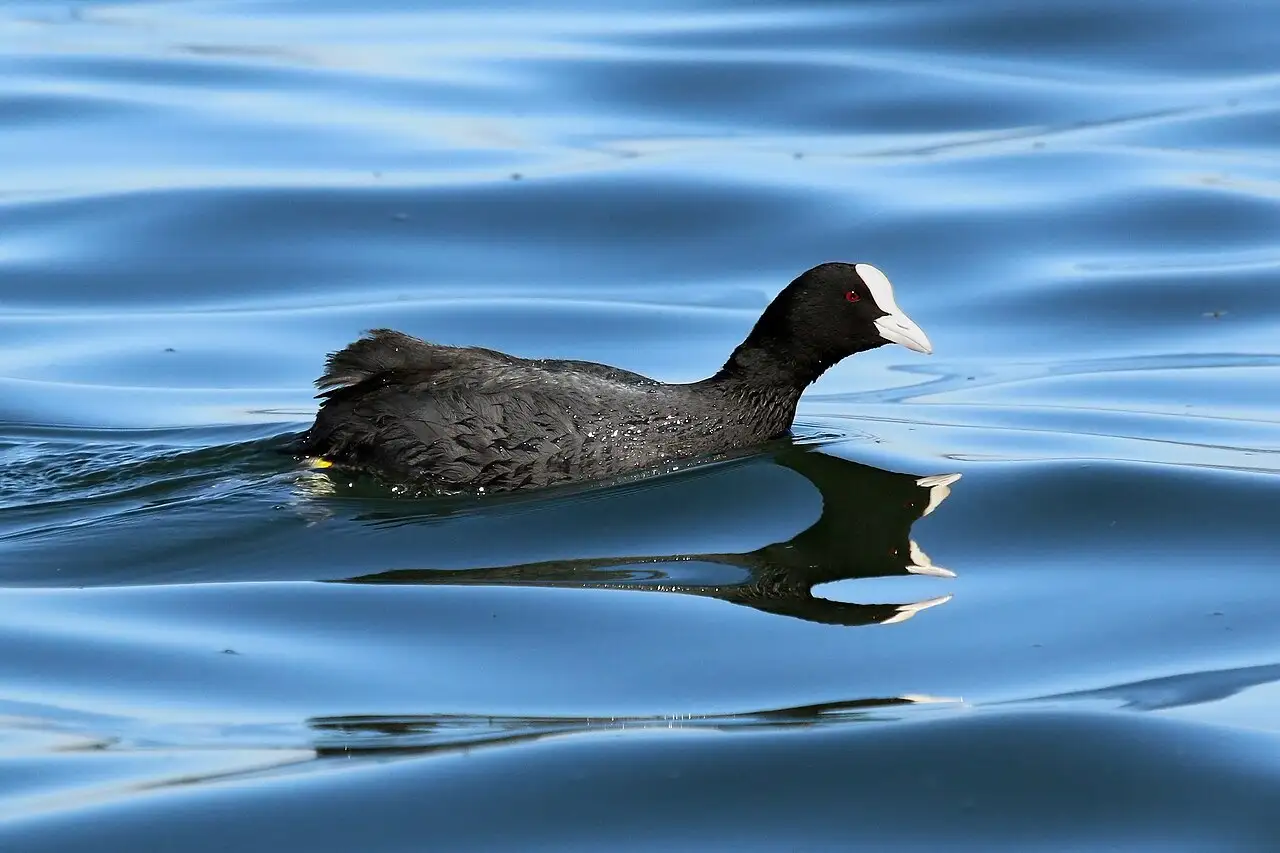
Eurasian Coot swimming in blue water, in profile, with almost black plumage and the white frontal shield and billPhoto: Charles J. Sharp, CC BY-SA 4.0Photo 1 of 4
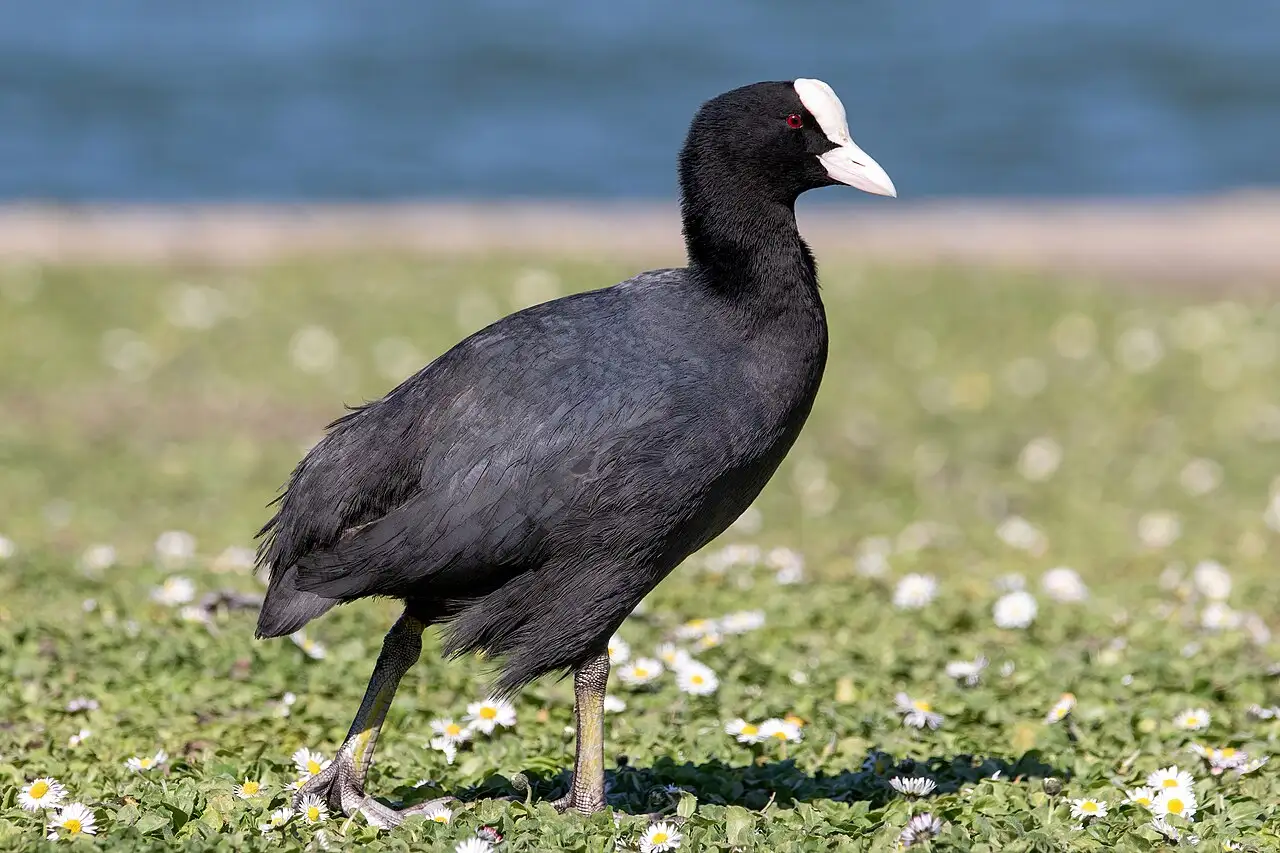
Eurasian Coot walking on the grass, with the long toes lobed with broad lobes and the white shieldPhoto: Alexis Lours, CC BY 4.0Photo 3 of 4
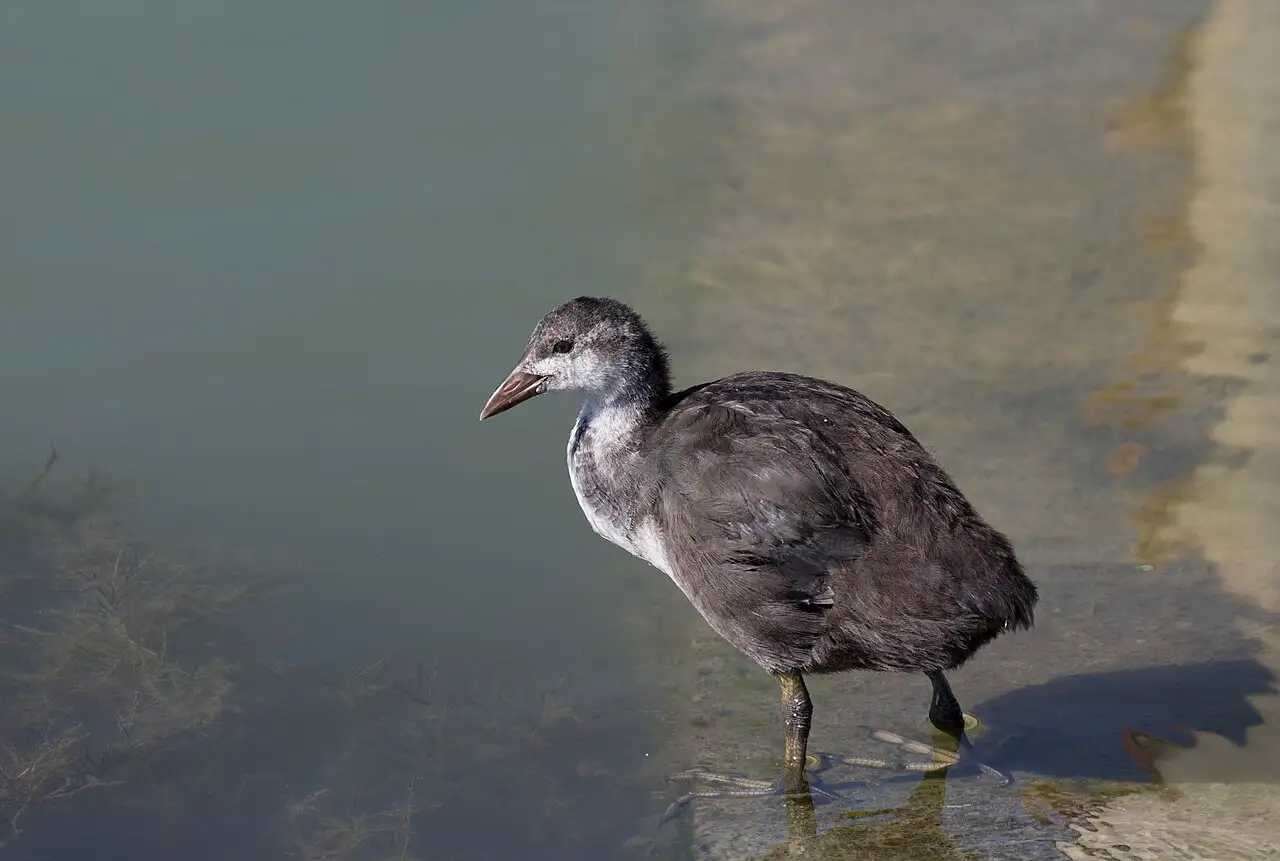
Young Eurasian Coot in shallow water, with greyish-brown plumage and paler throat and face, with an ochre billPhoto: Zeynel Cebeci, CC BY-SA 4.0Photo 4 of 4
1 / 4
Identification of the Eurasian Coot
The Eurasian Coot is a robust, good-sized rail, with practically black plumage, apart from the flanks and underparts, which take on a certain greyish tone, and the tips of the secondary flight feathers, which are white. The most striking aspect of its anatomy is the white frontal shield, which narrows towards the base of the bill, also white. Out of the water its peculiar toes can be seen, long and lobed with broad rounded lobes, which help the bird move forward when it swims.
Adult
Almost black plumage, with flanks and underparts somewhat greyish.
White frontal shield and bill.
White tips to the secondary flight feathers.
Young bird
Brownish dress with greyish nuances, paler on the throat and face.
Shield much reduced and ochre in colour.
Habitat and distribution of the Eurasian Coot
It is a widely distributed species, which can be seen from North Africa to the Far East. In Europe it is spread evenly across all suitable sites, even in the Scandinavian countries. Several subspecies have been described, and in Spain we find «atra».
It is distributed across the wetlands of the whole Peninsula, the Canaries and the Balearics, and is absent from Ceuta and Melilla; it is less frequent in Galicia, Asturias and Cantabria. Accommodating by nature, it is not particularly demanding: it settles in a great variety of natural or artificial wetlands, from brackish lagoons to marshes, reservoirs, rivers and mountain lakes. It usually favours open, calm waters, of relative depth and little current, with plenty of muddy shores and dense stands of marsh vegetation in which it hides and nests. It needs submerged vegetation, which can be a limiting factor in breeding. In winter it frequents habitats of the same characteristics.
It behaves as a partial migrant: birds of central and southern Europe are sedentary, although they make movements of some range in bad weather or when food is scarce, and the northern populations move south in the unfavourable season, so that some end up in the Guadalquivir marshes, the Ebro delta and El Hondo, and even cross to Africa. The coots resident in Spain are basically sedentary, although dispersive movements after breeding and flights away because of droughts are usual.
Areas where it is regularly recorded since 2010Squares of about 25 km where it is recorded regularly (occasional passage records are left out). Data from GBIF.org (308,869 records, retrieved October 2026); outline from Natural Earth.
Etymology of the Eurasian Coot
According to Wikipedia, the scientific name comes from Latin: «Fulica» means «coot» and «atra», «black». Linnaeus described it in 1758. In other languages it is called «fotja comuna» in Catalan, «galo de auga común» in Galician, «kopetazuri arrunta» in Basque and «Eurasian coot» in English1.
Population of the Eurasian Coot
In the 2021 European Red List of Birds the European breeding population is estimated at between 2,030,000 and 3,360,000 mature individuals, with a decreasing trend. The last census, from 2007, put the figure in Spain at 50,200–112,500 birds, a number that varies every year because of the irregular water levels of the wetlands, and the population seems to be on a slight downward trend, as in the rest of the continent1. Although the species seems to be in a good conservation state, it depends on wetlands with certain characteristics, so human-induced changes can affect the population locally; drought cycles and hunting pressure also have an influence.
Nest of the Eurasian Coot
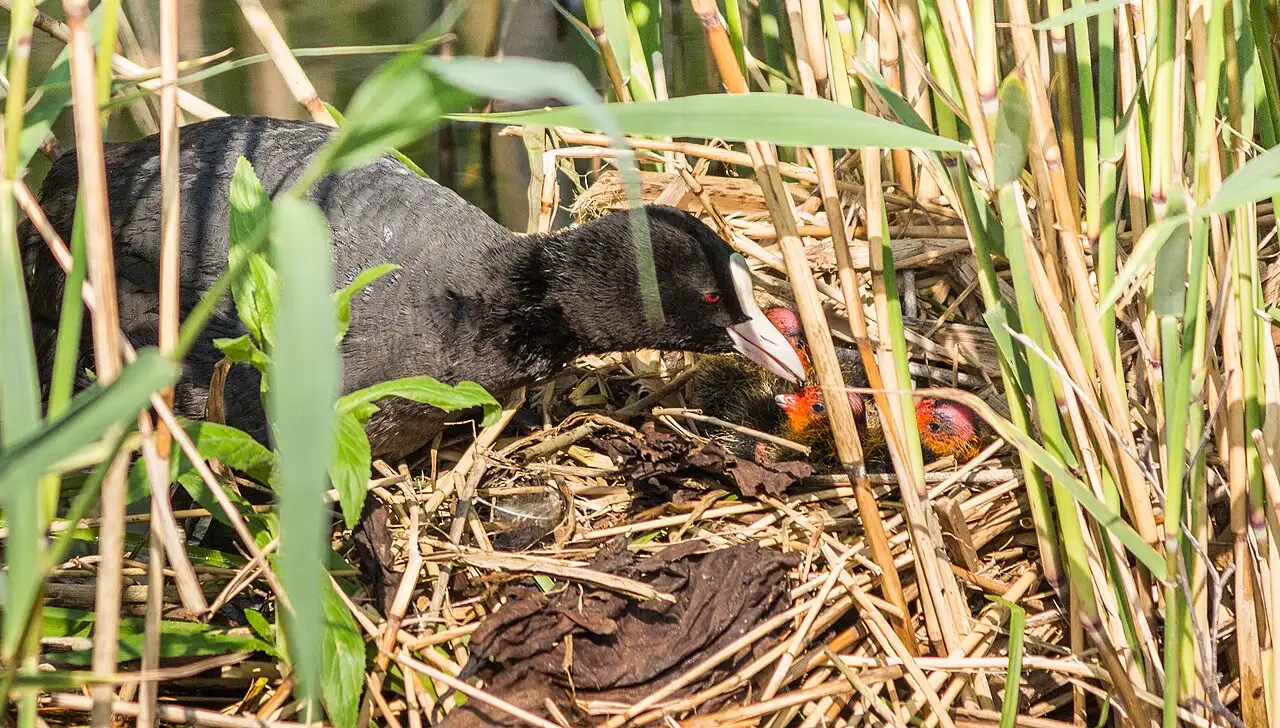
The nest is a bulky platform of aquatic plant stems, which the birds bend to make a floating structure that is nevertheless firmly anchored to the bottom, because the stems used are still alive. Then both adults add other materials to the nest and even go as far as building a kind of roof that insulates and camouflages the platform.
Courtship and breeding of the Eurasian Coot
When the breeding season begins, paired birds leave the groups to breed among the riverside vegetation, and are very territorial and exclusive: skirmishes and chases that end in fierce fights are usual. From March the females lay 6 to 10 greyish, finely spotted eggs in the nest, which both adults incubate for 21–24 days. The chicks are quite precocious: they soon leave the platform for the water, where their parents feed them, and they stay with them. At two months they reach full development. Because of the large losses caused by predators, it is quite usual for them to make up to three clutches a year.
Diet of the Eurasian Coot
Its diet contains food of animal and plant origin, although the latter predominates. It eats a great variety of plants, preferring shoots, stems and seeds of submerged aquatic plants, algae, and stems and rhizomes of cattails, reeds or rushes, which it supplements with some land plants, in particular cereals. The animal component increases in the breeding season, above all to feed the chicks, with molluscs, earthworms, larvae, water beetles and even small vertebrates.
Curious facts about the Eurasian Coot
It is a very prolific bird, which produces numerous, repeated clutches every year, perhaps as a mechanism to offset the intense predation it suffers1. EURING lists a bird ringed in the Netherlands that lived 23 years and 1 month, against AnAge’s 20.6.
The Eurasian Coot in Cabañeros
The habitat pages of this website do not mention it. GBIF.org records 66 observations of the Eurasian Coot in Cabañeros and its surroundings.
Where to see the Eurasian Coot in Cabañeros
In Cabañeros and its surroundings, all year round, in lagoons and reservoirs with marsh-vegetation shores.
When
All year round; in winter more are seen, in flocks.
What time
In good light.
Where
In wetlands of open, calm water of some depth, with marsh and submerged vegetation: lagoons, reservoirs and marshes.
What to look for
Look for the almost black plumage, the white shield and bill and, out of the water, the lobed toes.




 Same family
 Same family
 Same season in the park
 Same season in the park
 Same season in the park
 Same season in the park
 Same season in the park
 Same season in the park






