Present relatively frequently throughout the migration passages, especially in coastal areas and shallow wetlands
Lifespan
Record of 11.7 years in the wild according to AnAge; EURING lists a bird ringed in Sweden that lived 11 years and 8 months and was shot, and another ringed in Italy at 11 years and 11 months, recaptured by ringers
Conservation status
LC
NT
VU
EN
CR
EW
EX
Global (IUCN)
Least Concern
Spain
Data Deficient (DD) as a winter visitor and migrant in the Red List of Birds of Spain; on the List of Wild Species under Special Protection, but not in the Spanish Catalogue of Threatened Species
When to see it
Passage migrant
Months of the year when it is present
J
F
M
A
M
J
J
A
S
O
N
D
In Iberia
no
no
yes
yes
yes
no
yes
yes
yes
yes
no
no
Song or voice of the Wood Sandpiper
In flight it gives a hissing «chiff iff ifff»1; the alarm is a piercing «gip gip gip». The recording (alarm call and other calls) is by Jordi Calvet and was made at Llacunes de Montral (xeno-canto XC433536, quality A). It lasts 9 seconds and is a trimmed section of the original, without repeating or lengthening, from which we have removed the bass below 300 Hz, reduced the background noise and adjusted the volume; neither pitch nor speed has been changed.
In flight, the upperparts look fairly dark, which makes a square white area on the rump stand out even more, as well as the narrow transverse bars of the tail.
Flight typeMigratory; in flight, dark upperparts with a square white rump
In flight, the upperparts look quite dark, which makes a square white patch on the rump and the narrow cross bands of the tail stand out.
In flight it gives a sibilant «chiff iff ifff»; the alarm call is a penetrating «gip gip gip».
Outside the breeding season it prefers shallow wetlands, coastal areas and tidal zones, and its diet is based fundamentally on invertebrates, especially insects.
Photo gallery of the Wood Sandpiper
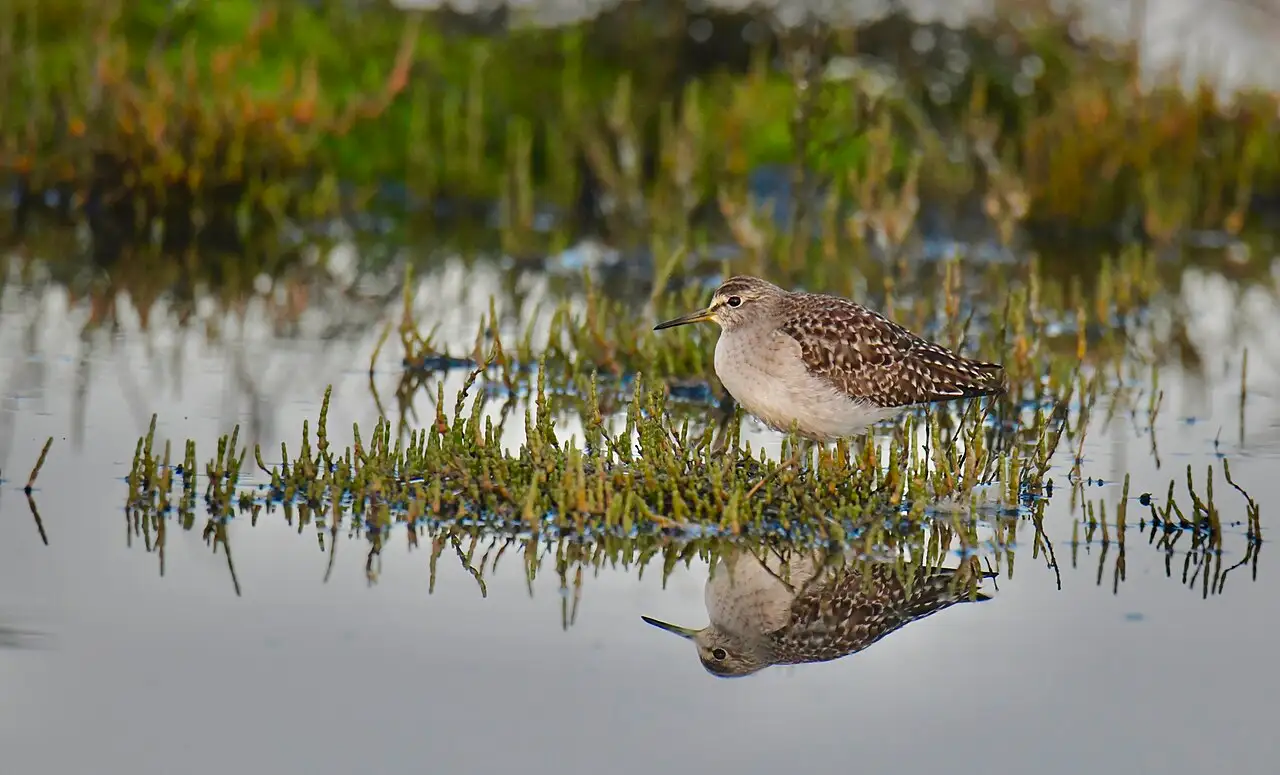
Wood Sandpiper standing among aquatic plants in shallow water, with brown back mottled with pale and its reflection in the waterPhoto: Luiz Lapa from Oeiras, Portugal, CC BY 2.0Photo 1 of 5
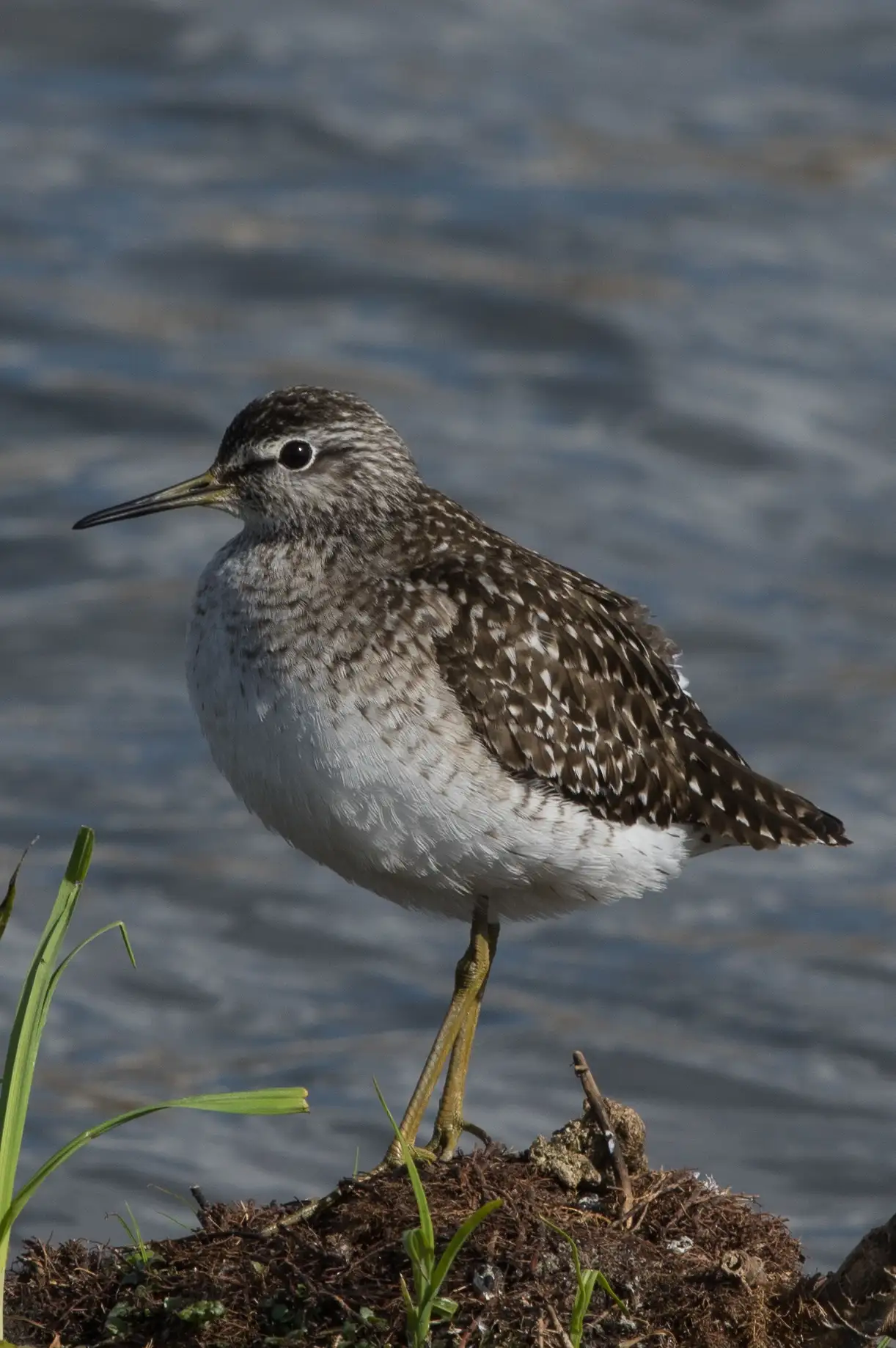
Wood Sandpiper in profile beside the water, perched on a small heap of plant debris, with pale eyebrow and yellowish legsPhoto: Hobbyfotowiki, CC0Photo 2 of 5
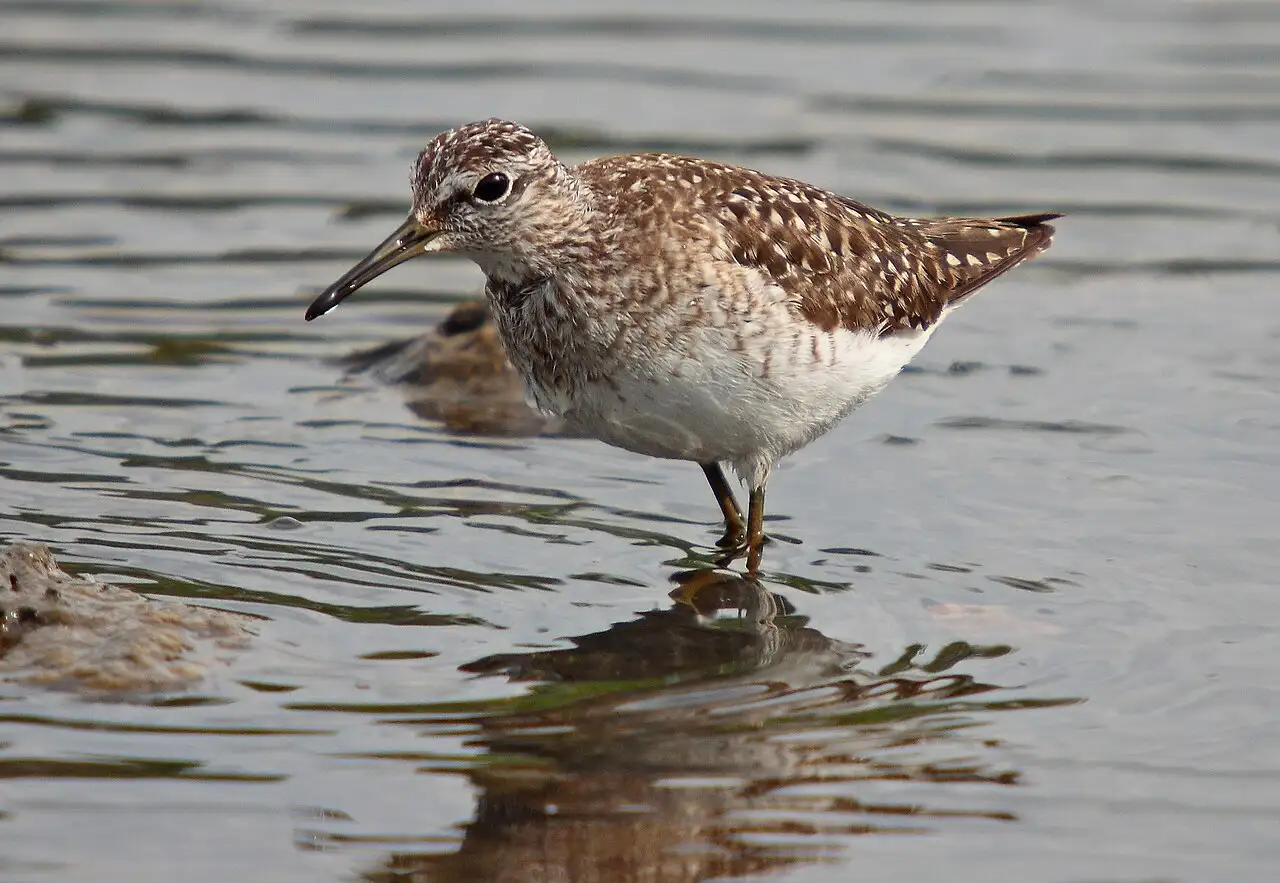
Wood Sandpiper wading in shallow water, with long bill, back mottled with pale and barred breastPhoto: Mark S Jobling, CC BY 3.0Photo 3 of 5
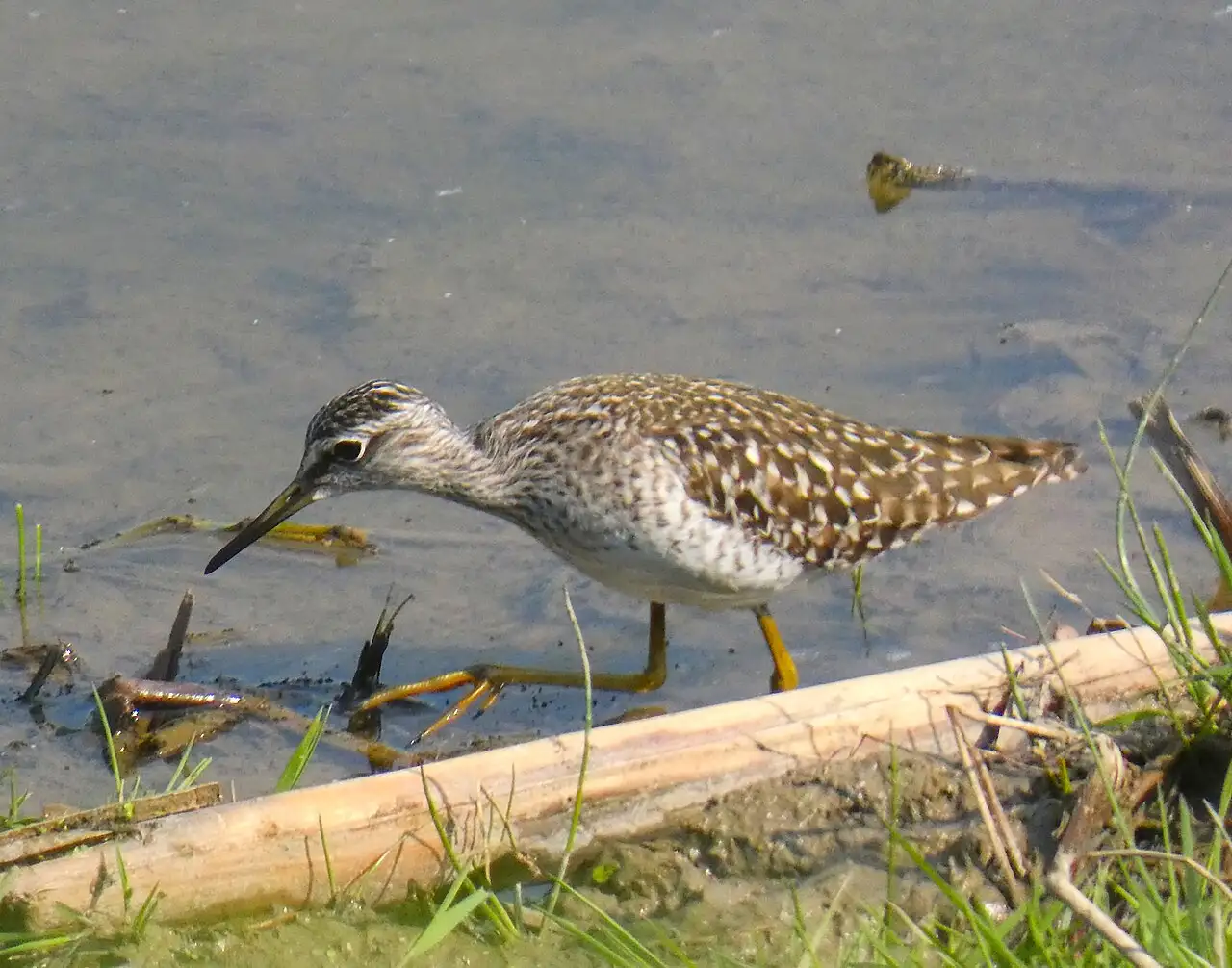
Wood Sandpiper with its neck bent, searching for food in the water beside a trunk, with yellowish legs and mottled backPhoto: Raugeier, CC BY-SA 4.0Photo 4 of 5
Wood Sandpiper wading among rushes and shallow water (Girona)Photo: Jordi Casanovas, CC BY 4.0Photo 5 of 5
1 / 5
Identification of the Wood Sandpiper
The Wood Sandpiper is a relatively slender wader, of more streamlined look than the other sandpipers, from which it differs by having longer, yellowish legs and a long whitish eyebrow that extends past the eye. The adult in breeding plumage has dark upperpart feathers, with abundant pale marks, and dark barring on the whitish breast, which gradually turns into larger spots towards the flanks. The belly is white, while the crown looks very streaked. The non-breeding bird shows narrower margins on the upperpart feathers, and a pale neck and breast, though slightly streaked. Juveniles look similar to the non-breeding adult, but with warmer margins on the upperpart feathers and somewhat more prominent breast barring. In flight, the upperparts look fairly dark, which makes a square white area on the rump stand out even more, as well as the narrow transverse bars of the tail.
Breeding adult
Dark upperparts with abundant pale marks; whitish barred breast, with larger spots towards the flanks.
White belly; heavily streaked crown and long whitish eyebrow.
Non-breeding and young bird
Non-breeding: narrower margins on the upperpart feathers; pale, slightly streaked neck and breast.
Young bird: warmer upper margins and somewhat more prominent breast barring.
Habitat and distribution of the Wood Sandpiper
It breeds in northern Europe and the northern half of Asia, from the Baltic to Mongolia, with a small population south of the Caucasus. It winters in tropical and central Africa, southern Asia and Oceania. It is a monotypic species, with no subspecies.
In Spain it is common on the Levante coast and in the Balearics during migration passage and, although somewhat rarer in the rest of the Peninsula, observations have been collected in practically all the autonomous communities, including the Canary Islands1. Its appearance in the territory is limited to migration passages, although it has been cited sporadically as a winter visitor: the post-breeding passage through the Levante regions concentrates in August and the pre-breeding one runs from March to May, with the greatest concentrations in April. It shows a wider distribution in spring than in winter.
In the breeding season it selects areas with coniferous woods, as well as patches of tundra with willows, birches and spruces, with extensive spaces covered in mosses and turf, almost always near water. Outside the breeding season it prefers shallow wetlands, coastal areas and tidal zones.
Areas where it is regularly recorded since 2010Squares of about 25 km where it is recorded regularly (occasional passage records are left out). Data from GBIF.org (39,503 records, retrieved October 2026); outline from Natural Earth.
Etymology of the Wood Sandpiper
In other languages it is called «valona» in Catalan, «bilurico manchado» in Galician, «kuliska pikarta» in Basque and «wood sandpiper» in English1. We have not found a source explaining the origin of the name «andarríos bastardo» or of the scientific name, so we do not venture one.
Population of the Wood Sandpiper
The 2021 European Red List of Birds estimates the European breeding population at between 2,090,000 and 2,920,000 mature individuals, with an unknown trend. The population in Spain has not been studied1. Both the population data and the demographic trend are unknown1. The most important threats revolve around the destruction and alteration of its breeding and wintering habitats, essentially through the drying out or pollution of wetlands.
Nest of the Wood Sandpiper
It sets the nest on the ground, among dense vegetation, normally on a small tussock or rise in the ground and often surrounded by water; sometimes it uses an old nest set in a tree. The structure is fairly shallow and unelaborate, 8–10 centimetres across and 4–5 deep, which it lines with stems and leaves if newly built.
Courtship and breeding of the Wood Sandpiper
It does not breed in Spain. In its northern breeding areas, laying takes place through the month of May and consists of three or four greenish eggs, with brown spots and streaks. Incubation lasts 22 or 23 days and the chicks develop in a month.
Diet of the Wood Sandpiper
Its diet is essentially based on invertebrates, especially insects.
Curious facts about the Wood Sandpiper
It differs from other sandpipers by the greater length of its legs1. Its presence is relatively frequent throughout the migration passages, especially in coastal areas and shallow wetlands of the Mediterranean seaboard and the Balearic Islands1. EURING lists birds of 11 years and 11 months (Italy) and 11 years and 8 months (Sweden), somewhat above AnAge’s 11.7 years.
The Wood Sandpiper in Cabañeros
The habitat pages of this website do not mention it, but it does appear in the bird list of the «Visitor guide to Cabañeros National Park» (OAPN, page 104). That list vouches for its presence in the Park, not for breeding there. GBIF.org records 3 observations of the Wood Sandpiper in Cabañeros and its surroundings, which fits a species that only crosses the Peninsula on migration passages and is rarer away from the Levante coast and the Balearics1. None of those observations falls within the Park boundary (according to OpenStreetMap): all are from the surroundings.
Where to see the Wood Sandpiper in Cabañeros
In Cabañeros and its surroundings, occasionally during migration passages, at ponds and shallow shores.
When
In Spain on passage: from March to May, peaking in April, and from July to October, with the post-breeding passage concentrated in August in the Levante.
What time
By day, at the edge of ponds and shallow water, eating insects.
Where
In shallow wetlands, coastal areas and tidal zones.
What to look for
Look for the yellowish legs and long eyebrow; in flight, the white, square rump, and listen for the «chiff iff ifff».



 Same family
 Same family
 Same family
 Same family
 Same order
 Same order
 Same order
 Same order






