Wingspan compared with a person with arms outstretched.
Length
30–33 cm
Wingspan
68–70 cm
Weight
150–241 g
Social life
In Spain it appears relatively scattered during passage and winter
Lifespan
Record of 24 years and 4 months in the wild according to AnAge; EURING lists a bird ringed in Great Britain and Ireland that lived 17 years and 2 months
Conservation status
LC
NT
VU
EN
CR
EW
EX
Global (IUCN)
Least Concern
Spain
Least Concern (LC) as a winter visitor and migrant in the Red List of Birds of Spain; on the List of Wild Species under Special Protection, but not in the Spanish Catalogue of Threatened Species
When to see it
Passage migrant
Months of the year when it is present
J
F
M
A
M
J
J
A
S
O
N
D
In Iberia
yes
yes
yes
yes
yes
yes
yes
yes
yes
yes
yes
yes
Song or voice of the Common Greenshank
Its most characteristic call, which it also gives in flight, is a very plaintive «tiu tiu tiu». The recording is from the British Library and captures the song and calls of a Common Greenshank in West Sutherland, in Scotland, where it breeds; we have trimmed and normalised it.
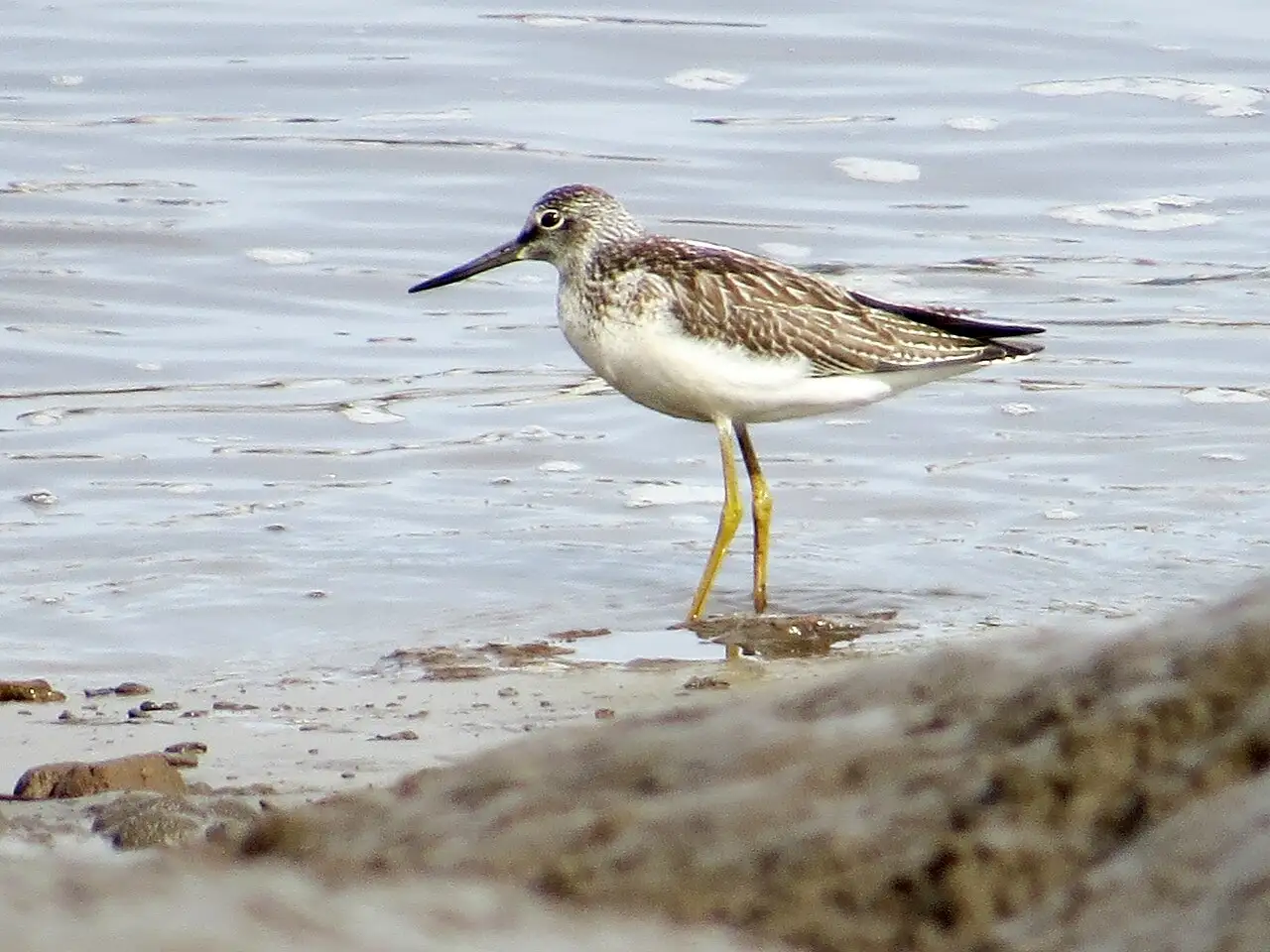
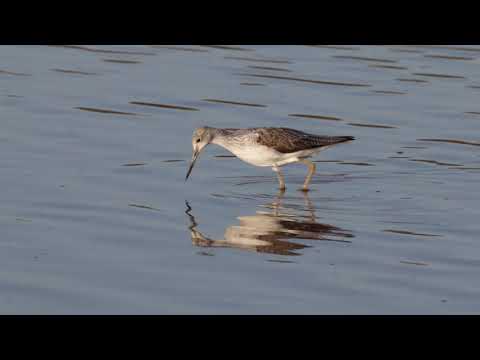
Common Greenshank in shallow water, in profile, with long, slightly upturned bill and mottled grey backPhoto: MPF, CC BY-SA 4.0Photo 4 of 4
1 / 4
Identification of the Common Greenshank
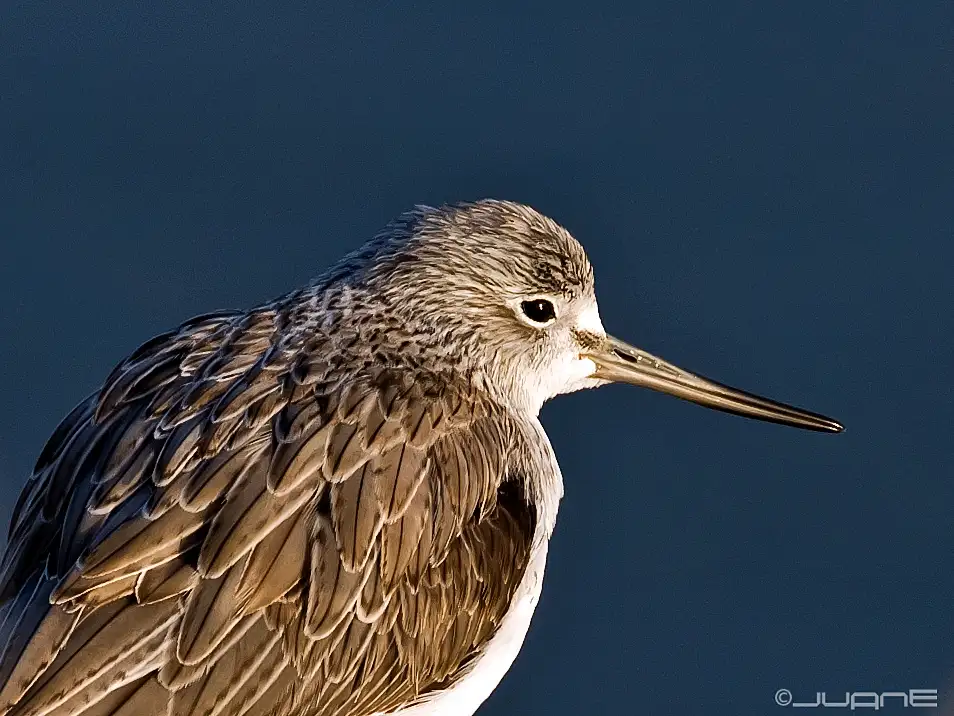
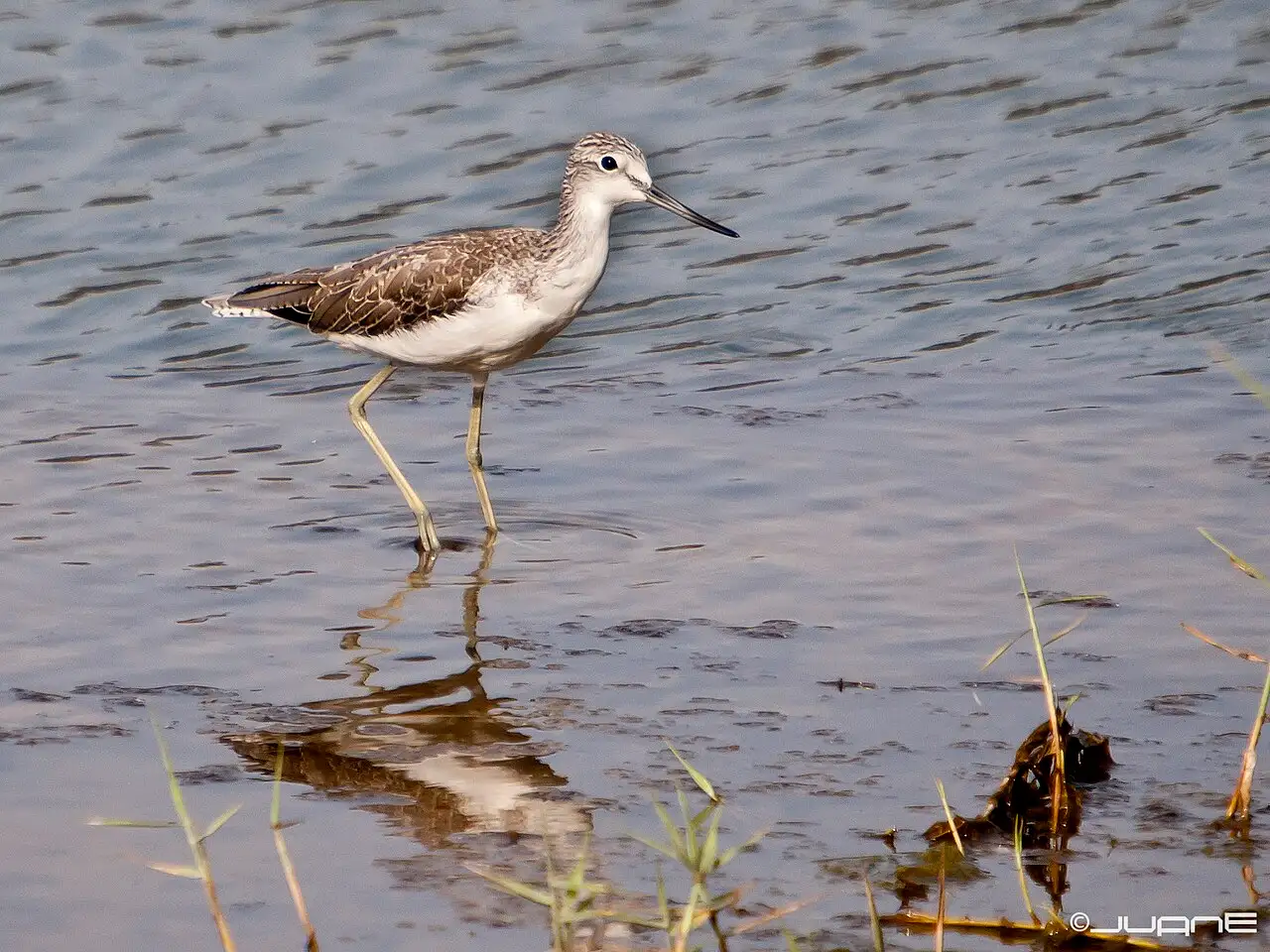
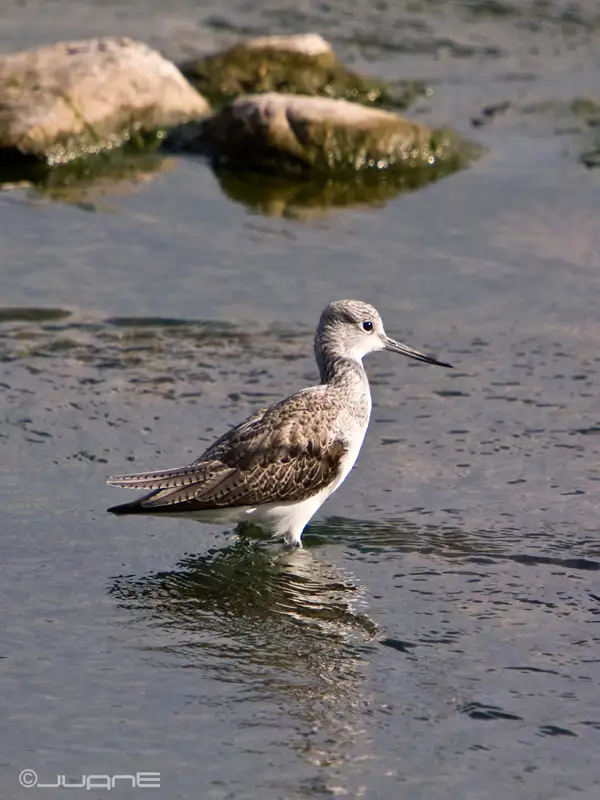
The Common Greenshank is a medium-sized, slender wader, with fairly long yellowish-green legs and a bill of considerable length, slightly upturned, with a greenish base and black tip. The adult in breeding dress has upperpart feathers of variable colouring, some dark with white scalloping and others grey with dark shafts and notches; the neck, breast and underparts are white, with heavy dark brown barring and chevrons on the flanks. The non-breeding adult is greyish, but looks mottled from the white edges of the upperpart feathers, which have a black inner scalloping, and the breast and underparts are completely white. The juvenile shows brown upper feathers with cream edges and dark scalloping and slight brown barring on the breast, with white underparts.
Adult in breeding dress
Dark upperparts with white scalloping and others grey with dark shafts.
Neck, breast and underparts white, with heavy dark brown barring on the flanks.
Non-breeding adult
Greyish and mottled from the white edges of the feathers above.
Breast and underparts completely white.
Juvenile
Brown upper feathers with cream edges and dark scalloping.
Slight brown barring on the breast and white underparts.
Habitat and distribution of the Common Greenshank
It breeds from the British Isles to the far east of Asia, across Siberia and central Asia. It winters in southern Europe, the Mediterranean region, tropical and southern Africa, southern and south-east Asia and Oceania. It has no subspecies.
In Spain it appears relatively scattered during passage and winter, although there are also some immature summering birds, mainly in coastal regions. In winter it shows a clear preference for the coast, and the best populations are in the Guadalquivir marshes, the Galician rías, the Ebro delta and the Villaviciosa estuary, among other sites. In spring it is widespread across the whole country and more abundant on the Atlantic, Cantabrian and Mediterranean coasts, and during migration it is also seen in inland wetlands. It is present on the Peninsula as well as in the Balearics and the Canaries.
During breeding it settles on the edges of forest areas and on steppes, and avoids mountain areas, arid expanses and masses of closed vegetation. Outside the breeding season it is less demanding and uses a multitude of aquatic habitats, such as estuaries, marshes and inland lagoons.
The birds that stop over in our territory come from central and Atlantic Europe. The autumn passage takes place between August and October on all our coasts, somewhat earlier on the Mediterranean ones, and the spring one between March and April, until May on the Cantabrian ones. At the Strait of Gibraltar and in the interior the passage is hardly noticeable.
Areas where it is regularly recorded since 2010Squares of about 25 km where it is recorded regularly (occasional passage records are left out). Data from GBIF.org (146,536 records, retrieved October 2026); outline from Natural Earth.
Etymology of the Common Greenshank
According to Wikipedia, the genus «Tringa» is the Neo-Latin name that Aldrovandi gave the Green Sandpiper from the ancient Greek «trungas», a thrush-sized wading bird, white-rumped and with its tail always on the move, mentioned by Aristotle. The epithet «nebularia» comes from the Latin «nebula», «mist», and, like the Norwegian name «skoddefoll», alludes to its damp, marshy habitat. In other languages it is called «gamba verda» in Catalan, «bilurico de patas verdes» in Galician, «kuliska zuria» in Basque and «common greenshank» in English1.
Population of the Common Greenshank
In the 2021 European Red List of Birds the European breeding population is estimated at between 452,000 and 942,000 mature individuals, with an increasing trend. There are no up-to-date data for the Spanish population. According to the Atlas of Wintering Birds in Spain (2010), during the first decade of the century an average of about 3,400 birds a year wintered in Spain, almost half in Catalonia.
The main threats cited are human disturbance, illegal hunting and, above all, the transformation and alteration of coastal habitat through urbanisation and the building of infrastructure.
Nest of the Common Greenshank
It does not breed in Spain. In its breeding areas, the nest is on the ground, in forest clearings, normally among rocks or bushes, and is a small hollow lined with various material, such as plant debris and feathers.
Courtship and breeding of the Common Greenshank
It does not breed in Spain, although it has some immature summering birds. In its breeding areas, laying takes place from late April to early May, although in Scandinavia it can be delayed until mid-June, and consists of three or four white or beige eggs, heavily speckled with reddish brown or chocolate. Incubation lasts 23 to 36 days and the chicks, very precocial, develop in about 25–31 days. On the post-breeding migration, one of the adults, usually the female, abandons the chicks at about four weeks of age and leaves its territory at the end of June or early July.
Diet of the Common Greenshank
It feeds mainly on invertebrates. In the breeding season insects and small fish take on special importance in its diet.
Curious facts about the Common Greenshank
It is the largest of the shanks that regularly appear in our territory, of fairly pale colouring1. AnAge gives a maximum longevity of 24 years and 4 months, quite a bit more than the 17 years and 2 months that EURING lists for a bird ringed in Great Britain and Ireland.
The Common Greenshank in Cabañeros
The habitat pages of this website do not mention it, and we have not found any other published source on it in the Park. GBIF.org records 16 observations of the Common Greenshank in Cabañeros and its surroundings.
Where to see the Common Greenshank in Cabañeros
In Cabañeros and its surroundings, during migration passages, on the shores of reservoirs and inland wetlands.
When
During migration passages: from August to October and from March to April or May; in Spain it also winters.
What time
By day, looking for food in shallow water.
Where
Outside the breeding season it uses estuaries, marshes, inland lagoons and other aquatic habitats.
What to look for
Look for its pale colouring and the green legs; in flight, the pale rump, and listen for its plaintive «tiu tiu tiu».




 Same family
 Same family
 Same family
 Same family
 Same order
 Same order
 Same order
 Same order






