Territorial, with a mainly polygynous mating system (one male with two or more females)
Lifespan
Record of 7 years and 2 months according to EURING (a bird ringed in Spain and recaptured by a ringer)
Conservation status
LC
NT
VU
EN
CR
EW
EX
Global (IUCN)
Least Concern
Spain
Near Threatened (NT) in the Red Book of the Birds of Spain; on the List of Wild Species under Special Protection, but not in the Spanish Catalogue of Threatened Species
When to see it
Resident
Months of the year when it is present
J
F
M
A
M
J
J
A
S
O
N
D
In Iberia
yes
yes
yes
yes
yes
yes
yes
yes
yes
yes
yes
yes
Breeding season
no
no
yes
yes
yes
yes
yes
yes
no
no
no
no
Song or voice of the Zitting Cisticola
The species is very easy to detect thanks to its characteristic sound. In flight, as it climbs on its peculiar undulating path, it gives an unmistakable «tsip-tsip-tsip», which it repeats monotonously.
SongZitting Cisticola
0:00 / 0:18
10 kHz5
The sonogram draws the sound: time runs from left to right, and the higher a trace sits, the higher the note.Recording by Jochem Verweij, xeno-canto XC821791 (Países Bajos) (CC BY-SA 4.0).
Flight of the Zitting Cisticola
In flight it follows a very undulating path and shows a characteristic silhouette, with rounded wings and a tail, which it usually keeps partly spread, also rounded in profile.
Flight typeVery undulating, singing as it climbs
As it rises in its particular undulating path, it gives an unmistakable «tsip-tsip-tsip» that it repeats monotonously.
In flight it follows a very undulating path, with rounded wings and the tail, which it usually holds partly spread, with a rounded profile.
When it lands among the vegetation, it clings to the stems keeping upright and constantly flicks its tail, with its band of black and white spots.
Photo gallery of the Zitting Cisticola
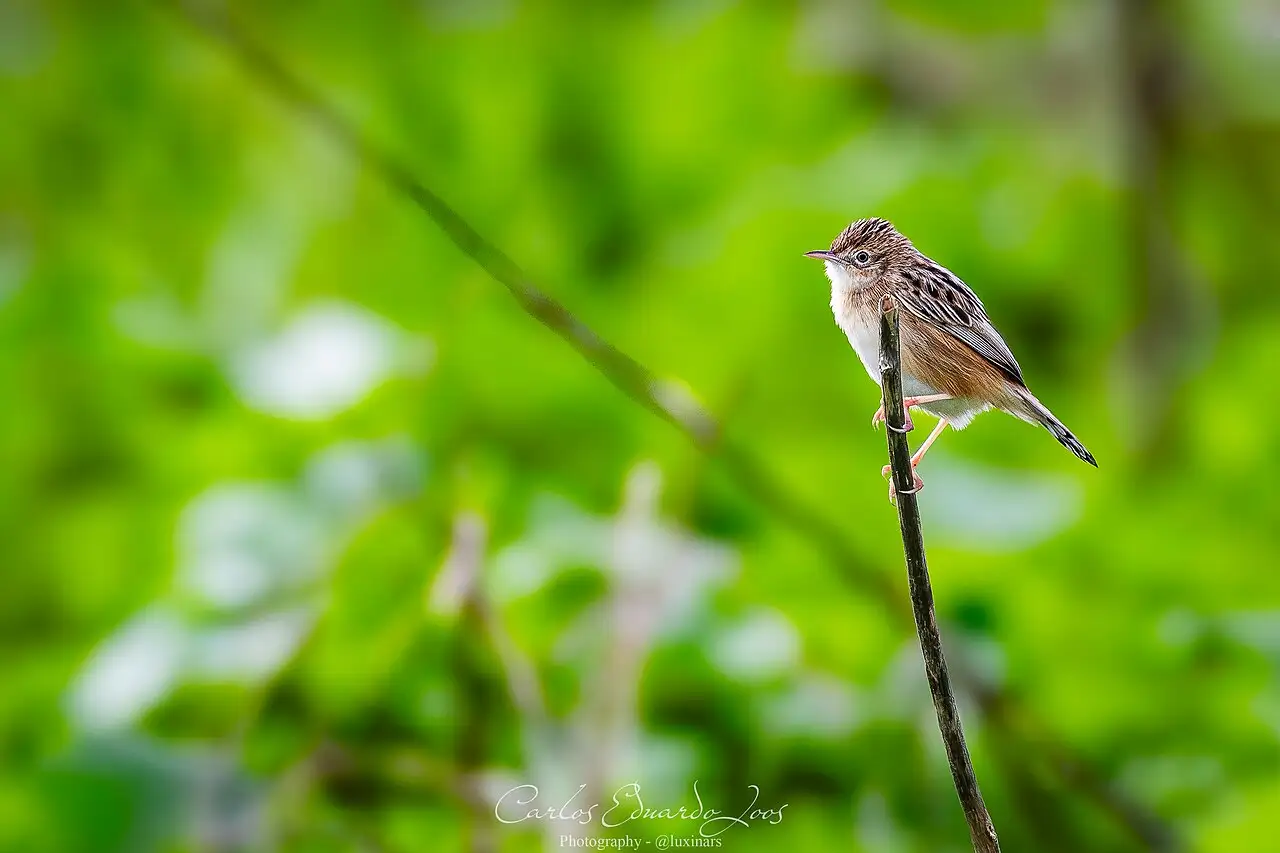
Zitting Cisticola perched on top of a thin stem, in profile, with streaked back and long tailPhoto: Carlos Eduardo Joos, CC BY 4.0Photo 1 of 4
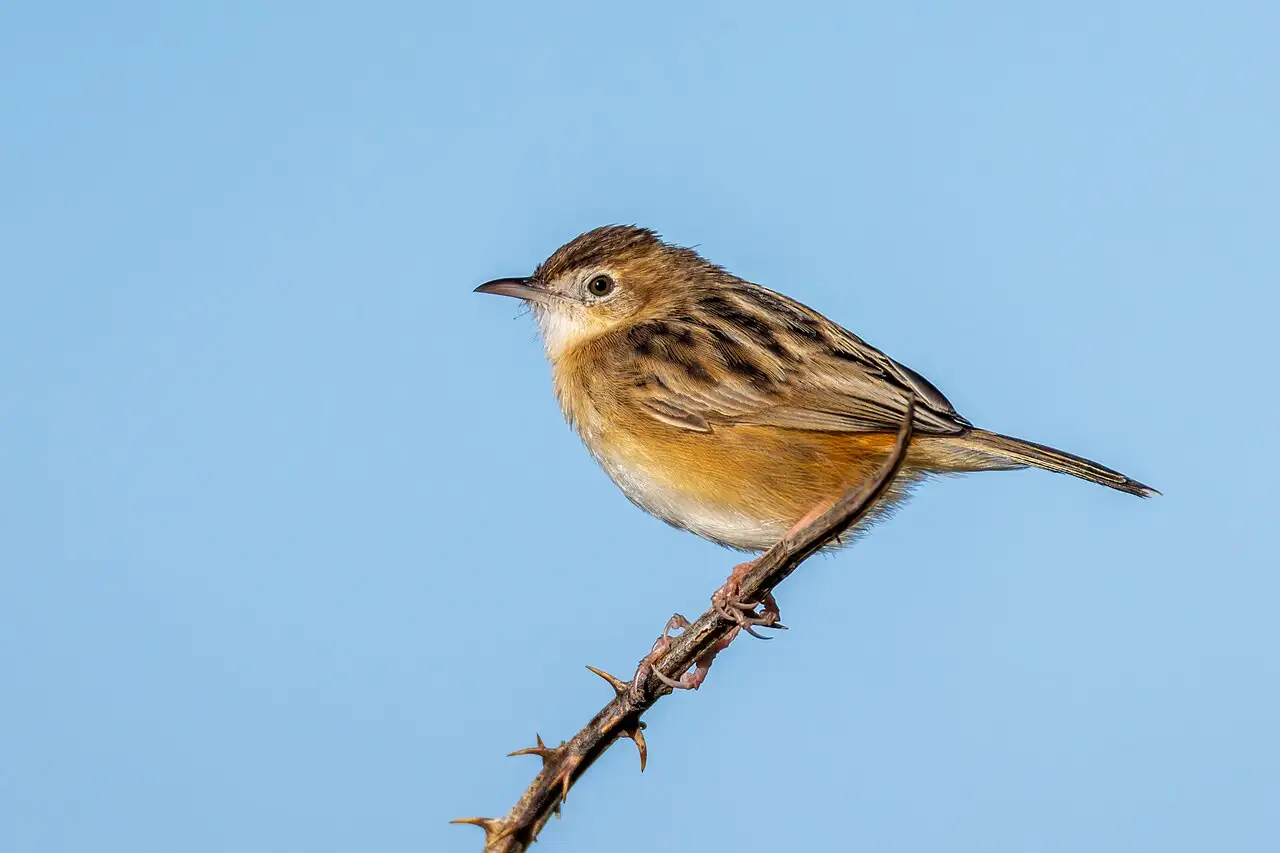
Zitting Cisticola perched on a thorny branch against a blue sky, in profile, with brown-streaked back, rufous rump and ochre underpartsPhoto: Alexis Lours, CC BY 4.0Photo 2 of 4
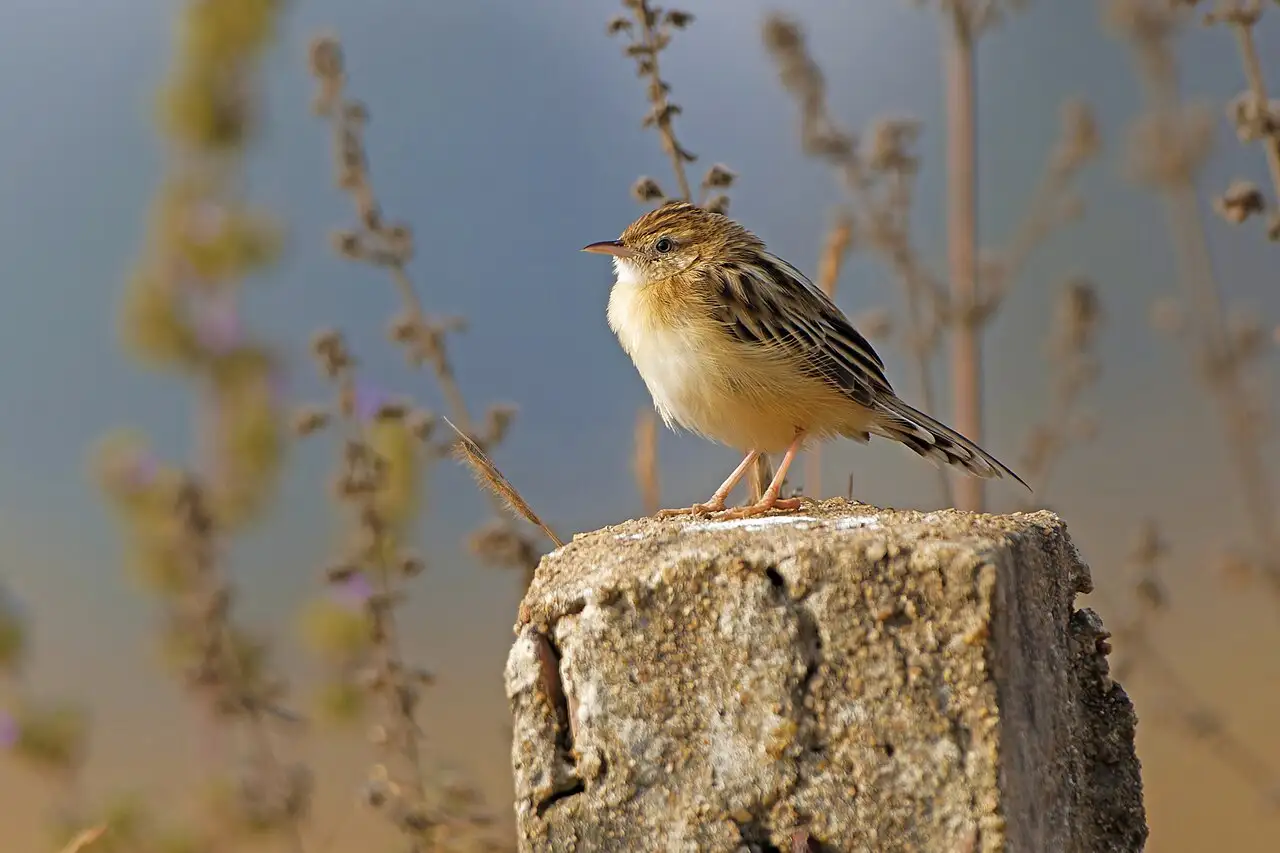
Zitting Cisticola on a stone post among dry grasses, with pale breast and streaked backPhoto: Shiv's fotografia, CC BY-SA 4.0Photo 3 of 4
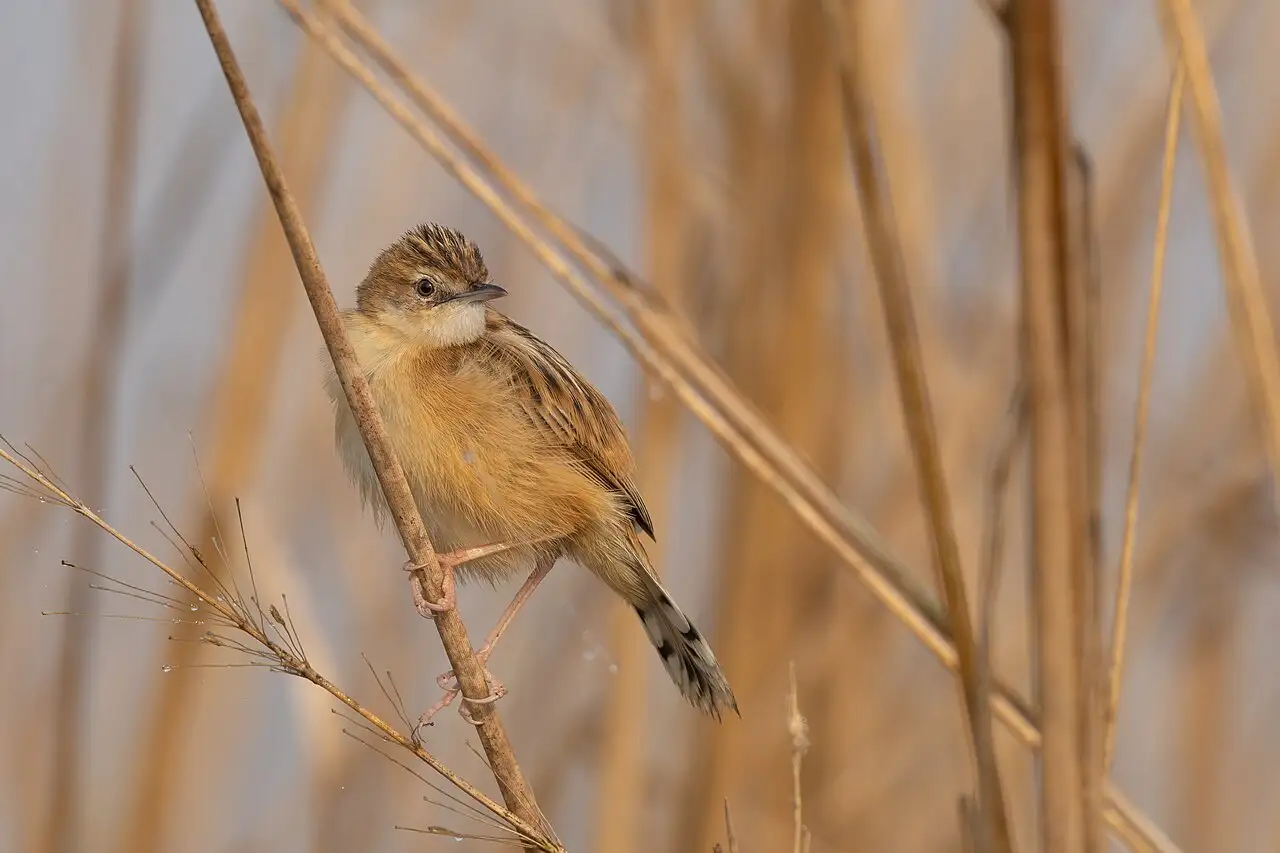
Zitting Cisticola clinging vertically to some dry reeds, with drooping tail and streaked crownPhoto: Tisha Mukherjee, CC BY-SA 4.0Photo 4 of 4
1 / 4
Identification of the Zitting Cisticola
The Zitting Cisticola is one of the smallest birds in Europe. It has the back and crown dark brown and heavily streaked, the rump rufous and the underparts pale, with ochre flanks and breast. In flight it follows a very undulating path and has a characteristic silhouette, with rounded wings and a tail, usually kept partly spread, also rounded in profile and of length increasing from the sides to the centre. At its tip, the tail shows a band of black and white spots very visible in flight. When it perches among vegetation, it usually clings to stems keeping vertical, while continually flicking its tail.
Adult
Back and crown dark brown, heavily streaked.
Rufous rump and pale underparts, with ochre breast and flanks.
Tail with a band of black and white spots.
Habitat and distribution of the Zitting Cisticola
It is widely distributed across the equatorial and tropical zones of Africa, Asia and Australia, as well as around the Mediterranean (southern Europe and North Africa) and the Near East. It has several subspecies, three of them in the western Palaearctic. In Spain the subspecies «cisticola» lives, distributed across the lowest, warmest parts of the Peninsula and the Balearics; it shuns cold regions and avoids forest and mountain areas. It occupies the Atlantic and Mediterranean coasts and the plains and river plains of most of the Tagus, Duero, Ebro, Guadiana and Guadalquivir basins.
It selects open plains with abundant dense herbaceous vegetation, both in wet and dry areas. The highest densities have been recorded in reedbeds and irrigated crops, although it also frequents rush beds, esparto grassland, pastures and cereal crops. It is present from sea level up to 950 metres in altitude (Sierra Nevada), although it is rare above 600–800 metres.
It is essentially resident, although northern populations may make dispersive movements south during autumn and return to their breeding areas between February and April.
Areas where it is regularly recorded since 2010Squares of about 25 km where it is recorded regularly (occasional passage records are left out). Data from GBIF.org (455,798 records, retrieved October 2026); outline from Natural Earth.
Etymology of the Zitting Cisticola
According to Wikipedia, «Cisticola» comes from the ancient Greek «kisthos» («rockrose») and the Latin «colere» («to inhabit»), and «juncidis» is a diminutive of the Latin «iuncus», which that encyclopedia translates as «reed». It is also known as «cistícola buitrón»; in other languages it is «trist» in Catalan, «carriza dos xuncos» in Galician, «ihi-txoria» in Basque and «zitting cisticola» in English1. According to Wikipedia, in the Doñana area it is called «cienlibras».
Population of the Zitting Cisticola
In the 2021 European Red List of Birds the European breeding population is estimated at between 2,270,000 and 3,680,000 mature individuals, with a stable trend. The Iberian breeding population is put at about 3,200,000 birds, with the highest concentrations in Tierra de Campos (Castilla y León), the Cádiz countryside and the Guadalquivir valley. It has expanded notably through the interior and north of the peninsula since the middle of the last century, with fluctuations from climate, and its current trends are slightly positive according to the SACRE programme (1998–2018). The main threats are habitat alteration or destruction through agricultural intensification (biocides, crops under plastic, ploughing of pastures), reforestation of marginal land and housing developments or infrastructure. It is also very sensitive to harsh winters, which can cause heavy mortality and limit its distribution.
Nest of the Zitting Cisticola
The nest is an elongated, closed cup, shaped like a pear or bottle, which they make from grasses and spiders’ webs and which is usually placed low among dense grass. The outer structure is built by the male and the female takes care of the inner lining.
Courtship and breeding of the Zitting Cisticola
It is a territorial species with a mainly polygynous mating system: one male with two or more females. The breeding period runs from March to August and the birds may make two or three clutches. The clutch consists of four to seven white or bluish eggs, often speckled. Incubation lasts 13 days and is done by the female, who also tends and feeds the chicks. These can fly 15 days after hatching, are independent at 20 and are able to breed when only a few months old.
Diet of the Zitting Cisticola
Its diet is made up mainly of insects.
Curious facts about the Zitting Cisticola
Because of its size, it is easier to detect by its unmistakable song than to see1. It is one of the smallest birds in Europe and, even so, it has expanded notably through the interior and north of the Peninsula since the middle of the last century. EURING lists a ringed bird from Spain that lived 7 years and 2 months.
The Zitting Cisticola in Cabañeros
The habitat pages of this website do not mention it. GBIF.org records 89 observations of the Zitting Cisticola in Cabañeros and its surroundings.
Where to see the Zitting Cisticola in Cabañeros
In Cabañeros and its surroundings, all year, among dense herbaceous vegetation.
When
All year, because it is resident; in the breeding season, from March to August, the song is easier to hear.
What time
In good light; its song in flight gives it away even if it is hardly seen.
Where
On open plains with dense herbaceous vegetation: reedbeds, rush beds, pastures and irrigated or cereal crops.
What to look for
Look for the very undulating flight, the rounded tail with black and white spots and the small size; listen for the «tsip-tsip-tsip».



 Same order
 Same order
 Same order
 Same order
 Same order
 Same order
 Same order
 Same order






