Grass, above all in spring; leaves, twigs and fruits of the woodland, such as acorns, in summer and autumn
Social life
Males and females in separate groups; they come together in the rut
Lifespan
Record of 31.5 years (in captivity)
Conservation status
LC
NT
VU
EN
CR
EW
EX
Global (IUCN)
Least Concern
Spain
Least concern; game species
When to see it
Mammal · in Cabañeros
Abundant all year. It is the most visible mammal of the raña, above all in the second half of the year.
Months of the yearly cycle
J
F
M
A
M
J
J
A
S
O
N
D
Rut
no
no
no
no
no
no
no
no
yes
yes
no
no
Births
no
no
no
no
yes
yes
no
no
no
no
no
no
Photos of the Red Deer
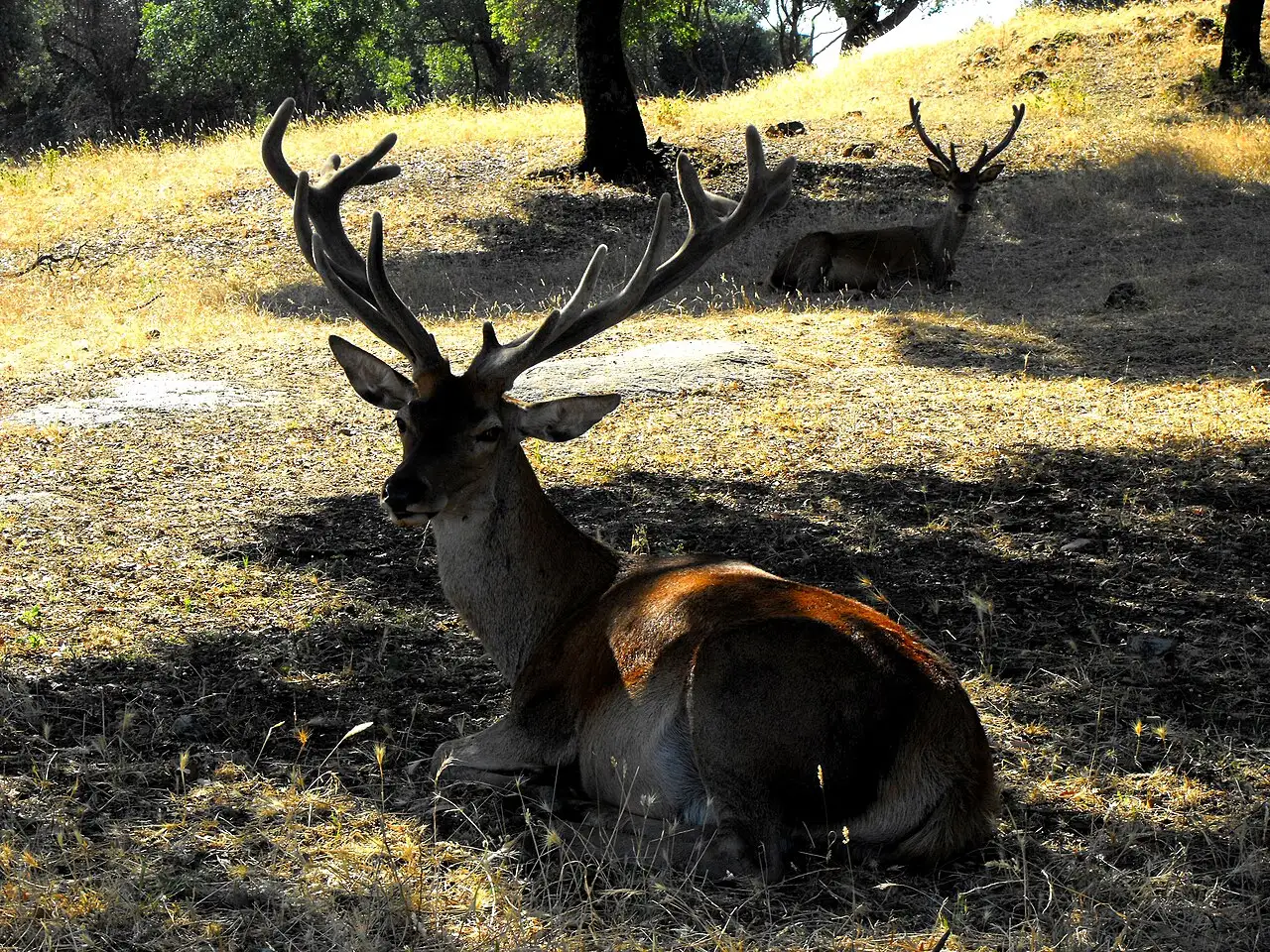
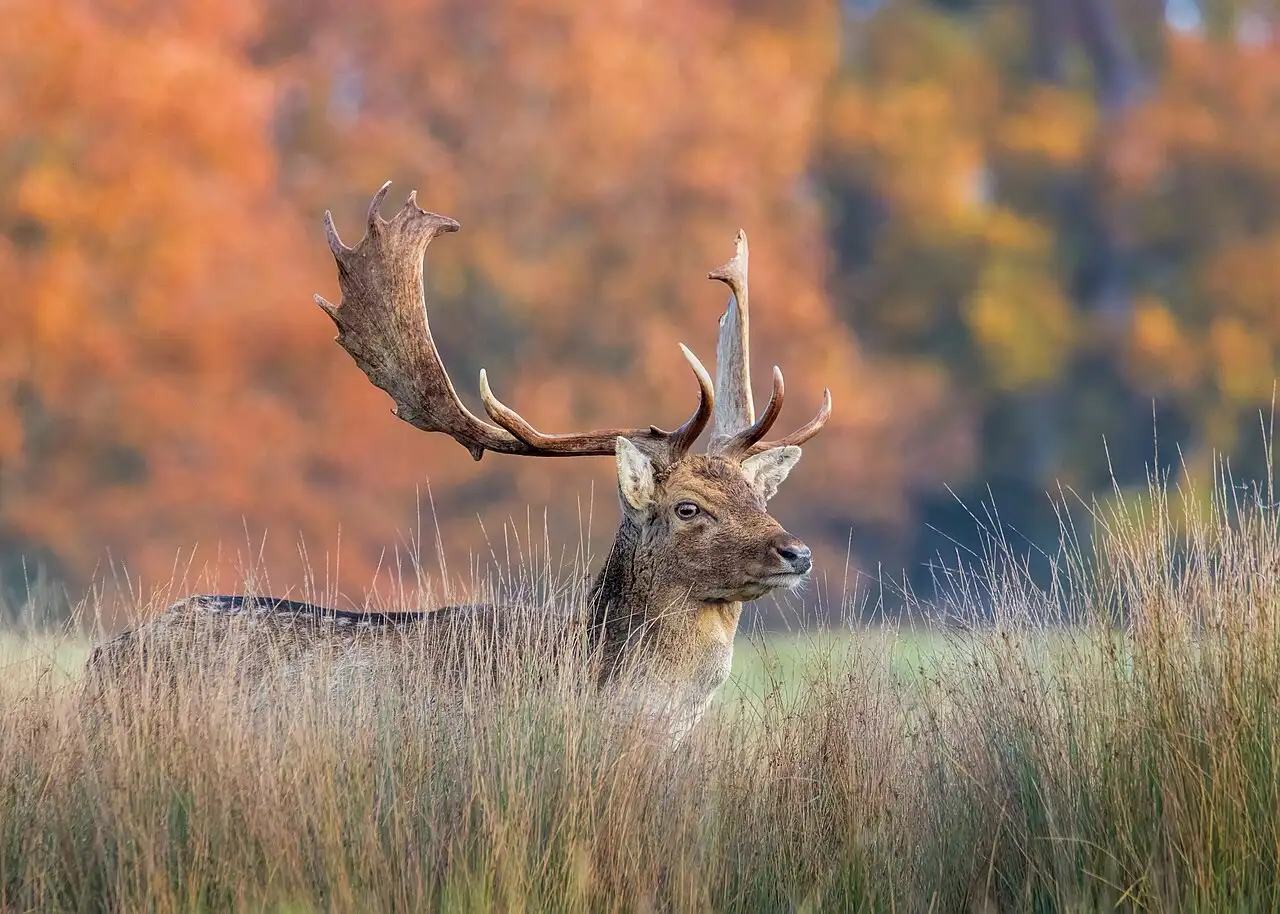
A stag lying in the shade of the holm oaks, with a full set of antlersPhoto: Camino a Gaia, CC BY-SA 4.0Photo 1 of 3
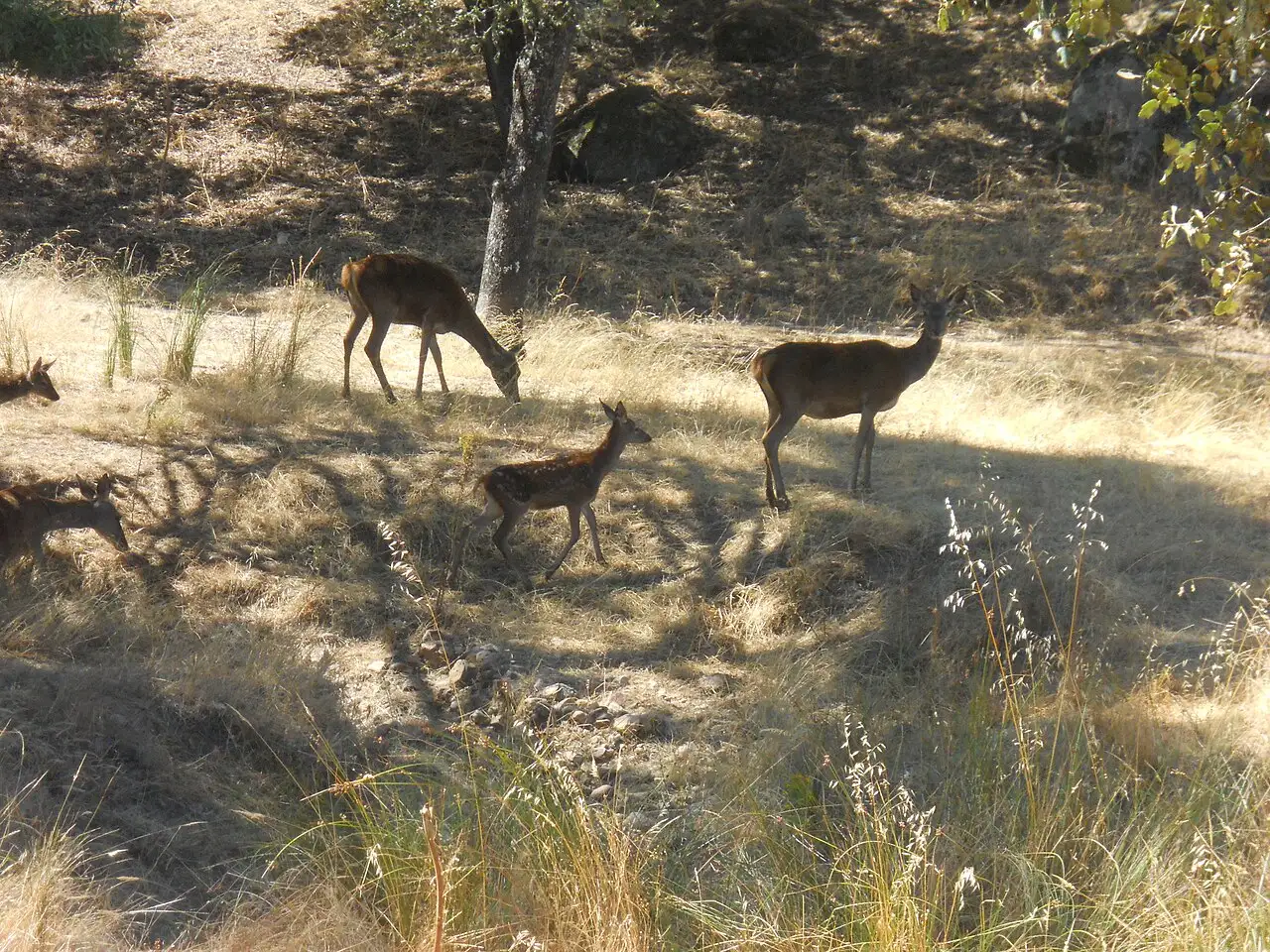
Hinds and a calf looking for shade in the Sierra de AndújarPhoto: Lichinga, CC BY-SA 4.0Photo 2 of 3
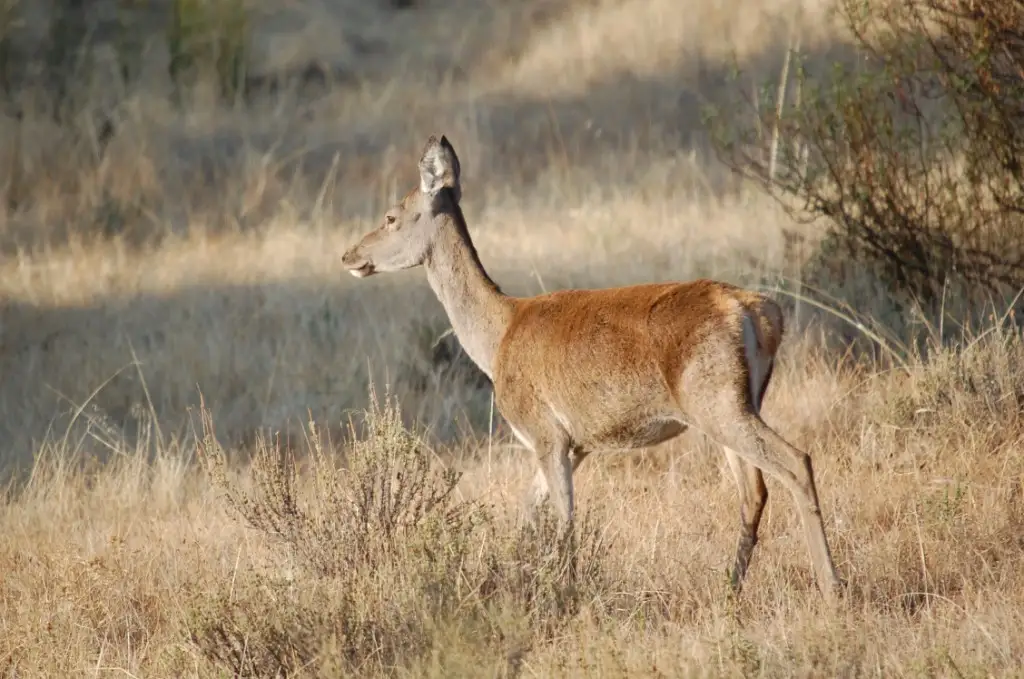
A hind crosses the dry grassland at the end of summerPhoto: cotallo-nonocot, CC BY 2.0Photo 3 of 3
1 / 3
Identification of the Red Deer
The male is called a stag («venado») and the female a hind («cierva»). The young of the previous year also have names of their own in the region: «gabarranas» for the females and «varetos» for the males. The antlers are the feature that changes most through the year: in spring they drop off at the base, the «rosette», and a new pair starts to grow which by the end of summer is already ossified and ready for the rut.
Habitat and distribution of the Red Deer
It lives in Mediterranean woods and scrub with clearings and pasture nearby, which is exactly what Cabañeros offers: woodland to shelter in and the raña to feed on. The map shows where it is regularly observed on the peninsula.
Areas where it is regularly recorded since 2010Squares of about 25 km where it is recorded regularly (occasional records are left out). Data from GBIF.org (254,750 records, retrieved October 2026); outline from Natural Earth.
The rut and the cycle of the year
With the first rains of September the rut begins. Hundreds of deer come down from the woodland to the raña and the stags fight over the hinds with hoarse roars and clashes of antlers through September and much of October. The most intense period is usually from mid-September to mid-October, but it changes from one year to the next with the rains. How each rut turns out is decided months earlier: after the very rainy spring of 2024 there was plenty of grass and the deer reached the rut in good shape and with good antlers, whose size and symmetry show how the year has gone for the animal. When and where to see it, in the rut in Cabañeros.
Afterwards, the deer gather in large groups to eat acorns and the pastures of the raña: in November there are herds of more than four hundred animals. They stay there until the end of December, when the frosts push them back into the woodland. Hinds give birth in May and June, after about 235 days of gestation, almost always to a single calf, and in May they return to the raña with the calves while the males grow new antlers.
The roar: the voice of the red deer
Two stags roaring in the United Kingdom. Recording from the British Library, Wikimedia Commons, CC BY-SA 4.0; trimmed to the stretches with roars.
The roar sounds like a shout, but it has a trick. To give it, the stag pulls its larynx down until it almost touches the sternum, and in doing so lengthens the tube the voice comes out through. The longer that tube, the lower its resonances, the so-called formants, and the bigger the animal that roars seems. Until 2001 it was thought that a lowered larynx was something only humans had; that year Tecumseh Fitch and David Reby showed that the red deer and the fallow deer also have it, and that the red deer also moves it as it roars.
The deception has a limit, set by the body itself: the larynx does not drop below the sternum, so the stag can only sound as big as it really is. That is why the pitch is a reliable warning, and rivals take notice. As early as 1979 Tim Clutton-Brock and Steve Albon, who were studying the deer of the Scottish island of Rum, saw that males get into roaring duels before they come to antlers. Both the depth and the rhythm count: keeping up roaring for hours is very costly, and a tired or poorly fed male roars less. Many fights are decided there, without a single blow, which with antlers of that size is the most sensible thing.
Hinds listen too. In 2007, Benjamin Charlton’s team found that, in the rut, they prefer to approach roars with lower formants, those of the largest males. And another study, by Karen McComb in 1987, found that hearing males roar brings their ovulation forward.
In Cabañeros the landscape does its part. On the flat, open raña, the roar travels kilometres, although the wind and the air that rises in the evening break it up. In the mountains, the cork oak slopes and the deep channels of the Estena or the Bullaque act as a sounding box, and the echo makes the roarer sound bigger, as the park newsletter of July–August 2026 explains. To hear it, dawn and dusk at the end of September and the beginning of October.
Diet of the Red Deer
It combines grazing with browsing. In spring, grass makes up at least three quarters of what it eats; in summer and autumn the leaves and twigs of shrubs and trees and the fruits of the woodland gain weight. For the red deer of Cabañeros, the fall of the acorn in autumn is a first-rate resource because of its high energy value.
The Red Deer in Cabañeros
At the start of the 20th century the red deer was rare in the Montes de Toledo, because of intense human activity in the mountains. When the woodland was abandoned, many estates were fenced to rear big game and the species recovered so much that it came to exceed what the woodland could sustain: excessive browsing can wipe out the vegetation and trampling erodes the soil.
Today the red deer has no natural predators in the park (no wolves, no bears, and the lynx is only just beginning to return), so its population is controlled by capturing live animals. The aim, according to the park guide, is to stay around twelve deer per hundred hectares, the density considered right to keep the balance between the deer and the vegetation. Cabañeros is, moreover, one of the few places on the peninsula where the life of the red deer in freedom can be studied, with space to move between the raña and the woodland according to the season.
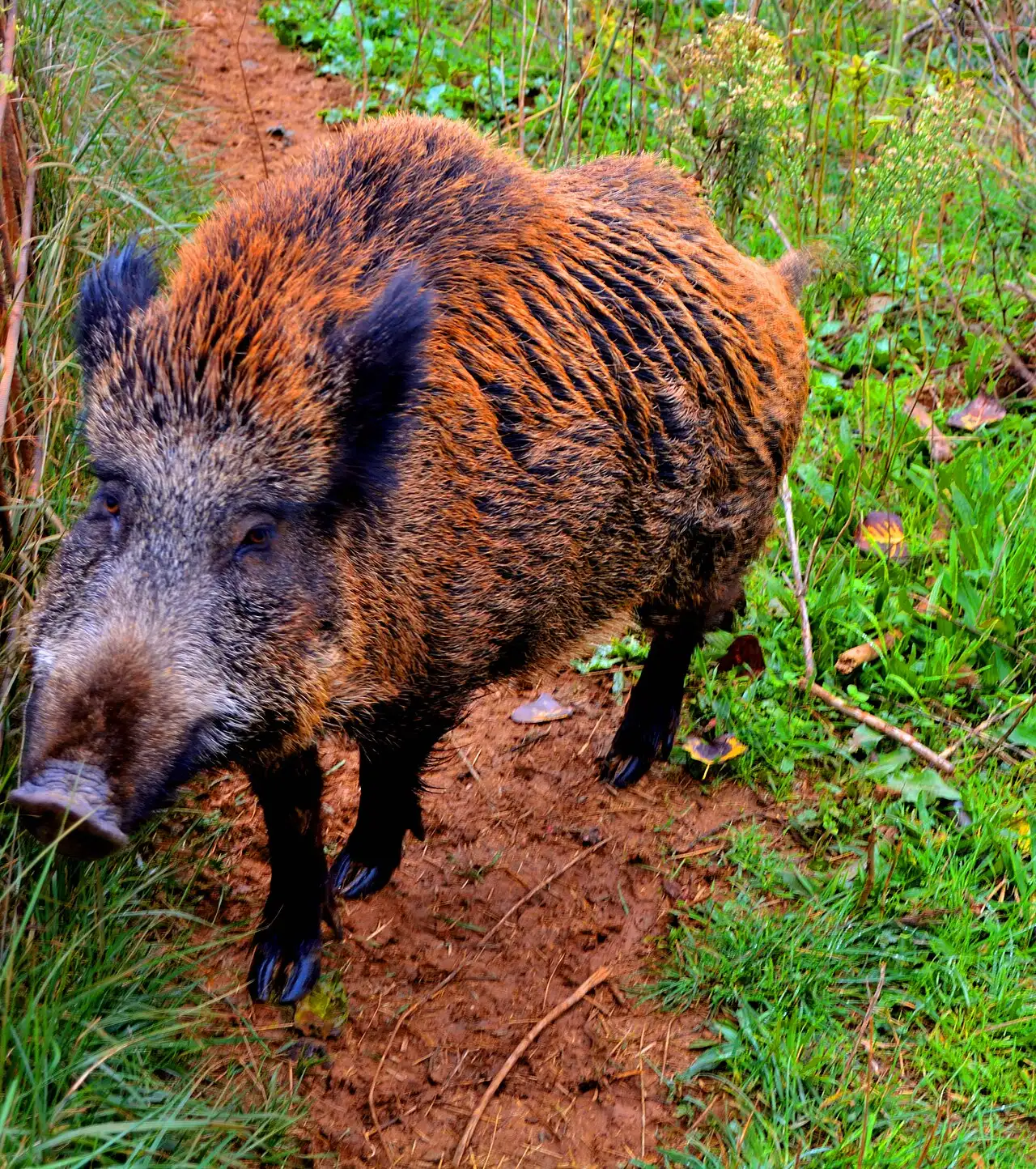
On 29 March 2023 the park’s Board of Trustees issued a favourable report on the Ungulate Management Plan, which sets out the measures to manage and control within the park the populations of ungulates, such as the red deer, the fallow deer or the wild boar, according to the newsletter of March–April 2023.
Where to see the Red Deer in Cabañeros
When
All year, but above all from September to December, when it is on the raña. In May the hinds return with their young.
What time
First thing in the morning and last thing in the afternoon, when it moves most.
Where
The raña: from the Casa Palillos observatory, the stork observatory or the Colada de Navalrincón, and on the 4×4 tour.
What to look for
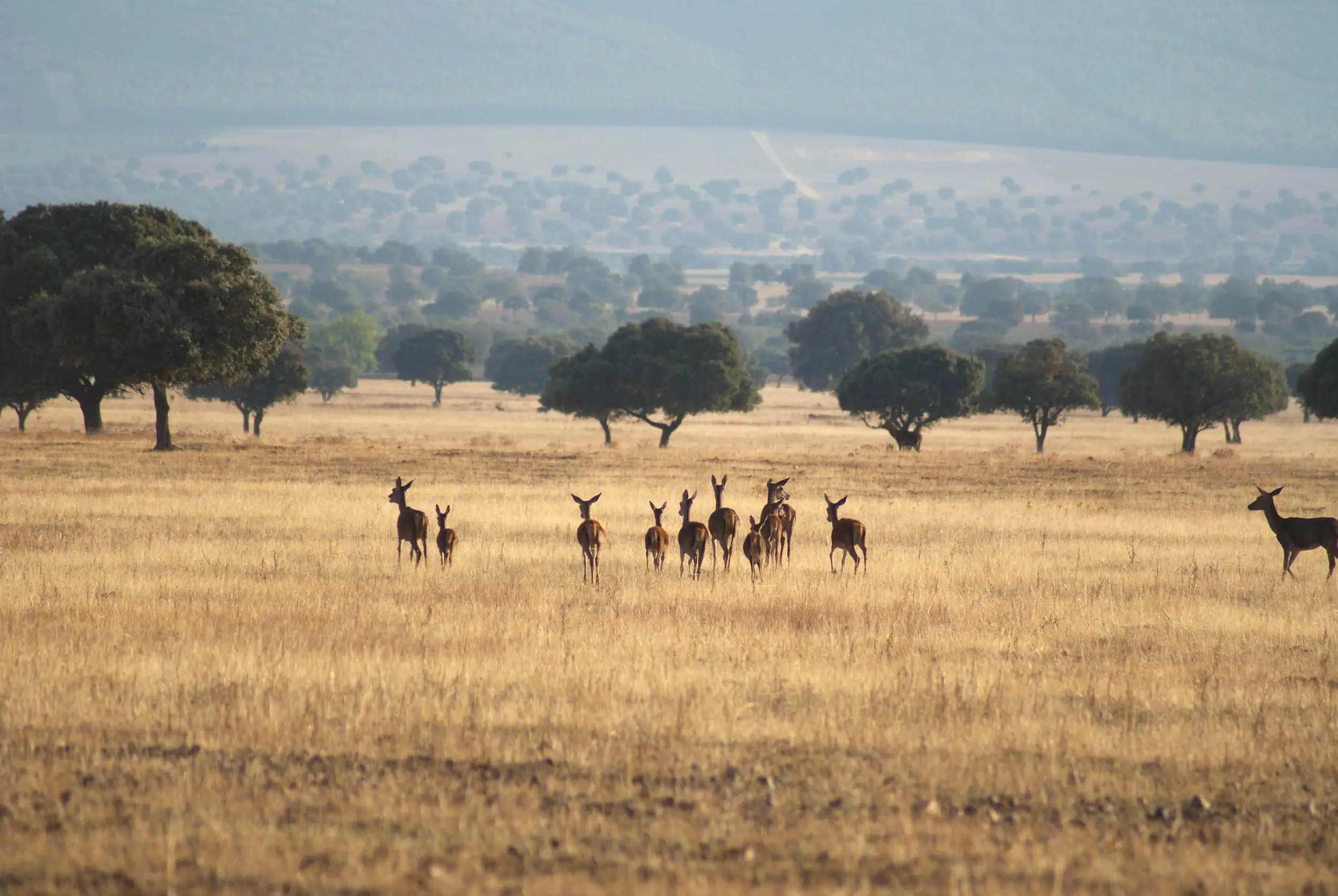
Groups of brown silhouettes among the holm oaks. In autumn, the roar will tell you where to look.
Newsletter «Desde el parque», Cabañeros National Park (OAPN): March–April 2023, July–August 2024 and July–August 2026 (in Spanish). All the newsletters.
Charlton, B. D., Reby, D. y McComb, K. (2007). Female red deer prefer the roars of larger males. Biology Letters, 3: 382-385. PMC
Clutton-Brock, T. H. y Albon, S. D. (1979). The roaring of red deer and the evolution of honest advertisement. Behaviour, 69: 145-170.
Fitch, W. T. y Reby, D. (2001). The descended larynx is not uniquely human. Proceedings of the Royal Society B, 268: 1669-1675. PMC
McComb, K. (1987). Roaring by red deer stags advances the date of oestrus in hinds. Nature, 330: 648-649. Nature
Reby, D. y McComb, K. (2003). Anatomical constraints generate honesty: acoustic cues to age and weight in the roars of red deer stags. Animal Behaviour, 65: 519-530.
Carranza, J. (2017). Ciervo – Cervus elaphus. En: Salvador, A. y Barja, I. (eds.), Enciclopedia Virtual de los Vertebrados Españoles. Museo Nacional de Ciencias Naturales (CSIC). vertebradosibericos.org
OAPN (2011). Guía de visita del Parque Nacional de Cabañeros. PDF
Parque Nacional de Cabañeros. Boletines de julio-agosto y septiembre-octubre de 2022.
AnAge: The Animal Ageing and Longevity Database. Cervus elaphus