Wingspan compared with a person with arms outstretched.
Length
21 cm
Wingspan
57–57 cm
Weight
100.5 g
Social life
Colonial, normally with colonies of 10–20 nests; in flight, in groups
Lifespan
Record of 26 years in the wild according to AnAge, which has it as Apus melba; EURING lists a bird ringed in Switzerland that lived 26 years, and another, also Swiss, 22 years
Conservation status
LC
NT
VU
EN
CR
EW
EX
Global (IUCN)
Least Concern
Spain
Least Concern (LC) as a breeder in the Red Book of the Birds of Spain; on the List of Wild Species under Special Protection, but not in the Spanish Catalogue of Threatened Species
When to see it
Summer visitor
Months of the year when it is present
J
F
M
A
M
J
J
A
S
O
N
D
In Iberia
no
no
yes
yes
yes
yes
yes
yes
yes
yes
no
no
Breeding season
no
no
no
yes
yes
yes
yes
yes
no
no
no
no
Song or voice of the Alpine Swift
It has a characteristic, easily recognised voice: while flying, normally in groups, it repeatedly gives a long, slow, high trill, with slight changes of rhythm, transcribed as «ti, ti, tititi, ti-ti-ti, tu, tu»1. The recording (flight call) is by Esperanza Poveda and was made in the Guadiato Valley (near Obejo), Córdoba, Andalusia (xeno-canto XC1161372, quality A). It lasts 9 seconds and is a trimmed stretch of the original, without repeating or lengthening it, from which we have removed the bass below 300 Hz, reduced the background noise and adjusted the volume; neither pitch nor speed has been changed.
It spends most of its life in the air, and is almost always seen flying and in groups, in towns as well as on coastal and inland cliffs. It routinely covers between 600 and 1,000 kilometres each day1. The legs, feathered and extremely short, prevent it from perching on the ground.
Flight typeSlow wingbeats and sweeping through the air with the mouth open
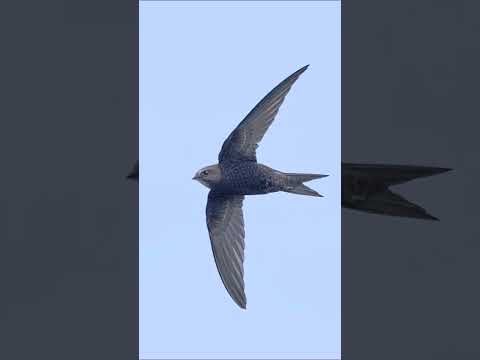
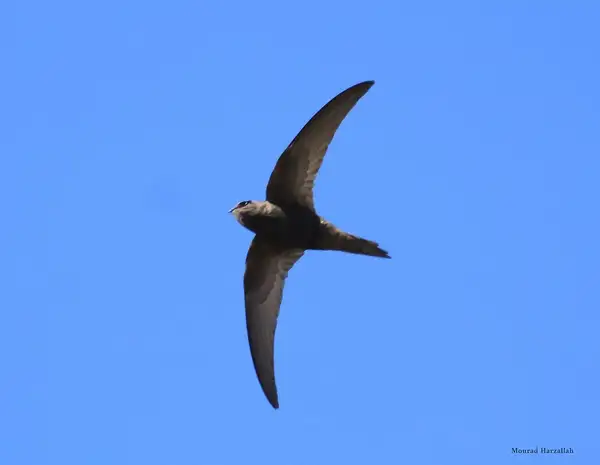
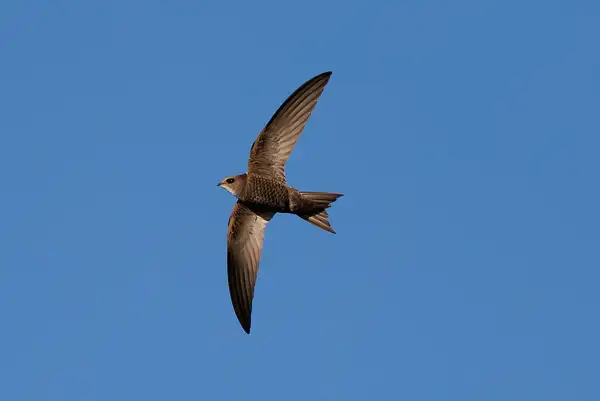
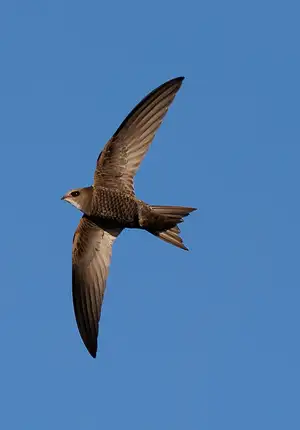
It has the typical crossbow-shaped silhouette, with very long, narrow wings, with slow wingbeats.
It is calculated to routinely cover 600–1,000 kilometres each day, sweeping the air with its mouth open like a butterfly net.
While flying, normally in groups, it repeatedly gives a long, slow, high trill, with slight changes of rhythm.
Photo gallery of the Alpine Swift
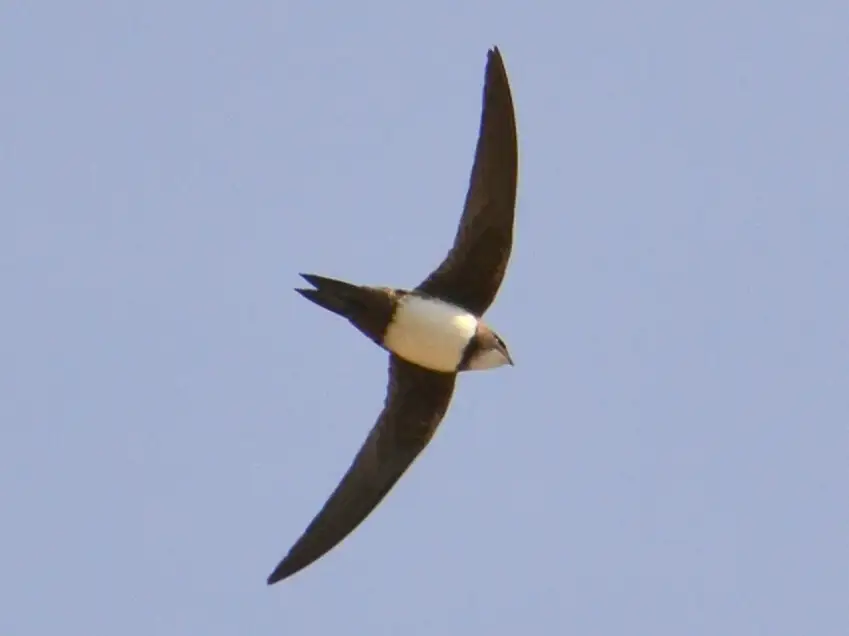
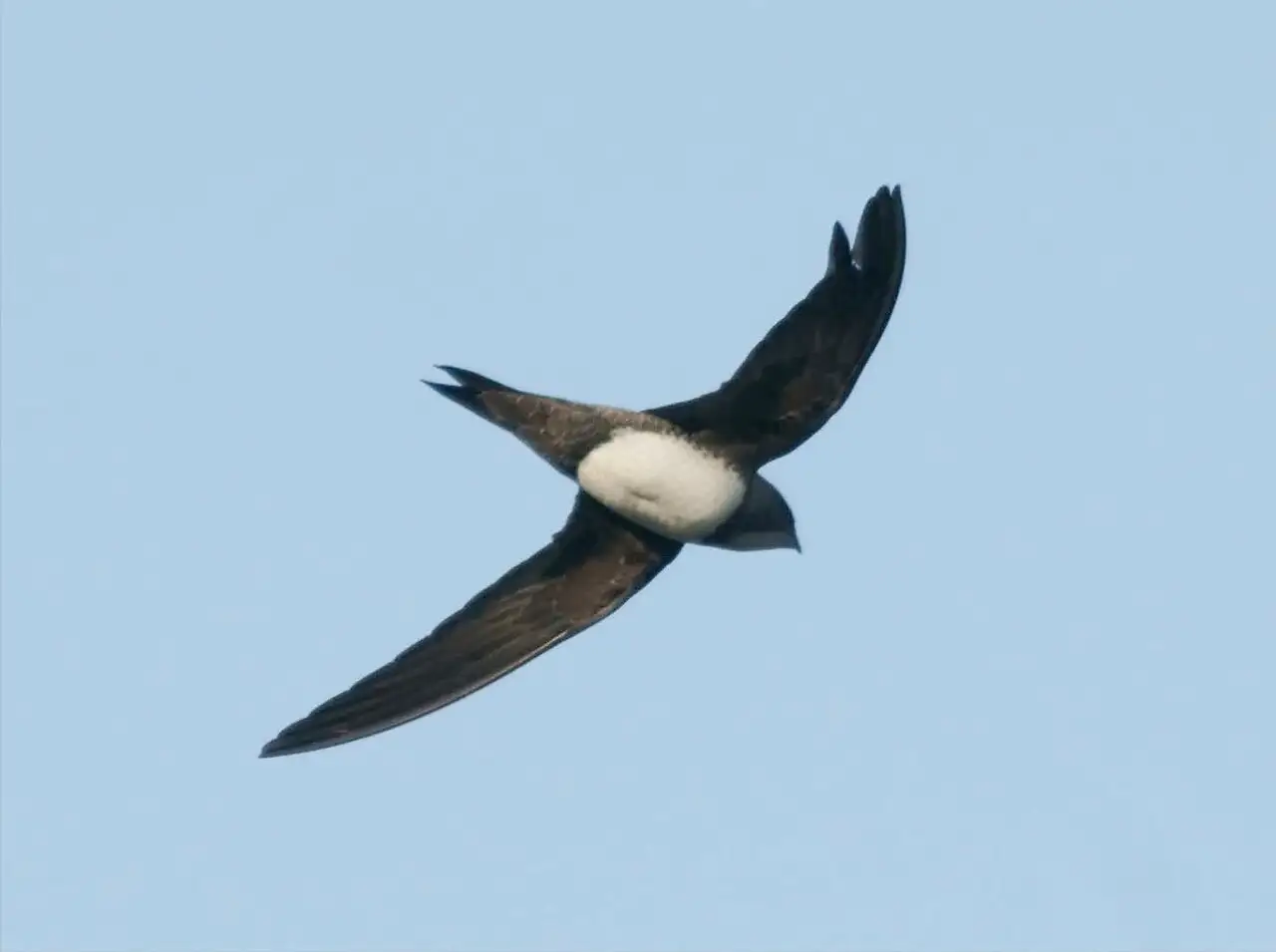
Alpine Swift in flight against a violet sky, with the long wings arched and the white belly clearly visiblePhoto: Birdwatching Barcelona, CC BY-SA 2.0Photo 1 of 4
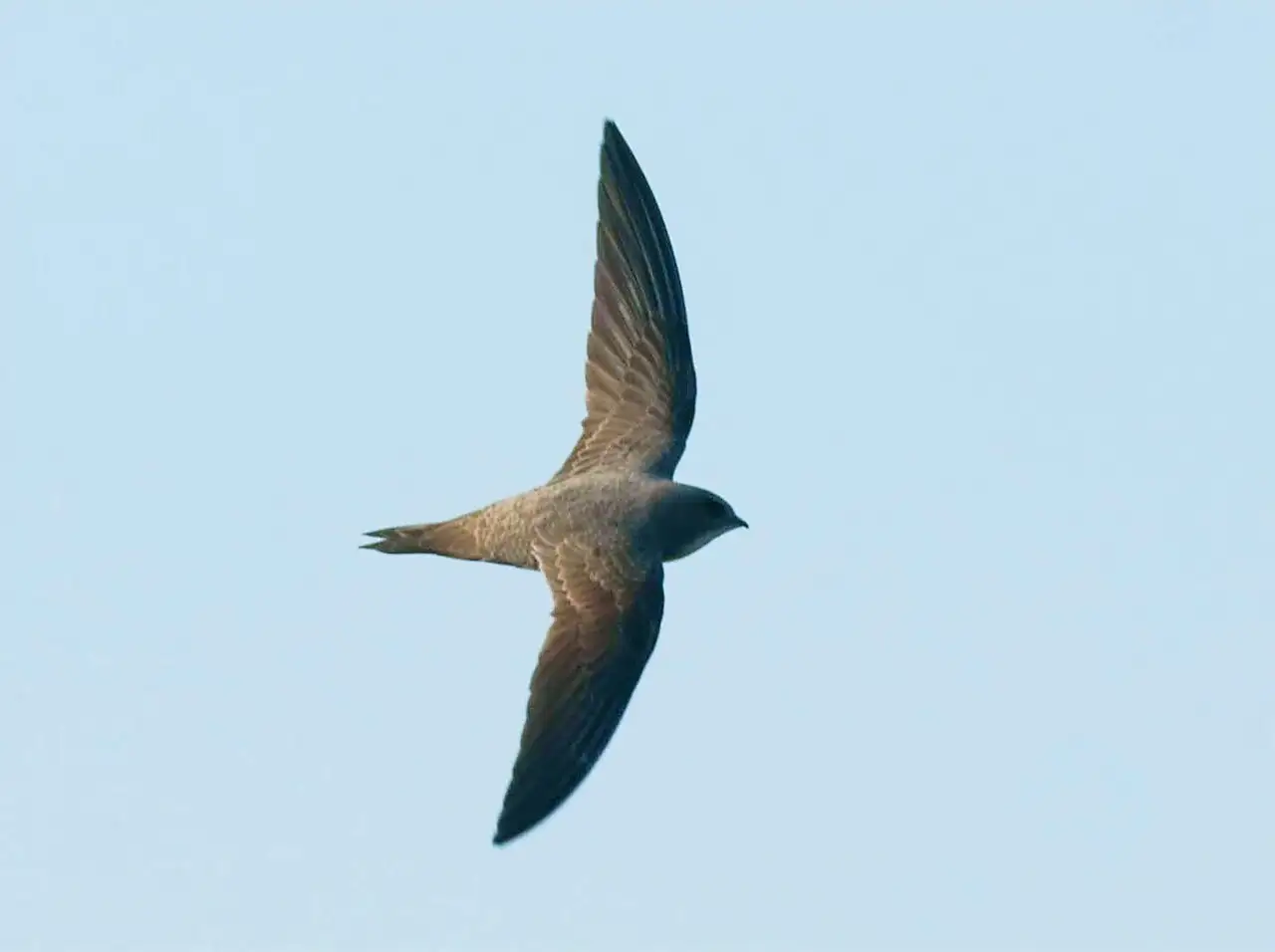
Alpine Swift in mid-turn, in profile, with the long, narrow wings open like a sickle and the olive-brown of the plumagePhoto: Ferran Pestaña, CC BY-SA 2.0Photo 4 of 4
1 / 4
Identification of the Alpine Swift
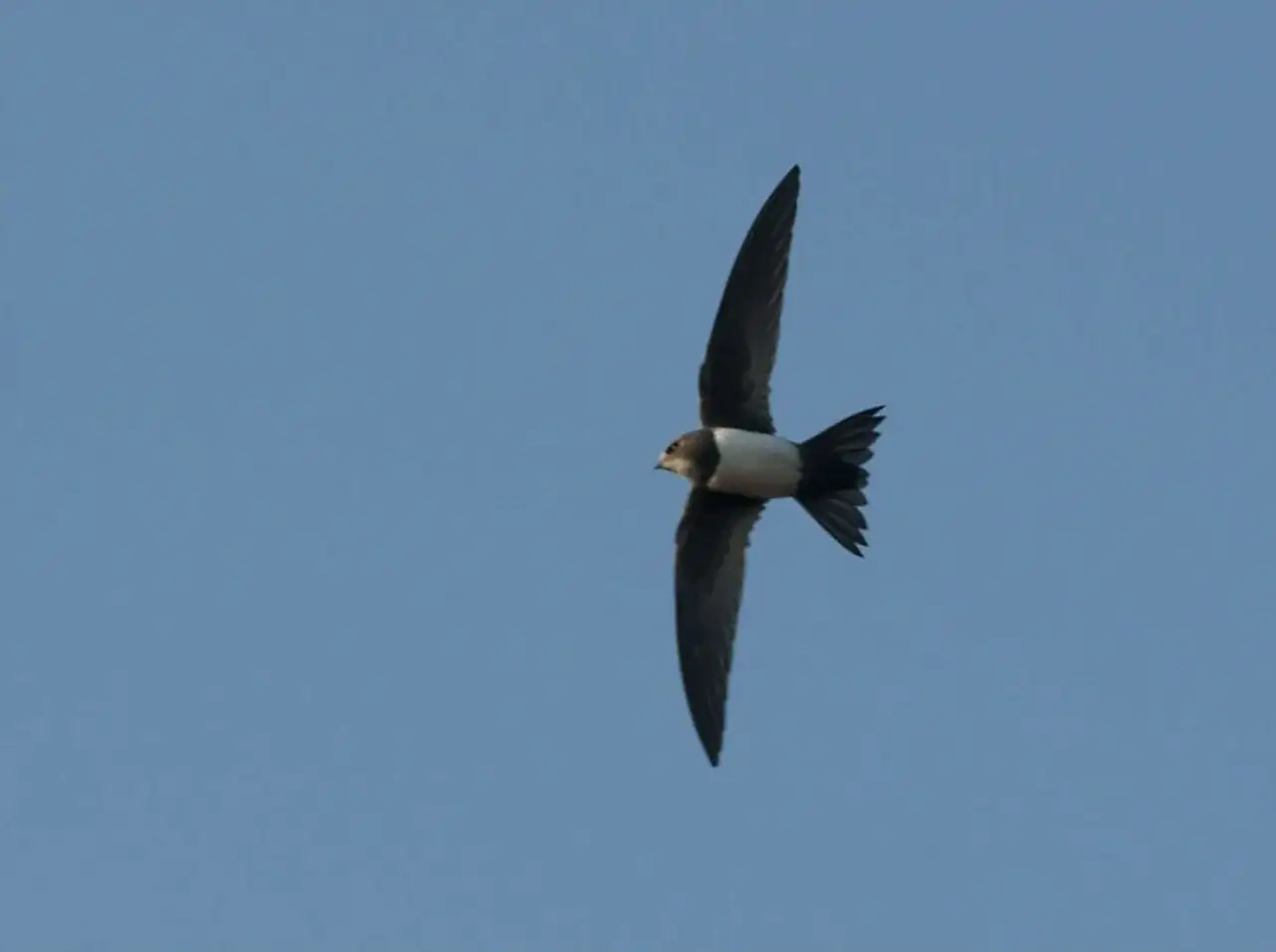
It is the biggest and showiest of the Spanish swifts. It has the typical crossbow-shaped silhouette, with a short, slightly forked tail and very long, narrow wings, with slow wingbeats. It has a short, flat bill with a very wide mouth; the legs, feathered and extremely short, prevent it from perching on the ground, and the feet, small and with strong claws, have all four toes pointing forwards. Its overall colouring is olive-brown, darker on the wings, with two prominent white areas on the belly and throat, separated by a brownish band. Both sexes are alike. Juveniles are very like the adults, although somewhat darker and with feathers edged in white.
Adult
Olive-brown, darker on the wings.
Two white areas, on the belly and on the throat, separated by a brownish band.
Young bird
Very like the adult, somewhat darker and with feathers edged in white.
Habitat and distribution of the Alpine Swift
As a breeder it occupies southern Europe, several separate areas of south-western Asia and, in Africa, the Maghreb, Mali, the Rift Valley, southern Africa and Madagascar. In Europe its distribution is fairly continuous in the southern third, with the northern limit in the Alps and the Carpathians. Outside the breeding season it is also found in equatorial Africa. Of the ten subspecies recognised, «melba» is the one in Spain and Europe; it is often classified in the genus «Apus»1.
In Spain it breeds on the Peninsula and in the Balearics, and is absent from Ceuta, Melilla and the Canaries; in the Balearics it is very localised. On the Peninsula it has an almost continuous distribution in the eastern half, coinciding with the limestone mountains, where its populations are densest and most numerous, and along the Mediterranean coast almost continuously from the Strait of Gibraltar to Girona. In the rest of the territory it breeds in a very fragmented way, with some medium-sized centres in eastern Sierra Morena, Las Villuercas (Cáceres), the Arribes del Duero, the upper Sil (León) and the Galician rías, and with an almost total absence from both Mesetas.
Because of its specialisation in the air, it is independent of vegetation, although it is limited by the availability of suitable nesting places. It sets its colonies mainly on cliffs, sea and inland, and prefers vertical, south-facing drops of some height. The best substrate is limestone, but colonies are known on granite, quartzite, slate and clay. Sometimes it uses human structures, rural ones such as bridges and dams, or urban ones; in Catalonia, since the 1960s, there has been some tendency to breed in buildings, even at the cost of abandoning rock colonies, and the small Extremaduran population breeds largely on bridges. There are colonies from sea level up to 1,700 metres in the Betic ranges and 1,900 in the Pyrenees.
It is a summer visitor: the European population winters in equatorial Africa. In Spain it is present between March and October, sometimes even in February and November. Passage through the Strait of Gibraltar is modest, peaking in March and September, although part of the birds come from other European countries, since the Iberian ones leave in October.
Areas where it is regularly recorded since 2010Squares of about 25 km where it is recorded regularly (occasional passage records are left out). Data from GBIF.org (59,582 records, retrieved October 2026); outline from Natural Earth.
Etymology of the Alpine Swift
In other languages it is called «ballester comú» in Catalan, «andoriñón real» in Galician, «malkar-sorbeltza» in Basque and «alpine swift» in English; its entry calls it «vencejo real»1. AnAge lists it as «Apus melba», the earlier scientific name. We have found no source explaining the origin of the names, so we do not venture a guess.
Population of the Alpine Swift
In the 2021 European Red List of Birds, the European breeding population is estimated at between 647,000 and 1,460,000 mature individuals, with the trend impossible to determine. The Spanish population is little known: the minimum estimate of 9,000 pairs must be revised upwards, because in Catalonia alone there are thought to be between 10,000 and 18,000, and figures of 30,000–50,000 pairs seem more realistic, although these are very ambiguous estimates.
It suffers no significant threats. Among the possible problems are cited disturbance at breeding colonies, especially if they are on buildings or bridges, and the use of pesticides1.
Nest of the Alpine Swift
The nest is a cup about 8–13 centimetres across and 4–10 deep, made of feathers glued together with plant matter and saliva. It can be set in holes and cracks of rocks and buildings or stuck to vertical surfaces; in the first case it is wider and flatter than in the second.
Courtship and breeding of the Alpine Swift
It lays a single clutch a year, and the breeding season runs from April–May to August. It is a colonial species, normally with small colonies of 10–20 nests that very rarely exceed 50 pairs. Return to the place of origin and fidelity are very marked, and pairs are known to have stayed together for at least 11 years. It mates in flight and at the nest. It usually lays two or three white eggs, which it incubates for about 20 days, and the chicks are fed about 10 times a day until they fly, at about 50 days.
Diet of the Alpine Swift
It is a specialist in aerial plankton, made up mostly of small insects, which it catches by sweeping the air with its mouth open, like a butterfly net. The commonest prey are hemipterans, such as bugs, hymenopterans, such as wasps and ants, small beetles and spiders. Where it coexists with other swifts it usually hunts higher and can catch bigger prey.
Curious facts about the Alpine Swift
It is the biggest and most striking of our swifts, in both appearance and voice, and the only one with white areas on the belly1. Its longevity record in EURING, 26 years, belongs to a Swiss bird found sick in a cold snap; AnAge, which has it as «Apus melba», also gives 26 years in the wild.
The Alpine Swift in Cabañeros
The habitat pages of this website do not mention it, and we have found no other published source about it in the Park; nor is it in the bird list of the «Visitor’s Guide to Cabañeros National Park» (OAPN). GBIF.org records 8 observations of the Alpine Swift in Cabañeros and its surroundings. Medium-sized breeding centres are cited in eastern Sierra Morena and in Las Villuercas (Cáceres), and an almost total absence from both Mesetas1. Only one of those observations falls within the Park boundary (according to OpenStreetMap); the rest are from the surroundings.
Where to see the Alpine Swift in Cabañeros
In Cabañeros and its surroundings, from March to October, in the air over the crags and the ranges.
When
Present from March to October, sometimes from February to November.
What time
By day, in the air, in groups passing by the crags.
Where
Over large south-facing rock cliffs, and over bridges and dams.
What to look for
Look for the two white patches, on the belly and on the throat; listen for the long, high trill.




 Same family
 Same family
 Same family
 Same season in the park
 Same season in the park
 Same season in the park
 Same season in the park
 Same season in the park





