Usually colonial, with colonies of a few pairs to several thousand
Lifespan
EURING lists a bird ringed in Italy that lived 20 years; another, in Portugal, 12 years and 1 month
Conservation status
LC
NT
VU
EN
CR
EW
EX
Global (IUCN)
Least Concern
Spain
Least Concern (LC) as a breeder in the Red Book of the Birds of Spain; on the List of Wild Species under Special Protection, but not in the Spanish Catalogue of Threatened Species
When to see it
Summer visitor
Months of the year when it is present
J
F
M
A
M
J
J
A
S
O
N
D
In Iberia
no
yes
yes
yes
yes
yes
yes
yes
yes
yes
no
no
Breeding season
no
no
yes
yes
yes
yes
yes
yes
yes
yes
no
no
Song or voice of the Pallid Swift
It has a characteristic voice: while flying, above all at the breeding colonies, it repeatedly gives a two-syllable, brief, monotonous scream of low pitch, «ruuek…, rueek». Unlike the Common Swift, the sound is the same in both sexes, and it is considered very useful for telling them apart, above all in poor light: uniform, two-syllable, low voices are those of Pallid Swifts1. The recording (call, also in flight) is by Jacobo Ramil Millarengo and was made at Portiño de San Miguel de Deiro, Vilanova de Arousa, Pontevedra, Galicia (xeno-canto XC744921, quality A). It lasts 9 seconds and is a trimmed stretch of the original, without repeating or lengthening it, from which we have removed the bass below 300 Hz, reduced the background noise and adjusted the volume; neither pitch nor speed has been changed.
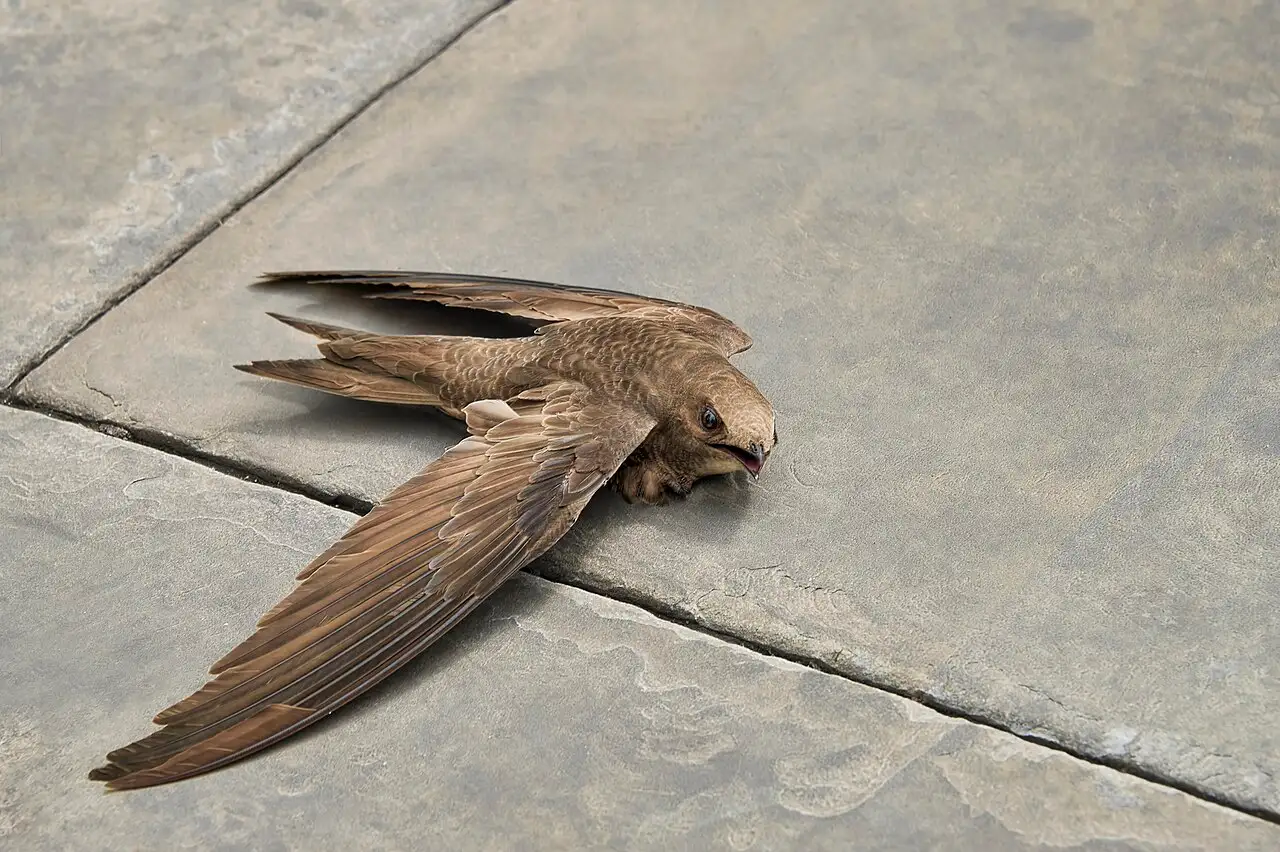
It spends most of its life in the air, and so is almost always seen flying and in a group, over urban centres as well as beside coastal and inland cliffs. It has feathered, extremely short legs, which prevent it from perching on the ground, and small feet with strong claws, with all four toes forwards, for gripping walls.
Flight typeSweeping the air with the mouth open, almost always in the air and in a group
It spends most of its life in the air, so it is almost always seen flying and in a group, over urban centres as well as beside coastal and inland cliffs.
It catches aerial plankton, made up mostly of small insects, by sweeping in flight with its mouth open like a butterfly net.
While flying, above all at the breeding colonies, it repeatedly gives a two-syllable, brief, monotonous scream of low pitch: «ruuek…, rueek».
Photo gallery of the Pallid Swift
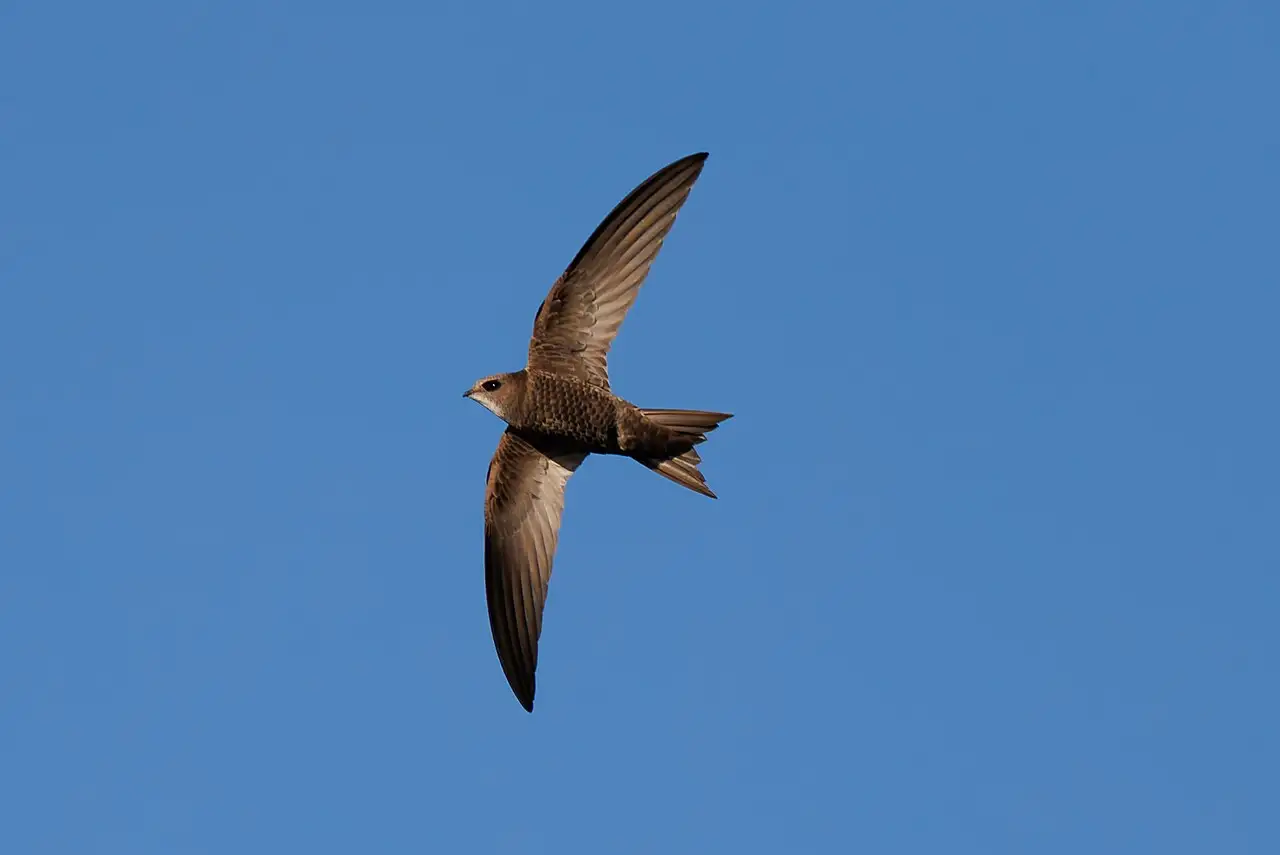
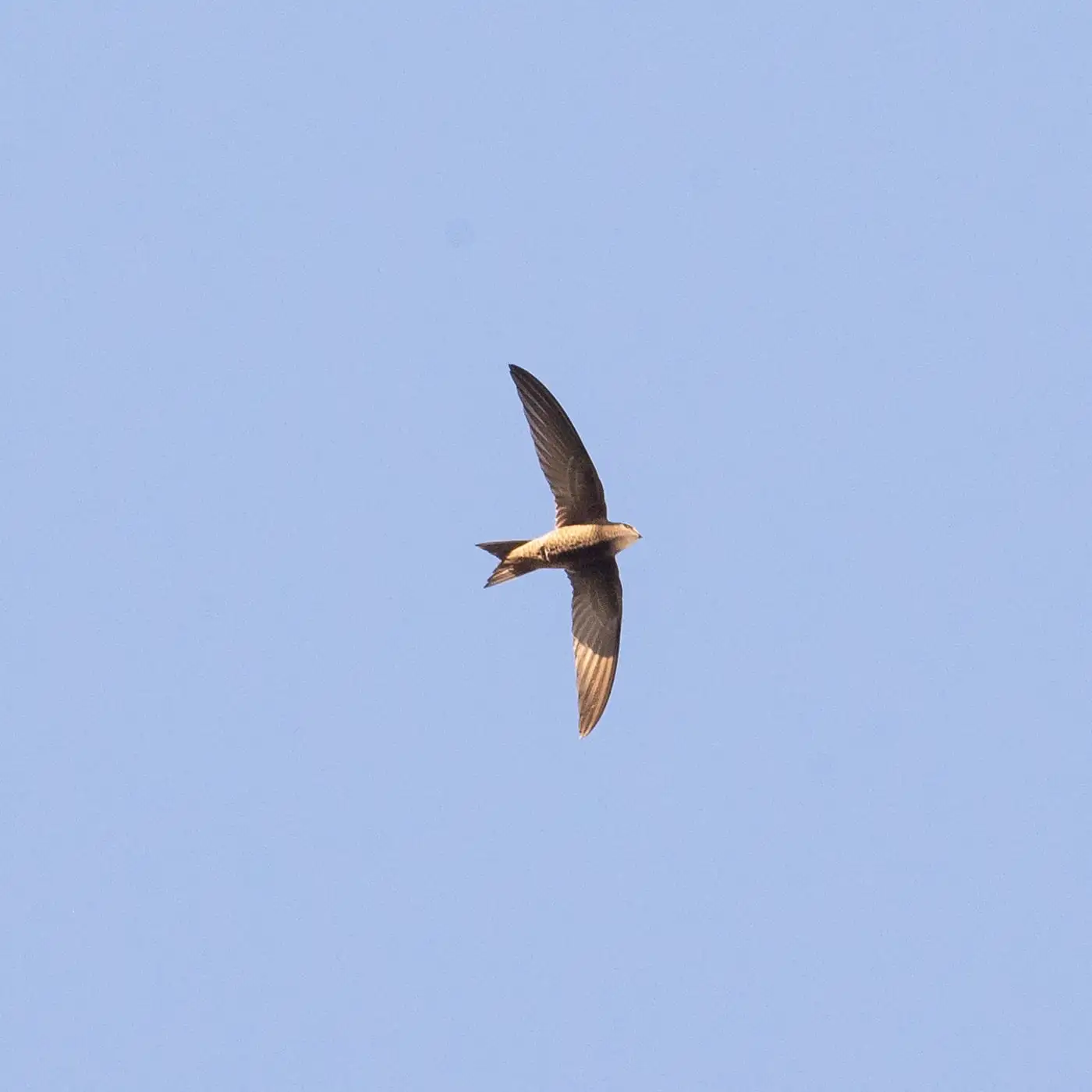
Pallid Swift in flight seen from below against a blue sky, with long, narrow wings, a short, forked tail and grey-brown plumagePhoto: Hobbyfotowiki, CC0Photo 1 of 5
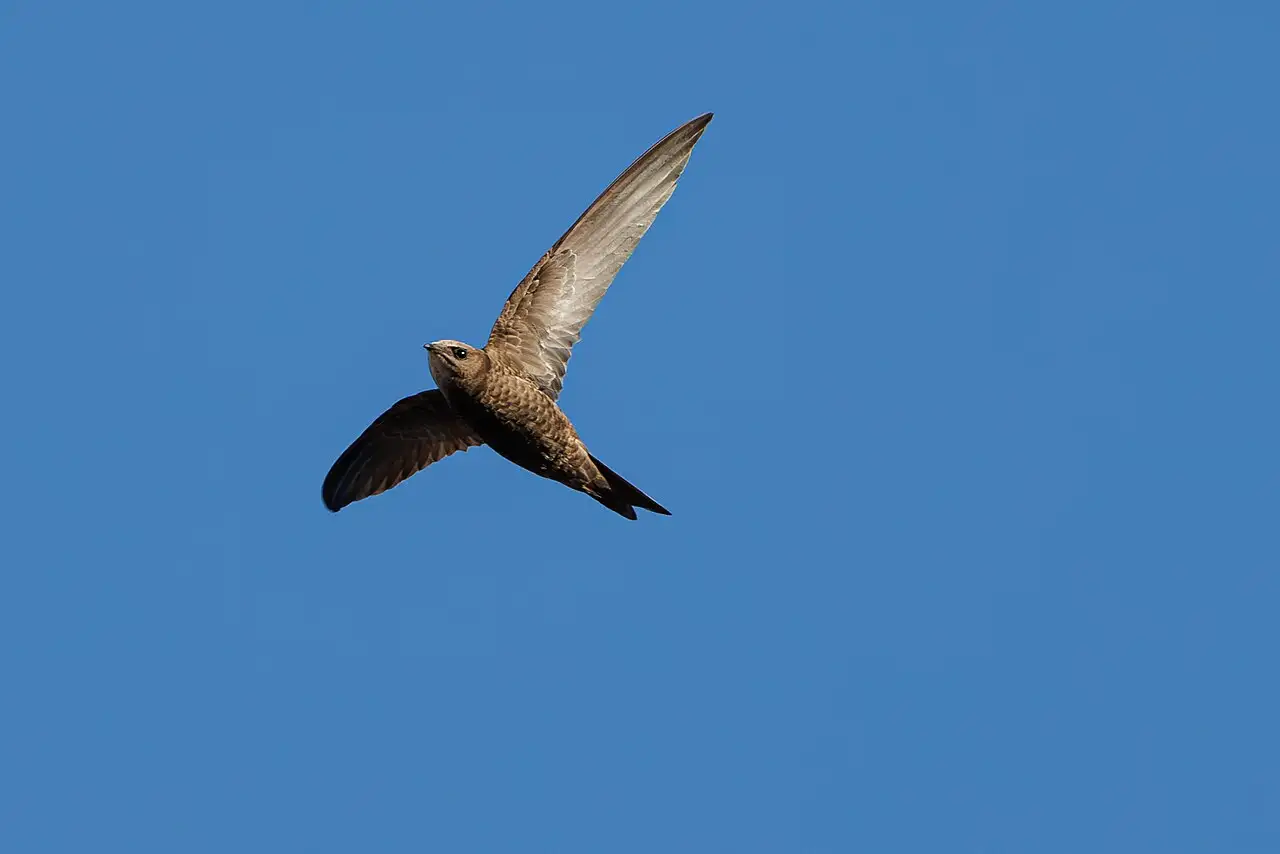
Pallid Swift in mid-turn against a blue sky, with the wings open and arched like a sicklePhoto: Hobbyfotowiki, CC0Photo 2 of 5
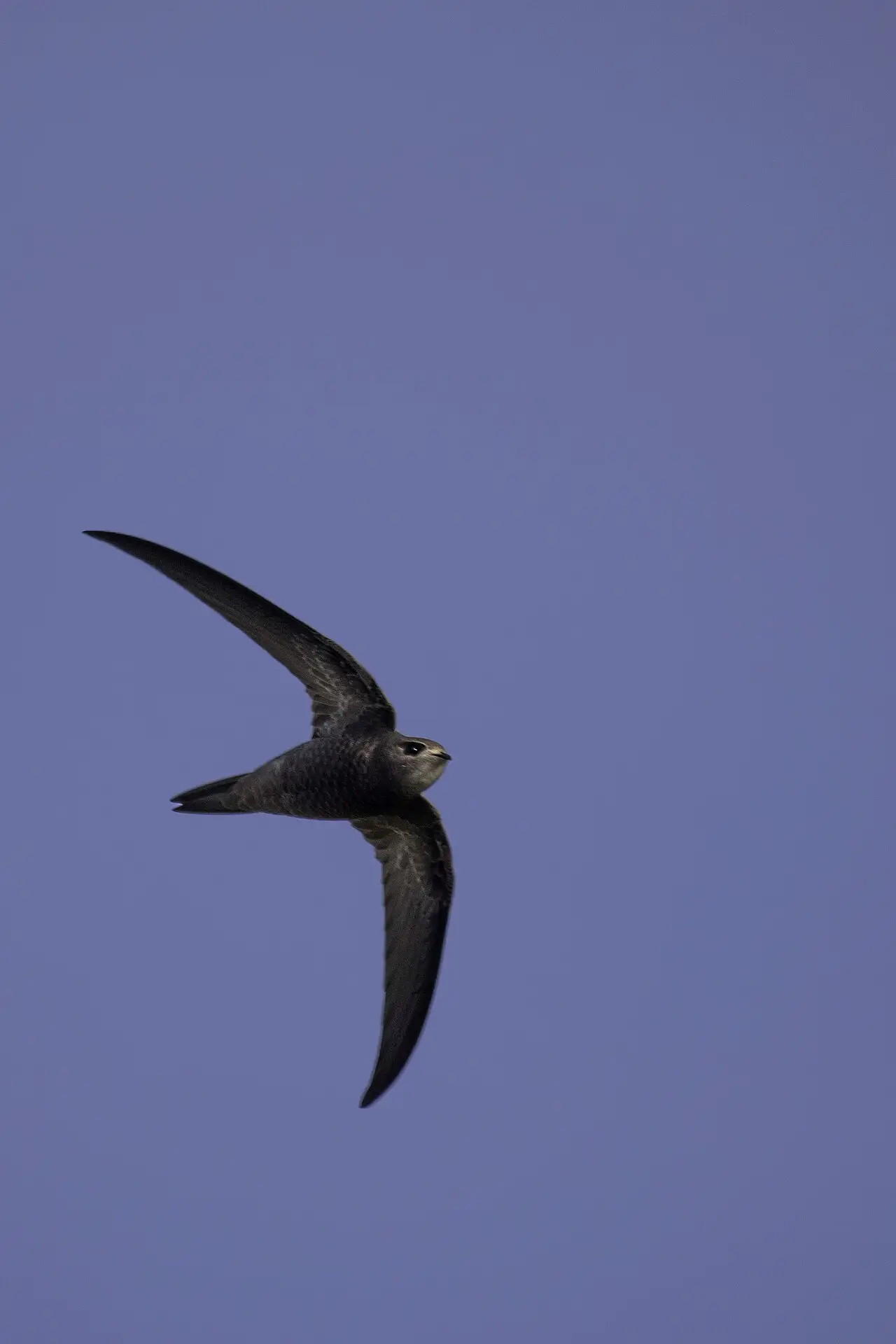
Pallid Swift in flight against a violet evening sky, with thin sickle-shaped wings and a short tailPhoto: TRinaud, CC BY 4.0Photo 3 of 5
Pallid Swift on the ground of a square with the long wings spread over the paving, in uniform brown plumagePhoto: Steve Slater, CC BY 2.0Photo 4 of 5
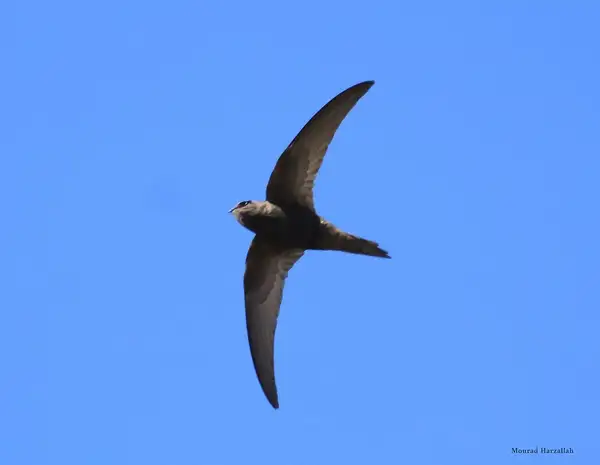
Pallid Swift in flight, seen from below against a blue sky (Madrid)Photo: euqirneto, CC BY 4.0Photo 5 of 5
1 / 5
Identification of the Pallid Swift
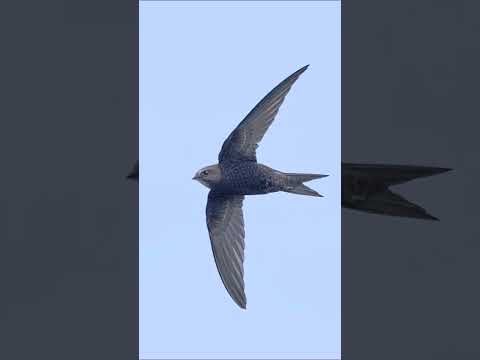
The Pallid Swift has a crossbow-shaped silhouette, with a short, forked tail and long, narrow wings. It has a short, flat bill with a very wide mouth, feathered and extremely short legs, which prevent it from perching on the ground, and small feet with strong claws, with all four toes pointing forwards. It wears a uniform grey-brown colouring, except on the throat, which is white, and the inner underside of the wings is paler. With little-worn plumage it shows a scaly overall look. It is easily confused with the Common Swift, and to tell them apart good light and a short distance are needed: the Pallid has a paler, browner overall tone and more white on the throat, and at times a more marked mask, more contrast on the underwing and a more scaly look can be seen. Both sexes are alike. Juveniles, very like the adults, are somewhat darker and have a more marked scaly look, from the feathers edged in white.
Adult
Uniform grey-brown, with white throat and paler underwing.
Crossbow silhouette, short, forked tail.
Young bird
Somewhat darker, with feathers edged in white that give a more marked scaly look.
Habitat and distribution of the Pallid Swift
As a breeder it occupies an apparently fragmented range in the south-west Palearctic, with the best populations in the Mediterranean basin, the Arabian Peninsula and the Persian Gulf; it also breeds in the Canaries, Madeira, the North African Atlantic coast, the Nile valley and the Sahara mountains. In general it settles in areas near the sea and inland populations are rare, where it usually lives in urban centres. Of the three subspecies described, the one present in Spain is «brehmorum», the darkest. It winters in tropical Africa, north of the equator.
In Spain it occupies mainly the southern half of the Peninsula and the Mediterranean coast, with the Balearics, Ceuta and Melilla, with scattered presence on the north coast and the Ebro valley and localised in the Canaries. Colonies are cited, at apparently isolated points, in Zaragoza, Madrid, Toledo, Cuenca and the A Coruña coast; the best populations are in the far south, from Huelva to Murcia1. In recent years new colonies have been discovered inland, due above all to telling it apart better from the Common Swift and not so much to a natural expansion, and it may be more widespread than the data show.
Although its specialisation in the air makes it relatively independent of habitat, in Spain it prefers to breed in warm, sunny, human-settled areas with little forest. It sets up its colonies on cliffs, above all coastal, and in urban areas, where it usually coincides with the Common Swift, though at times in different buildings or neighbourhoods; there are also colonies in outlying districts and small rural settlements, as in Cáceres. It lives mainly in low-altitude areas, but breeds from sea level up to villages such as Trevélez (Granada), at 1,750 metres, or Piornal (Cáceres), at 1,200.
It is a summer visitor and trans-Saharan migrant, with wintering areas in tropical Africa and sporadic records in midwinter in Spain. The first arrival on the Peninsula varies, according to year and place, between early February and early March, the month when the bulk of the population arrives; in the Canaries it is seen from January. From August it leaves the colonies progressively, and complete departure ranges from mid-September to the end of October, even November. Passage through the Strait of Gibraltar peaks in the first fortnights of March and August. Its period of presence is longer than that of the Common Swift1. Observations in February–March and September–October probably correspond to Pallid Swifts1.
Areas where it is regularly recorded since 2010Squares of about 25 km where it is recorded regularly (occasional passage records are left out). Data from GBIF.org (38,879 records, retrieved October 2026); outline from Natural Earth.
Etymology of the Pallid Swift
According to Wikipedia, «Apus» is the Latin name of the swift, which the ancients took for a legless swallow (from the Ancient Greek «a», «without», and «pous», «foot»), and «pallidus» is Latin for «pale». In other languages it is called «falciot pàl·lid» in Catalan, «cirrio pálido» in Galician, «sorbeltz arrea» in Basque and «pallid swift» in English1.
Population of the Pallid Swift
In the 2021 European Red List of Birds, the European breeding population is estimated at between 152,000 and 424,000 mature individuals, with an unknown trend. The Spanish population is little known, with very variable data: 25,000 pairs are cited in Extremadura and only 50–250 in the Canaries, with a wide margin of error because of confusion with the Common Swift. A conservative minimum of 200,000 birds in Spain is tentatively proposed1.
The trend of the Spanish population is unknown; the increase in occupied area is attributed, in principle, to better knowledge. Among the possible problems are cited the loss of nesting sites through renovation of old buildings, its poor suitability for breeding in new buildings, urban air pollution, the use of pesticides and competition with other swifts1.
Nest of the Pallid Swift
The nest is in natural rock holes or in buildings, and rarely in trees. It is a cup 10–12 centimetres across, made of plant matter and feathers glued together with saliva.
Courtship and breeding of the Pallid Swift
It lays two clutches a year, although in Spain some colonies may lay only one and the proportion of pairs that breed twice may change from year to year. The breeding season runs from March to October, with broods mainly in April–June and July–September. Colonies range from a few pairs to several thousand. It mates in flight and at the nest. It usually lays two or three white eggs, although the number ranges from one to four; both sexes incubate for 21 days and feed the chicks up to four times an hour, until they fly, at about 45 days. Its fidelity to the birthplace and between mates is not as marked as in the Common Swift.
Diet of the Pallid Swift
It is a specialist in aerial plankton, made up mostly of small insects, which it catches by sweeping the air with its mouth open, like a butterfly net. The commonest prey are hymenopterans, such as wasps and ants, hemipterans, such as bugs, dipterans, such as flies and mosquitoes, and small beetles.
Curious facts about the Pallid Swift
It is an almost twin species of the Common Swift, with which it is relatively often confused1. Its longevity record in EURING, 20 years, belongs to a bird ringed in Italy and checked by the ringer; it is a high figure, and we have found no other source to compare it with, because AnAge does not list the species.
The Pallid Swift in Cabañeros
The habitat pages of this website do not mention it, but it does appear in the bird list of the «Visitor’s Guide to Cabañeros National Park» (OAPN, page 105). That list attests its presence in the Park, not that it breeds there. GBIF.org records 8 observations of the Pallid Swift in Cabañeros and its surroundings. Isolated colonies in Toledo and 25,000 pairs in Extremadura are cited, with no localities in the Park1. Of those observations, 6 fall within the Park boundary (according to OpenStreetMap); the rest are from the surroundings.
Where to see the Pallid Swift in Cabañeros
In Cabañeros and its surroundings, from February to October, in the air over villages and crags.
When
It arrives between early February and early March and leaves between mid-September and the end of October.
What time
By day, in the air, in flocks circling around the colonies.
Where
Over warm, sunny towns and cities, and beside coastal and inland cliffs.
What to look for
Look for the paler tone and the white throat; listen for the low, two-syllable «ruuek…, rueek».
It is similar in song and appearance1. It is the one that most resembles it: the Pallid has a paler, browner overall tone and more white on the throat, and its voice is two-syllable and low.
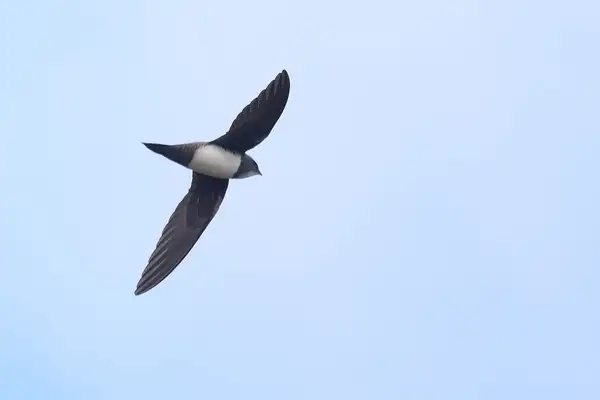
It is also known as «vencejo real»: it is the biggest of our swifts and the only one with white areas on the belly, something the Pallid does not have1.
Photo: José Antonio León Mangado (Navarre), CC0
Other birds
Birds related to the Pallid Swift or sharing its habitats in Cabañeros.



 Same family
 Same family
 Same family
 Same season in the park
 Same season in the park
 Same season in the park
 Same season in the park
 Same season in the park





