Pairs form in March and April, and both parents care for the chicks
Lifespan
Record of 9 years and 10 months according to EURING (a bird ringed in Spain and checked by a ringer)
Conservation status
LC
NT
VU
EN
CR
EW
EX
Global (IUCN)
Least Concern
Spain
Least Concern (LC) in the Red Book of the Birds of Spain; on the List of Wild Species under Special Protection, but not in the Spanish Catalogue of Threatened Species
When to see it
Summer visitor
Months of the year when it is present
J
F
M
A
M
J
J
A
S
O
N
D
In Iberia
no
yes
yes
yes
yes
yes
yes
yes
yes
yes
no
no
Breeding season
no
no
yes
yes
yes
yes
yes
no
no
no
no
no
Song or voice of the Greater Short-toed Lark
It is prolonged, with short verses that include different trills and warbles. It is normally given during ascending or undulating flights.
SongGreater Short-toed Lark
0:00 / 0:22
10 kHz5
The sonogram draws the sound: time runs from left to right, and the higher a trace sits, the higher the note.Recording by Milan Ruzic, xeno-canto XC478478 (CC BY-SA 4.0).
Flight of the Greater Short-toed Lark
It has a light, fast flight, with gentle undulations and sudden drops. In flight it shows pale underwings, without a white border, and a dark tail.
Flight typeLight and fast, with gentle undulations and sudden drops
Its song, prolonged, with short verses of trills and warbles, is normally given in ascending or undulating flights.
It has a light, fast flight, with gentle undulations and sudden drops. It shows pale underwings, without a white border, and a dark tail.
It occupies moorland, steppes and dry cereal crops, with sparse grassy formations such as fallows, sown fields and pastures.
Photo gallery of the Greater Short-toed Lark
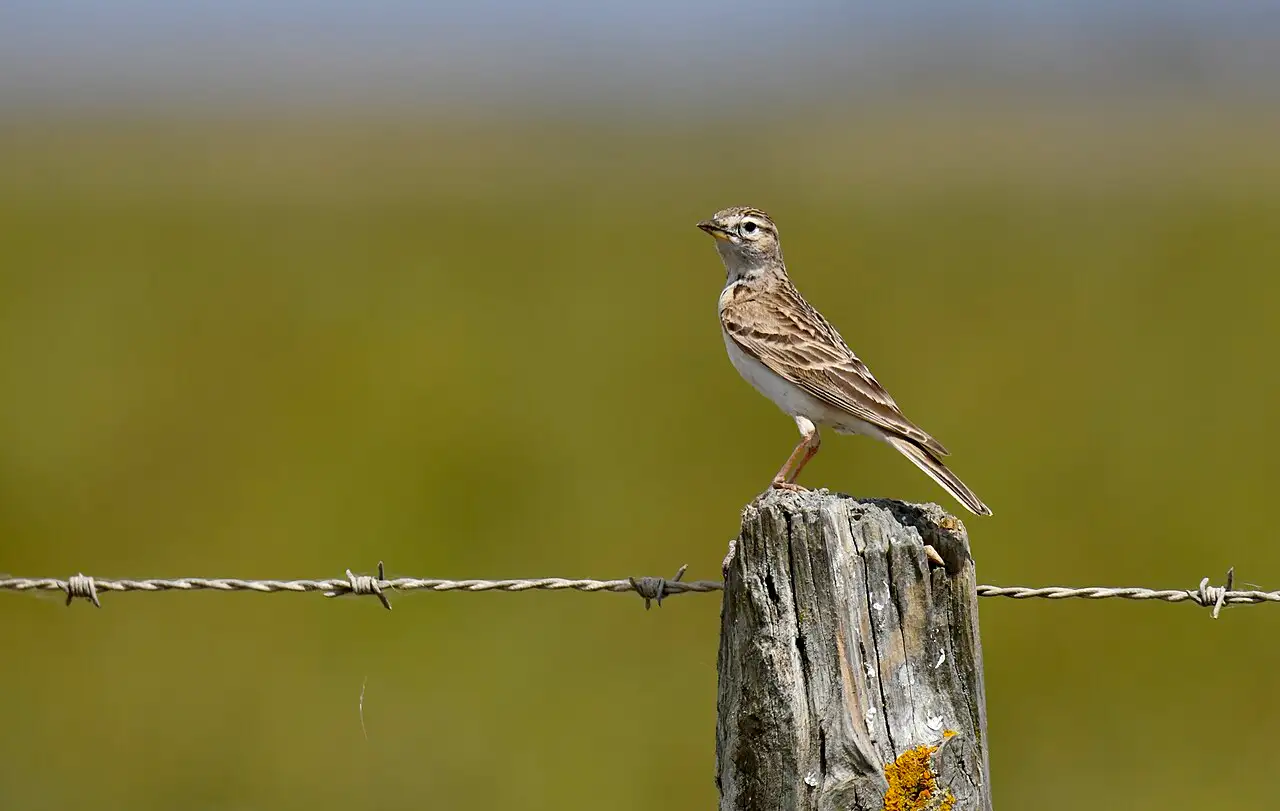
Greater Short-toed Lark on a wooden post of a wire fence, in profile, with streaked back and whitish breastPhoto: Luiz Lapa from Oeiras, Portugal, CC BY 2.0Photo 1 of 4
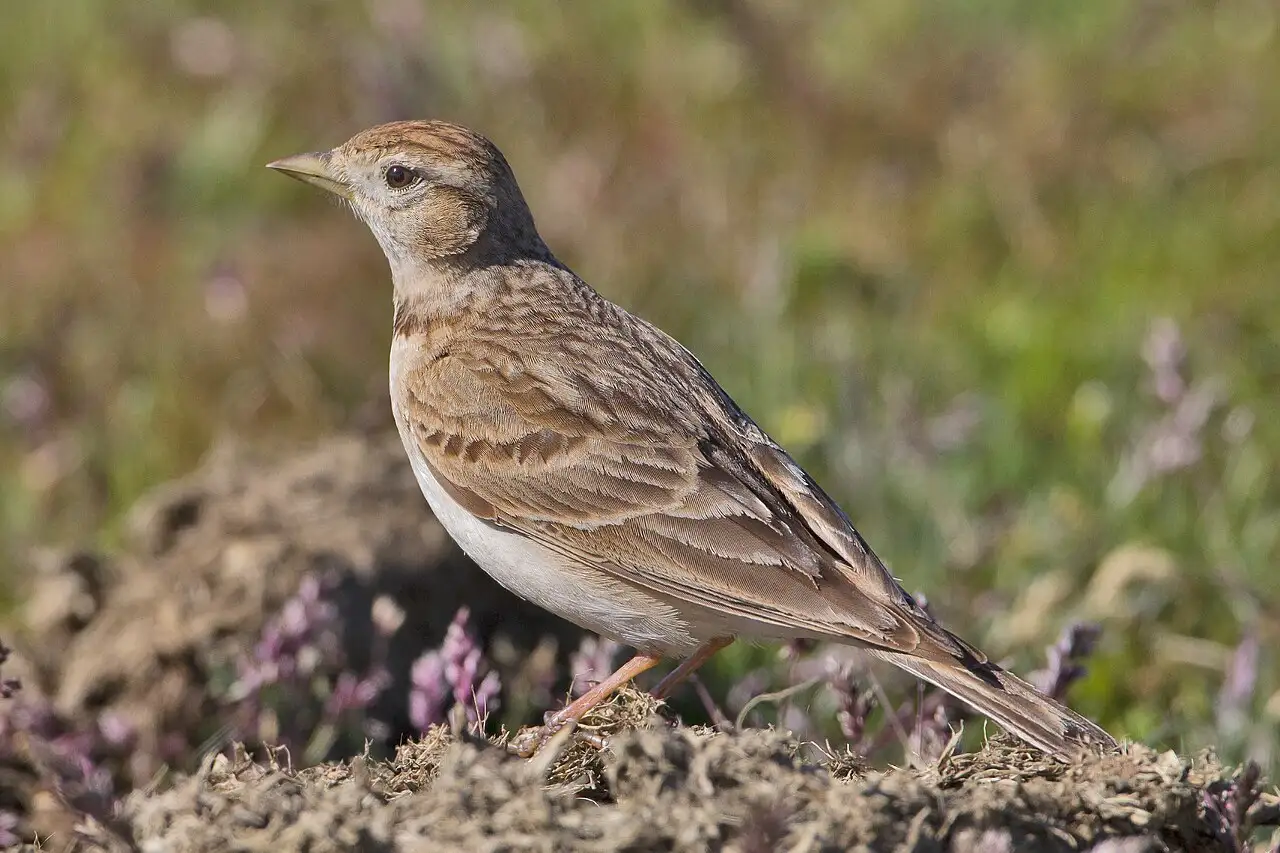
Greater Short-toed Lark in profile on a mound of earth with purple flowers, with pale eyebrow, pale brown back and whitish bellyPhoto: Juan Lacruz, CC BY-SA 3.0Photo 3 of 4
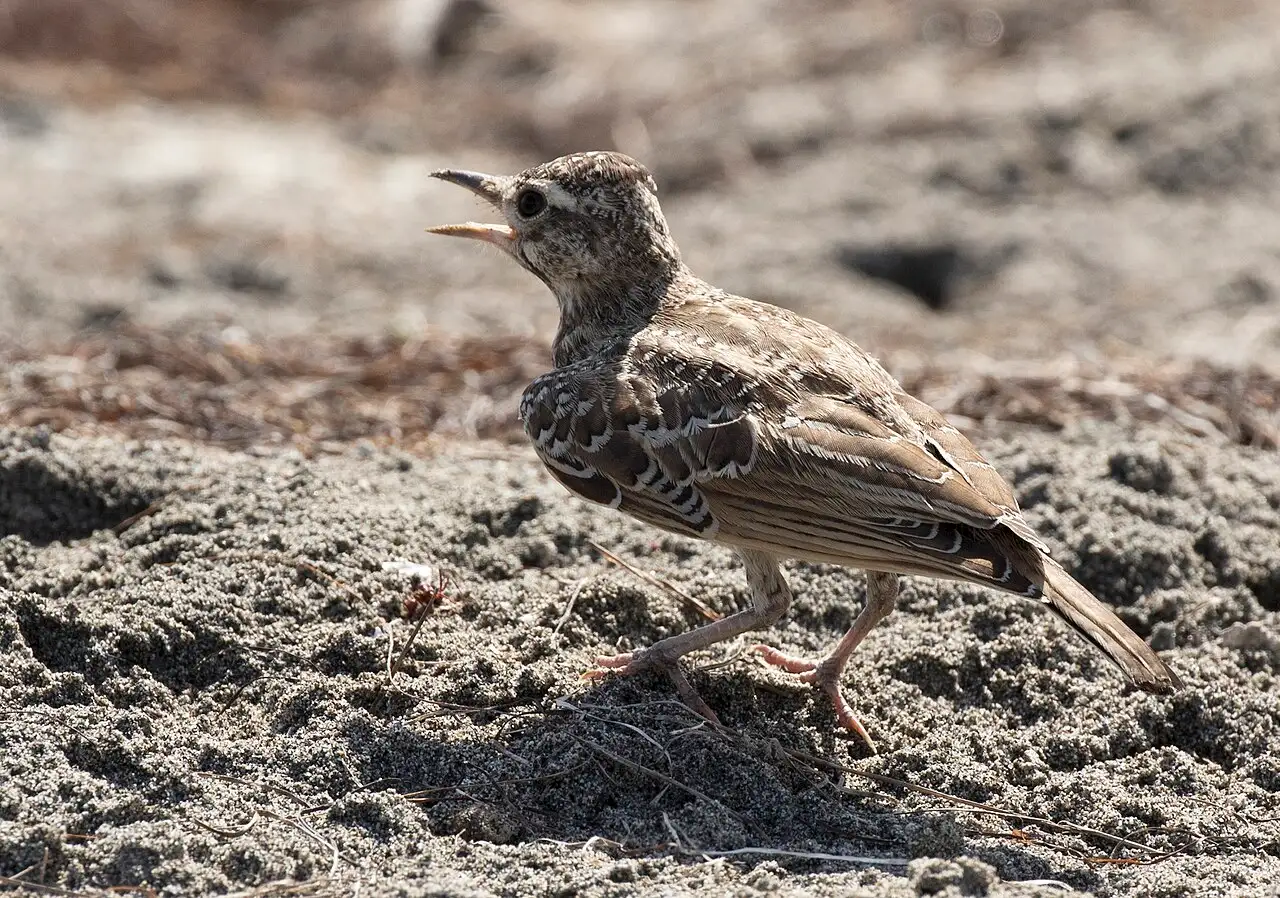
Greater Short-toed Lark on a ground of sand and stones, with open bill and streaked backPhoto: Zeynel Cebeci, CC BY-SA 4.0Photo 4 of 4
1 / 4
Identification of the Greater Short-toed Lark
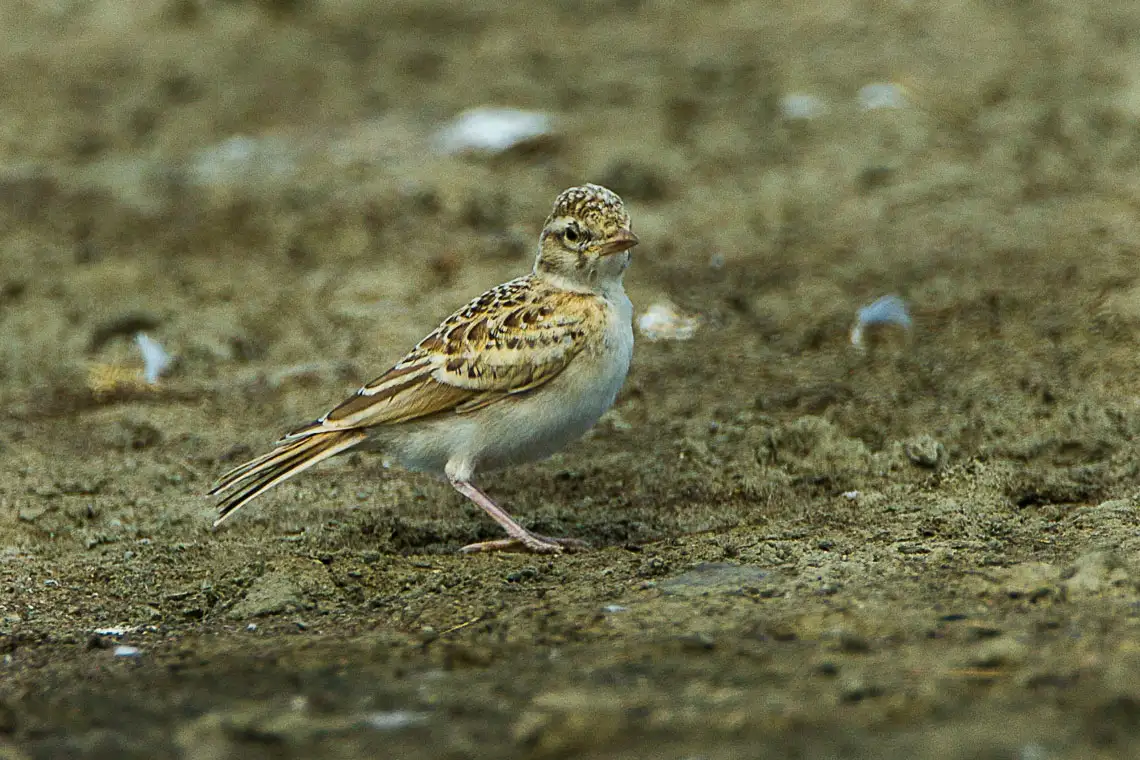
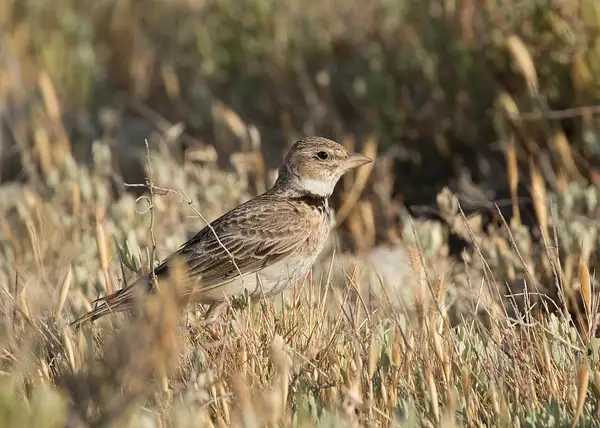
The Greater Short-toed Lark is a small lark, in pale brown tones, with the back streaked with black. Like the Calandra Lark, it has a dark patch on each side of the neck. Its breast is whitish and unstreaked. The pale supercilium contrasts with the crown and with the dark line behind the eye. In flight it shows pale underwings, without a white border, and a dark tail.
Adult
Pale brown tones, with a back streaked with black.
Whitish, unstreaked breast and dark patches on both sides of the neck.
Pale supercilium and dark line behind the eye.
Habitat and distribution of the Greater Short-toed Lark
It is distributed around the Mediterranean, in Europe and North Africa, and more widely and continuously across the Middle East, the Black Sea and central Asia, as far as northern China. In Europe, the main populations are on the Iberian Peninsula, in Turkey and southern Russia, and the European birds winter in sub-Saharan Africa.
In Spain it is widely distributed through the interior and the south-eastern coastal strip of the peninsula, as well as in the Balearics. It is absent from the Cantabrian strip and from extensive forest and mountain areas, and also from the Canaries, Ceuta and Melilla. It is strictly a summer visitor and the subspecies «brachydactyla» lives here.
It occupies moorland, steppes and dry cereal crops, and selects sparse grassy formations, such as fallows, sown fields and pastures. It is a species tied to warm, dry areas. It can reach high altitudes (up to 2,100 metres in the Sierra Nevada), but finds its best conditions below 1,000 metres.
It winters in the Sahel, in a strip between Mauritania and Somalia. Spring migration takes place from the end of March to early June and autumn migration runs from the end of August to early October, peaking in September.
Areas where it is regularly recorded since 2010Squares of about 25 km where it is recorded regularly (occasional passage records are left out). Data from GBIF.org (19,165 records, retrieved October 2026); outline from Natural Earth.
Etymology of the Greater Short-toed Lark
According to Wikipedia, «Calandrella» is a diminutive of «kalandros», the Greek name of the lark, and «brachydactyla» comes from «brakhús» («short») and «dáktulos» («toe»). In other languages it is called «terrerola vulgar» in Catalan, «calandriña común» in Galician, «txoriandre arrunta» in Basque and «greater short-toed lark» in English1.
Population of the Greater Short-toed Lark
According to the 2021 European Red List of Birds, the population is around 9.30–17.4 million individuals, with an unknown trend. The Third Atlas of Breeding Birds in Spain estimates a population of 1.26 to 1.64 million birds, and the SACRE monitoring programme shows a stable trend, tending to increase in recent decades. The main threat is the destruction or alteration of the steppe habitat through agricultural intensification, which promotes the disappearance of fallows, field margins and waste ground; other risk factors are pesticides and the growth of irrigated crops or crops under plastic.
Nest of the Greater Short-toed Lark
It places the nest on the ground, in a hollow lined with little leaves, twigs and feathers.
Courtship and breeding of the Greater Short-toed Lark
In Spain the breeding season runs from March to July and it can lay two clutches a year. Pairs form in March and April and laying begins in May. The clutch consists of three to six greyish eggs with scattered brown speckles that sometimes form a ring at one end. Incubation lasts 13 days and is carried out by the female alone. The chicks are cared for by both parents and fly at 12–13 days.
Diet of the Greater Short-toed Lark
Its diet is mixed in spring and summer, when it eats invertebrates and seeds. For the rest of the year it feeds basically on seeds.
Curious facts about the Greater Short-toed Lark
In Spain it is common in the cereal crops and pastures of the interior, although it seems to have declined in recent decades, and some of its most important populations are on the Iberian Peninsula1. EURING lists a bird ringed in Spain that lived 9 years and 10 months.
The Greater Short-toed Lark in Cabañeros
The habitat pages of this website do not mention it. GBIF.org records 78 observations of the Greater Short-toed Lark in Cabañeros and its surroundings.
Where to see the Greater Short-toed Lark in Cabañeros
In Cabañeros and its surroundings, from February to October, on open cereal and fallow land.
When
From February to October: passage runs from the end of March to early June and from the end of August to early October.
What time
In good light and in the breeding season, when it sings in flight.
Where
On moorland, steppes and dry cereal crops, with fallows, sown fields and sparse pastures.
What to look for
Look for the whitish, unstreaked breast, the pale eyebrow and the dark patches at the sides of the neck.



 Same family
 Same family
 Same family
 Same family
 Same order
 Same order
 Same order
 Same order






