Wingspan compared with a person with arms outstretched.
Length
90–105 cm
Wingspan
1.7–2.05 m
Weight
2.9 kg
Social life
Elusive; it fishes alone or in small groups, and after breeding forms local groups
Lifespan
Record of 19 years and 10 months in the wild (a bird ringed in the Czech Republic)
Conservation status
LC
NT
VU
EN
CR
EW
EX
Global (IUCN)
Least Concern
Spain
Vulnerable (VU) in the 2021 Red Book of the Birds of Spain and in the Spanish Catalogue of Threatened Species
When to see it
Summer visitor
Months of the year when it is present
J
F
M
A
M
J
J
A
S
O
N
D
In Iberia
yes
yes
yes
yes
yes
yes
yes
yes
yes
yes
yes
yes
Song or voice of the Black Stork
Very rarely, during its stay at the nest, a mew similar to the Common Buzzard’s is heard, or a whistle, «shi-luu, shi-luu…», with the first syllable hoarse and the second clear. The recording (flight call and song, a duet, of a pair flying over its feeding area) is by Jarek Matusiak and was made in Warsaw (Poland) (xeno-canto XC254678, quality A). It lasts 9 seconds and is a trimmed section of an 18 s clip, without repeating or lengthening, from which we have removed the bass below 250 Hz, reduced the background noise and adjusted the volume; neither pitch nor speed has been changed. It is from Poland, not Spain.
It is very elusive, but is usually seen in flight near its nests. In flight it is also very dark, with underparts in which black predominates, except the belly, breast and armpits, and entirely dark upperparts.
Flight typeGlides with neck and legs stretched out
It circles on the warm air with wings wide open, almost without flapping. In flight it is very dark, with black underparts except the belly, breast and armpits.
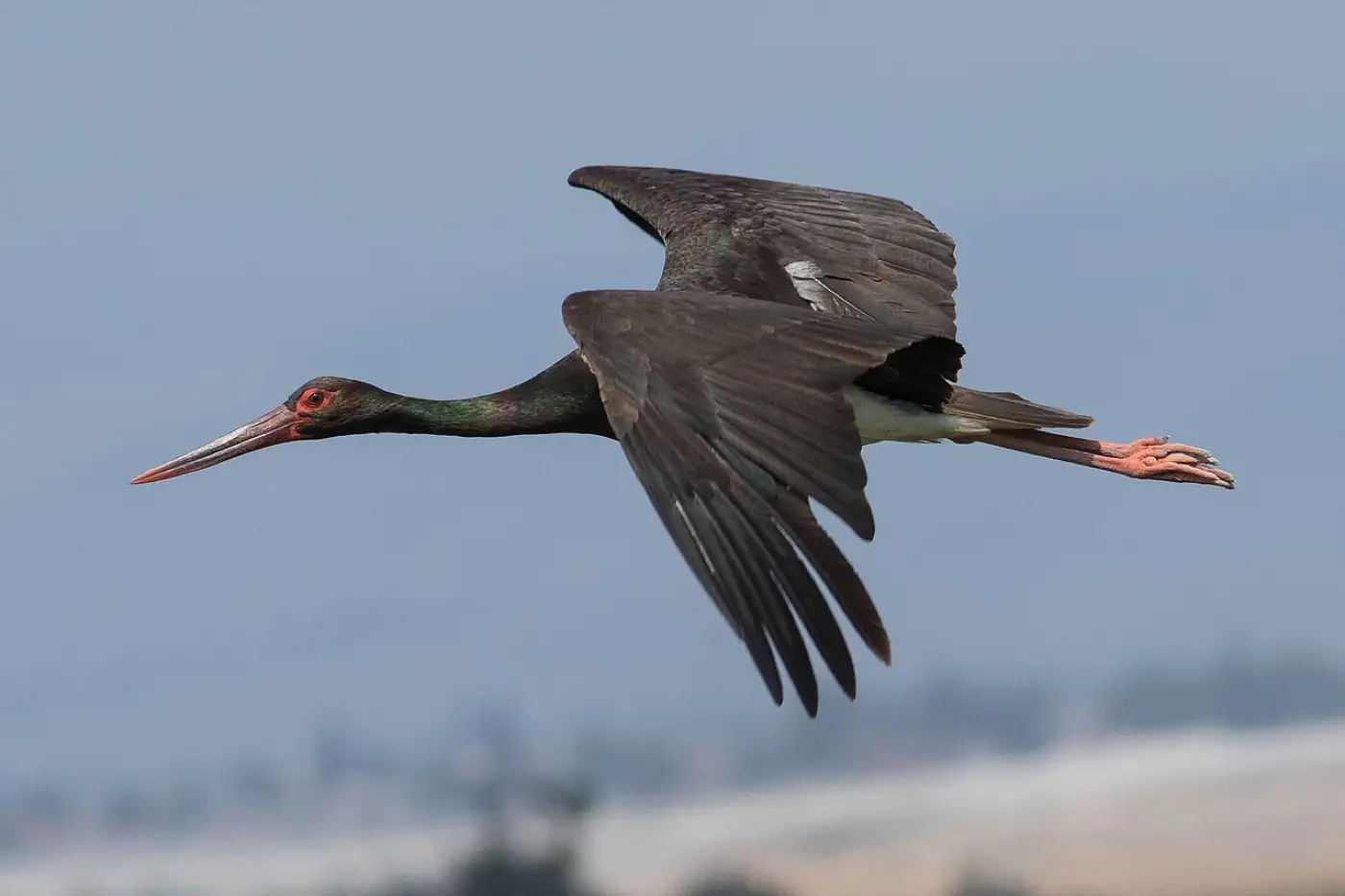
It glides with neck and legs stretched out, following the cliffs and the watercourses where it breeds and feeds.
Photo gallery of the Black Stork
Black Stork in flight, with neck and legs stretched out, dark wings open and red billPhoto: מינוזיג - MinoZig, CC BY-SA 4.0Photo 1 of 4
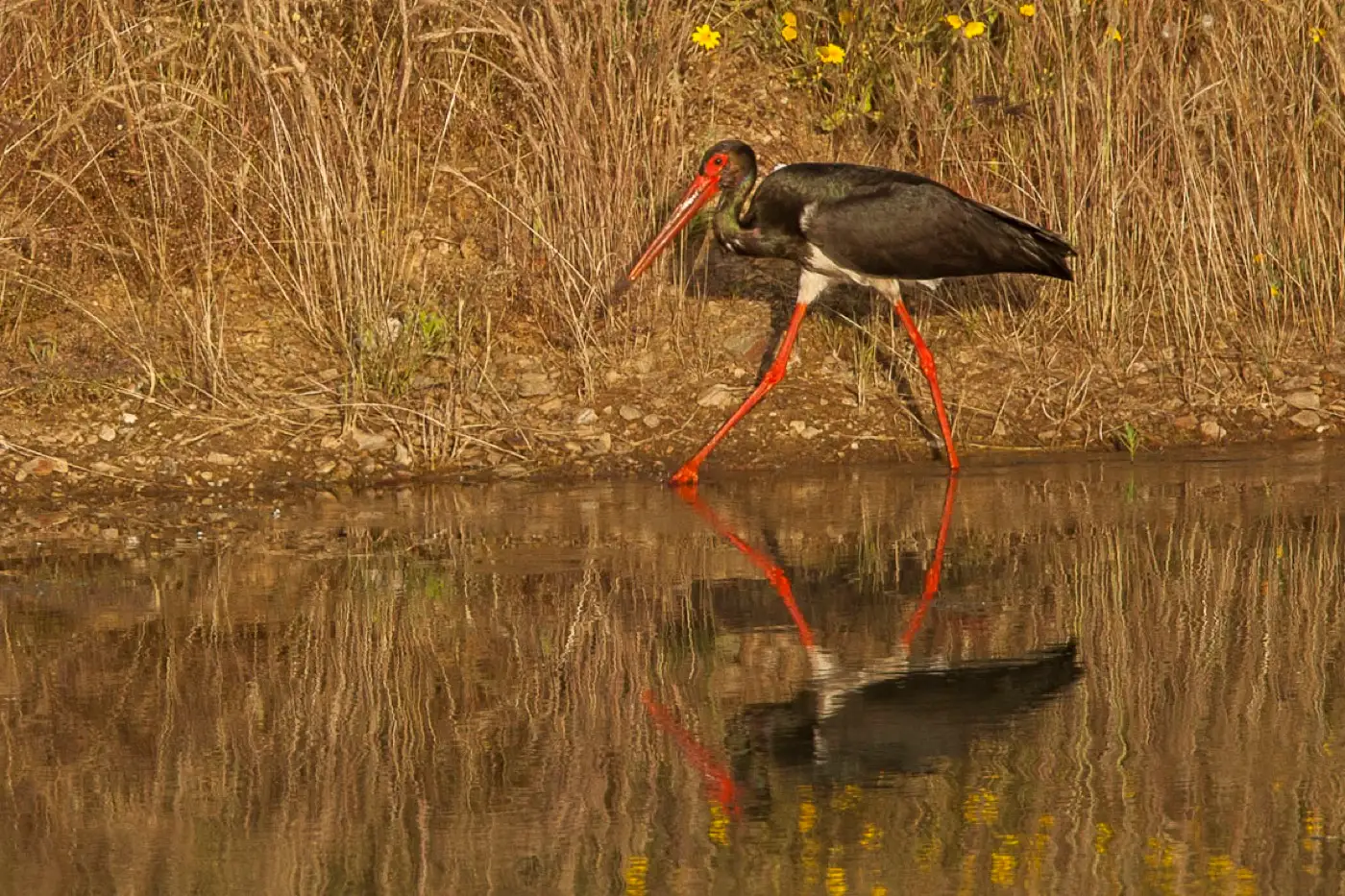
The Black Stork is a wader of predominantly dark tones. The adult has all the upperparts, head and neck black, with striking, essentially greenish iridescence on the neck and head. The underparts are white. It has reddish-orange legs and a red bill, a tone that extends around the eye.
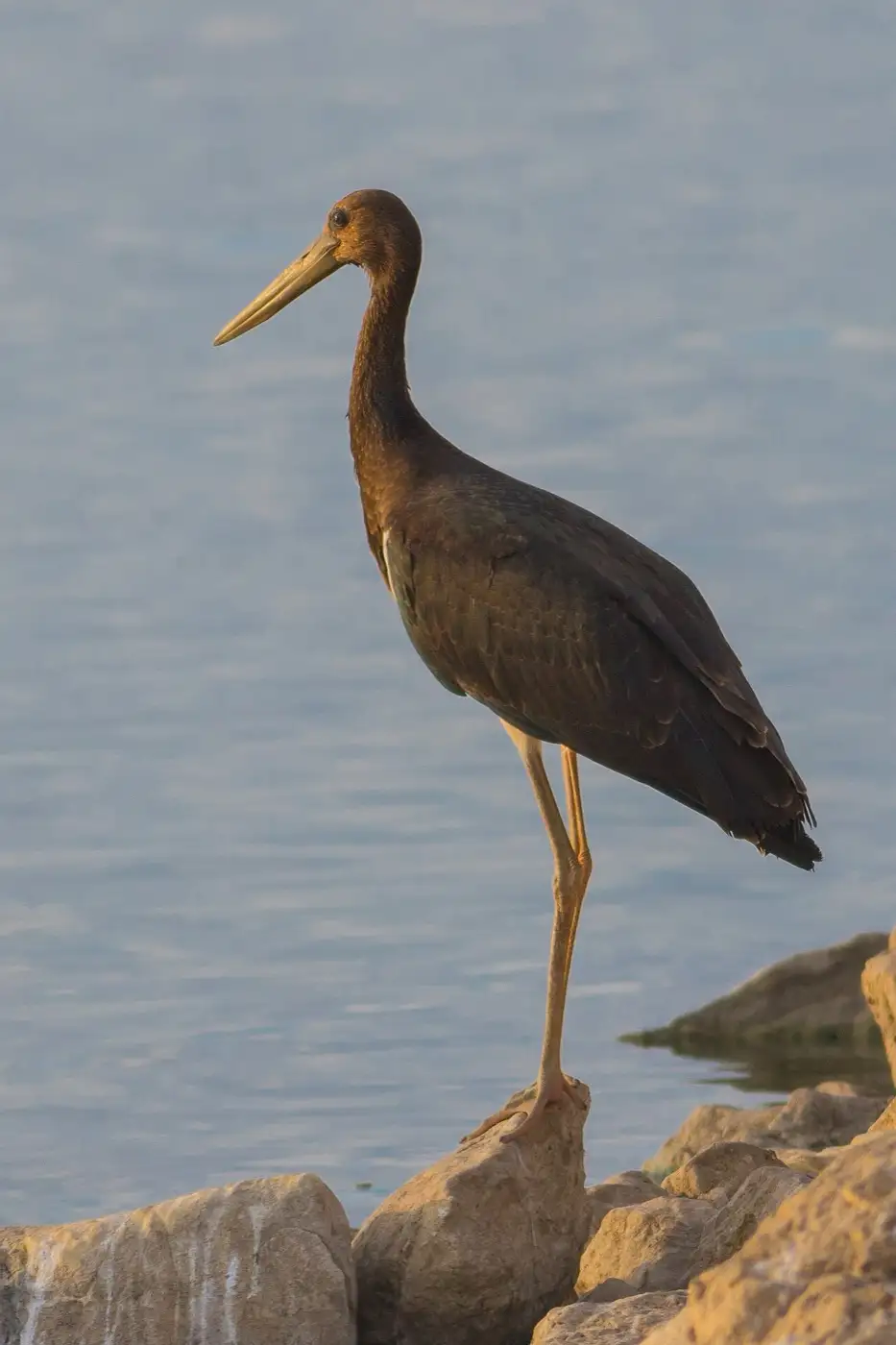
Young birds hatched that year lack the iridescence, and their tone is much browner, with greyish bill and legs. Sub-adults are similar to adults, but with less iridescence and a bill that is not completely red.
It is a very elusive bird, but is usually seen in flight near its nests or wading on the shores of rivers or reservoirs, as well as in damp meadows.
Adult
Upperparts, head and neck black, with greenish iridescence; underparts white.
Red bill, a colour that extends around the eye, and reddish-orange legs.
Young bird
Much browner, without iridescence, with greyish bill and legs.
Habitat and distribution of the Black Stork
The species, monotypic, is distributed in three apparently disjunct cores: from the Iberian Peninsula to the countries of eastern Europe; Asia, with a little-known population; and southern Africa, with an isolated population that does not connect on migration with those of the Palaearctic. European birds winter in sub-Saharan Africa and the Near East.
In Spain it breeds in the south-western quadrant of the Peninsula, and its nesting population is spread across Castilla y León, Extremadura, Madrid, Castilla-La Mancha and Andalusia, always in surroundings close to aquatic environments and rocky cliffs. On migration passages (February–April and August–October) it is seen across much of peninsular Spain, and is more abundant in the eastern half and during the autumn passage. Although most of the population is migratory, there are small wintering cores in Doñana and its surroundings, in Extremadura reservoirs (Orellana, in Badajoz, stands out) and in the Tiétar river valley (Ávila–Toledo–Cáceres). In some areas it is considered locally resident.
In the breeding season it is associated with wooded areas, river cliffs and sierra crags (60 % of known pairs breed on rock), relatively close to wetlands. The woodland environment it occupies varies: in Extremadura, Andalusia, Castilla-La Mancha and Salamanca cork oak dehesas stand out; in Ávila, Segovia and Madrid, pine woods. In winter it is seen in marshes, rice fields, reservoir shores and similar areas. After breeding, the birds concentrate in small local groups, which migrants from western Europe progressively join and replace, extending the passage to the end of October.
Areas where it is regularly recorded since 2010Squares of about 25 km where it is recorded regularly (occasional passage records are left out). Data from GBIF.org (45,568 records, retrieved October 2026); outline from Natural Earth.
Etymology of the Black Stork
«Ciconia» and «nigra» are the Latin words for «stork» and «black»: the scientific name says, quite simply, «black stork».
Population of the Black Stork
According to the 2021 European Red List of Birds, the Black Stork population is estimated at between 20,200 and 32,400 mature individuals, with an unknown trend. The Spanish population is made up of about 386 breeding pairs, of which 346 are certain and about 40 probable, according to the last census, in 2017 (Del Moral, 2022). It is located mainly in the Guadalquivir basin (45 %), followed by the Tagus (41 %); the Guadiana and Duero hold 7 %. More than half the population and 58.8 % of nesting points are in the network of Special Protection Areas for Birds. The trend is positive or stable in Andalusia and Extremadura, and negative in the peripheral populations of Castilla-La Mancha, Castilla y León and Madrid; overall it seems stable, but there are signs of decline in isolated populations, lower breeding success and a 33 % reduction of the area occupied between the Second and Third Atlas. Among the threats stand out habitat alteration through the hydrological management of watercourses, droughts, pollution and the transformation of wetlands; water-level fluctuations in reservoirs; and human disturbance, such as tourist boating, climbing, fishing or off-road vehicles near nests.
Nest of the Black Stork
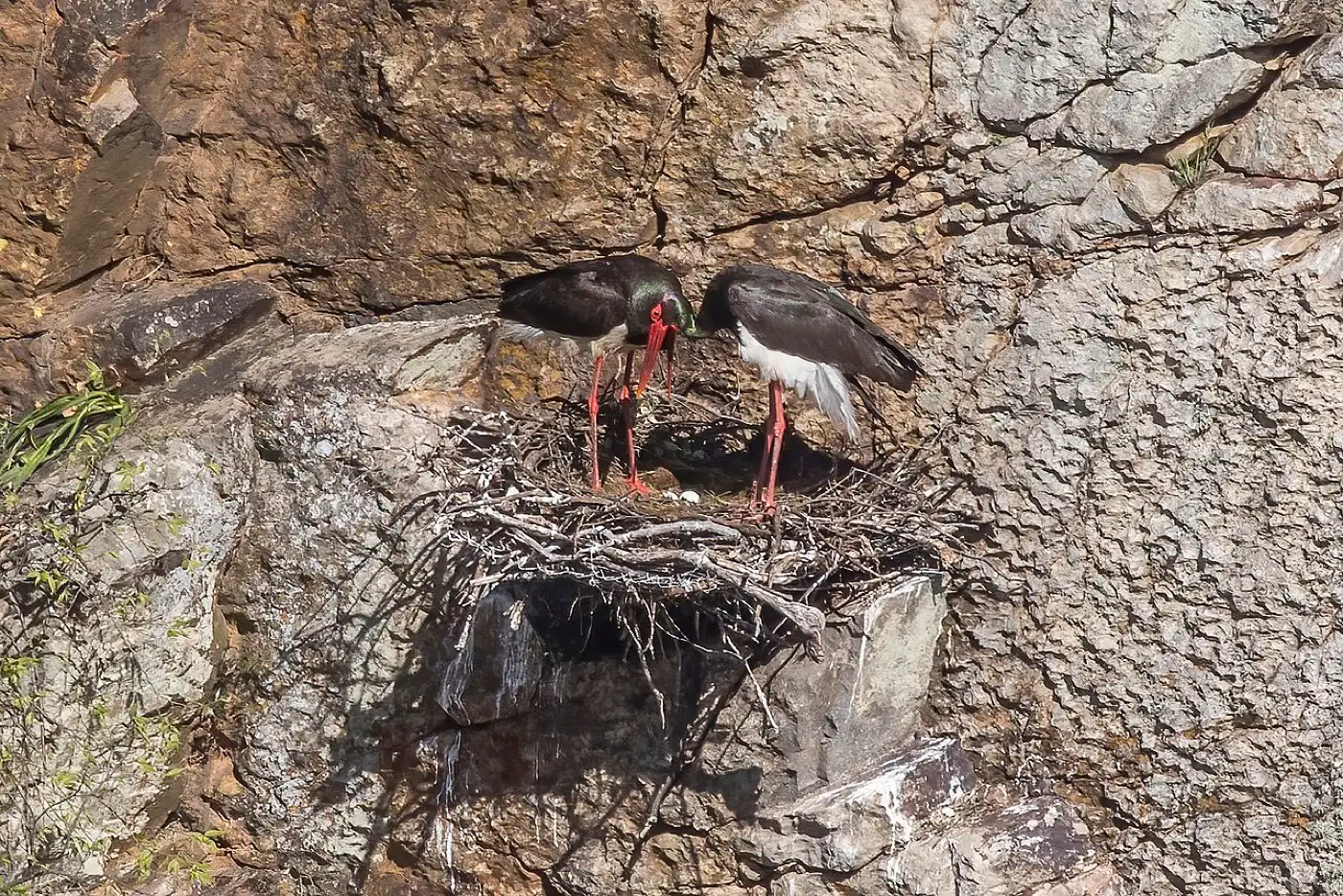
The nest is a large structure of branches, reinforced with earth and grasses and typically filled with moss and some grass or paper. It is habitually reused and can reach a great size; both sexes take part in its construction. The preferred substrate is rock, followed by cork oak and pine.
Courtship and breeding of the Black Stork
The female lays two to six eggs, commonly three to five, white, which both sexes incubate for 35–36 days, although periods of up to 46 have been cited. The chicks are cared for by both parents, and one of them always stays with them for the first 10–15 days. The parents regurgitate food, at first directly into the chicks’ throats and later onto the nest, from which the young take it. In about 63–71 days they complete plumage development and fly, and they become independent quickly. An average of 2.5 to 3 chicks fly from each brood.
Diet of the Black Stork
It is based on fish, which it catches in shallow water; it fishes alone or in small groups. The diet is supplemented with insects, amphibians, small mammals, reptiles, crustaceans (crabs) and small birds taken at the nest.
Curious facts about the Black Stork
Unlike its relative the White Stork, the Black Stork does not nest near people, but in hidden places of the sierras and woods of the south-western quadrant of the Peninsula. It is one of our most emblematic and elusive birds. 60 % of pairs breed on rock.
The Black Stork in Cabañeros
This website’s page on the sclerophyllous woodland stresses its presence, since it nests in the wooded areas. The page on the rivers of Cabañeros says that at the end of August a small group can be found which, in post-breeding concentration, takes advantage of the concentrations of aquatic fauna left in the pools, and lists it among the birds that can be found breeding on the River Bullaque.
Where to see the Black Stork in Cabañeros
In the pools of the Cabañeros rivers at the end of August, and in the wooded areas where it nests.
When
From February to October; at the end of August, in the pools, in post-breeding concentration.
What time
Throughout the day, with binoculars and without getting close: it is very elusive and disturbance near the nest causes broods to be lost.
Where
On rivers, pools, reservoir shores and damp meadows; to breed, on cliffs and in trees.
What to look for
A dark stork, with a white belly and red bill and legs.
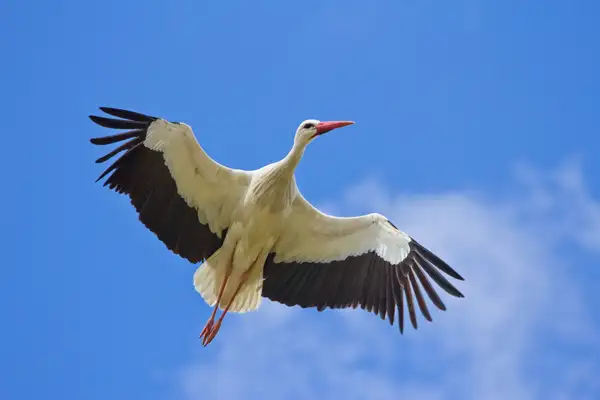
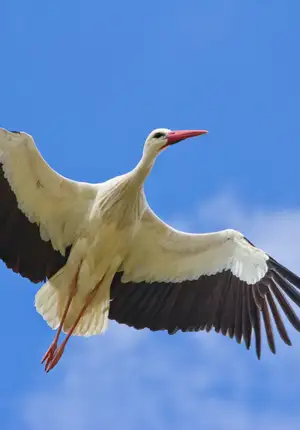
Its better-known relative, with white plumage and black flight feathers and red bill and legs. It nests near people, unlike the Black Stork, which does so in hidden places.
Photo: Carlos Delgado, CC BY-SA 3.0
Other birds
Birds related to the Black Stork or sharing its habitats in Cabañeros.



 Same family
 Also in sclerophyllous woodland
 Also in sclerophyllous woodland
 Also in sclerophyllous woodland
 Also in sclerophyllous woodland
 Also in sclerophyllous woodland
 Also in sclerophyllous woodland
 Also in sclerophyllous woodland






