Wingspan compared with a person with arms outstretched.
Length
62–69 cm
Wingspan
1.62–1.78 m
Weight
1.2–2.3 kg
Social life
Solitary or in pairs
Lifespan
Up to 17 years
Conservation status
LC
NT
VU
EN
CR
EW
EX
Global (IUCN)
Least Concern
Spain
Specially protected (Spain)
Castilla-La Mancha
Vulnerable
When to see it
Summer visitor in Cabañeros
Months of the year when it is present
J
F
M
A
M
J
J
A
S
O
N
D
In Iberia
no
no
yes
yes
yes
yes
yes
yes
yes
yes
no
no
In Cabañeros
no
no
yes
yes
yes
yes
yes
yes
yes
no
no
no
Breeding season
no
no
no
yes
yes
yes
yes
yes
no
no
no
no
Song or voice of the Short-toed Snake Eagle
The snake eagle’s calls are short and abrupt; they may be either repeated or longer and more sustained.
CallShort-toed Snake Eagle
0:00 / 0:20
10 kHz5
The sonogram draws the sound: time runs from left to right, and the higher a trace sits, the higher the note.
Flight of the Short-toed Snake Eagle
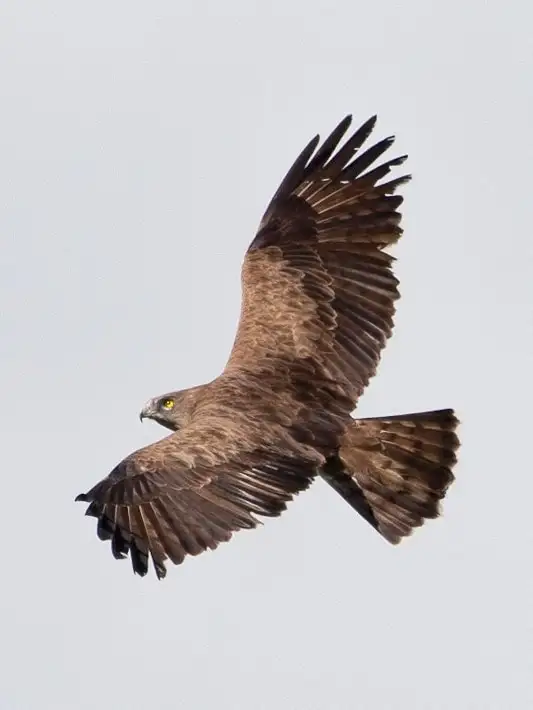
The Short-toed Snake Eagle moves with its wings arched forward, glides upward spreading its long, straight wings to the full, stretching out its head, and flutters heavily.
Flight typeGlides and hovers
It climbs in circles using the warm air, with flat wings and hardly flapping them. Then it glides to its hunting ground.
It turns to face the wind and hangs still in the air with quick wingbeats, like an enormous kestrel. If it does not like what it sees, it drops down a step and hovers again.
It half-closes its wings and drops almost vertically. At the last moment it thrusts its feet forward to seize the snake.
Photo gallery of the Short-toed Snake Eagle
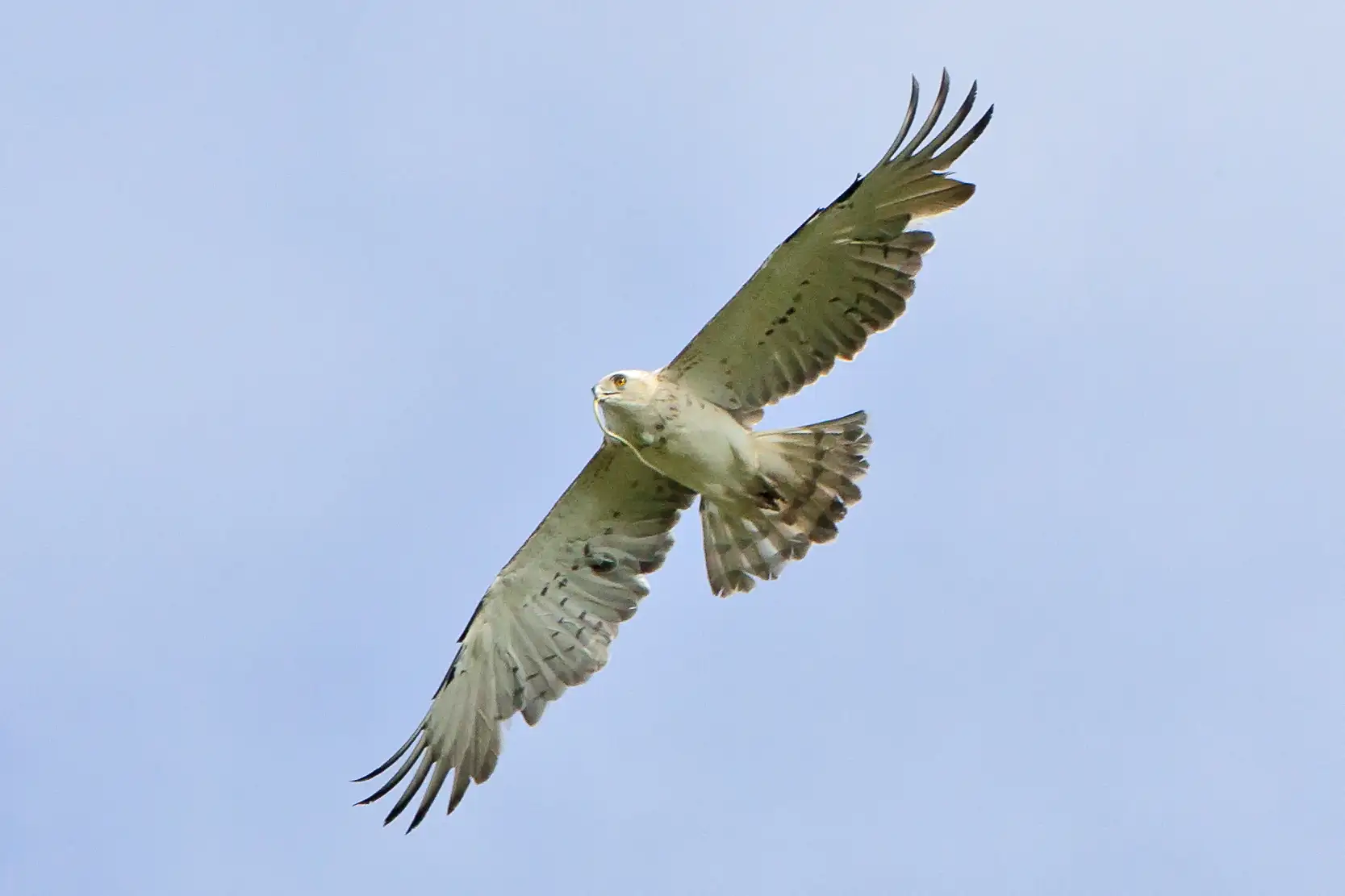
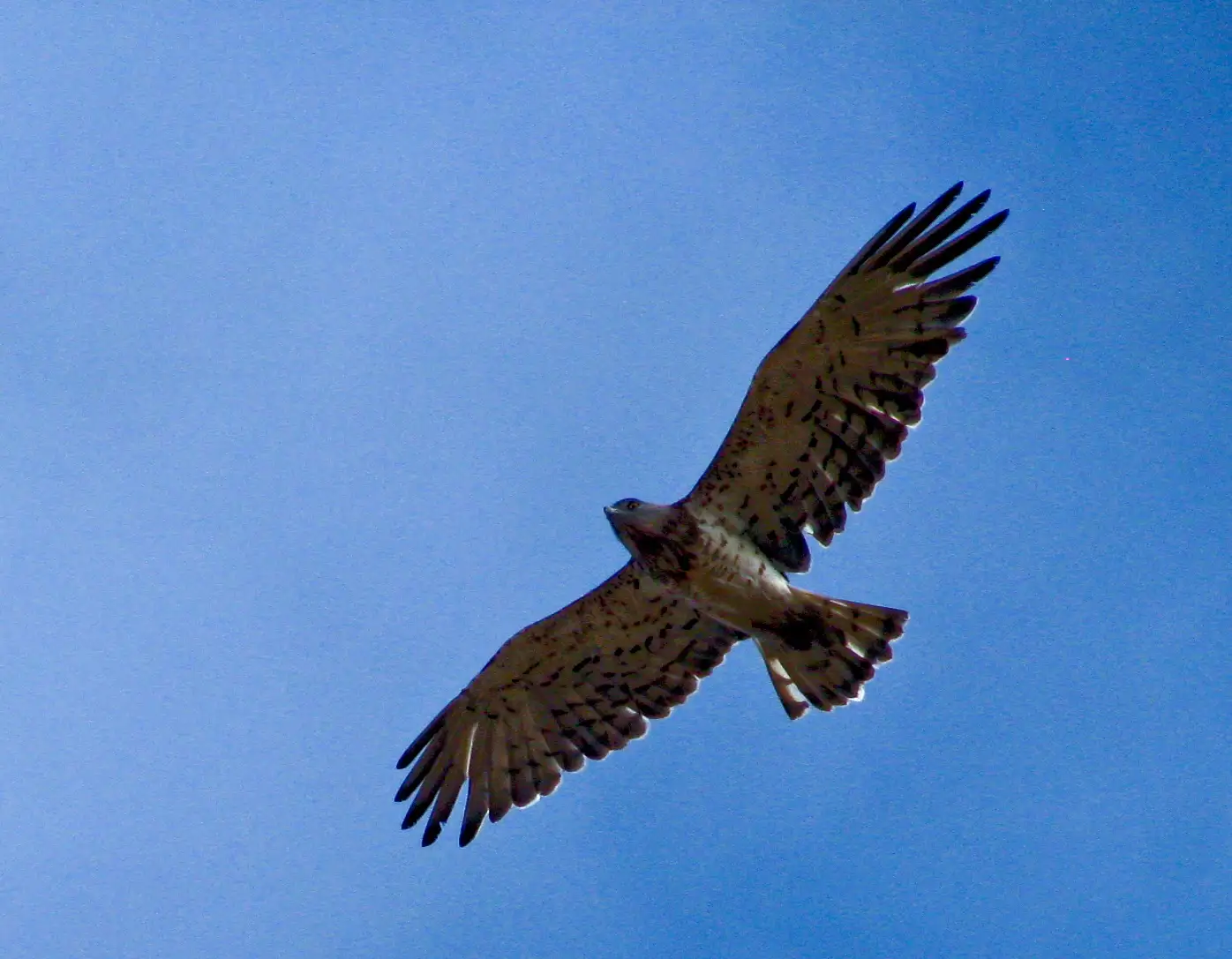
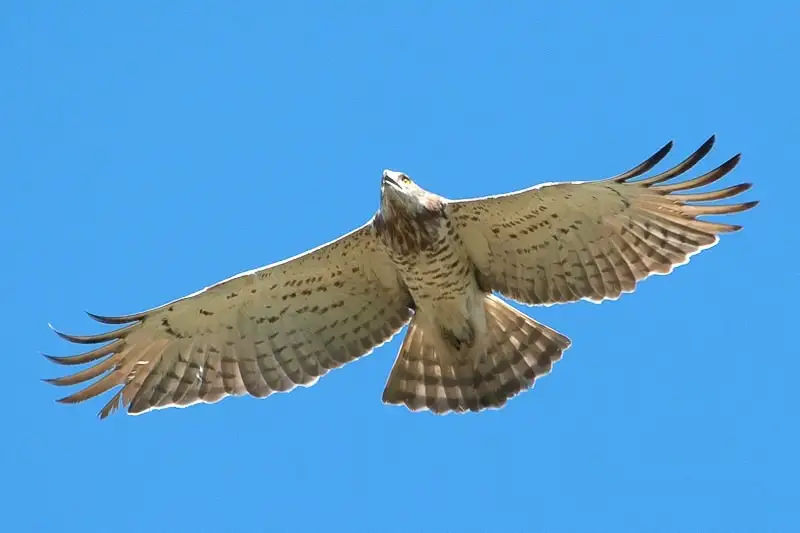
In flight, seen from below: pale breast and wings, brown hoodPhoto: Juan Lacruz, CC BY-SA 3.0Photo 1 of 6
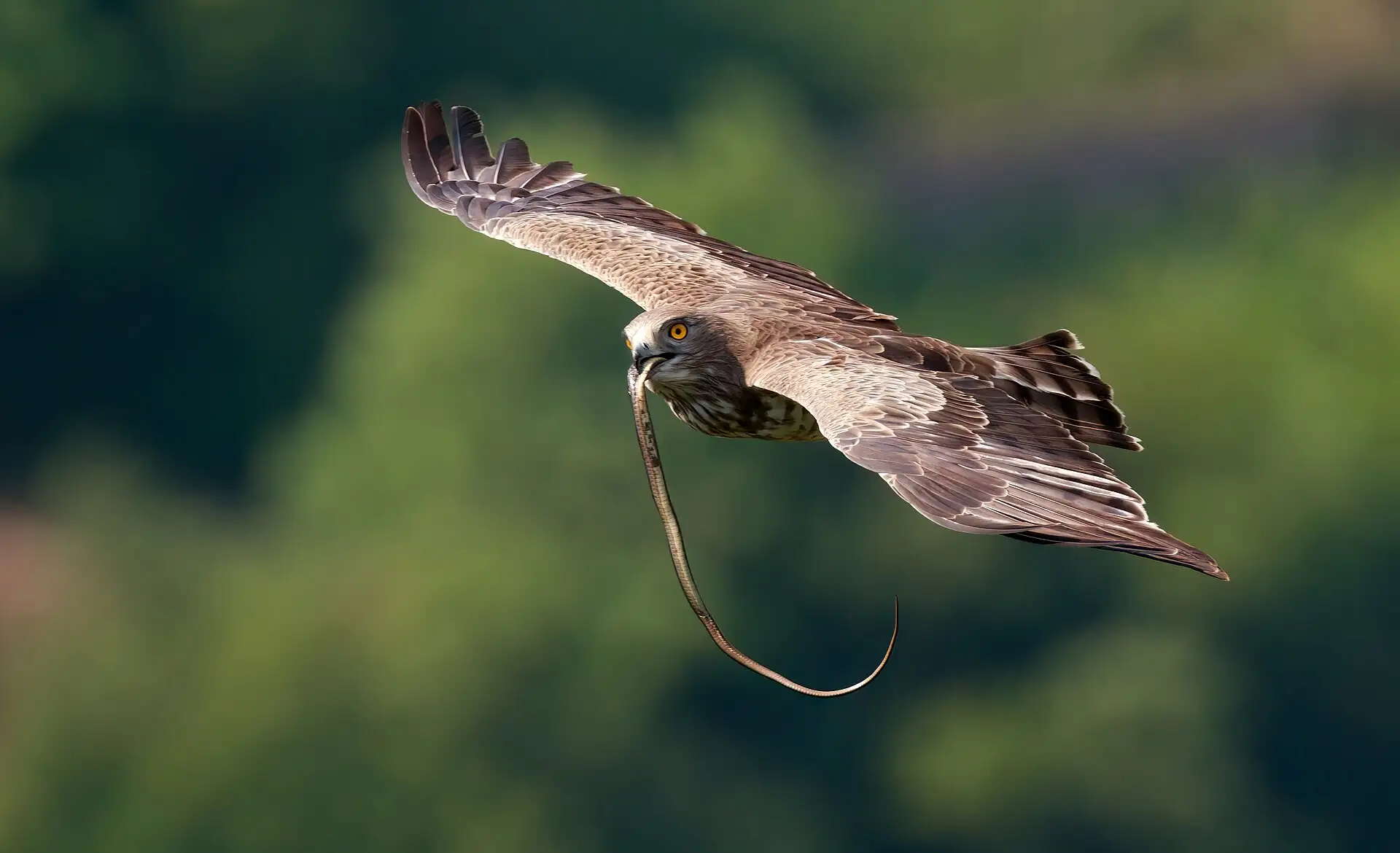
In flight, with the long, broad wings spreadPhoto: Luis Jiménez Delgado from Algeciras, Spain, CC BY 2.0Photo 5 of 6
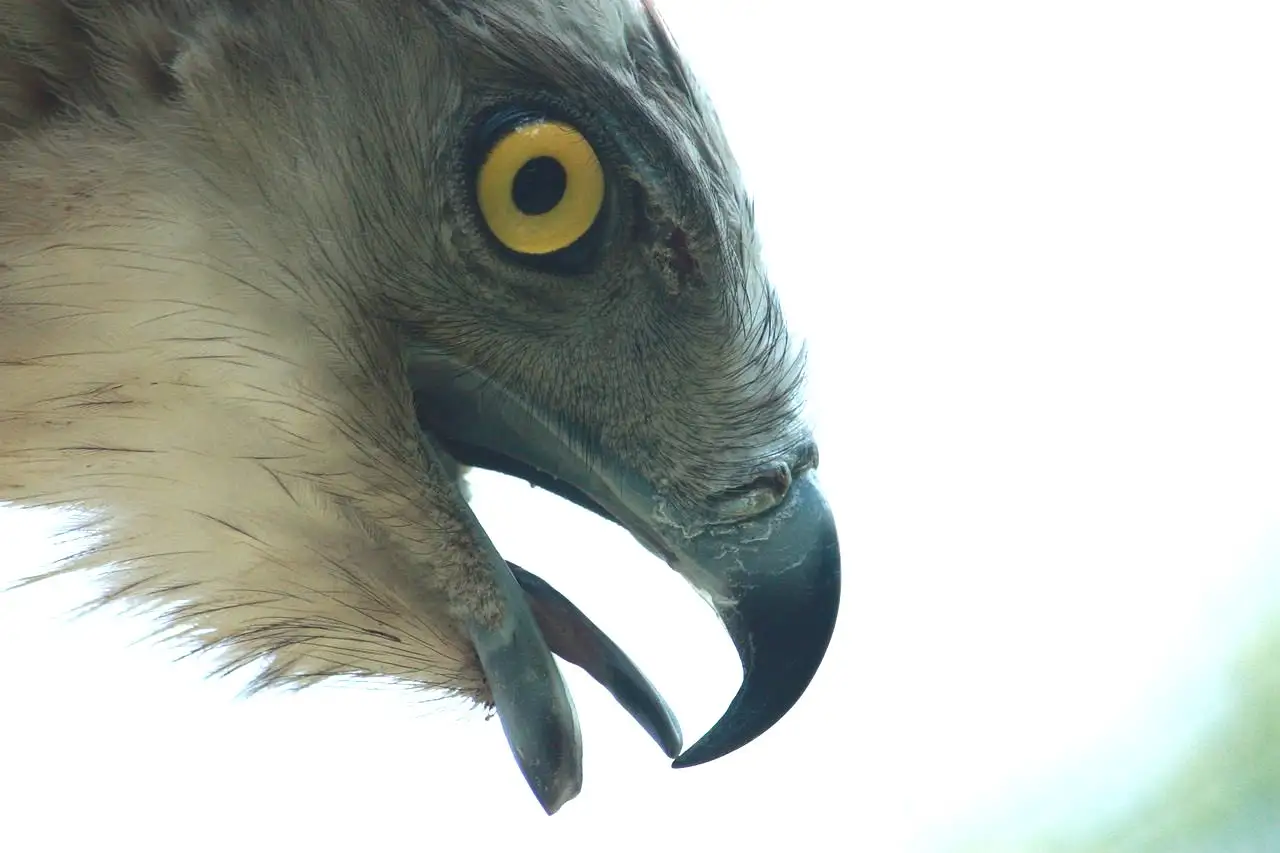
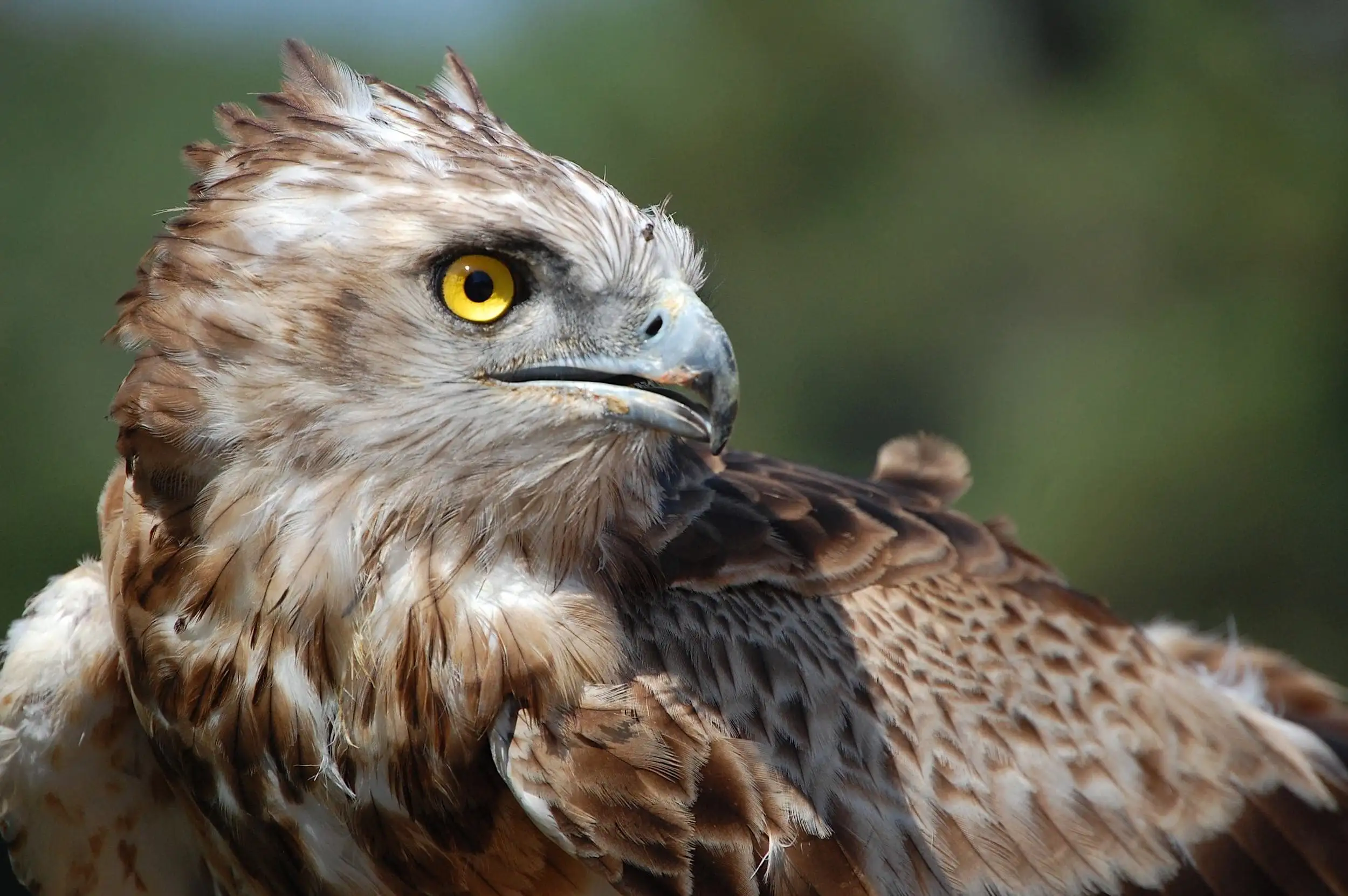
Perched: the round head and yellow eyesPhoto: MarioM, CC BY-SAPhoto 6 of 6
1 / 6
Identification of the Short-toed Snake Eagle
The Short-toed Snake Eagle is a large eagle that makes quite an impression, with its yellow eyes, its owl-like face and its tousled plumage. It is a bird that can be seen up close, perhaps perched on a tree or on an electricity pole. Besides, its great flying abilities, together with its build (broad wings and tail), let it stay in the air for hours, hovering over the slopes until it spots its prey.
The snake eagle has a round, bulky head. Its eyes are yellow. Its bill is short, curved and vigorous. When we watch the snake eagle in flight, we can see the dark hood on its head, which stands out against the white underparts, with light brown flecks.
The upperparts are light brown, with dark brown tones that reach the head. Its new feathers are dark, while the old ones are paler and have frayed edges.
The underparts stand out for their striking white colour, with fine streaks and bands with a slight bluish or greyish touch.
The wings are long and broad. Their tips are broad and rounded. The wrists have no dark patch.
Its tail is long, with several bands, the terminal one being larger. Its powerful legs are bare. The tarsi are short.
When the snake eagle makes up its mind to hunt, it flutters before diving, with its head tilted back, its wings almost closed and its chest thrust out, to attack decisively, spreading its feet at the last instant.
Young birds have less barred underparts and more discreet bands on the tail. Their upperparts are darker than the adults’. The wings, narrower, show almost black flight feathers.
Habitat and distribution of the Short-toed Snake Eagle
The Short-toed Snake Eagle ranges across the whole of Eurasia, from the Iberian Peninsula to India. It also appears in the north of Africa, in the Atlas mountains.
On the Peninsula it breeds in practically the whole territory. We do not find it, however, on the archipelagos. Its preference for wooded areas is marked, which is why we notice its absence on the great plateaus. Its populations are abundant in the sierras of Catalonia and the Levante, the Iberian and Central systems, the Pyrenees, the Betic ranges, the Montes de Toledo and the province of Cáceres.
Areas where it is regularly recorded since 2010Squares of about 25 km where it is recorded regularly (occasional passage records are left out). Data from GBIF.org (145,007 records, retrieved October 2026); outline from Natural Earth.
The snake eagles that breed in Europe are migratory birds that leave their breeding grounds in late summer to head for the tropical savannas of Africa, rich in tempting prey. The post-breeding passage takes place between mid-September and October and the pre-breeding one in April.
In summer it soars over high, open slopes and rocky areas with trees and scrub. It usually prefers wooded terrain, although it may also appear on marshy plains, coastal dunes and cultivated fields.
Etymology of the Short-toed Snake Eagle
«Circaetus» comes from Greek: it joins «κίρκος» (kírkos), meaning «hawk, buzzard», and «ἀετός» (aetós), «eagle». From Latin comes gallicus, -a, -um = Gallic, of Gaul [Lat. Gallia, -ae f.].
Population of the Short-toed Snake Eagle
Spain is the great stronghold of the snake eagle in Europe. The oldest estimates spoke of 2,000–3,000 pairs on the Peninsula, but it is a hard bird to count and they fell well short: SEO/BirdLife’s national census of 2009–2010 counted 10,380 territories in Spain alone, more than half of all the snake eagles that breed in Europe. Some authors also maintain a recent increase in the population.
Nest of the Short-toed Snake Eagle
Its nest is very large, built of small branches in the crown of big trees. They make one clutch, between April and June, and lay only 1 egg.
Mating and breeding
The Short-toed Snake Eagle shows a clearly forest character when it has to breed, seeking areas of woodland and dense scrub, regardless of altitude and botanical composition, as it ranges from sea level to mountain areas 1,400 metres high. This bird can therefore occupy almost any wood on the Peninsula, as long as there are open areas with reptiles nearby to hunt in.
The clutch, of a single egg, is laid between mid-April and early May. Incubation lasts between 45 and 47 days and the chick takes some two and a half months to fly, so most of the young do not make their first flights until well into August.
Diet of the Short-toed Snake Eagle
The Short-toed Snake Eagle feeds mainly on reptiles, such as snakes and lizards. The way this bird catches its prey is astonishing: after hovering at great height above them, it plunges dizzily to catch them. Once the prey is still, the snake eagle pecks it on the nape or head to kill it.
Curious facts about the Short-toed Snake Eagle
It is the bird that spends the most time flying compared with those of its genus. The head is the first thing it swallows of the animals it hunts.
Situation in Cabañeros
The snake eagle is a fairly common summer visitor and breeder in Cabañeros. At the beginning of March a first group arrives to breed. The second group, made up mostly of immature birds, many of them moulting their primary flight feathers, arrives in May.
The snake eagles of Cabañeros seek the wooded areas of the sierras to set up their nest, almost always in holm oaks and cork oaks, although they can be found in pines. A month after arriving, more or less in April, they lay their first and only egg. The female incubates the egg while the male brings her food.
Some authors have pointed to polyandry in this species (HIRALDO, 1987), or at least some collaboration by an immature bird, forming trios during the breeding season. The post-breeding migration occurs in mid-September, when they leave the breeding areas. In Cabañeros, it feeds mainly on reptiles such as snakes and lizards.
Where to see the Short-toed Snake Eagle in Cabañeros
The Short-toed Snake Eagle can be seen all over Cabañeros. However, it is most likely to be found over sparse scrub and grasslands of the rañas. Also flying over the sierras where they hide their nests.
When
From March to September, which is when it is in the park. From mid-September on it is hard to find.
What time
From mid-morning to mid-afternoon. It needs the sun to warm the ground so that the thermals it glides on can form.
Where
Over the rañas with sparse scrub and the grasslands, where it hunts, and flying over the sierras where it has its nest.
What to look for
A pale eagle, still in the air over the raña, beating its wings without moving forward. From below the dark hood is easy to make out.
It is considerably smaller, the size of a Common Buzzard, and has no hood. In the pale form, which is the commonest, the black flight feathers contrast with the rest of the wing, almost white, and where the wing joins the body two white patches show, the famous «landing lights».
Photo: Derek Keats from Johannesburg, South Africa, CC BY 2.0
It has longer, narrower wings, bent at the wrist like those of a large gull, and right there it has a black patch that the snake eagle lacks. The head is white, with a dark eye-stripe. It also hovers, but over water, before diving for fish.
Other birds
Birds related to the Short-toed Snake Eagle or sharing its habitats in Cabañeros.



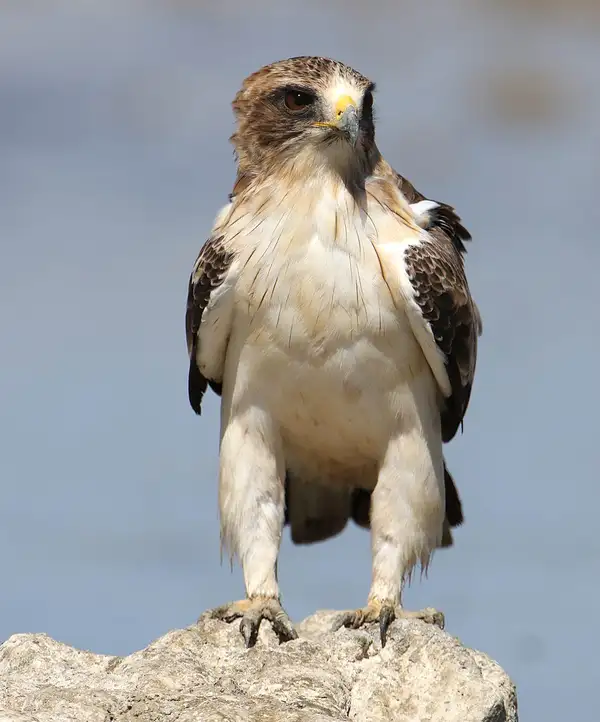
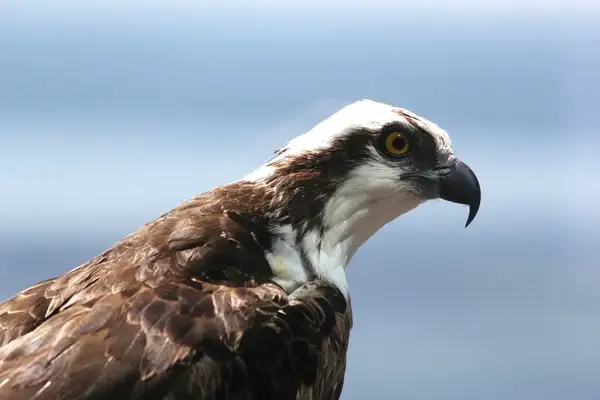
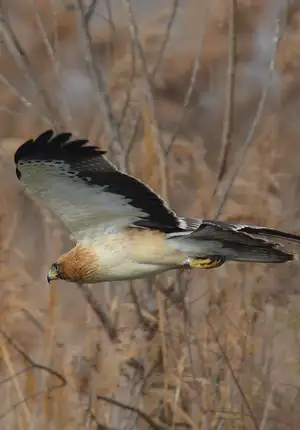 Same family
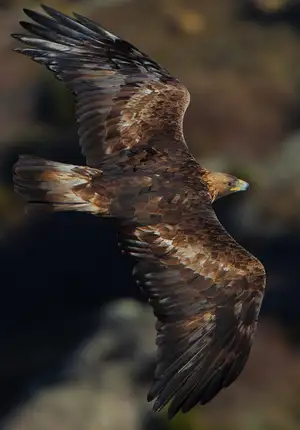 Same family
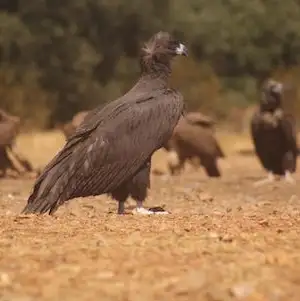 Same family
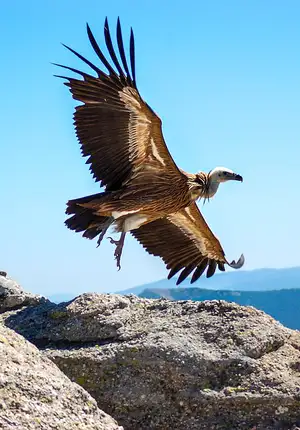 Same family
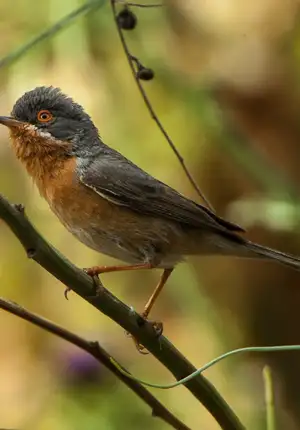 Also in sclerophyllous woodland
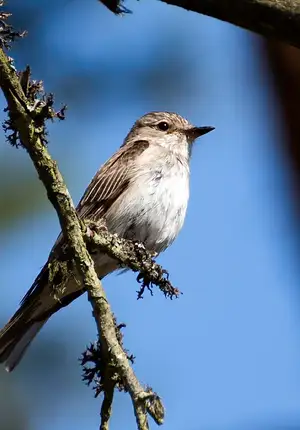 Also in sclerophyllous woodland
 Also in sclerophyllous woodland
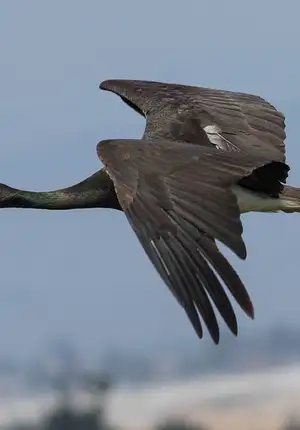 Also in sclerophyllous woodland






