Up to 8 years in captivity according to the MNCN (Stöbener, 1979); a maximum in the wild is not backed by the sources consulted
Conservation status
LC
NT
VU
EN
CR
EW
EX
Global (IUCN)
Least Concern
Spain
Least Concern (LC) as a breeder in the Red Book of the Birds of Spain; on the List of Wild Species under Special Protection, but not in the Spanish Catalogue of Threatened Species
When to see it
Resident
Months of the year when it is present
J
F
M
A
M
J
J
A
S
O
N
D
In Iberia
yes
yes
yes
yes
yes
yes
yes
yes
yes
yes
yes
yes
Breeding season
no
no
yes
yes
yes
yes
yes
no
no
no
no
no
Song or voice of the Black Wheatear
Its song is melodious and not very loud, a long, soft warble; the call is a «pii-pii-pii-chac», very like that of other wheatears1. The recording (song) is by Pere Josa and was made in Ribera d’Ebre (near Riba-roja d’Ebre), Tarragona, Catalonia (xeno-canto XC840753, quality A). It lasts 9 seconds and is a trimmed section of the original, without repeating or lengthening, from which we have removed the bass below 300 Hz, reduced the background noise and adjusted the volume; neither pitch nor speed has been changed.
Its flight is direct, with agile wingbeats. It is a resident bird although northern populations may make movements of some size towards more southerly territories1; there are winter records in the Balearics and at some coastal sites in western Andalusia.
Flight typeDirect, with agile wingbeats
It likes to perch in prominent places, among rocky escarpments, walls, ravines and crags.
Its flight is direct, with agile wingbeats, and shows the white rump and base of the tail, with a black inverted T at the end.
It feeds mainly on insects, such as beetles and ants, which it catches on the ground.
Photo gallery of the Black Wheatear
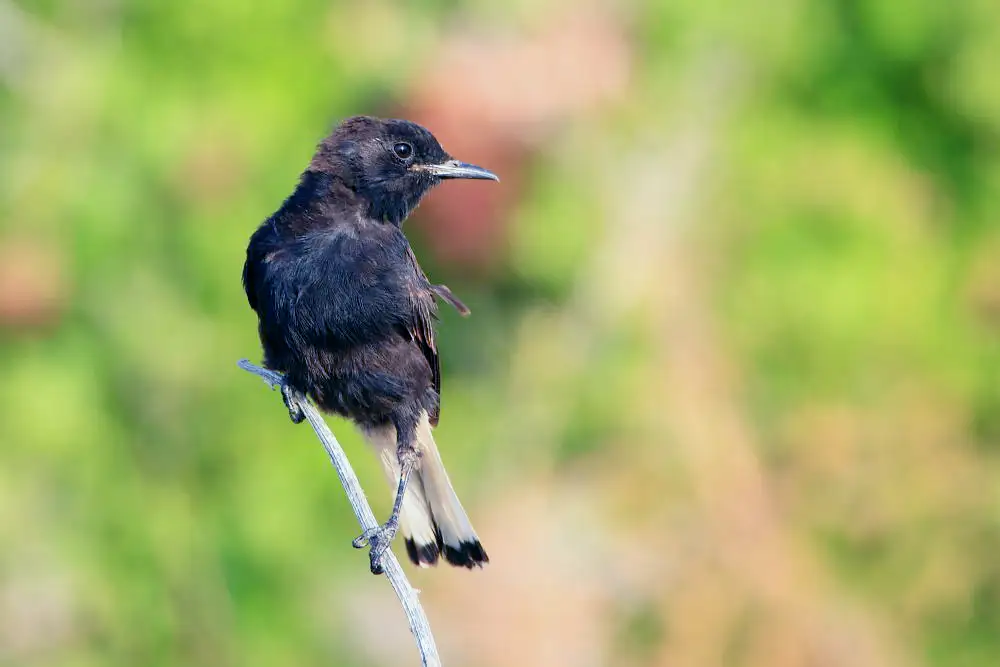
Black Wheatear with glossy black plumage perched sideways on a wire, with the tail spread showing the white base and the black T at the endPhoto: carlespastor, CC BY-SA 4.0Photo 1 of 4
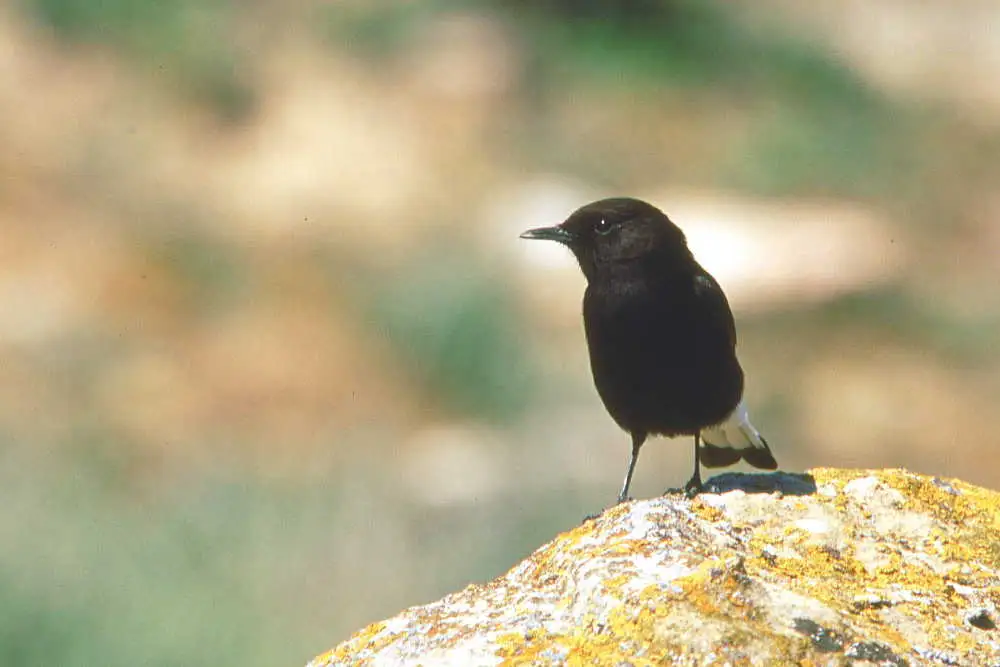
Black Wheatear with black plumage, seen from behind on a rock covered in yellow lichens, with white rumpPhoto: carlespastor, CC BY-SA 4.0Photo 2 of 4
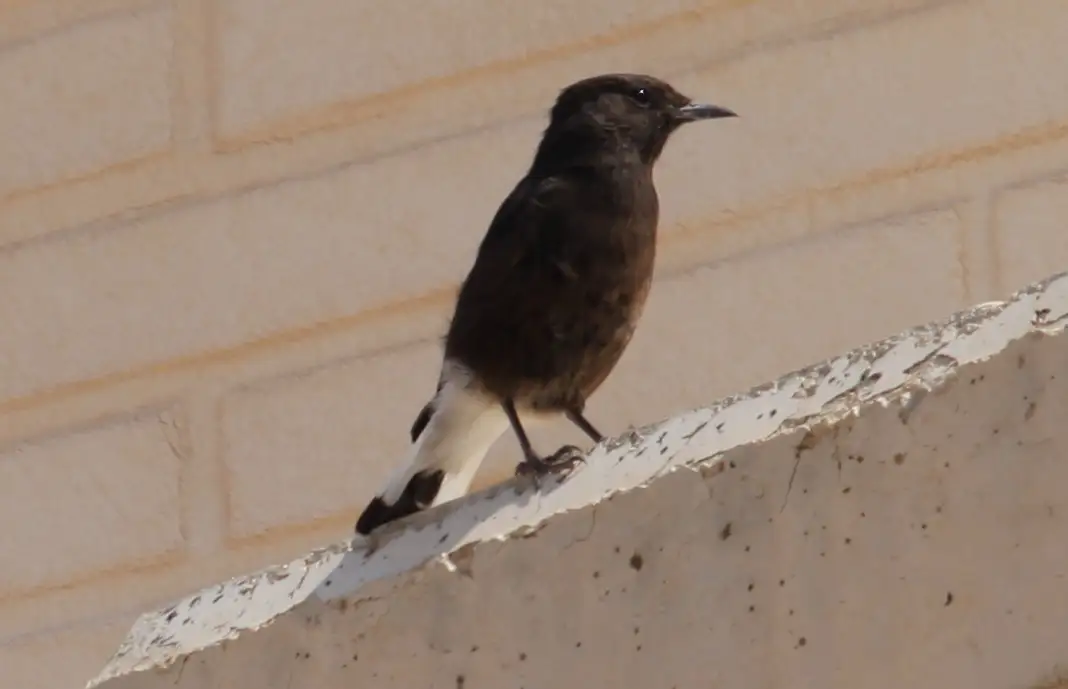
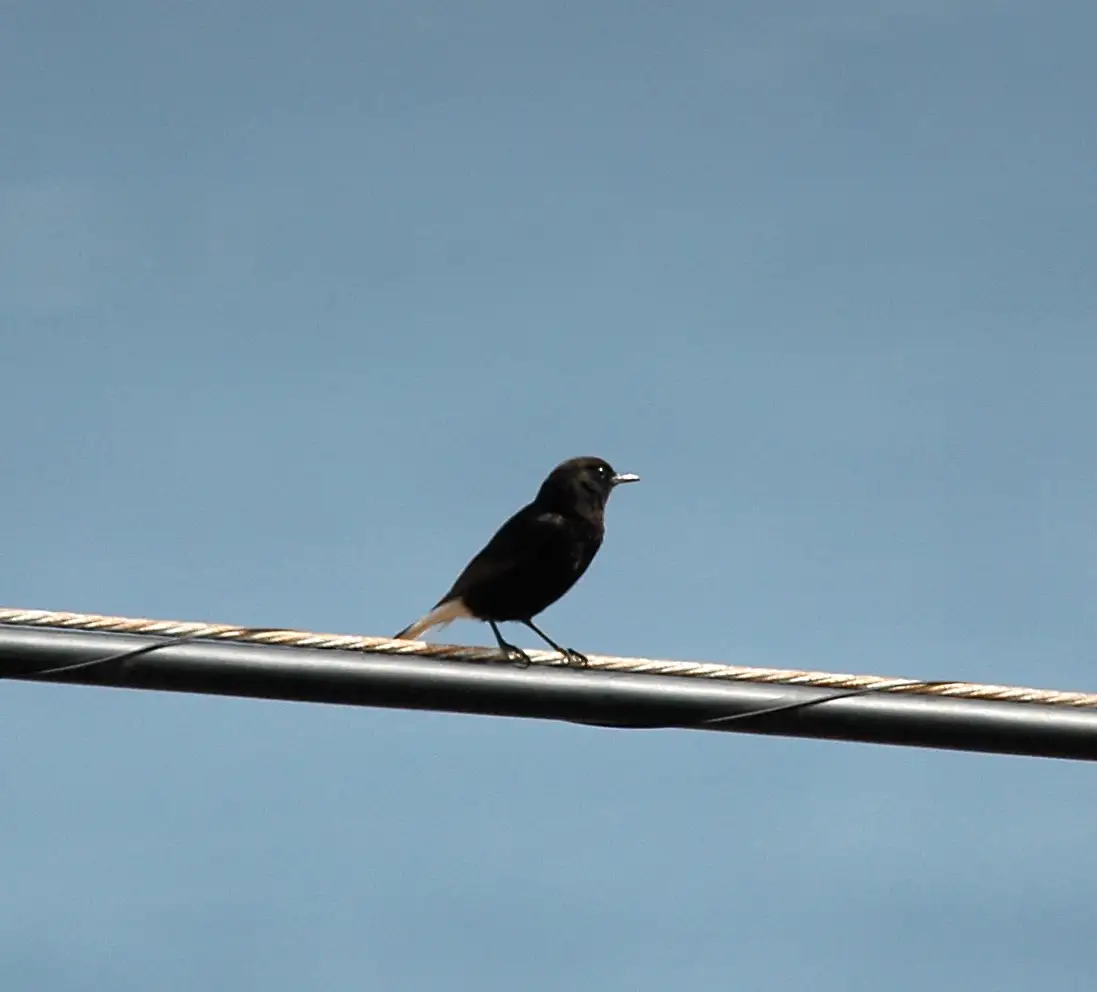
A relatively large bird, of unmistakable look because of its colouring. It is a very dark bird, with glossy black plumage in males and dark brown in females. Against that background the white rump and tail base stand out, contrasting with a black inverted T at the end of the tail, very visible and characteristic in flight. It likes to perch in prominent places. Its flight is direct, with agile wingbeats.
Male
Glossy black, with white rump and tail base.
Black inverted T at the end of the tail.
Female
Dark brown, with the same black-and-white tail.
Habitat and distribution of the Black Wheatear
Its distribution is confined to the Iberian Peninsula and north-west Africa, from western Libya to the western Sahara. It has two subspecies, one restricted to Iberia, «leucura», and another limited to North Africa, «syenitica».
In Spain it occupies the warmest areas of the Peninsula, entering by the Ebro valley as far as Navarre1. It is widely distributed across the Levante and the Andalusian Mediterranean and extends along Sierra Morena to reach points in the centre of the Peninsula and the provinces of Cáceres and Badajoz. It does not breed in the Balearics, the Canaries or Ceuta; in Melilla the African subspecies lives.
It is a species typical of arid environments, devoid of vegetation and with rocky scarps or walls. It inhabits dry terrain, such as ravines, river or coastal cliffs, steppe areas, dry watercourses, olive groves or foothill areas, from sea level to the 1,800 metres of Sierra Nevada.
Areas where it is regularly recorded since 2010Squares of about 25 km where it is recorded regularly (occasional passage records are left out). Data from GBIF.org (12,953 records, retrieved October 2026); outline from Natural Earth.
Etymology of the Black Wheatear
In other languages it is called «còlit negre» in Catalan, «pedreiro negro» in Galician, «buztanzuri beltza» in Basque and «black wheatear» in English1. We have not found a source explaining the origin of the Spanish or scientific name, so we do not venture one.
Population of the Black Wheatear
In the 2021 European Red List of Birds, the European breeding population is estimated at between 8,100 and 32,200 mature individuals, spread across France, Spain and Portugal, with an apparently stable trend. For Spain there are no sufficiently up-to-date data, although some authors put it in 2004 at around 4,700 pairs, with the largest populations in Alicante, Murcia and the Andalusian provinces washed by the Mediterranean; the SACRE programme gives a stable trend between 1998 and 2018.
Despite its restricted distribution and small population, it is not considered threatened, because of the kind of environments it inhabits and its recent trends1. Some local problems are cited: the alteration of its steppe habitat by forest plantation or new irrigation, and the high rate of predation it suffers1.
Nest of the Black Wheatear
It builds it in hollows of rock walls or of walls of abandoned buildings. It is a small cup of grasses and roots, lined with feathers and hair, normally protected by a little palisade of pebbles that the male carries beforehand.
Courtship and breeding of the Black Wheatear
The breeding period is quite early and long: courtship runs from December to February, the nest is built in February and clutches are spread, according to the MNCN, from March to July in Guadix (Granada), replacements included, with one or two clutches a year. The clutch ranges between two and six pale bluish, finely speckled eggs, which the female incubates for 12–18 days. The chicks, fed by both parents, fly at 15 days.
Diet of the Black Wheatear
It is based on eating insects, such as beetles and ants, which it catches on the ground.
Curious facts about the Black Wheatear
It is a bird unmistakable for its overall black or very dark tone and its partly white tail, and recalls that its worldwide distribution is limited to north-west Africa and the Iberian Peninsula1. The oiseaux.net sheet gives it a weight of 41 g, and oiseaux-birds.com’s, between 37 and 44 g. The MNCN cites up to 8 years in captivity (Stöbener, 1979); this is not a wild maximum, and with the sources consulted it is not backed.
The Black Wheatear in Cabañeros
The habitat pages of this website do not mention it, but it does appear in the bird list of the «Visitor guide to Cabañeros National Park» (OAPN, page 106). That list vouches for its presence in the Park, not for breeding there. GBIF.org records 5 observations of the Black Wheatear in Cabañeros and its surroundings. It extends along Sierra Morena to reach points in the centre of the Peninsula1. Only one of those observations falls within the Park boundary (according to OpenStreetMap); the rest are from the surroundings.
Where to see the Black Wheatear in Cabañeros
In Cabañeros and its surroundings, on rocky scarps, cliffs and dry-stone walls of the sierras.
When
Present all year; courtship begins in December and the chicks fly in spring.
What time
By day, perched on top of a rock, a wall or a wire, and hunting insects on the ground.
Where
In ravines, cliffs, dry watercourses, olive groves and foothill areas, with scarps or walls.
What to look for
Look for the white tail with the black T in flight; listen for the long, soft warble.
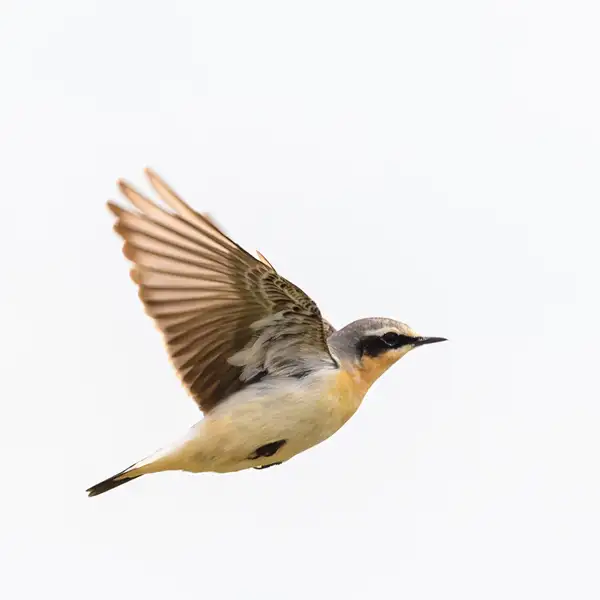
It is similar in song1: it says the call of the Black Wheatear is very like that of other wheatears. The Northern Wheatear is also called «collalba gris»1.
Photo: Stephan Sprinz, CC BY 4.0
Other birds
Birds related to the Black Wheatear or sharing its habitats in Cabañeros.



 Same family
 Same family
 Same family
 Same family
 Same order
 Same order
 Same order
 Same order





