In winter, in flocks ranging from a few individuals mixed with other finches to exclusive groups of several dozen
Lifespan
Record of 14.8 years in the wild according to AnAge; EURING lists a bird ringed in Sweden that lived 14 years and 9 months
Conservation status
LC
NT
VU
EN
CR
EW
EX
Global (IUCN)
Least Concern
Spain
Data Deficient (DD) in the Red Book of the Birds of Spain as a breeding species; on the List of Wild Species under Special Protection, but not in the Spanish Catalogue of Threatened Species
When to see it
Winter visitor
Months of the year when it is present
J
F
M
A
M
J
J
A
S
O
N
D
In Iberia
yes
yes
yes
no
no
no
no
no
yes
yes
yes
yes
Song or voice of the Brambling
The male’s song is a vibrant, dry peep, like the European Greenfinch’s: «pruirrng»1. The calls with which they call to each other when in a flock recall those of the Rock Sparrow: «chuiee-chuiee». The recording (call) is by Jorge Valella Robledo and was made at Puerto de Aralla (near Aralla de Luna), León, Castilla y León (xeno-canto XC1054015, quality B). It lasts 9 seconds and is a trimmed section of the original, without repeating or lengthening, from which we have removed the bass below 300 Hz, reduced the background noise and adjusted the volume; neither pitch nor speed has been changed.
With the cold it arrives in flocks, often mixed with Chaffinches, Citril Finches or Siskins. Its journeys are not regular and depend on the food available, so each winter may bring many or almost none.
Flight typeIn flocks, often mixed with other finches
It breeds in northern Europe and Asia, and in winter moves south; in Spain it is usually detected from October or November until February or March.
It often appears mixed with Chaffinches, Citril Finches and Siskins, in flocks of a few individuals or, sometimes, exclusive ones of several dozen.
It feeds on seeds and fruits, and in central Europe preferably eats beechnuts in winter; its journeys depend on food availability.
Photo gallery of the Brambling
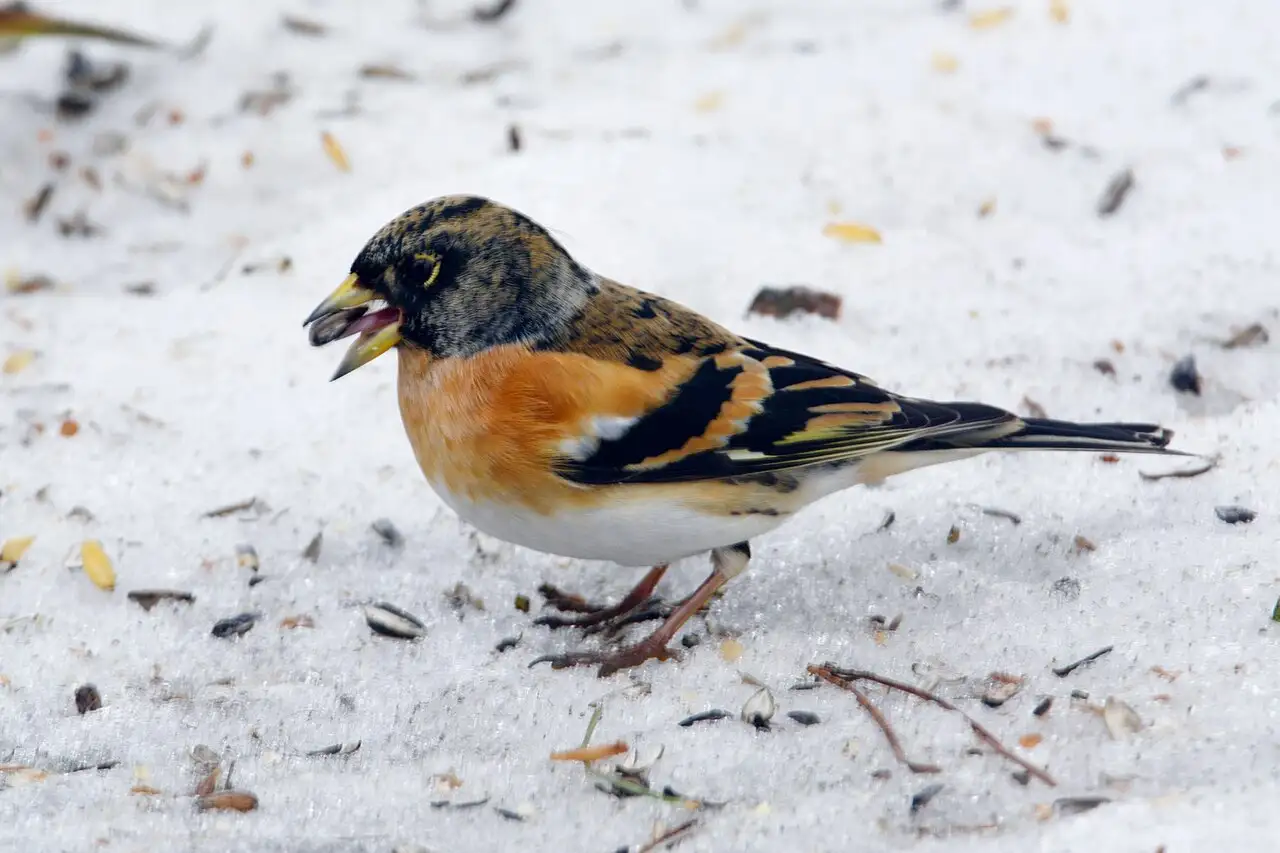
Male Brambling pecking seeds in the snow, with orange breast, dark spotted head and the black-and-white wing barsPhoto: Pedalito, CC0Photo 1 of 5
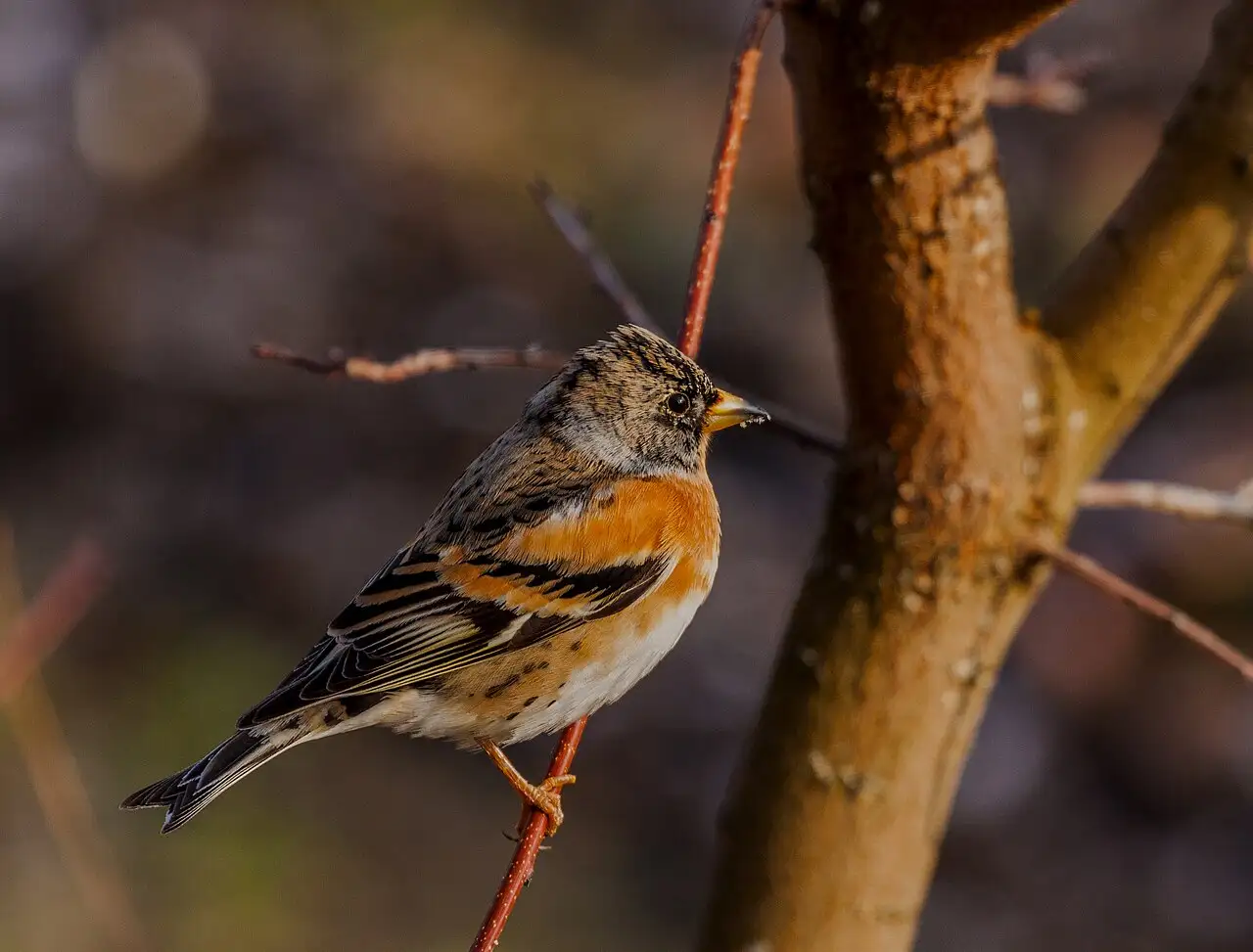
Brambling perched on a thin branch, in profile, with orange breast and back streaked with brown and blackPhoto: Fischer.H, CC BY-SA 4.0Photo 3 of 5
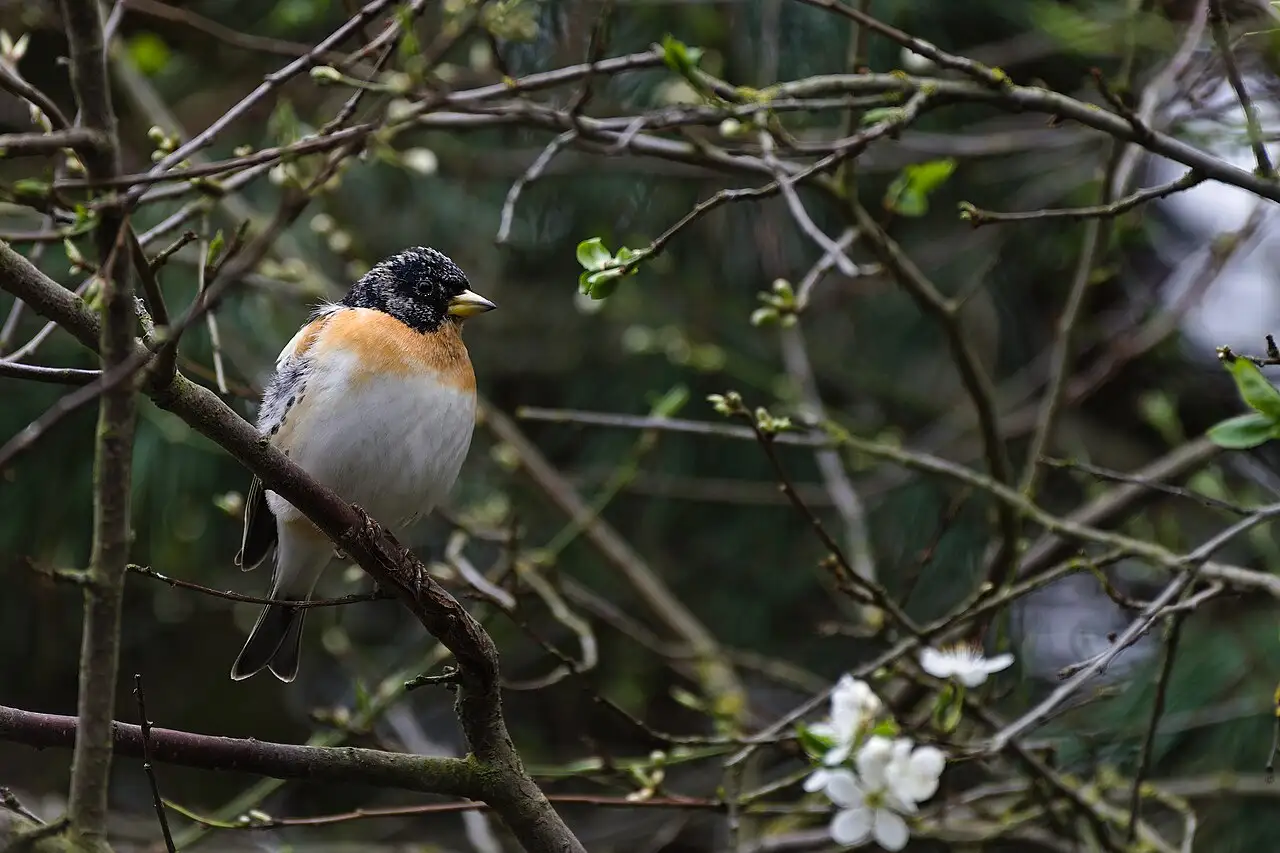
Brambling perched on a branch among shrubs with white flowers, with black head and orange breastPhoto: Romzig, CC0Photo 4 of 5
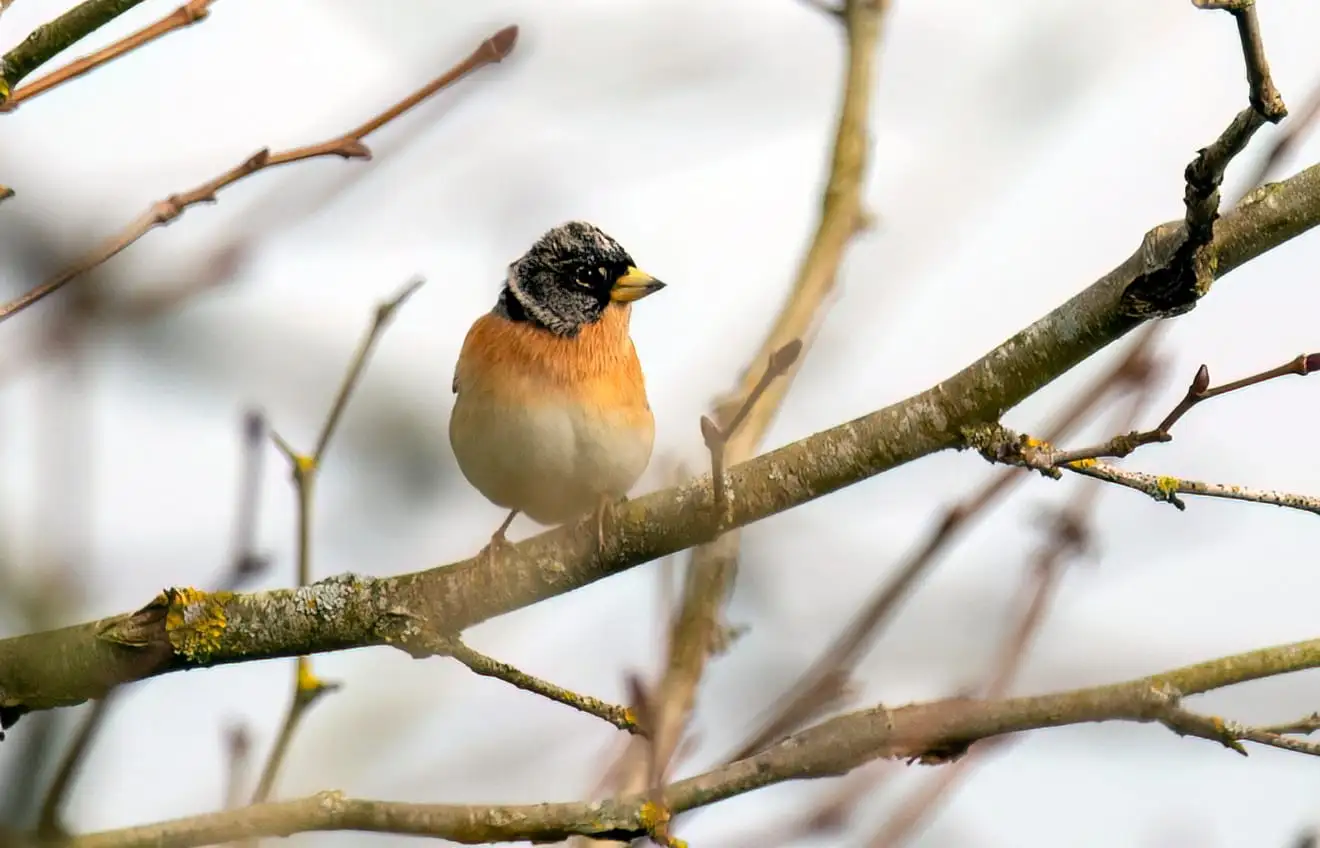
Male Brambling perched on a branch, with dark spotted head, orange breast and yellow bill (Galicia)Photo: maria meizoso, CC BY-NC 4.0Photo 5 of 5
1 / 5
Identification of the Brambling
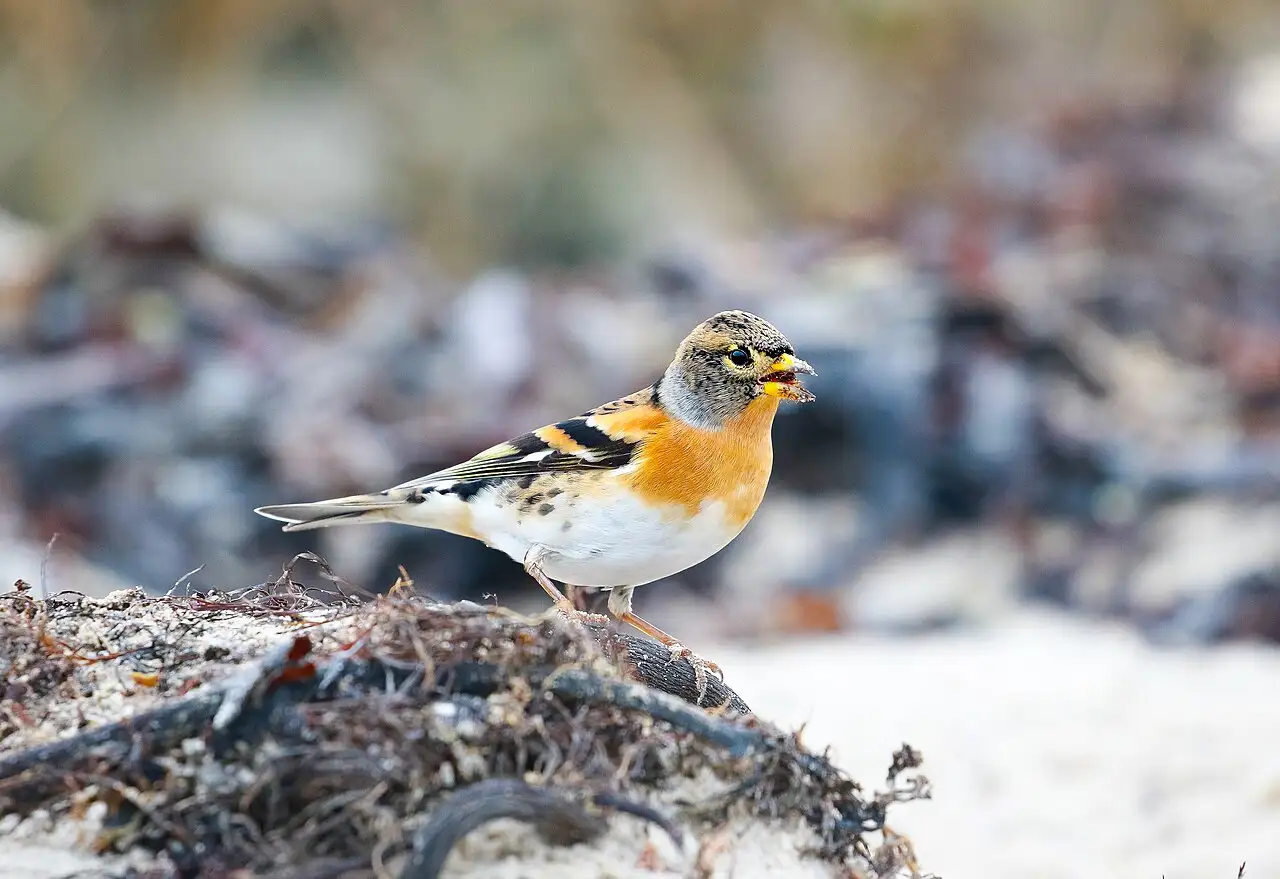
Male and female Bramblings have the breast and throat a pale orange colour, the bill yellowish and the belly white. In breeding plumage, males show an intense black colour on the head, which they begin to acquire already during the winter, and the bill turns black. It is very like the Common Chaffinch in shape and size, with which it also mixes in flocks, and is told from it by its conspicuous white rump and by lacking the white wing and tail bands so typical of chaffinches.
Adult
Breast and throat orange, belly white and bill yellowish.
White rump, no white bands on the wings or tail.
Habitat and distribution of the Brambling
It breeds in northern Europe and Asia, in boreal woods dominated by spruce, Scots pine or birch. Practically the whole European population is concentrated in Norway, Sweden, Finland and Russia, where it is very common. It has no subspecies. In winter it spreads over almost the whole of Europe, to the most southerly countries and North Africa.
In Spain it can be seen anywhere in Iberian and Balearic territory in winter, and has occasionally been recorded in the Canaries. It appears in very varied habitats: alpine meadows in mountain areas, montane beech or Scots pine woods, but also dehesas, fallows and maize stubble.
Its populations of northern Europe and Asia move south in winter and irrupt in high or low numbers depending on the breeding success of the year and food availability. Although in Spain it is detected from October or November and disappears in February or March, it is not considered a typically migratory species, but rather a nomadic one: the route and length of its journeys are not regular1. Ringing has shown that birds wintering on the Peninsula had been recaptured in earlier winters in Belgium or Germany.
Areas where it is regularly recorded since 2010Squares of about 25 km where it is recorded regularly (occasional passage records are left out). Data from GBIF.org (18,861 records, retrieved October 2026); outline from Natural Earth.
Etymology of the Brambling
Linnaeus included it in 1758 in the tenth edition of the «Systema Naturae» with the name it bears today, «Fringilla montifringilla» (Wikipedia). In other languages it is called «pinsà mec» in Catalan, «pimpín norteño» in Galician, «negu-txonta» in Basque and «brambling» in English1. According to Jobling, the epithet «montifringilla» combines «mountain» and «finch»; we have not found a source explaining the origin of its Spanish name, «real» («royal»), so we do not venture one.
Population of the Brambling
In the 2021 European Red List of Birds, the European breeding population is estimated at between 14 and 26 million mature individuals, with a decreasing trend. No information is available on the size of the wintering population in Spain, where anything from a few individuals mixed with other finches to exclusive flocks of several dozen Bramblings is observed.
It is not a very frequent species in Spain nor does it pose special conservation problems1. As it often appears in flocks mixed with other finches, it could be affected by the same threats as its relatives: the abuse of herbicides and pesticides, habitat changes and illegal hunting.
Nest of the Brambling
It builds the nest in trees, pines, birches or spruces, and camouflages it on the outside with mosses and lichens1. It breeds in the boreal woods of northern Europe and Asia.
Courtship and breeding of the Brambling
It breeds once a year, between May and June. The female lays and incubates between four and nine eggs; the chicks hatch two weeks later, and in another two or three weeks they already fly. These are the data given for the species, and they refer to the boreal woods of northern Europe and Asia: there is no breeding calendar to attribute to Cabañeros1.
Diet of the Brambling
It is an omnivorous bird. It feeds on seeds and fruits and, in summer, on beetles and butterfly larvae, very especially of the group «Epirrita». In central Europe it preferably eats beechnuts in winter.
Curious facts about the Brambling
It is a good example of a nomadic rather than migratory bird: its journeys depend on food availability, and that is why it irrupts in very different numbers from one winter to the next1. Its longevity record is the same in the two sources we have looked at: 14.8 years in AnAge and 14 years and 9 months in EURING, a bird ringed in Sweden.
The Brambling in Cabañeros
The habitat pages of this website do not mention it, and we have not found any other published source on it in the Park; nor does it appear in the bird list of the «Visitor guide to Cabañeros National Park» (OAPN). GBIF.org records 10 observations of the Brambling in Cabañeros and its surroundings. It is cited in dehesas and fallows of the Peninsula during winter1. Only one of those observations falls within the Park boundary (according to OpenStreetMap); the rest are from the surroundings.
Where to see the Brambling in Cabañeros
In Cabañeros and its surroundings, in winter, among the flocks of Chaffinches in dehesas, fallows and stubble fields.
When
It is detected from October or November and disappears in February or March.
What time
By day, on the ground or in the trees where the other finches feed.
Where
In dehesas, fallows, maize stubble, pine woods, beech woods and alpine meadows.
What to look for
Look for the white rump when the flock takes off and the orange of the breast; listen for the «chuiee-chuiee» of the calls.
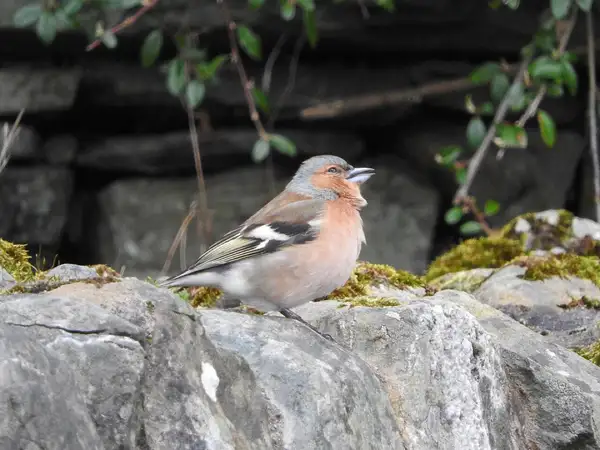
It is similar in song and appearance1. The Brambling is told by its white rump and because it lacks the white wing and tail bands that the Chaffinch has.



 Same family
 Same family
 Same family
 Same family
 Same order
 Same order
 Same order
 Same order






