Both sexes take turns incubating and care for and feed the chicks
Lifespan
Record of 12 years and 2 months in the wild according to EURING (a bird ringed in Belgium); AnAge gives 9 years
Conservation status
LC
NT
VU
EN
CR
EW
EX
Global (IUCN)
Least Concern
Spain
Least Concern (LC) as a breeder in the Red List of Birds of Spain; on the List of Wild Species under Special Protection, but not in the Spanish Catalogue of Threatened Species
When to see it
Summer visitor
Months of the year when it is present
J
F
M
A
M
J
J
A
S
O
N
D
In Iberia
no
no
yes
yes
yes
yes
yes
yes
yes
yes
yes
no
Breeding season
no
no
no
no
yes
yes
yes
no
no
no
no
no
Song or voice of the Common Whitethroat
It can sing both from a perch on a shrub or small tree and in flight. Its song consists of a series of brief, varied phrases, following one another quickly, and the result is a pleasant melody that alternates some high elements with harsher, lower ones. It also gives a nasal, harsh call. The recording is of a male singing from the top of a tree in a garden in Paris; we have trimmed it and filtered the bass slightly.
It can sing both from a perch on a shrub or small tree and in flight.
Flight typeIt sings both from a perch and in flight
It is typical of mosaic landscapes, where small copses alternate with meadows, farmland, hedges and mountain scrub.
It can sing both from a perch on a shrub or small tree and in flight, with a series of brief, varied phrases.
It feeds on all kinds of invertebrates, above all beetles, ants, bugs and flies, and in late summer and autumn also on berries.
Photo gallery of the Common Whitethroat
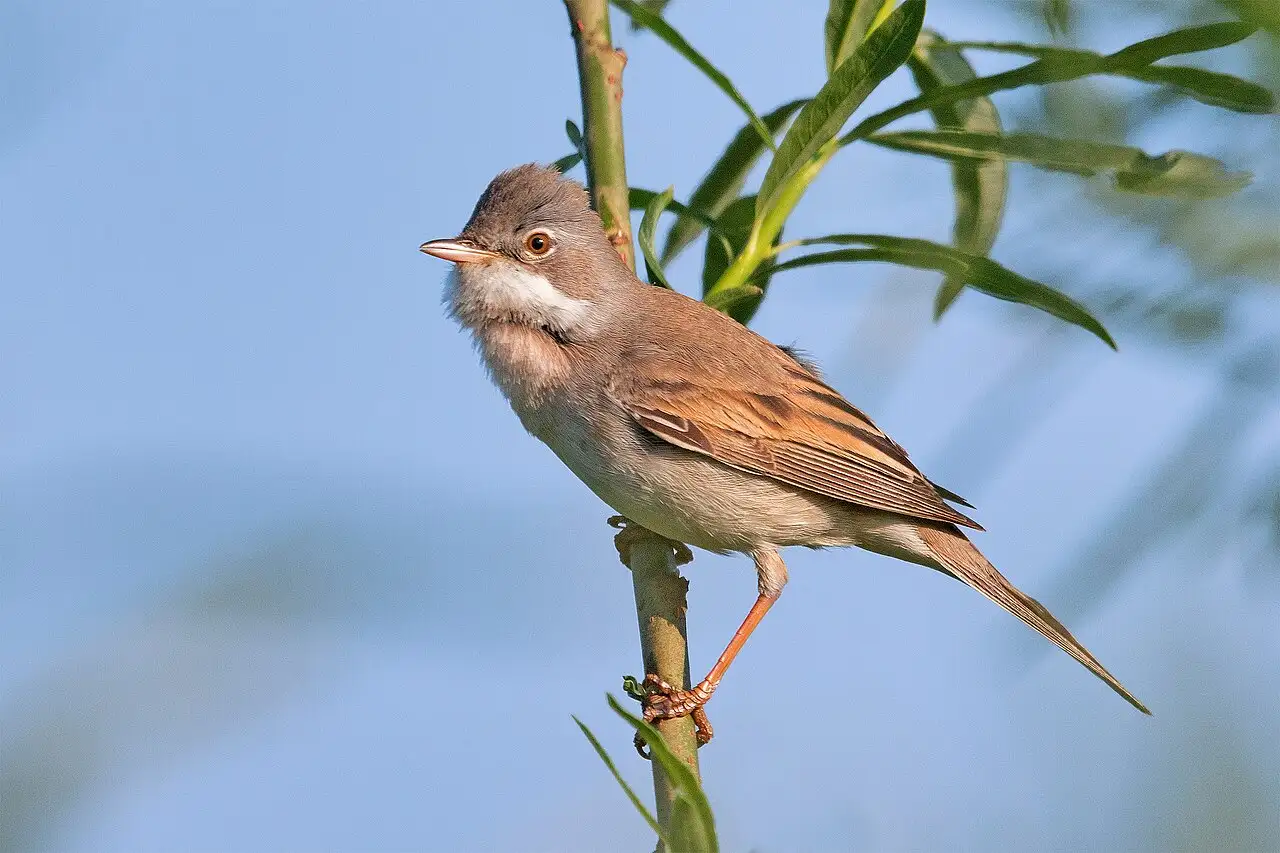
Male Common Whitethroat perched on a stick, with grey head, white throat, russet wings and long tailPhoto: Andreas Trepte, CC BY-SA 2.5Photo 1 of 4
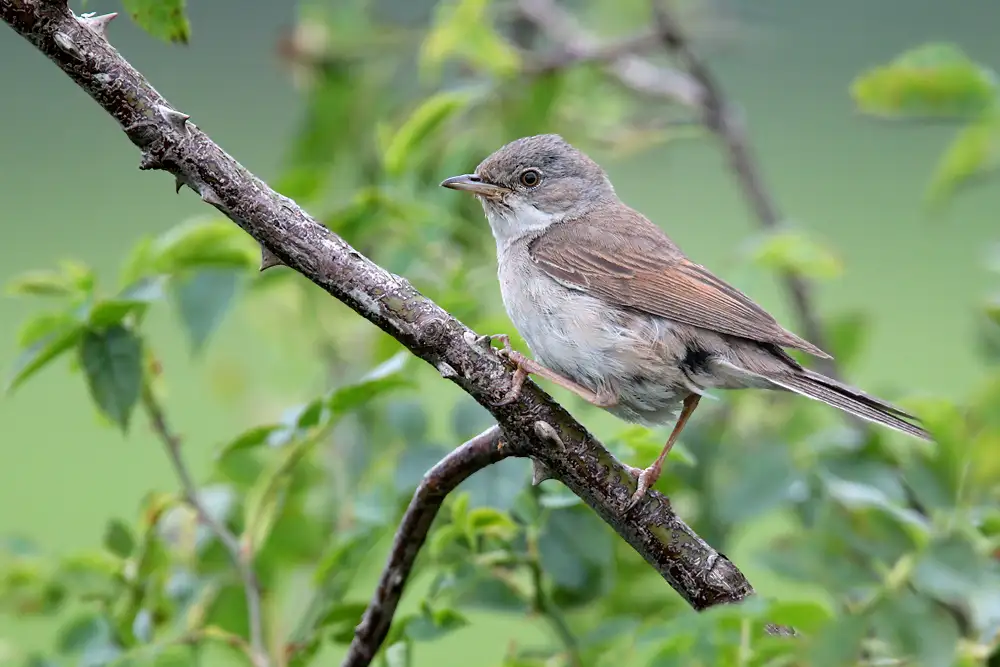
Common Whitethroat in profile on a thorny branch among green leaves, with pale throat and brown backPhoto: PeterRohrbeck, CC BY-SA 4.0Photo 2 of 4
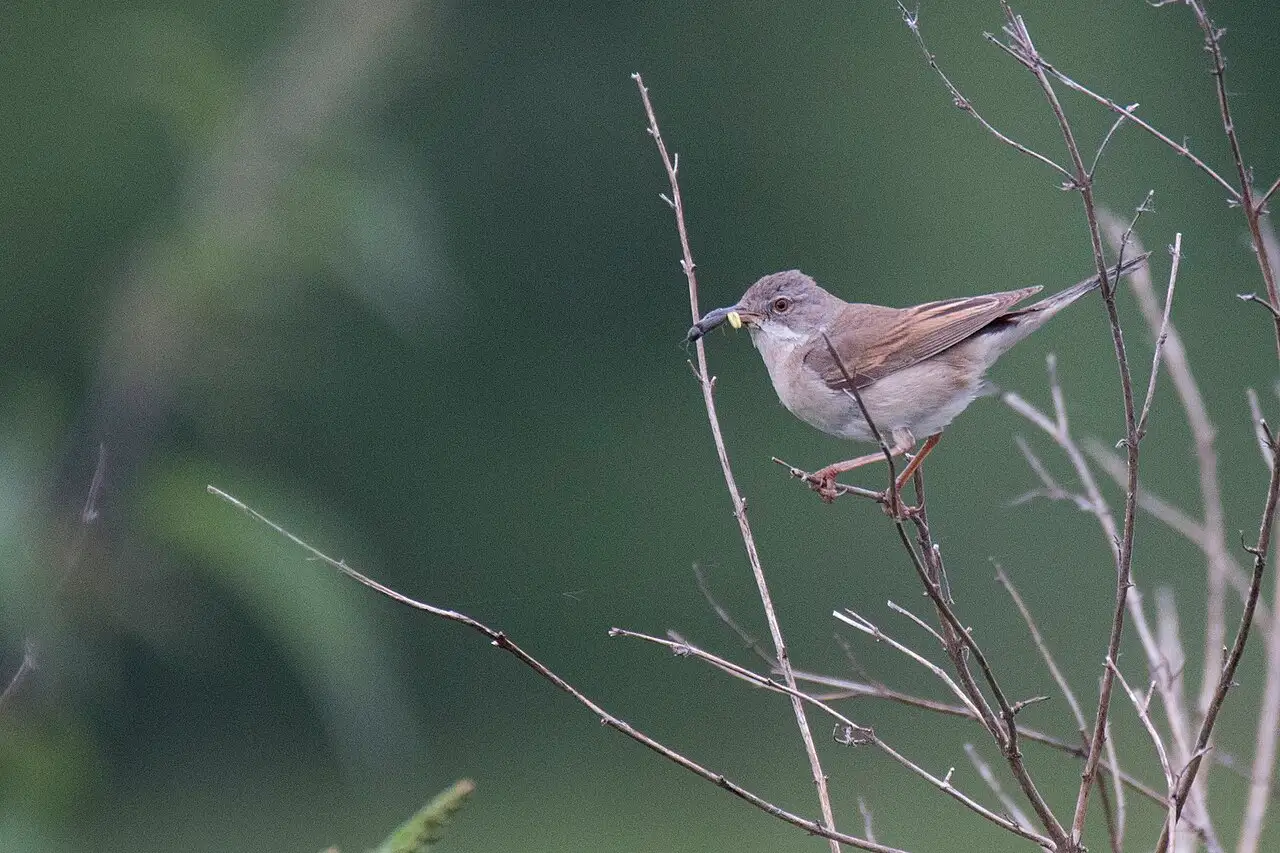
Common Whitethroat at the tip of a dry branch with an insect in its bill, against a blurred green backgroundPhoto: Jac. Janssen from Baarlo lb, NL, CC BY 2.0Photo 3 of 4
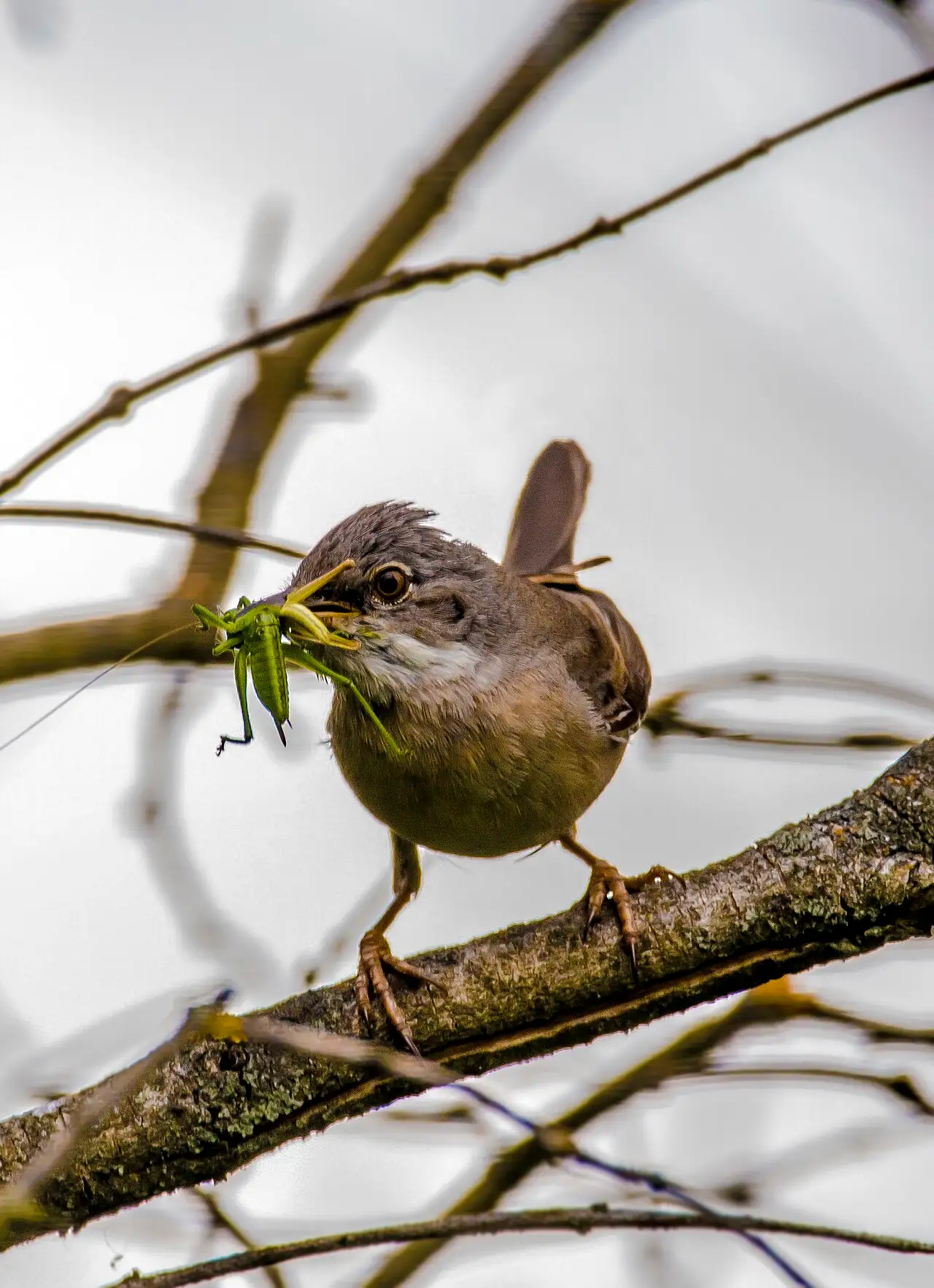
Common Whitethroat perched on a branch with a green caterpillar in its bill and the tail raisedPhoto: Andrew Kalinin, CC BY 4.0Photo 4 of 4
1 / 4
Identification of the Common Whitethroat
The Common Whitethroat is medium-sized, with a relatively long tail and white outer tail feathers. The male has a brown back, with a grey head in breeding plumage and brown for the rest of the year, russet wings, white throat and whitish underparts with pink tones. The female shows more subdued tones, with the head and back browner, the throat whitish and duller, and the belly also whitish and without the slightly salmon tones of the male. Both sexes have pale legs, and adults have a reddish iris, which contrasts with a faint pale orbital ring.
Male
Grey head in breeding plumage and brown the rest of the year.
White throat, russet wings and whitish underparts with pink tones.
Female
Head and back browner, throat whitish and duller.
Whitish belly, without the male’s salmon tones.
Habitat and distribution of the Common Whitethroat
As a breeder it has a wide, extensive distribution across Europe and western Asia, and appears patchily in North Africa, the Middle East and the Near East. Its wintering areas extend south of the Sahara, from Senegal to Ethiopia, and reach South Africa in the south.
In Spain it is distributed continuously across the whole northern third of the Peninsula, with the highest abundances in the north-west (western León, eastern Galicia). More patchily and scattered it is found in the Pyrenees, the Central System, the Montes de Toledo and the Betic and Subbetic ranges. As a breeder it is absent from the Balearics, the Canaries, Ceuta and Melilla.
On the Peninsula it shows a marked preference for cool, damp sites in the northern third or for mountain areas in the south. It is associated with scrub that replaces oak woodland, with mosaics of grassland and shrubby hedges, fringes of shrubs on woodland edges, mountain scrub and Cantabrian heaths with gorse and heather. It is distributed from sea level to 2,050 metres altitude, in Sierra Nevada, with optima between 1,000 and 1,500.
It is a long-distance trans-Saharan migrant. The pre-breeding passage runs from March to June, with peaks in late April, and the post-breeding one takes place between August and early November, with peaks in late September. The Peninsula and the Balearic Islands also receive migrating warblers from central and western Europe.
Areas where it is regularly recorded since 2010Squares of about 25 km where it is recorded regularly (occasional passage records are left out). Data from GBIF.org (52,315 records, retrieved October 2026); outline from Natural Earth.
Etymology of the Common Whitethroat
According to Wikipedia, the English ornithologist John Latham described it in 1783 and published the name «Sylvia communis» in the supplement to his work, in 1787; «communis» is Latin and means «common». Today it is placed in the genus «Curruca», which Johann Matthäus Bechstein introduced in 1802. In other languages it is called «tallareta vulgar» in Catalan, «papuxa común» in Galician, «sasi-txinboa» in Basque and «common whitethroat» in English1.
Population of the Common Whitethroat
In the 2021 European Red List of Birds the European breeding population is estimated at between 39,200,000 and 59,200,000 mature individuals, with an increasing trend. In Spain there may be around a million birds, with the largest populations in Castilla y León, but the trend is negative, with a moderate decline for the national contingent.
It is not considered a threatened species, although it seems to have undergone a slight decline in recent years. Among the risk factors are cited the alteration of breeding habitats by fires, scrub clearance and the removal of shrubby field boundaries and broadleaf copses, as well as the severe periodic droughts of the Sahel, where it winters1.
Nest of the Common Whitethroat
The nest is built by the male low down, in the thicket of a small shrub or in a bush among shrubs and tall grasses. It is a small basket of twigs and leaves, lined with hair, little dry leaves and feathers.
Courtship and breeding of the Common Whitethroat
The breeding season runs from May to July, and it may make two clutches a year. The clutch consists of one to seven eggs, usually four or five, white to greenish and diffusely speckled. Incubation lasts 11 or 12 days and both sexes take turns. The chicks, which both parents also care for and feed, become able to fly at 10–12 days, and after leaving the nest the young stay another 15–20 days in their parents’ care until they become independent.
Diet of the Common Whitethroat
It feeds on all kinds of invertebrates, mainly beetles, ants, bugs and flies, although berries can make up an important part of its diet in late summer and autumn.
Curious facts about the Common Whitethroat
It is a very common warbler in Europe, where it is distributed almost continuously, and typical of mosaic landscapes where small copses alternate with meadows, farmland, hedges and mountain scrub1. EURING lists a bird ringed in Belgium that lived 12 years and 2 months, somewhat more than AnAge gives (9 years).
The Common Whitethroat in Cabañeros
The habitat pages of this website do not mention it, but the Montes de Toledo, where the Park lies, are named among the few sites in the south of the Peninsula where it is found, patchily and scattered1. We have not found any other published source on it in Cabañeros. GBIF.org records 19 observations of the Common Whitethroat in Cabañeros and its surroundings.
Where to see the Common Whitethroat in Cabañeros
In Cabañeros and its surroundings, from March to November, in scrub, hedges and shrubby fringes of damp woodland.
When
From March to November: it is a summer visitor; the pre-breeding passage is from March to June and the post-breeding one from August to early November.
What time
By day, singing from a perch or in flight.
Where
In mosaics of scrub, hedges and grassland, and on the shrubby fringes of woodland.
What to look for
Look for the white throat and the rufous wings; listen for its brief phrases with high, harsh notes.



 Same family
 Same family
 Same family
 Same family
 Same order
 Same order
 Same order
 Same order






