In family flocks, noisy and trusting, above all in autumn and winter
Lifespan
Record of almost 9 years in the wild (a bird ringed in the United Kingdom)
Conservation status
LC
NT
VU
EN
CR
EW
EX
Global (IUCN)
Least Concern
Spain
Included in the List of Wild Species under Special Protection; not in the Spanish Catalogue of Threatened Species
When to see it
Resident
Months of the year when it is present
J
F
M
A
M
J
J
A
S
O
N
D
In Iberia
yes
yes
yes
yes
yes
yes
yes
yes
yes
yes
yes
yes
Breeding season
no
no
yes
yes
yes
no
no
no
no
no
no
no
Song or voice of the Long-tailed Tit
It calls almost non-stop, above all in autumn and winter, when it goes in family groups: clicks and a dry, repeated lisp, «tsi-tsi-tsi-tsiii», which it finishes with a harsher call, «tssrrrarp». This is a group feeding in a tree; they are often heard before they are seen.
CallsLong-tailed Tit
0:00 / 0:24
10 kHz5
The sonogram draws the sound: time runs from left to right, and the higher a trace sits, the higher the note.Recording by Borja, Wikimedia Commons (CC BY-SA 4.0).
Flight of the Long-tailed Tit
It flies with weak, quick wingbeats, over short, undulating stretches, with the long tail swaying behind. They cross clearings one after another, in single file, without separating, and stop at each tree to go over it from top to bottom.
Flight typeShort and undulating, in single file
It leaves the branch with a weak flutter, with the long tail stretched out behind. It is always in a group, from branch to branch.
Short, undulating flight, with buzzing wingbeats and the tail swaying like a kite's tail. They cross one after another, almost without separating.
It brakes by spreading its tail and hangs from the twig, never ceasing to cheep, while the rest of the group arrives.
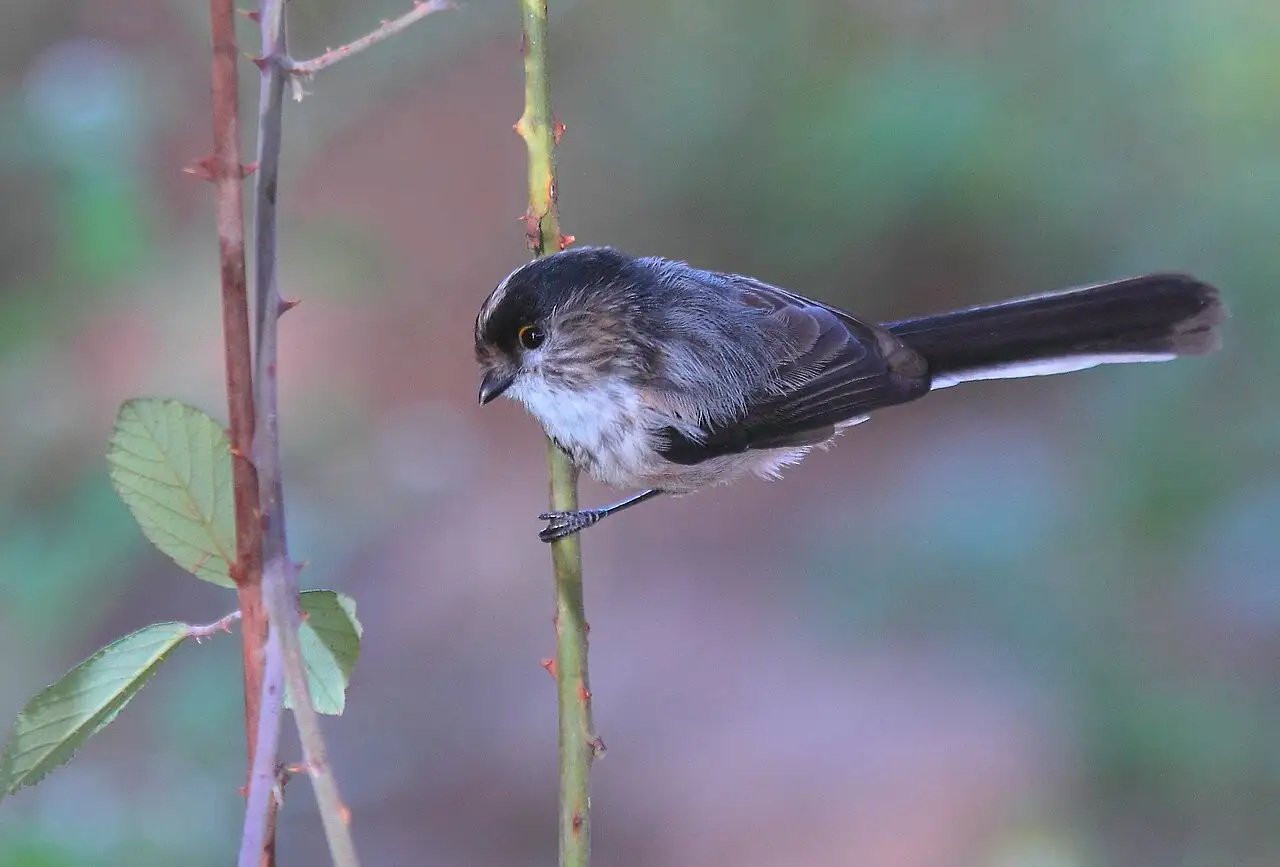
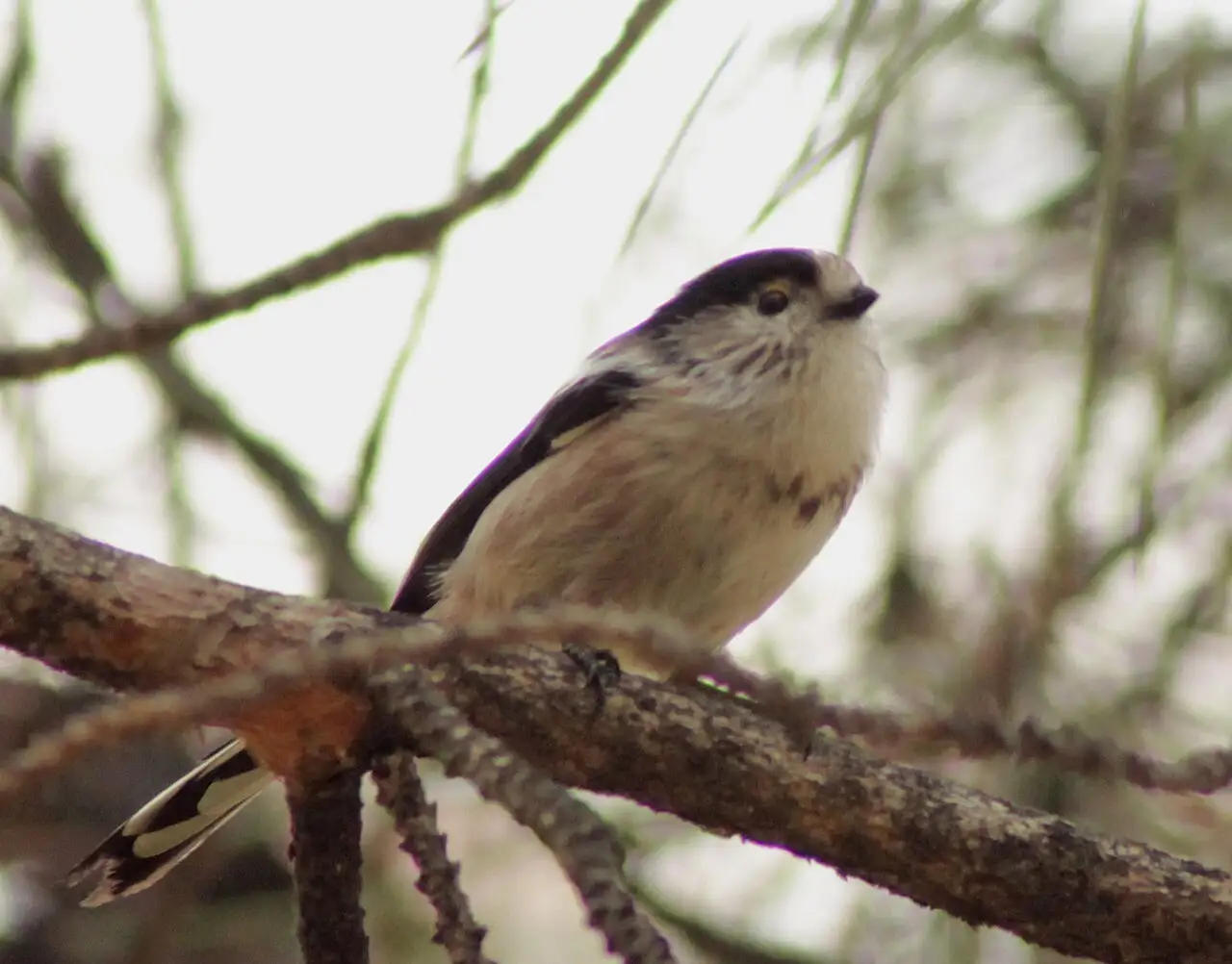
Long-tailed Tit of the Iberian subspecies «irbii», photographed in Madrid: pale head with a dark band and long tailPhoto: Luis García (Zaqarbal), CC BY-SA 3.0 esPhoto 2 of 4
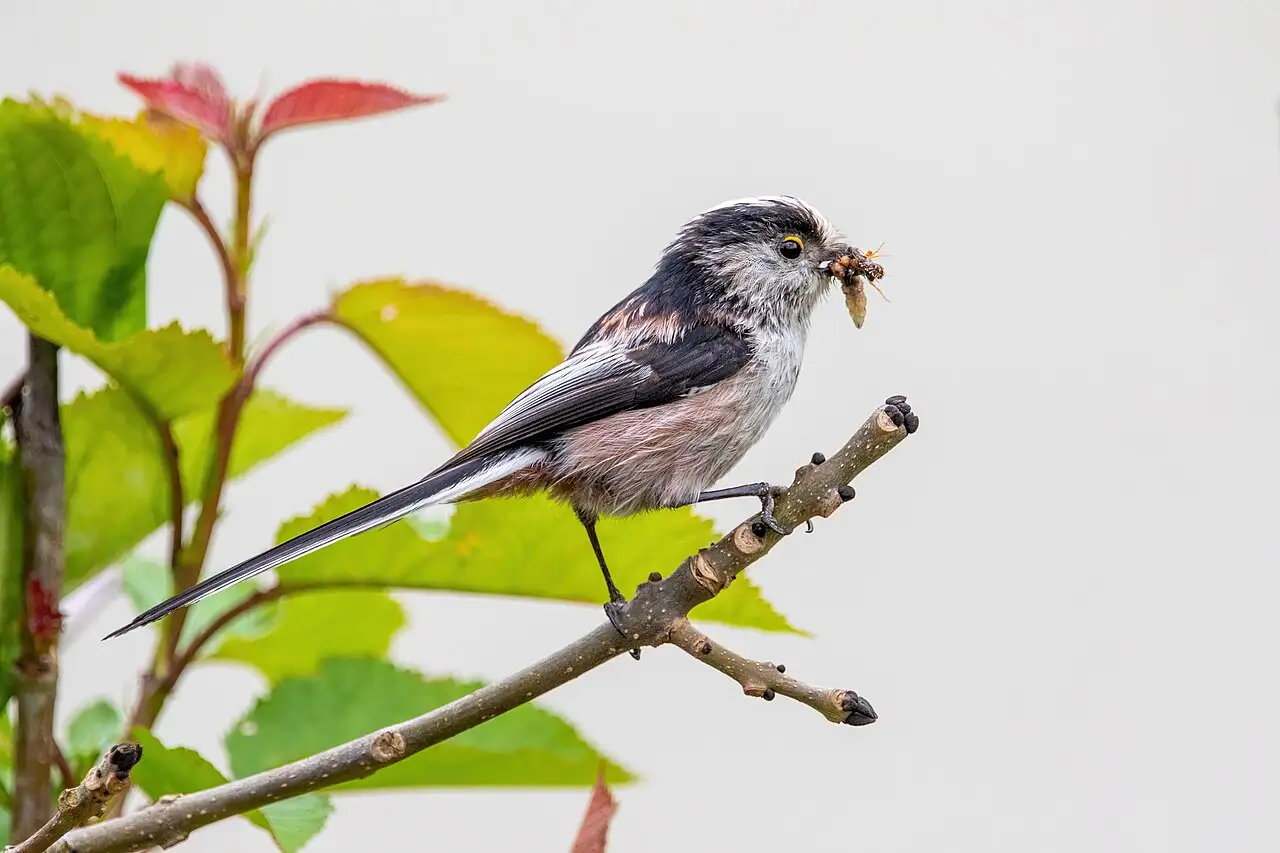
Long-tailed Tit with an insect in its bill, perched on a twig, on its way to the nestPhoto: Alexis Lours, CC BY 4.0Photo 3 of 4
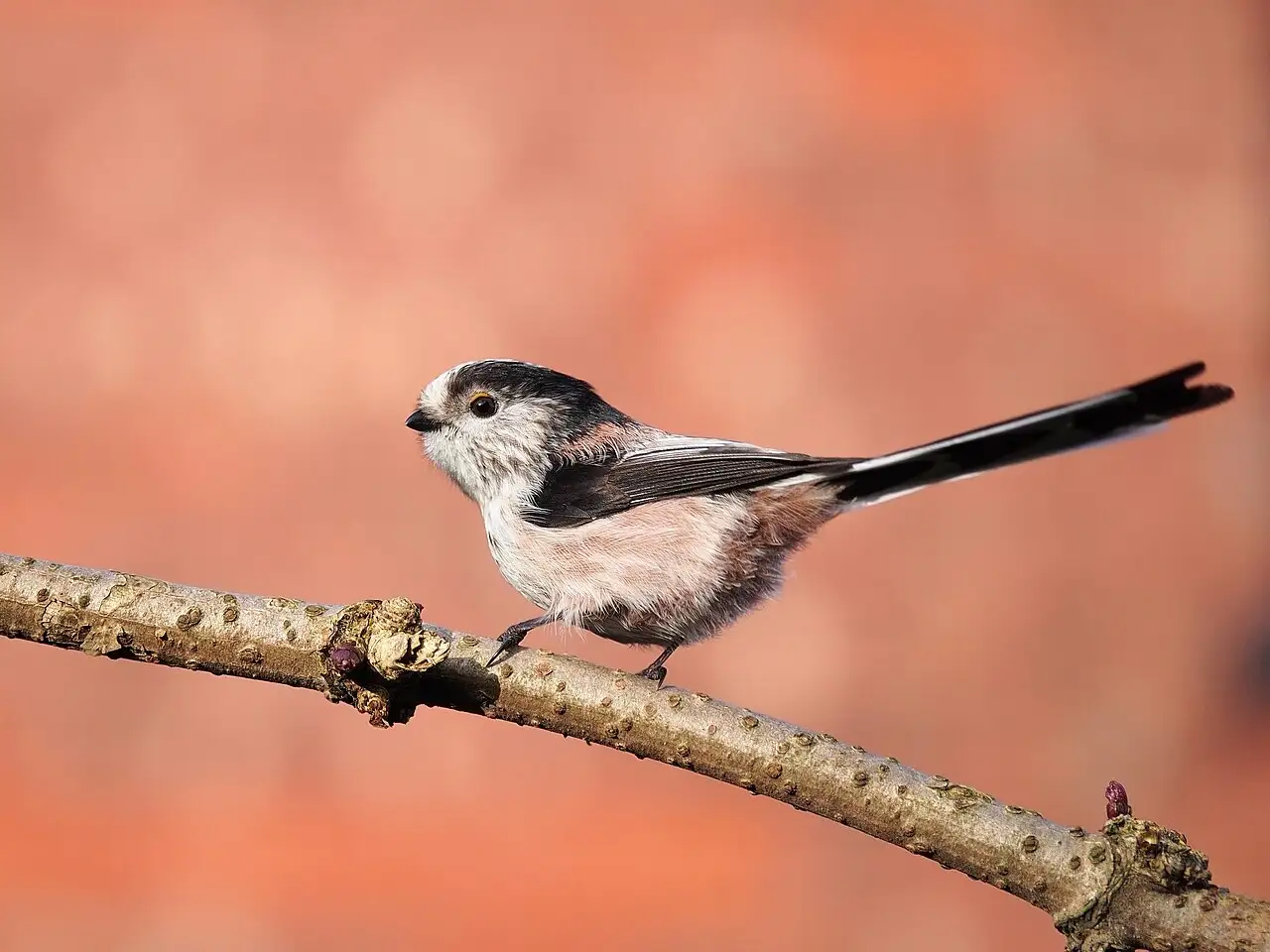
Long-tailed Tit in profile on a branch, with tiny body, pinkish breast and long black tailPhoto: Francis C. Franklin, CC BY-SA 3.0Photo 4 of 4
1 / 4
Identification of the Long-tailed Tit
It is recognised by the length of the tail, 7 to 9 cm, which contrasts with a little round body with short wings. At first glance it looks like a dark bird, but up close a pale band crossing the head can be seen and a greyish breast with rufous tints, against the black and grey of the back, tail and wings. On the Peninsula there are two subspecies: «macedonicus» in the northern half and «irbii» in the southern half.
Habitat and distribution of the Long-tailed Tit
It is spread from the Iberian Peninsula to Asia; it is absent from the far north of Scandinavia, North Africa, Sardinia and the Balearics. It has many subspecies.
In Spain it is frequent over almost the whole territory, except in the Ebro and Duero valleys, La Mancha and other very dry areas with few trees. It does not climb above 1,700 metres. It needs trees, with some preference for deciduous oak copses, but it also breeds in pine woods, and in winter is more abundant in holm oak and cork oak woods. It prefers woods with well-developed scrub. On a peninsular scale it is sedentary, although it moves nomadically in search of food, above all in autumn and winter, and in hard winters some from the north may arrive.
Areas where it is regularly recorded since 2010Squares of about 25 km where it is recorded regularly (occasional passage records are left out). Data from GBIF.org (306,710 records, retrieved October 2026); outline from Natural Earth.
Etymology of the Long-tailed Tit
«Aegithalos» comes from the Greek «aigithalos», the name of a small bird, and «caudatus» is «with a tail» in Latin. It is literally «the little bird with the tail».
Population of the Long-tailed Tit
In Spain there are between 4.6 and 5.7 million birds, with the highest densities in the broadleaf woods of the north-west, in Galicia and León, and with a stable trend. In Europe between 16.3 and 29.2 million mature individuals are estimated, also stable. It is classified as Least Concern. Felling and the fragmentation of woodland are its main threat, and in semi-arid zones it depends on riverside woods, which are among the scarcest and most altered habitats. It is also affected by the simplification of woodland through excessive thinning or through plantations of pine, poplar or eucalyptus.
Nest of the Long-tailed Tit
It does not make the typical cup: the pair builds, in two or three weeks, a closed, elongated nest, with a small hole in the upper third, in the branches of a tree or a shrub. They make it from the hair of large mammals, cobwebs and moss, line it with feathers and camouflage it on the outside with lichens. It measures some 20 cm long and 10 to 15 wide and easily goes unnoticed.
Courtship and breeding of the Long-tailed Tit
It breeds once a year, although it sometimes makes two clutches. From March to May the female lays between 7 and 12 eggs, white and sometimes with reddish spots, which hatch after 13 or 14 days. Male and female feed the young, which at two weeks can already fly and stay close to their parents.
Diet of the Long-tailed Tit
It is eminently insect-eating. It finds tiny insects and arachnids on the leaves and twigs of trees as it bustles non-stop from side to side, sometimes hanging head down.
Curious facts about the Long-tailed Tit
Its nest, a bag of cobwebs and moss covered in lichens, is one of the most delicate constructions made by our birds. And flocks of long-tailed tits are, in winter, a good clue for finding other woodland birds, which often join them.
The Long-tailed Tit in Cabañeros
The habitat pages of this website cite it among the birds of the scrublands, together with the tit, the blackbird and the chaffinch, with less abundance than the three warblers that make up 80 % of the community: the Dartford, Western Subalpine and Sardinian Warblers.
Where to see the Long-tailed Tit in Cabañeros
In the scrub with trees and in the dehesas and woods of Cabañeros, above all in autumn and winter, when they go in flocks.
When
All year round; in autumn and winter, in family flocks, they are easier to see.
What time
Throughout the day, although in the first hours of the morning the flocks are most active.
Where
On the thin branches of holm oaks, cork oaks and shrubs, where they go over the leaves and twigs one by one.
What to look for
A tiny bird with a very long tail, which crosses the clearing in single file with others, cheeping non-stop.
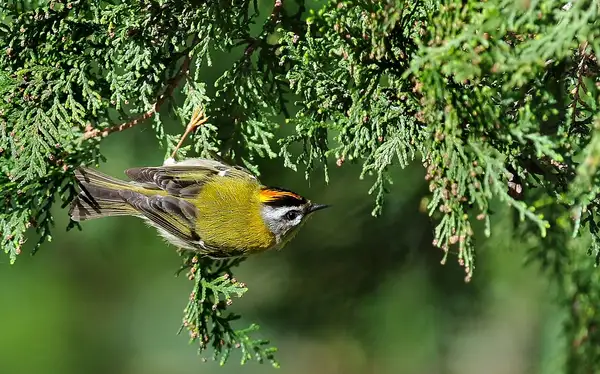
Smaller and short-tailed, with a white eyebrow and black stripes on the face and an orange crown. Its song is a high, thin series that resembles the Long-tailed Tit’s call.
Photo: Olivença, CC BY-SA 3.0
Goldcrest
Regulus regulus
How to tell them apart
The same size as the Common Firecrest, without the eyebrow or the dark stripes on the face, with a yellow crown edged in black. It is much less frequent in the southern half.
Photo: Thomas Bresson, CC BY 3.0
Other birds
Birds related to the Long-tailed Tit or sharing its habitats in Cabañeros.




 Also in scrubland
 Also in scrubland
 Also in scrubland
 Also in scrubland
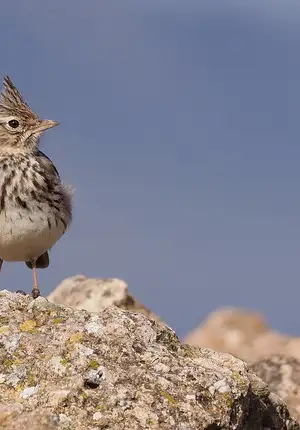 Also in scrubland
 Also in scrubland
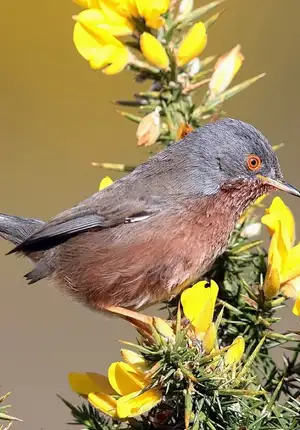 Also in scrubland
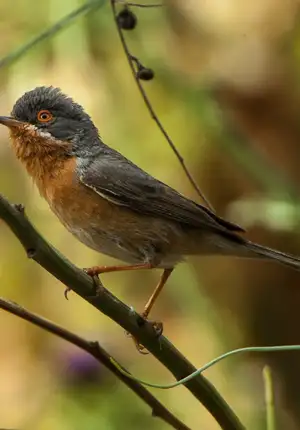 Also in scrubland






