Wingspan compared with a person with arms outstretched.
Length
33–39 cm
Wingspan
80–95 cm
Weight
280–420 g
Social life
The chicks hatch asynchronously and soon establish a hierarchy for access to food; the male usually just brings prey to the female, who tears it up for the young
Lifespan
Record of 30 years and 9 months according to EURING (a bird ringed in the Netherlands and found dead); AnAge gives up to 34 years
Conservation status
LC
NT
VU
EN
CR
EW
EX
Global (IUCN)
Least Concern
Spain
Near Threatened (NT) as a breeder in the Red Book of the Birds of Spain; on the List of Wild Species under Special Protection and, the Canarian subspecies, Vulnerable (VU) in the Spanish Catalogue of Threatened Species
When to see it
Resident
Months of the year when it is present
J
F
M
A
M
J
J
A
S
O
N
D
In Iberia
yes
yes
yes
yes
yes
yes
yes
yes
yes
yes
yes
yes
Breeding season
no
no
yes
yes
yes
yes
yes
yes
yes
yes
no
no
Song or voice of the Western Barn Owl
It shows a great variety of vocalisations, often screeching and strident, although the most common sound is a very loud, metallic hiss, which rises progressively in volume and pitch as the bird gives it. The female usually gives a hoarser, lower screech, somewhat purring and repetitive.
CallWestern Barn Owl
0:00 / 0:24
10 kHz5
The sonogram draws the sound: time runs from left to right, and the higher a trace sits, the higher the note.Recording by Luis Gracia, xeno-canto XC345927 (España) (CC BY-SA 4.0).
Flight of the Western Barn Owl
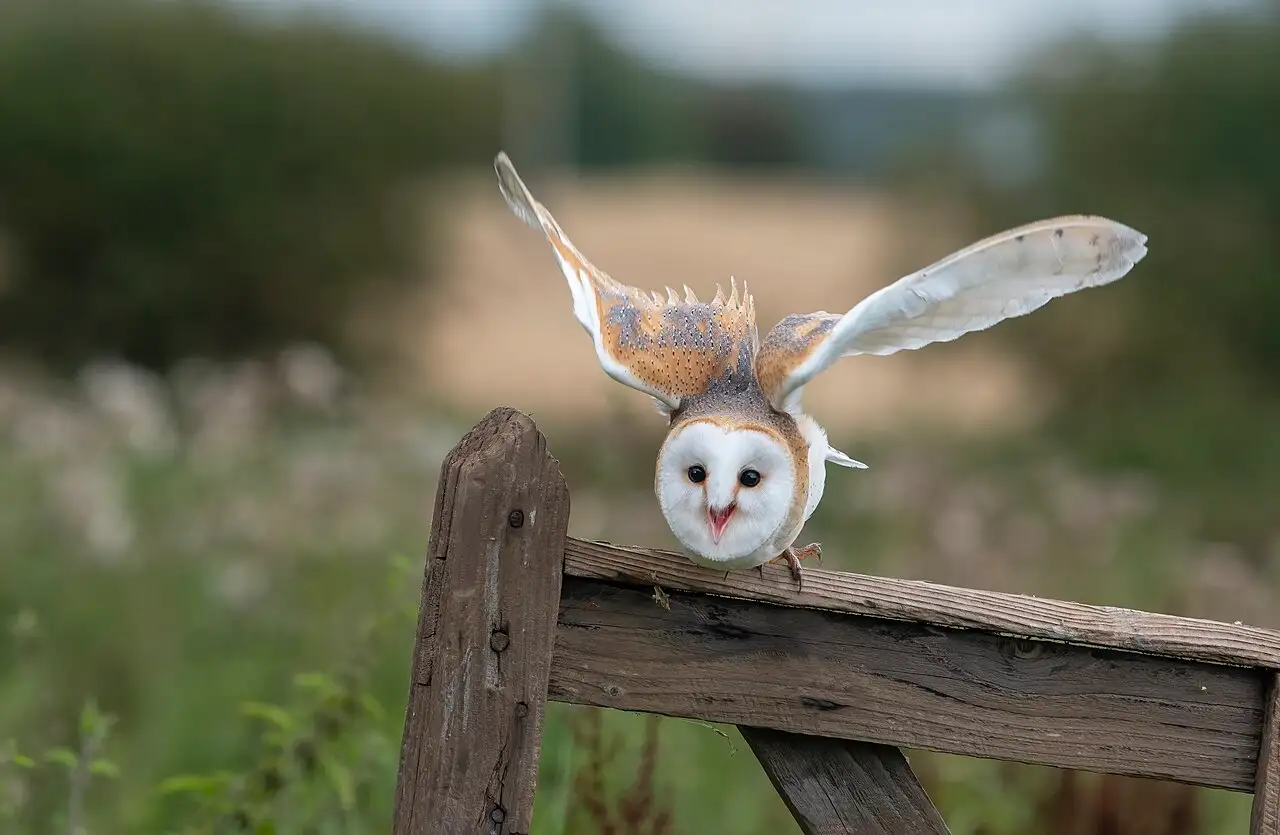
The flight of this nocturnal raptor, with long, relatively broad wings, is elegant, silent and agile thanks to the bird’s light weight. It is not rare to see it hover skilfully over a spot while scanning the ground for prey.
Flight typeElegant, silent and agile, sometimes hovering
Settled in lofts, ruins, churches or old attics, or on rocky cliffs, quarries and hollow trees, it goes out to hunt in open or semi-wooded landscapes.
Its flight, with long, relatively broad wings, is elegant, silent and agile thanks to the bird's light weight, and it is not rare to see it hover over a spot while scanning the terrain.
It is a generalist predator, with a marked preference for small mammals: field mice, rats, voles and shrews.
Photo gallery of the Western Barn Owl
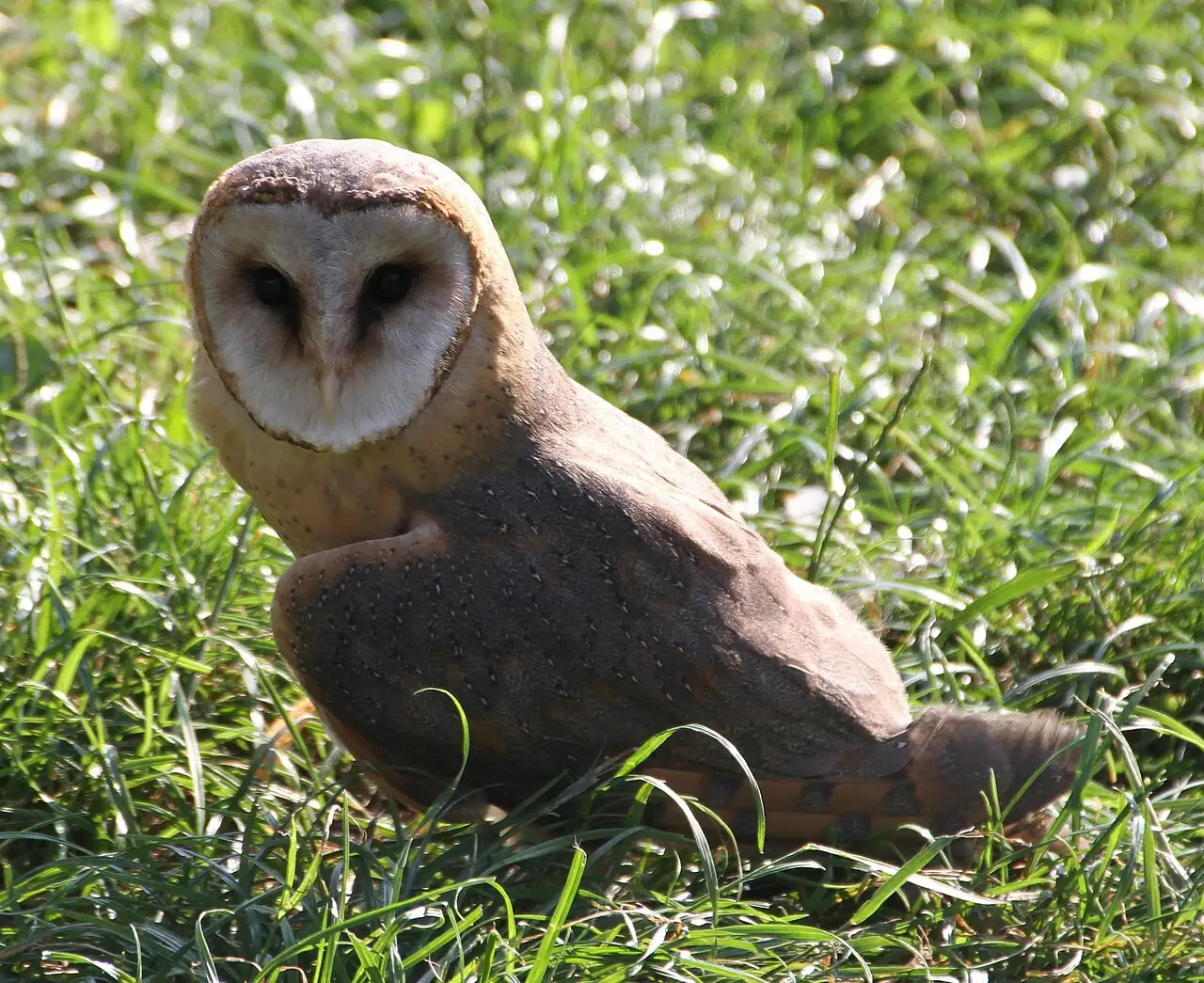
Western Barn Owl perched on the grass, with white heart-shaped face, black eyes and tawny backPhoto: Bjoertvedt, CC BY-SA 4.0Photo 1 of 4
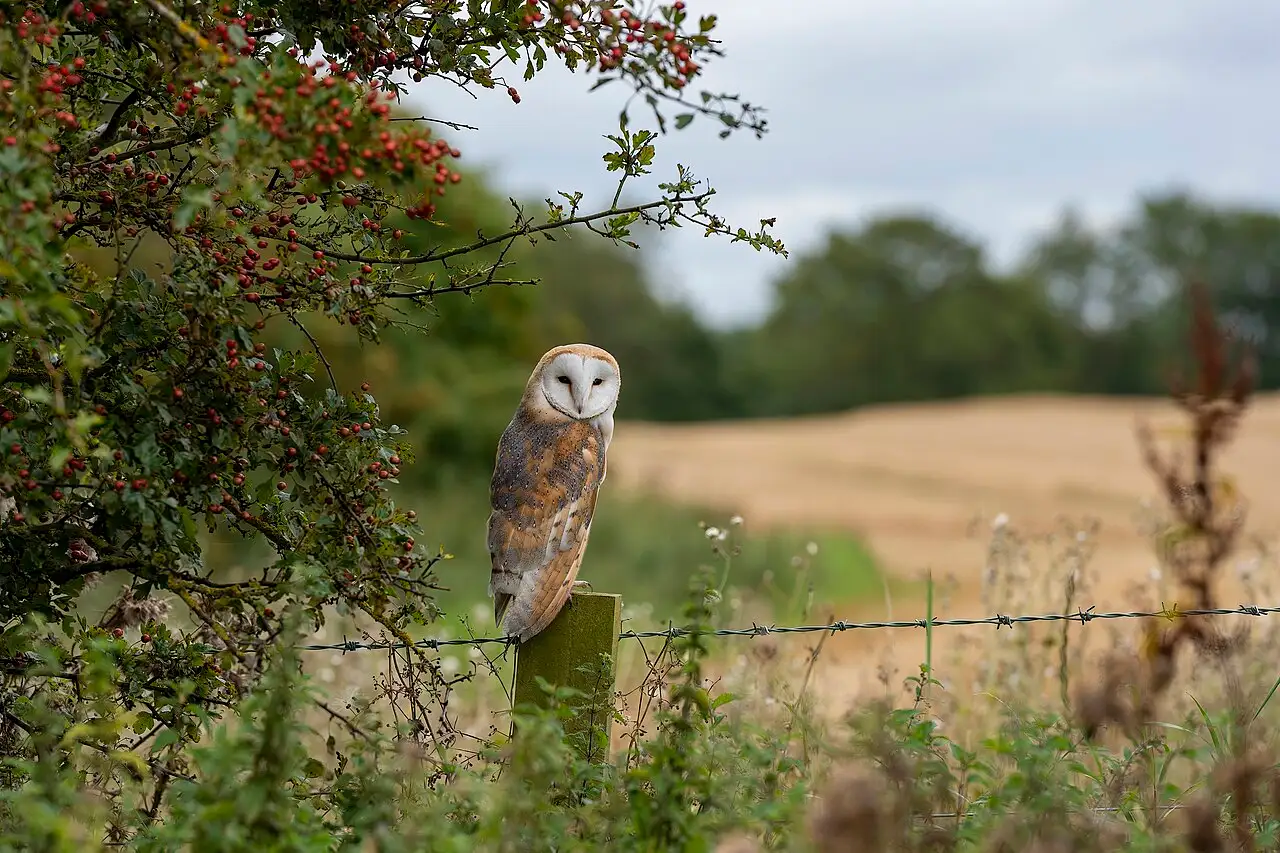
Western Barn Owl perched on a post of a wire fence, in profile, in front of a cereal fieldPhoto: caroline legg, CC BY 2.0Photo 2 of 4
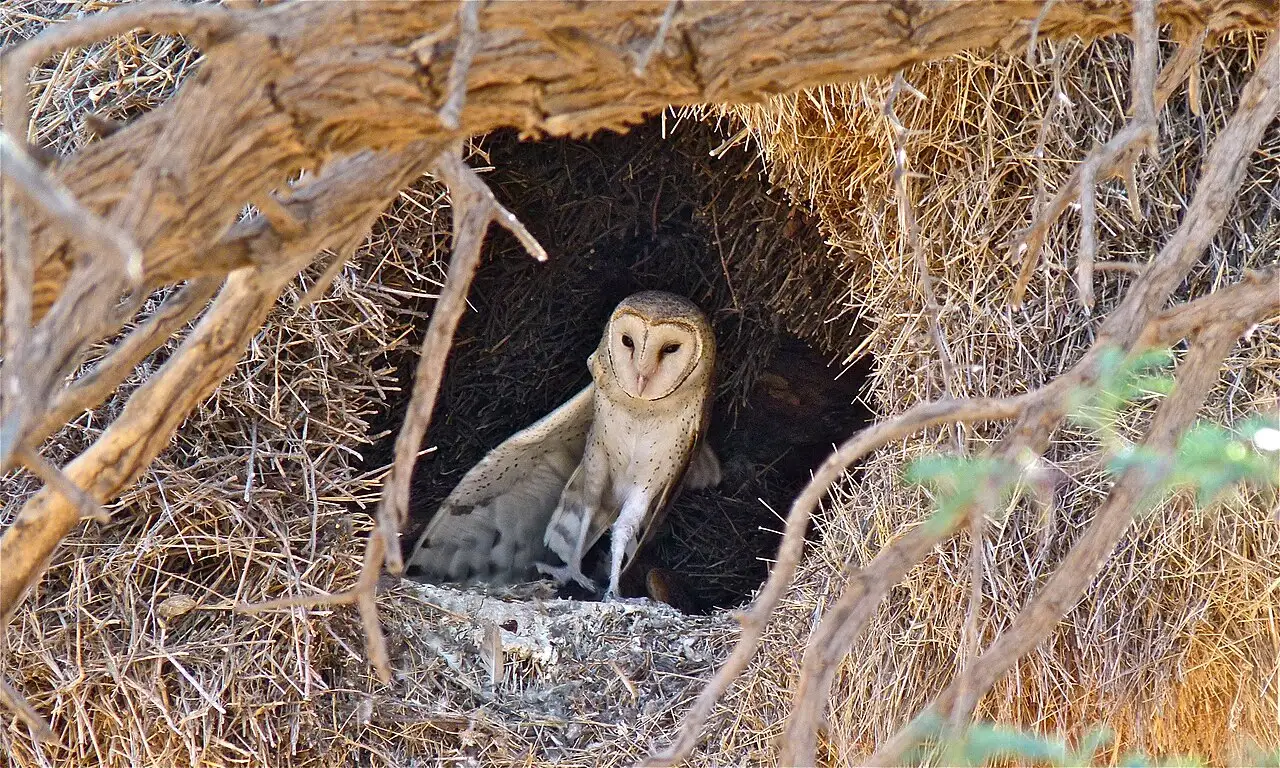
Western Barn Owl peering out of a hole in a hayloft, with wings half open, among the straw and branchesPhoto: Bernard DUPONT from FRANCE, CC BY-SA 2.0Photo 3 of 4
Western Barn Owl taking off from a wooden gate, with wings open and the white face from the frontPhoto: caroline legg, CC BY 2.0Photo 4 of 4
1 / 4
Identification of the Western Barn Owl
The Western Barn Owl, the only representative of the family Tytonidae in European territory, is a medium-sized raptor of slender appearance, long legs and bulky head, wearing contrasting plumage in which tawny and golden tones predominate on the back and pure white, even slightly silvery, on the underparts. The back feathers and the upper part of the wings and tail are finely vermiculated with subtle black, grey and whitish dotting, and the underparts may show variable spotting. On the face, unmistakable for its heart shape, the intensely black eyes and the prominent pale bill stand out.
Adult
Back tawny and golden, vermiculated with black, grey and whitish.
Underparts pure white, sometimes with variable spotting.
Heart-shaped facial disc, black eyes and pale bill.
Young bird
Plumage very similar to the adult’s, with subtle differences that are hard to see in the field.
Habitat and distribution of the Western Barn Owl
Practically cosmopolitan, it ranges over almost the whole world and is absent only from the coldest or excessively arid regions. In Europe it is distributed over a good part of the continent and the main islands, except the Scandinavian peninsula and Iceland, with very uneven densities. Up to 30 subspecies have been described.
It is a fairly well-distributed bird in Spain, although scarce in some very mountainous regions or in the arid south-east. In our territory there are up to three subspecies: «alba», which occupies the whole Peninsula, the Balearics, the North African enclaves and the central and western Canary Islands; «gracilirostris», endemic to Fuerteventura, Lanzarote, La Graciosa and Alegranza; and «guttata», formerly considered a winter visitor, which also breeds on the Peninsula.
It is a characteristic inhabitant of open or semi-wooded landscapes, and settles in a great variety of habitats, from steppe areas to dehesas, as well as wetlands, suburban areas and wooded farmland. It avoids very dense woods and very mountainous areas, where it is absent or scarce above 800–1,000 metres.
The populations of western Europe are basically sedentary and, at most, make short movements. Those of more northerly areas may cover greater distances, and every winter birds arrive from central and eastern Europe. Movements of up to 300 kilometres by dispersing young birds have been confirmed, apparently in response to food availability.
Areas where it is regularly recorded since 2010Squares of about 25 km where it is recorded regularly (occasional passage records are left out). Data from GBIF.org (28,871 records, retrieved October 2026); outline from Natural Earth.
Etymology of the Western Barn Owl
According to Wikipedia, the epithet «alba» comes from Latin «albus» («white»): Scopoli, who described it in 1769 as «Strix alba», knew few nocturnal raptors so extensively white. In other languages it is «òliba comuna» in Catalan, «curuxa común» in Galician, «hontz zuria» in Basque and «western barn owl» in English1.
Population of the Western Barn Owl
In the 2021 European Red List of Birds the European breeding population is estimated at between 164,000 and 356,000 mature individuals, with a decreasing trend. In Spain there are no concrete estimates, but the Noctua night-bird monitoring programme shows a negative trend, with a calculated decline of 35 % between 2006 and 2018. Among the causes are cited the change of farming uses towards monocultures, the massive use of pesticides and rodenticides, which reduce prey and cause indirect poisoning, the loss of nesting sites through building work and renovations and frequent road deaths, which cause thousands of casualties each year, above all among dispersing young birds1.
Nest of the Western Barn Owl
It settles mainly in the vicinity of people, in very sheltered sites such as lofts, barns, cavity walls or stores, although many occupy rocky cliffs, quarries and hollow trees. As is customary among nocturnal raptors, the nest has no structure and may be placed directly on the ground, although they prefer a ledge or a mound.
Courtship and breeding of the Western Barn Owl
Its long breeding period normally runs from March to October, although broods have been documented in every month of the year, largely because it settles in the vicinity of people. The clutch is four to seven eggs, which the female incubates for 30 or 31 days from the first. If conditions allow and prey is abundant, it may make a second clutch, and replacement ones are usual if the brood is lost. The chicks hatch asynchronously and soon establish a hierarchy for access to food, which may mean the death of the smallest. Both parents feed them, although the male usually just brings prey to the female, who tears it up for the young. Young barn owls fly at 50–55 days and are not independent until 3–5 weeks later.
Diet of the Western Barn Owl
A generalist predator, its diet includes a wide variety of the local fauna, with a marked preference for small mammals: field mice, rats, voles and shrews. It frequently catches small birds, above all at roosts, as well as large insects, amphibians and reptiles. It has a high metabolic rate, which forces it to eat large amounts of food, far above what other winged predators of similar size need.
Curious facts about the Western Barn Owl
It is the protagonist of lurid stories that link it with death and the world of darkness, although it is a very beneficial predator of rodents1. EURING lists a bird ringed in the Netherlands that lived 30 years and 9 months. In Cabañeros, moreover, a pair has bred for at least a decade in a nest box with a camera, which SEO/BirdLife broadcasts live.
The Western Barn Owl in Cabañeros
The habitat pages of this website do not mention it, but there is a separate source. According to an Ecoticias note of 26 February 2021 on the cameras of Cabañeros National Park, barn owls have been breeding for at least a decade in a nest box installed in the Park, near the Casa Palillos Visitor Centre, and since 2018 it has been watched by video camera; the Park makes those nests available to SEO/BirdLife’s monitoring programme. GBIF.org records 61 observations of the Western Barn Owl in Cabañeros and its surroundings.
The Casa Palillos nest box, season by season
The box is next to the visitor centre and has cameras inside and out, which the park lends to SEO/BirdLife’s monitoring programme; it can be watched live on its YouTube channel. Between this box and the lesser kestrel colony next door, in 2023 the programme had more than 25,000 hours recorded and more than two million views. What has happened inside, according to the park’s bulletin (all the bulletins), makes a series:
2023: copulations already in February, a clutch of 6 eggs and first hatching on 25 April. The male disappeared in the middle of breeding and another arrived. 3 of the 6 chicks came through, ringed on 20 May.
2024: first egg on 24 February, a month earlier than the year before. In the early hours of 1 May, with the parents away, an intruder barn owl came in and killed the 5 chicks; it is a way of eliminating the competition’s offspring, and the park and SEO/BirdLife decided not to intervene so the pair would not abandon the box. It did not abandon it: it made a replacement clutch of 8 eggs, the first hatching came on 19 June and 7 chicks flew, ringed in mid-August.
2025: the earliest laying recorded, 9 eggs, from a female whom those following her online call «Federica». A spell of bad weather left her without prey and 6 of the 9 chicks died. She made a second clutch of 5 eggs and from it 4 more chicks came out: 7 in all.
2026: three of Federica’s chicks ringed. Fighting over a prey, two fell from the nest; the eldest climbed back up on its own during the night, but the small one, put back in the box, fell again. After two days on the ground, dehydrated and with an injured wing, it spent the summer at the El Chaparrillo recovery centre.
By the way: barn owls do not drink. All the water they need comes from their prey, and that is why a chick on the ground and not eating dehydrates so quickly.
Where to see the Western Barn Owl in Cabañeros
In Cabañeros and its surroundings, throughout the year, in dehesas, farmland and buildings.
When
All year round; it is resident, and its long breeding period runs from March to October.
What time
At dusk and at night: it is a nocturnal raptor; sometimes it is seen hovering over a spot.
Where
In open or semi-wooded landscapes: dehesas, farmland, steppe areas, wetlands and the vicinity of buildings with lofts, ruins or churches.
What to look for
Look for the heart-shaped face, the tawny back and the white underparts; listen for the metallic hiss.



 Same order
 Same order
 Same order
 Same order
 Same season in the park
 Same season in the park
 Same season in the park
 Same season in the park






