Wingspan compared with a person with arms outstretched.
Length
37–41 cm
Wingspan
60–63 cm
Weight
375 g
Social life
The female builds the nest, incubates the eggs and cares for the chicks during the first days
Lifespan
EURING lists a bird ringed in the Netherlands that lived 23 years and 2 months and was shot; AnAge, under Anas querquedula, gives 14.7 years in the wild
Conservation status
LC
NT
VU
EN
CR
EW
EX
Global (IUCN)
Least Concern
Spain
Critically Endangered (CR) as a breeder and Data Deficient (DD) as a winter visitor in the 2021 Red Book of the Birds of Spain; not on the List of Wild Species under Special Protection or in the National Catalogue of Threatened Species
When to see it
Passage migrant
Months of the year when it is present
J
F
M
A
M
J
J
A
S
O
N
D
In Iberia
no
yes
yes
yes
no
no
yes
yes
yes
yes
no
no
Song or voice of the Garganey
The male gives a dry rattling during the breeding season and the female, fairly silent, a nasal «ga-ga-ga» and a faint, short, high quack1. The recording (song) is by Stein Ø. Nilsen and was made in El Fondo d’Elx-Crevillent Natural Park (xeno-canto XC737247, quality A). It lasts 9 seconds and is a trimmed section of the original, without repeating or lengthening, from which we have removed the bass below 200 Hz, reduced the background noise and adjusted the volume; neither pitch nor speed has been changed.
In flight, the male shows silver-grey wings and a dark head and neck, and two pale lengthwise bars are traced on the speculum; the female and young are very dark, with a speculum similar to the adult male’s.
Flight typeExtraordinarily agile on migration passage, in flocks that follow mainly the Mediterranean coasts
It occupies shallow freshwater wetlands, with emergent and even floating vegetation, which serves as shelter and food.
In flight, the male shows silvery-grey wings, a dark head and neck and, on the speculum, two pale lengthwise bars.
It obtains food by filtering the water with its bill; it eats mainly aquatic invertebrates, amphibian larvae and small fish.
Photo gallery of the Garganey
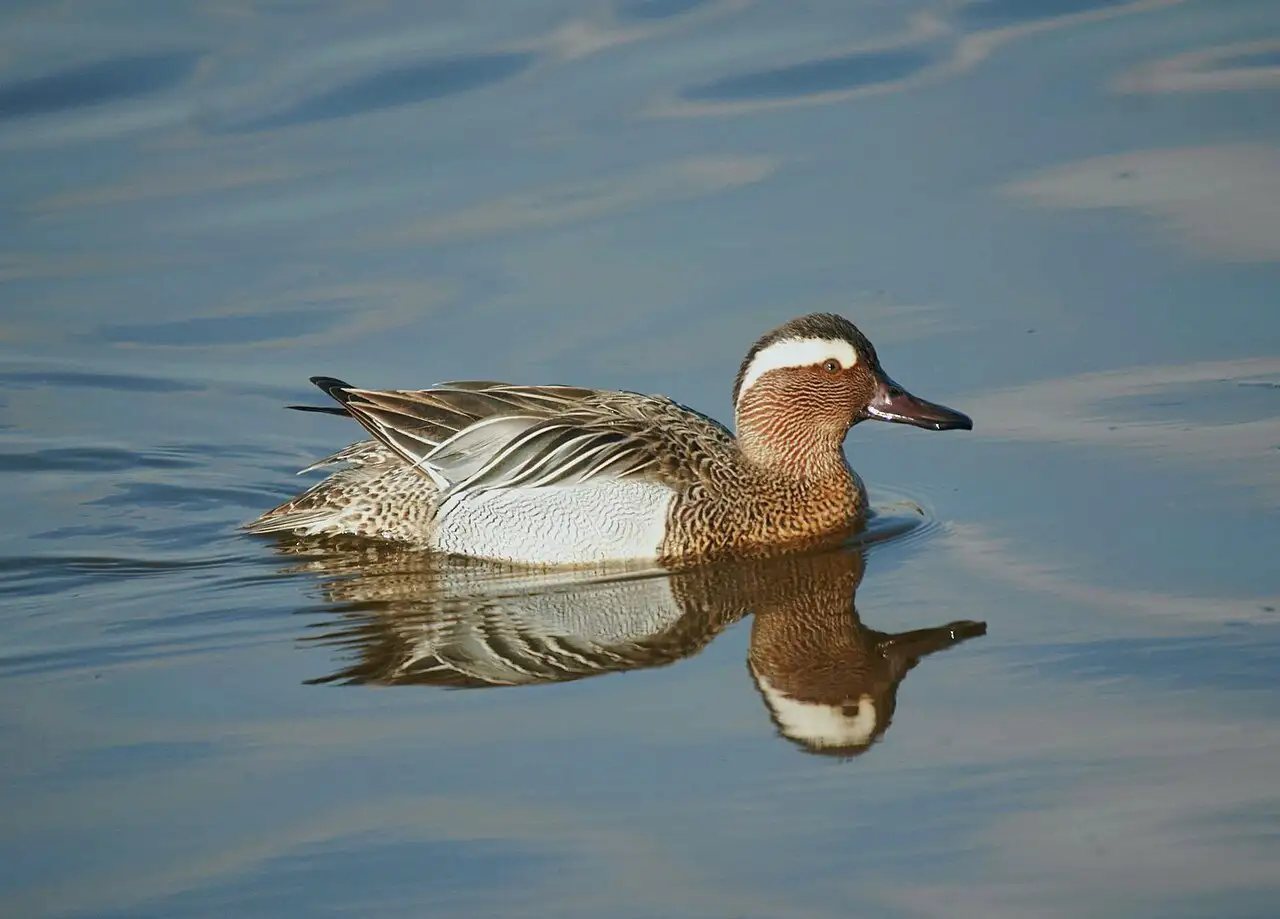
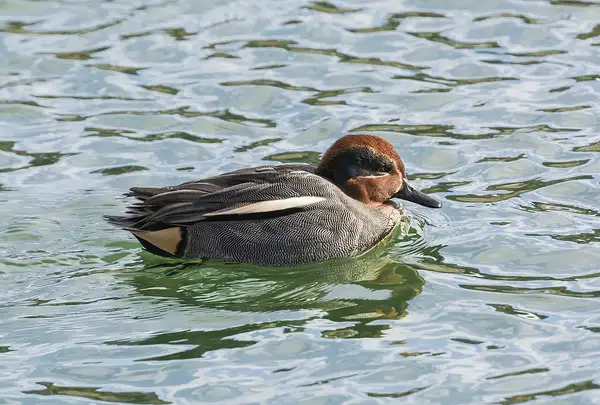
Male Garganey swimming in profile, with brown head and a broad white eyebrow, grey flanks and the reflection in the blue waterPhoto: Ferran Pestaña from Barcelona, España, CC BY-SA 2.0Photo 1 of 4
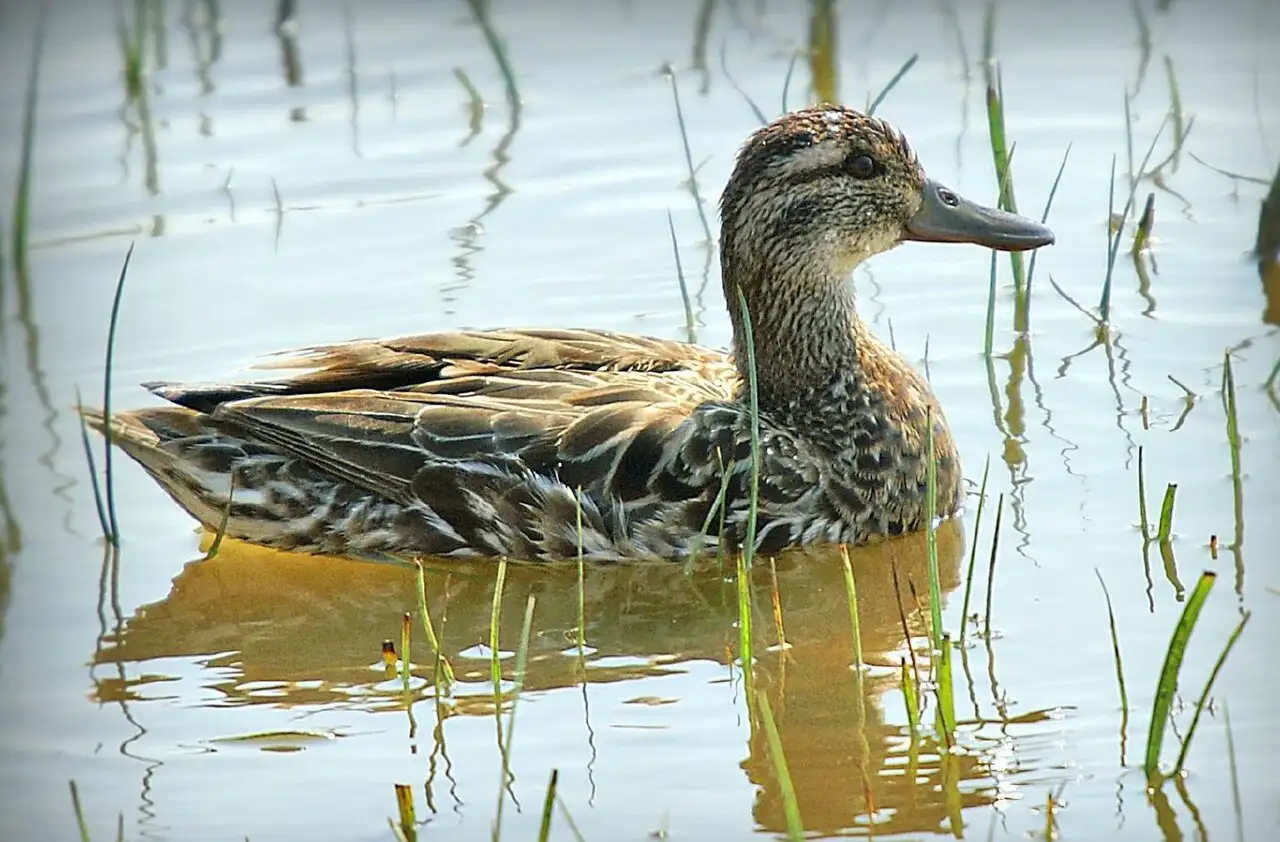
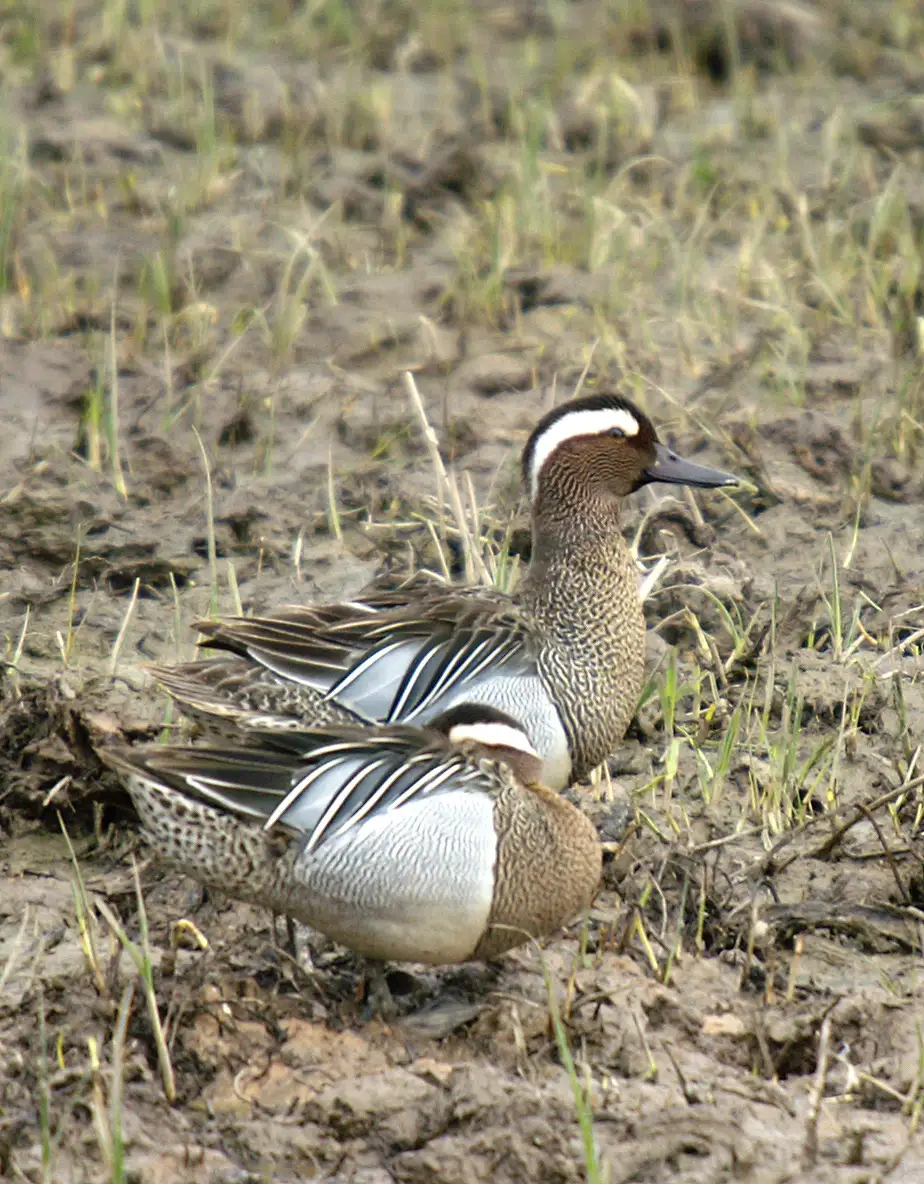
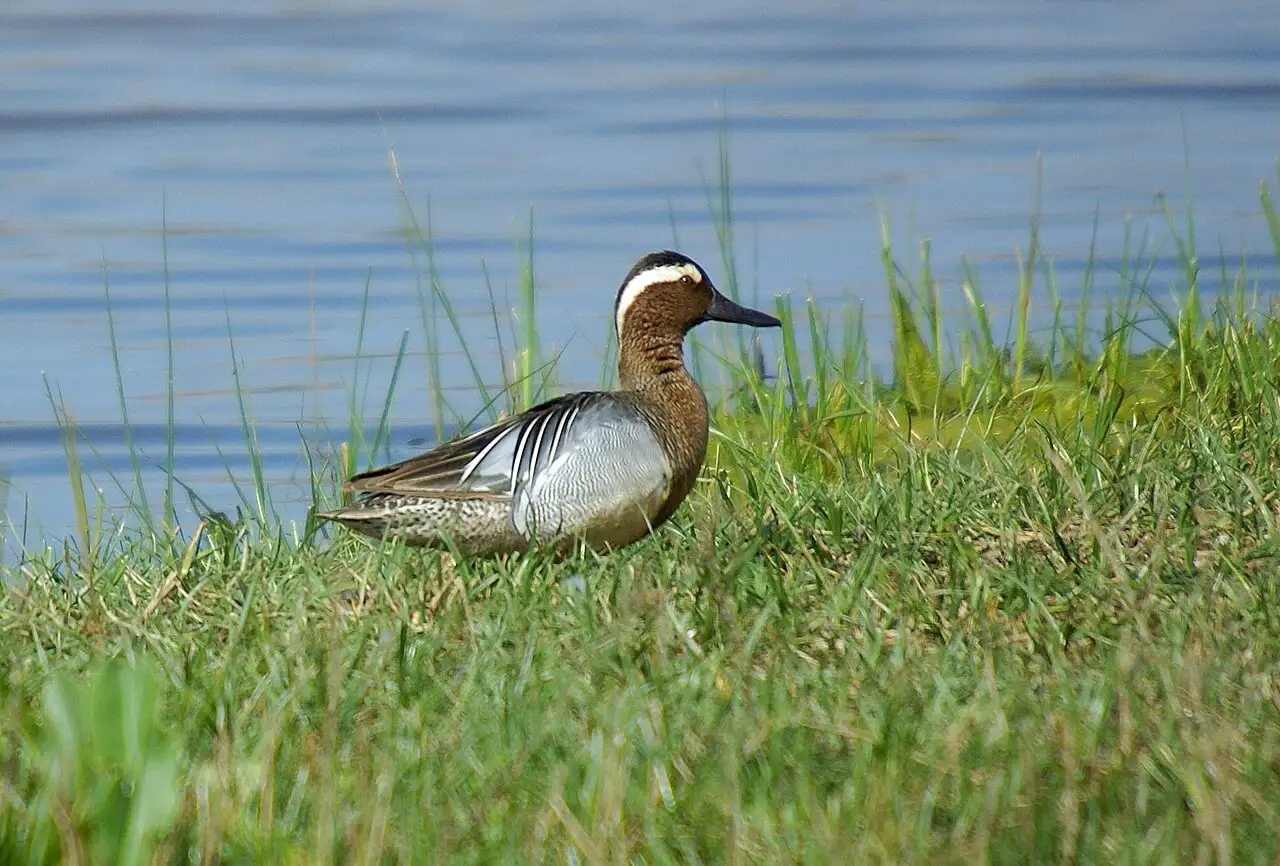
The Garganey, which in many regions of Spain is known as the summer teal, is a small dabbling duck with marked sexual dimorphism. The adult male has a mottled rump and ash-grey flanks, with a vertical white bar separating them from the breast. The head and breast are brown, with minimal streaking, and the back has a greyish tone, with long scapular feathers that hang to the sides. On the head a broad, long white eye-stripe, like an eyebrow, stands out. The adult female is entirely mottled brown, with a pearl-grey, fairly long bill; on her head pale areas are traced on the throat and the corner of the bill and a discreet dark eye-stripe. Young birds are very like females, but with a darker belly and a narrower pale terminal edge on the secondaries.
Adult male
Head and breast brown with a broad white eyebrow; ash-grey flanks separated from the breast by a vertical white bar.
Long scapulars hanging to the sides; mottled rump.
Female and young bird
Female: entirely mottled brown, with a fairly long pearl-grey bill and a discreet dark eye-stripe.
Young bird: similar to the female, with a darker belly and a narrower pale edge on the secondaries.
Habitat and distribution of the Garganey
It is distributed across the Palaearctic eastwards to the Pacific. It occupies southern Siberia and northern and central Asia; the extremes of the range fluctuate considerably and there are also scattered breeding areas. It has no subspecies.
In Spain it breeds sparsely but regularly in the Guadalquivir marshes, the wetlands of Castilla-La Mancha and the Ebro delta, and seems to have stopped breeding in the Aiguamolls de l’Empordà1. As a winter visitor, it is considered a rare water bird of scarce distribution in the country.
It occupies wetlands, preferably freshwater and shallow. It needs abundant emergent, even floating, vegetation as shelter and food, but avoids areas of high plant cover. During wintering in Spain it has been seen in large brackish coastal salt pans.
It is a species that passes through Spain between February and mid-April, with the bulk of the migration in March. The return to the wintering areas takes place between late July and early October, with peaks in September, and the flow occurs mainly along the Mediterranean coasts, coming from central and eastern Europe. It winters in freshwater wetlands of tropical Africa and, sparsely, in southern Europe, Spain included.
Areas where it is regularly recorded since 2010Squares of about 25 km where it is recorded regularly (occasional passage records are left out). Data from GBIF.org (16,353 records, retrieved October 2026); outline from Natural Earth.
Etymology of the Garganey
It is also known as «cerceta de verano» (summer teal); in other languages it is «xarrasclet» in Catalan, «cerceta do estío» in Galician, «udako zertzeta» in Basque and «garganey» in English1. AnAge and other databases list it as «Anas querquedula», the same taxon. We have not found a source explaining the origin of the register’s name, «cerceta carretona», or of the scientific name, so we do not venture one.
Population of the Garganey
The 2021 European Red List of Birds puts the European population at between 680,000 and 920,000 individuals, with a decreasing trend. In Spain the breeding population is in a critical situation: in the last census (2007) the calculated nesting population was only 5 to 8 pairs, when in the 1990s between 100 and 130 were estimated, with important variation from year to year (Third Atlas of Breeding Birds in Spain)1. Today it can be considered residual.
The main threat is the degradation and drying out of breeding, migration-passage and wintering wetlands; it is a species very sensitive to prolonged periods of drought and, therefore, to climate change. Also cited are disturbance from crayfish fishers, hunting (above all when it was allowed in March), lead poisoning and botulism. To stem its decline it is proposed to regenerate suitable habitats with floodable meadows, purification ponds and green filters, prevent illegal entries into reserve areas in the breeding season, limit huntable species, ban lead shot, monitor botulism and reduce pesticides in rice fields1.
Nest of the Garganey
The nest is set among riverside vegetation or in a soft hollow on dry ground or in crops, but always near wetlands. The female builds it.
Courtship and breeding of the Garganey
The Garganey can delay the start of the breeding season considerably depending on the water conditions of the habitat, and may even not breed if these are unfavourable. The female lays 6 to 14 eggs, normally 8 or 9, straw-coloured or glossy brown, and incubates them for 21–23 days. The chicks are nidifugous and feed themselves, but the female cares for them during the first days; the plumage develops in about 35–40 days and they fly shortly afterwards. Oiseaux.net places breeding in May in its European context; it is not a calendar for Cabañeros.
Diet of the Garganey
It gets its food by filtering water with its bill. Its diet, mainly of animal origin, is made up of aquatic invertebrates, amphibian larvae and small fish, although it also takes plant matter: seeds, roots, tubers, green parts of rushes, grasses and aquatic plants.
Curious facts about the Garganey
The Garganey is gaining ground in the north and losing it in the southern countries of its range, Spain among them1. The longevity given by EURING, 23 years and 2 months in a bird shot in the Netherlands, is high for such a small duck; AnAge, which lists it as «Anas querquedula», gives 14.7 years in the wild.
The Garganey in Cabañeros
The habitat pages of this website do not mention it, and we have not found any other published source on it in the Park; nor does it appear in the bird list of the «Visitor guide to Cabañeros National Park» (OAPN). GBIF.org records 4 observations of the Garganey in Cabañeros and its surroundings, which fits a species that only passes through the wetlands of the Peninsula. The wetlands of Castilla-La Mancha are cited among its breeding areas1. None of those observations falls within the Park boundary (according to OpenStreetMap): all are from the surroundings.
Where to see the Garganey in Cabañeros
In Cabañeros and its surroundings, occasionally, during migration passage, in shallow ponds and reservoirs.
When
In Spain on passage: from February to April, with the bulk in March, and from late July to October, peaking in September.
What time
By day, filtering the water with its bill in shallow, vegetated water.
Where
In freshwater, shallow wetlands with emergent or floating vegetation.
What to look for
Look for the male's broad white eyebrow; listen for his dry rattling in the breeding season.




 Same family
 Same family
 Same family
 Same family
 Same season in the park
 Same season in the park
 Same season in the park
 Same season in the park






