Wingspan compared with a person with arms outstretched.
Length
75–105 cm
Wingspan
1.9–2.6 m
Weight
3.1–18 kg
Social life
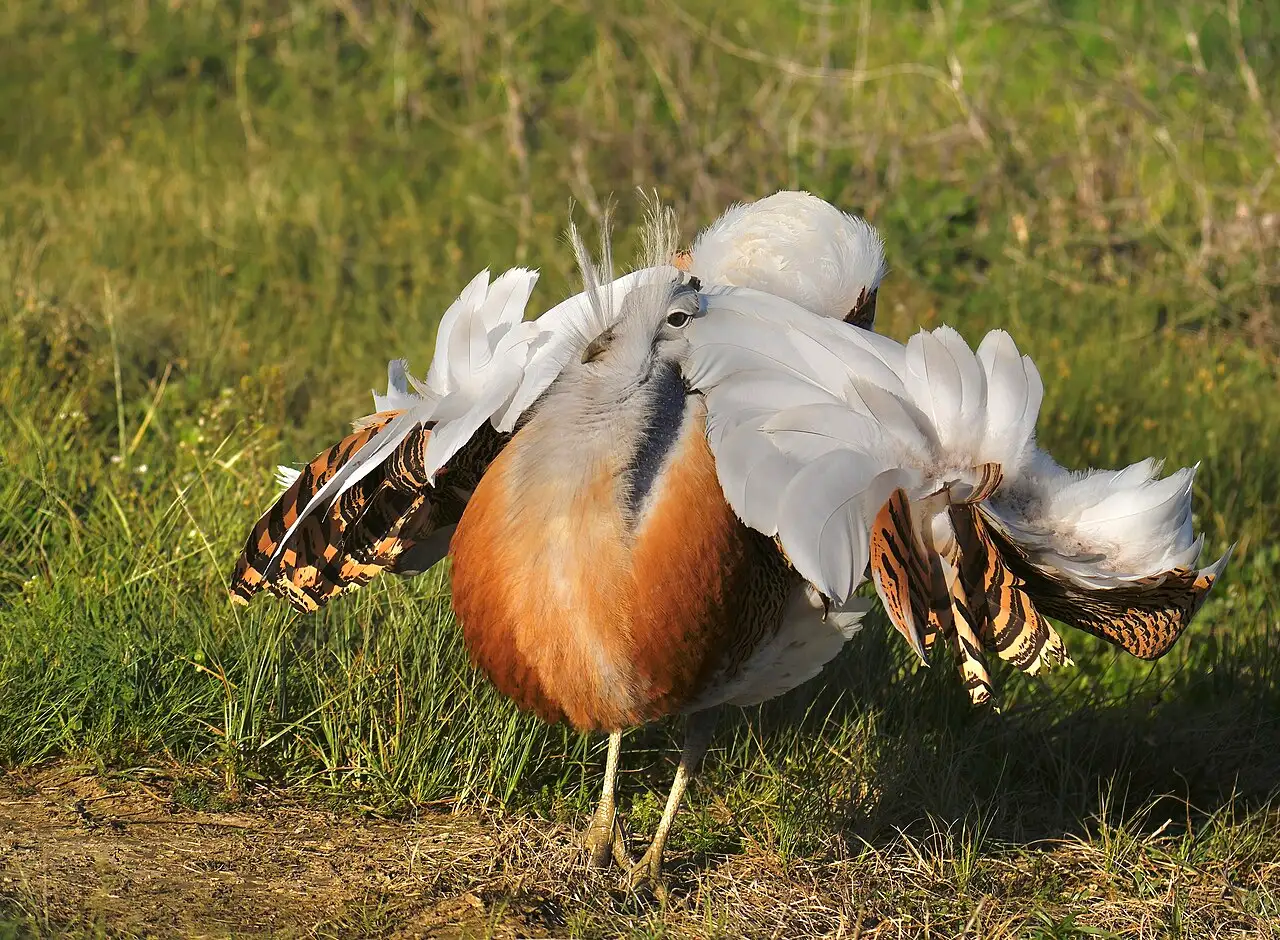
Males gather in an aggregated lek, a specific area used year after year for the courtship displays, the «ruedas»
Lifespan
Record of 13 years and 8 months in the wild according to EURING (a bird ringed in Germany); AnAge gives 28.3 years in captivity
Conservation status
LC
NT
VU
EN
CR
EW
EX
Global (IUCN)
Endangered
Spain
Near Threatened (NT) in the 2021 Red Book of the Birds of Spain; on the List of Wild Species under Special Protection, but not in the Spanish Catalogue of Threatened Species
When to see it
Resident
Months of the year when it is present
J
F
M
A
M
J
J
A
S
O
N
D
In Iberia
yes
yes
yes
yes
yes
yes
yes
yes
yes
yes
yes
yes
Song or voice of the Great Bustard
The species is always extremely silent, although males may give some vocalisations during courtship. The recording is from the AviCanto YouTube channel and captures some of those sounds; we do not know where it was recorded. The xeno-canto recordings of this species have non-commercial licences, and the only one on Wikimedia Commons looked like a loop.
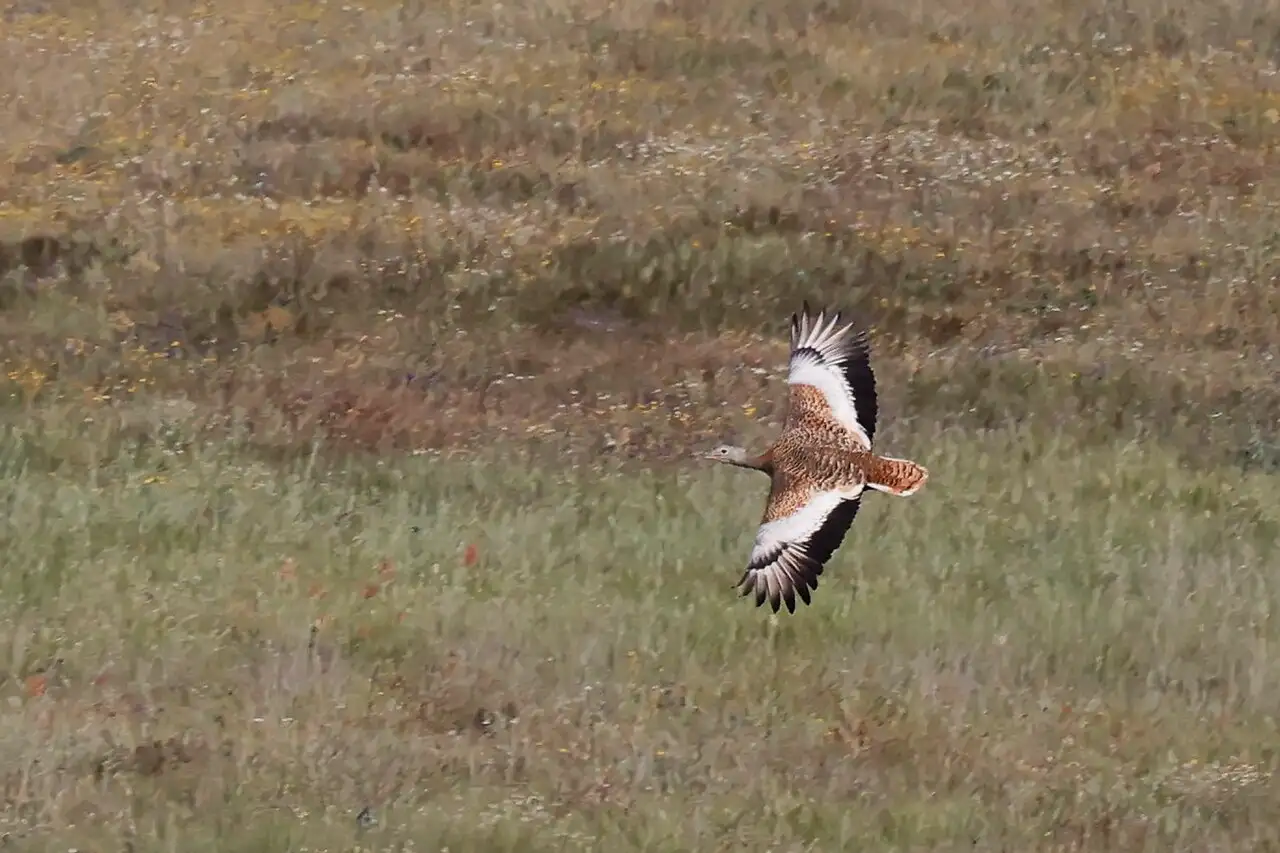
In flight an extensive white band formed by the median and greater coverts stands out, contrasting sharply with the black flight feathers.
Flight typeHeavy, at the edge of being able to fly; in flight a white band on the wings stands out
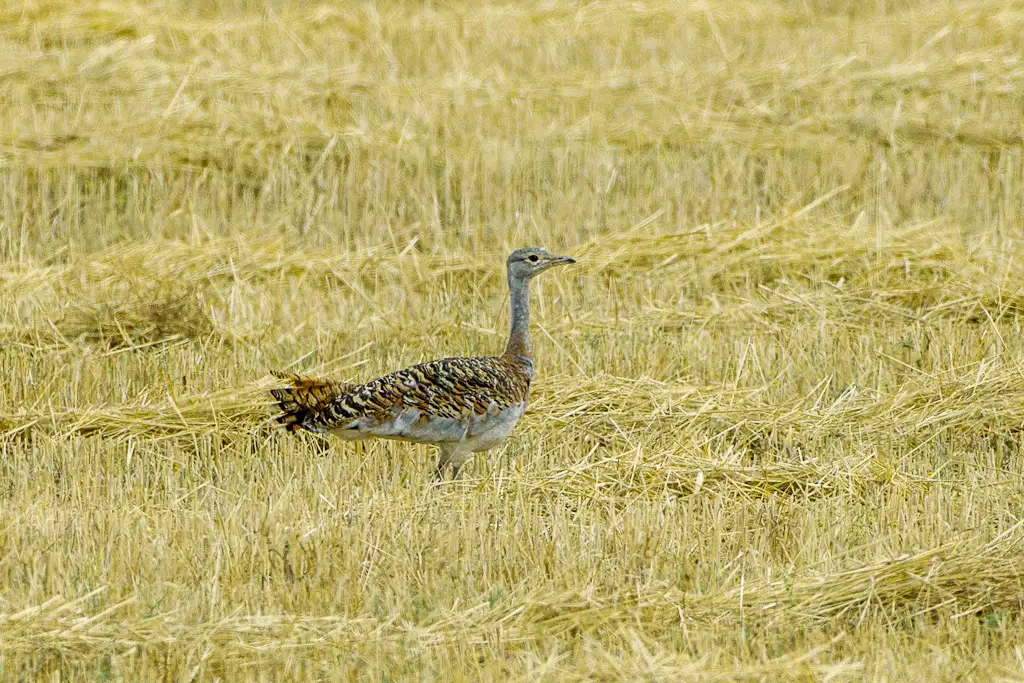
It usually moves on foot through the open areas it frequents: cereal plains with fallows, wasteland, legumes and grassland.
It is one of the heaviest flying birds known; the male, which can approach 18 kilograms, is right on the edge of the ability to fly.
In flight a broad white band on the coverts stands out, in vivid contrast with the black flight feathers.
Photo gallery of the Great Bustard
Male Great Bustard in full courtship display, with the white feathers of the back and wings turned outwards and the orange breast puffed upPhoto: Luiz Lapa from Oeiras, Portugal, CC BY 2.0Photo 1 of 4
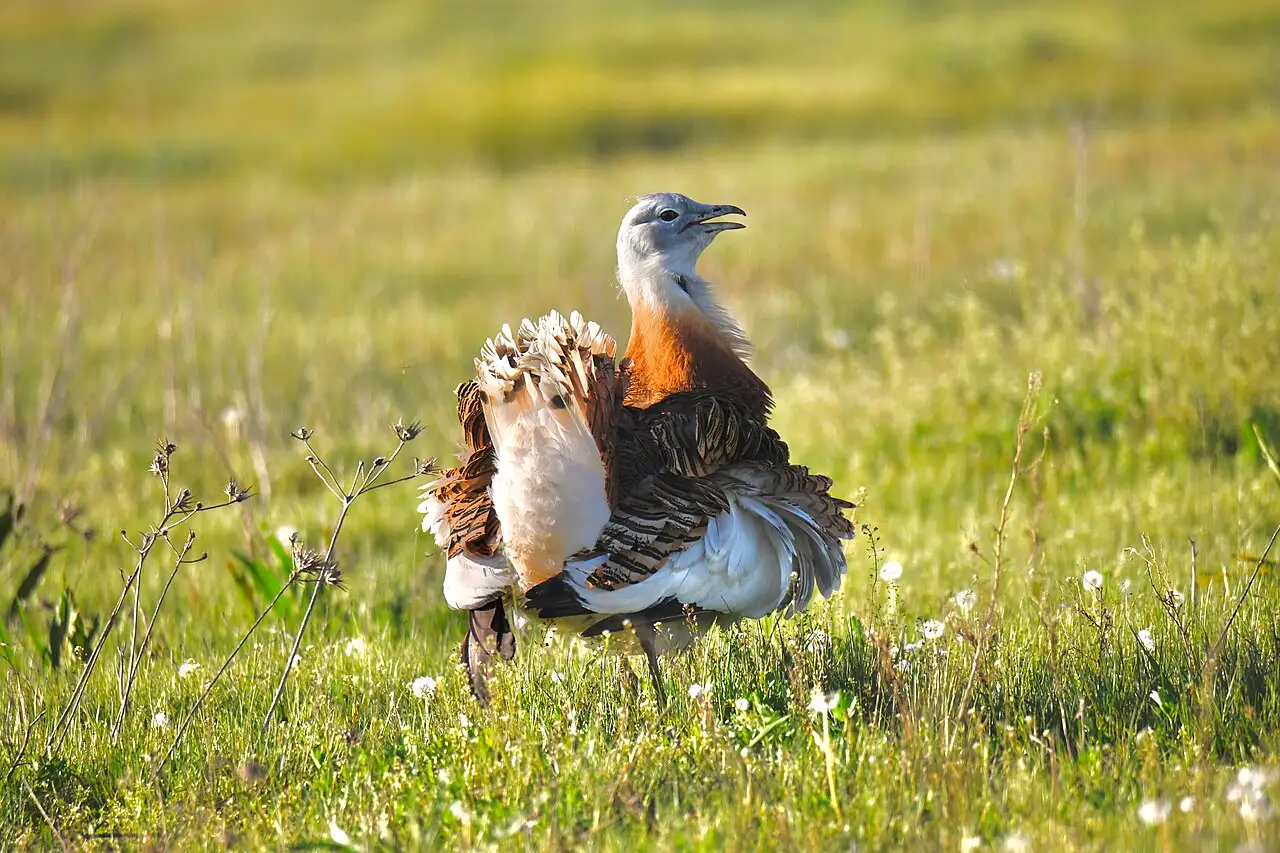
Male Great Bustard in breeding condition, with thickened, reddish neck, the whiskers beside the bill and the white plumage of the back raisedPhoto: Luiz Lapa from Oeiras, Portugal, CC BY 2.0Photo 2 of 4
Great Bustard walking over a cereal stubble in Extremadura, with grey head, heavily barred brown back and white bellyPhoto: Francesco Veronesi from Italy, CC BY-SA 2.0Photo 3 of 4
The Great Bustard is an unmistakable bird, of enormous size, very bulky and heavy, which usually moves by walking across the open areas it frequents. The male, much bigger than the female, can reach a weight close to 18 kilograms, right at the edge of being able to fly. In the plumage of both sexes, fairly similar, brown tones predominate, slightly reddish and golden on the back, with profuse transverse barring. The head and neck are grey, and become brownish or reddish near the body; below the plumage is white. The wings have the same pattern as the back, but an extensive white band formed by the median and greater coverts is very conspicuous, contrasting sharply with the black flight feathers. Females differ from males, besides in size, in having somewhat duller plumage and in the sexual characters that males acquire in the breeding period: long, pointed, stiff, erectile feathers rising from the lower jaw, which is why they are called «barbones» (bearded ones), and an evident thickening of the neck, which also takes on a showy deep reddish colour.
Male
Much bigger than the female; it can reach almost 18 kilograms.
In the breeding season, whiskers of stiff feathers and a thickened, reddish neck.
Female
Smaller and with somewhat duller plumage.
Young bird
The immature male looks like the female, but has the sides of the neck partly tinged reddish brown.
Habitat and distribution of the Great Bustard
It appears very discontinuously across different regions of the Palaearctic, from northern Morocco to north-east Asia. Two subspecies are recognised, and in Spain «tarda» lives, which in the middle of the last century occupied extensive areas in almost all regions of the Peninsula. Today its populations are much more fragmented, although it is still widely distributed across the two plateaus and Extremadura, with smaller cores in Andalusia, Aragón and Navarre; in southern Valencia and northern Murcia it is very scarce and localised.
It is a bird tied to extensive grassy plains. In our territory, because of the extreme scarcity of this type of site, it occupies mainly flat or slightly rolling land, without trees and usually given over to dryland cereal growing, in which scattered plots of fallow, wasteland, legumes and pasture alternate. In summer it chooses sunflower crops and even areas of scattered trees, such as small olive groves, almond groves or open dehesas.
Although the Spanish population is mostly resident, part of its numbers make movements of some size, apparently related to age and sex. Females are the most mobile, and males move from the breeding areas to the summering ones and from there to the wintering ones. Even so, they show extreme fidelity to their breeding sites and post-breeding gathering places, which suggests a very low colonisation capacity.
Areas where it is regularly recorded since 2010Squares of about 25 km where it is recorded regularly (occasional passage records are left out). Data from GBIF.org (20,432 records, retrieved October 2026); outline from Natural Earth.
Etymology of the Great Bustard
According to Wikipedia, the genus «Otis» was introduced by Linnaeus in 1758 from the Greek name «ōtís», which Pliny the Elder uses in his «Natural History» for a similar bird. The epithet «tarda» is Latin and means «slow» and «deliberate», an adjective that describes its way of walking. From the Latin phrase «avis tarda», «slow bird», comes the English word «bustard», through Old French «bistarda». In other languages it is called «pioc salvatge eurasiàtic» in Catalan, «avetarda grande» in Galician, «basoilo handia» in Basque and «great bustard» in English1.
Population of the Great Bustard
The 2021 European Red List of Birds puts the European population of Great Bustards at about 38,000 individuals, and the Third Atlas of Breeding Birds in Spain puts the Spanish one at between 24,000 and 26,000 birds, about 50 % of the world total.
It is very sensitive to habitat alteration, which usually causes local extinctions, generally irreversible. Hunting was very severe from the middle of the last century until the 1980s and caused the disappearance of many cores and the fragmentation of populations. Today the main problem is habitat loss through agricultural intensification, landscape simplification and the proliferation of infrastructure and housing developments, which remove breeding sites and reduce the food available and productivity.
Nest of the Great Bustard
Females prepare a shallow nest, little more than a slight hollow lined with a few stems, sheltered in grassland or in a cereal or vineyard crop.
Courtship and breeding of the Great Bustard
Its mating system is the so-called aggregated lek: all the breeding males of a wide area gather in a specific spot, used year after year for the spectacular courtship displays, the «ruedas» (wheels). After mating, the males take no interest in their offspring, and all the burden of incubation and rearing falls on the females, who lay two or three bluish, greenish, grey or brown eggs and incubate them for 21–28 days. The chicks, with camouflaged down, move around a lot as soon as they hatch and travel with their mother in search of food. The young develop in about 30–35 days, but dependence on the mother lasts from six months to more than a year. Breeding success is low, because of adverse weather or predation, and females reach sexual maturity at three or four years and males at five or six.
Diet of the Great Bustard
Its diet is based on plants and invertebrates, in proportions that vary with the season. In spring and summer it takes great quantities of grasshoppers, crickets and other invertebrates, which it supplements with shoots and seeds; in winter legumes and other plant foods become very important. Occasionally it catches a small vertebrate, such as rodents and lizards.
Curious facts about the Great Bustard
It is the bulkiest of the species of the Iberian birdlife and one of the heaviest flying birds known, and recalls that Spain holds half of the world population1. Wikipedia records that a male weighed 19 kilograms in a study done in Spain and that the largest verified specimen, from Manchuria, was around 21.
The Great Bustard in Cabañeros
On this website’s habitat pages, in the grasslands section, it is said that Cabañeros has the only stable population of Great Bustard in the Montes de Toledo, which lives alongside other steppe species, such as the Little Bustard (Tetrax tetrax) and the Eurasian Stone-curlew (Burhinus oedicnemus). GBIF.org records 16 observations of the Great Bustard in Cabañeros and its surroundings.
Where to see the Great Bustard in Cabañeros
In Cabañeros, through the year, in the grasslands and open rañas, where the only stable population of the Montes de Toledo lives.
When
All year; it is mostly resident, and the males' courtship wheels are the showiest sight.
What time
By day; males gather in a specific spot to perform the wheel.
Where
On open, treeless plains, with dryland cereal, fallows, wasteland and grassland; in Cabañeros, the grasslands.
What to look for
Look for its enormous size and, in flight, the white band of the wings; it is extremely silent.



 Same family
 Same season in the park
 Same season in the park
 Same season in the park
 Same season in the park
 Same season in the park
 Same season in the park
 Same season in the park






