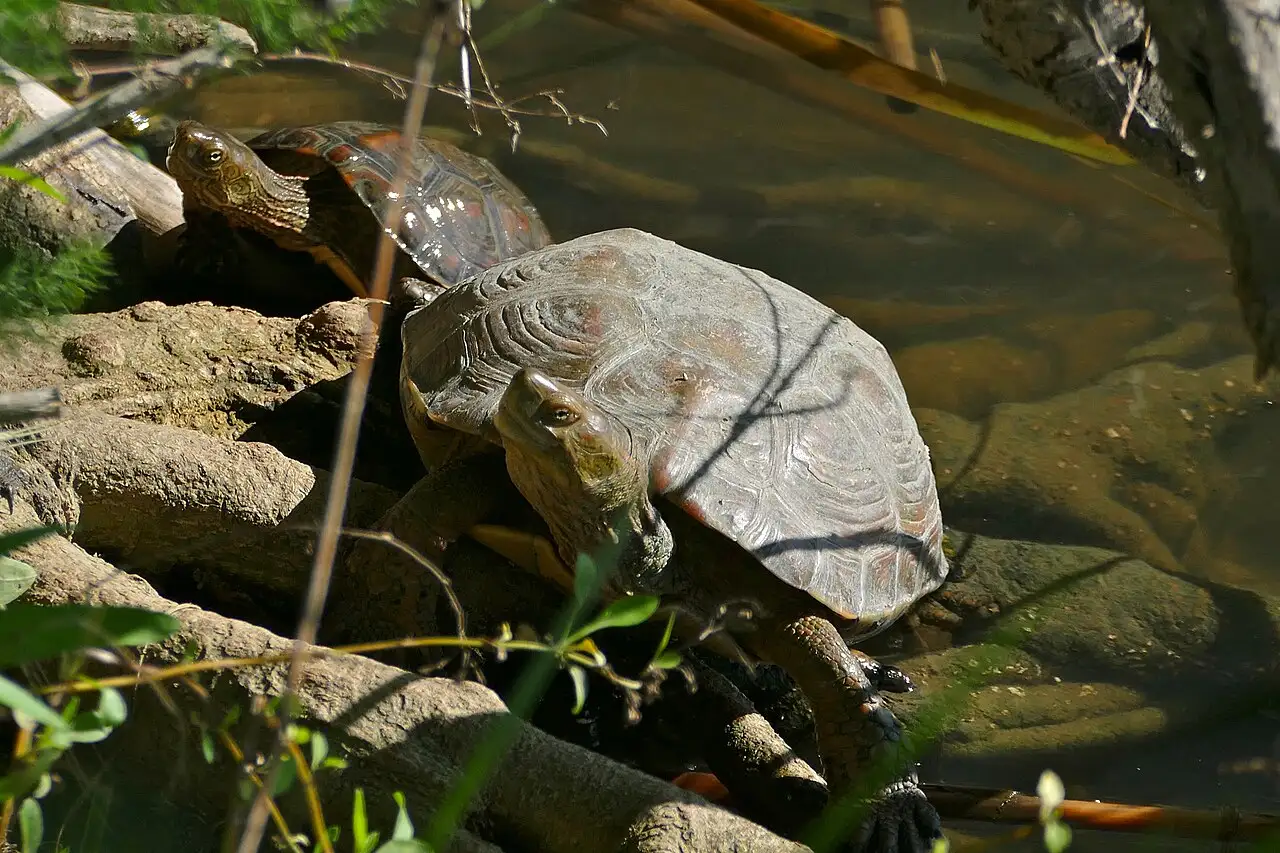
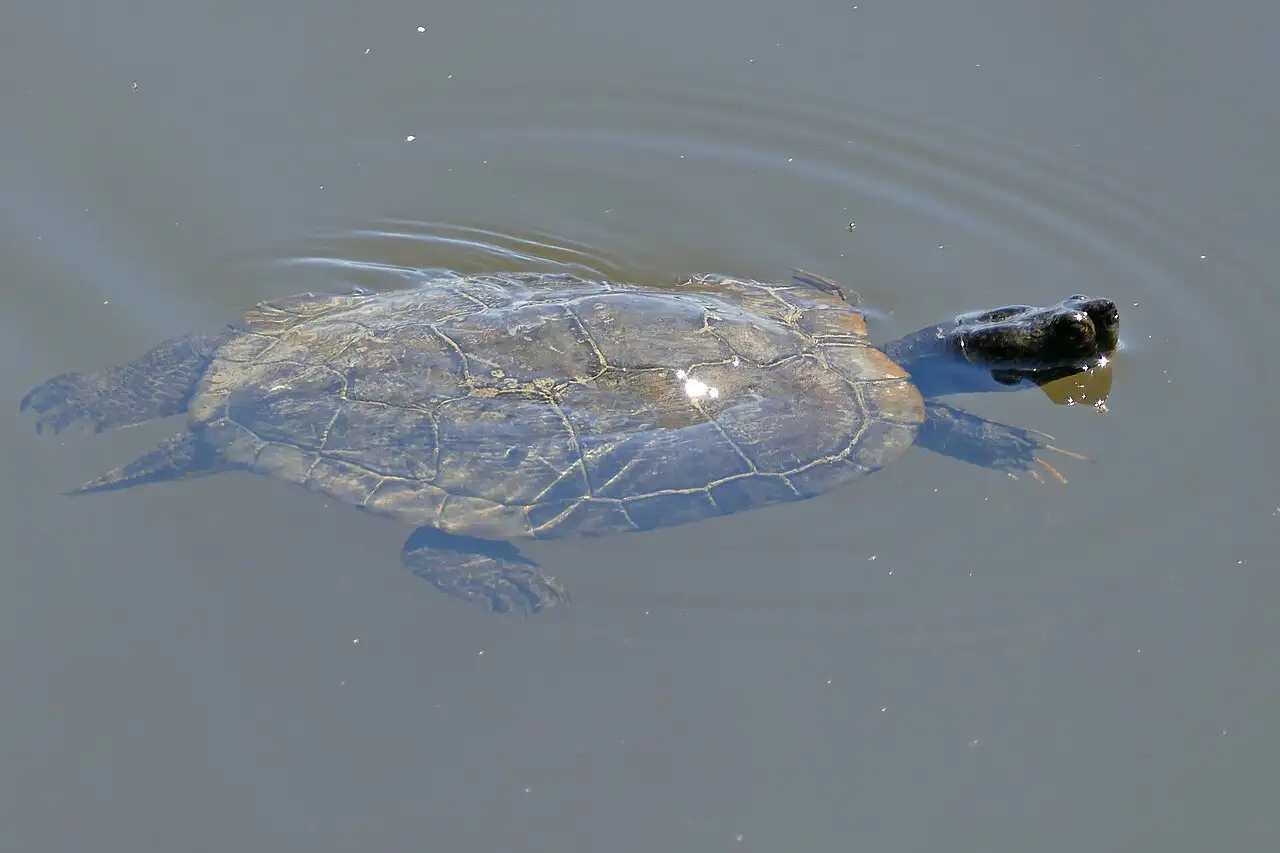
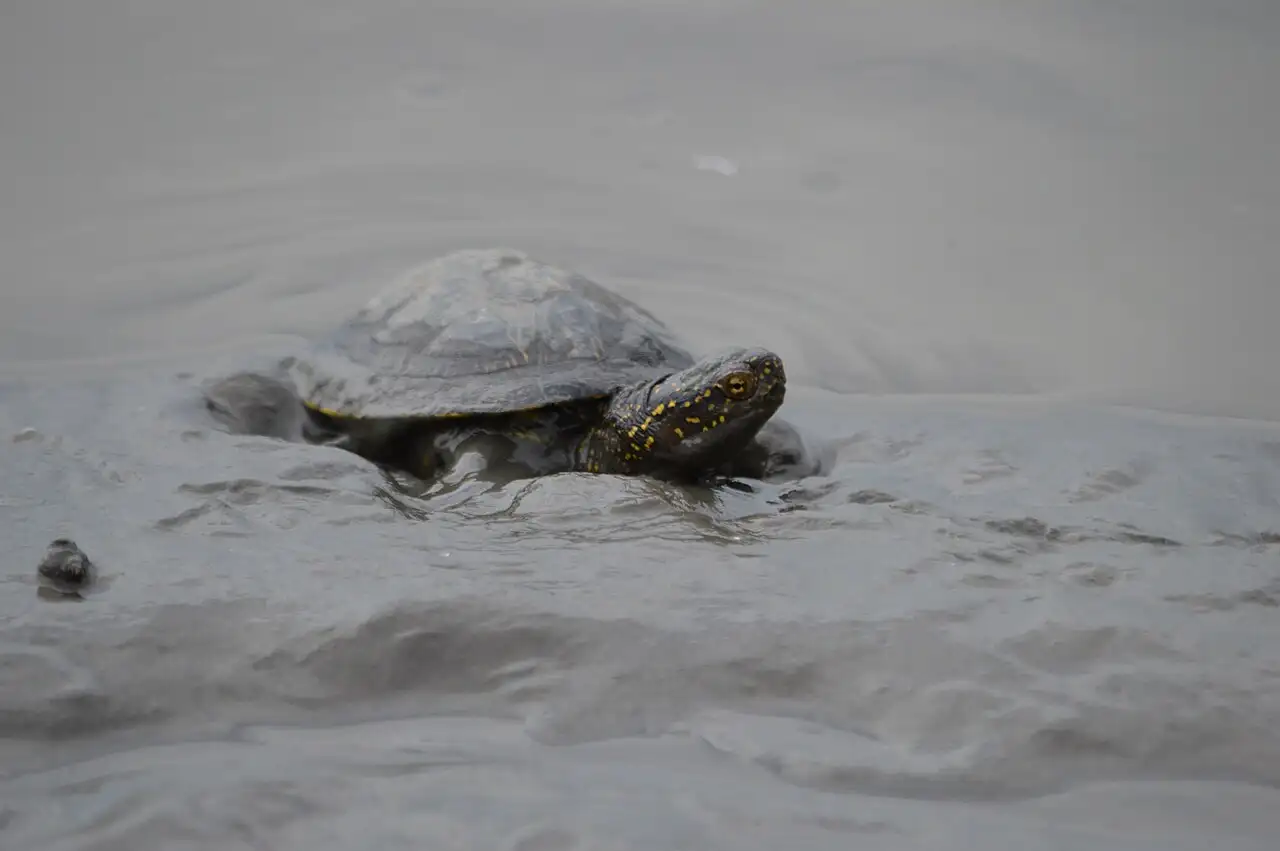
Its shell measures between 10 and 18 centimetres in most adults, and some exceed 20. It is told apart from the European Pond Turtle by the flatter shell and the pale stripes on the neck, against the yellow dots of the latter.
Habitat and distribution of the Spanish Pond Turtle
Rivers, streams, ponds and reservoirs, including seasonal ones. It tolerates less clean water than the European Pond Turtle.
Areas where it is regularly recorded since 2010Squares of about 25 km where it is recorded regularly (occasional records are left out). Data from GBIF.org (8,538 records, retrieved October 2026); outline from Natural Earth.
Breeding of the Spanish Pond Turtle
Females carry eggs from April to July and can lay twice, between May and July, four to ten eggs each time. Incubation lasts 50 to 82 days in the wild. In Europe it is listed as vulnerable.
Diet of the Spanish Pond Turtle
Adults are mainly herbivorous, but also eat aquatic invertebrates and carrion.
The Spanish Pond Turtle in Cabañeros
The park guide gives it as the commonest turtle, both in the rivers and ponds of the raña and in those of the mountains, always avoiding the highest parts. According to the website, it occupies the medium and large pools with little current in the lower stretches, while the European Pond Turtle prefers the small pools of the upper courses.
It lives in the pools of the Boquerón del Estena, in the reservoir of the Brezoso stream and in the ponds of the raña.
Where to see the Spanish Pond Turtle in Cabañeros
When
From February to October, above all in spring.
What time
In the hours of sun, when it comes out to warm up.
Where
The pools of the Boquerón del Estena and the reservoir of the Brezoso stream, according to the park website.
What to look for
Stones and logs at the water's edge with several turtles in the sun; they dive in if you come close.
Díaz-Paniagua, C., Andreu, A. C. y Keller, C. (2015). Galápago leproso – Mauremys leprosa. En: Salvador, A. y Marco, A. (eds.), Enciclopedia Virtual de los Vertebrados Españoles. Museo Nacional de Ciencias Naturales (CSIC). vertebradosibericos.org
OAPN (2011). Guía de visita del Parque Nacional de Cabañeros. PDF
Real Decreto 139/2011, Listado de Especies Silvestres en Régimen de Protección Especial y Catálogo Español de Especies Amenazadas. BOE