Wingspan compared with a person with arms outstretched.
Length
55–65 cm
Wingspan
1.48–1.71 m
Weight
1.9 kg
Social life
Not prone to gatherings, although before migrating it meets at communal roosts near vulture restaurants, farms or rubbish tips
Lifespan
Record of 28 years and 11 months in the wild according to EURING (a bird ringed in Spain); in captivity, AnAge gives up to 37 years
Conservation status
LC
NT
VU
EN
CR
EW
EX
Global (IUCN)
Endangered
Spain
Vulnerable (VU) in the 2021 Red Book of the Birds of Spain and in the Spanish Catalogue of Threatened Species; the Canary subspecies, Endangered (EN)
When to see it
Summer visitor
Months of the year when it is present
J
F
M
A
M
J
J
A
S
O
N
D
In Iberia
yes
yes
yes
yes
yes
yes
yes
yes
yes
yes
yes
yes
Song or voice of the Egyptian Vulture
It is a silent species, and the little it is heard, as in this recording, is brief calls. On xeno-canto there is no recording of it with a free licence.
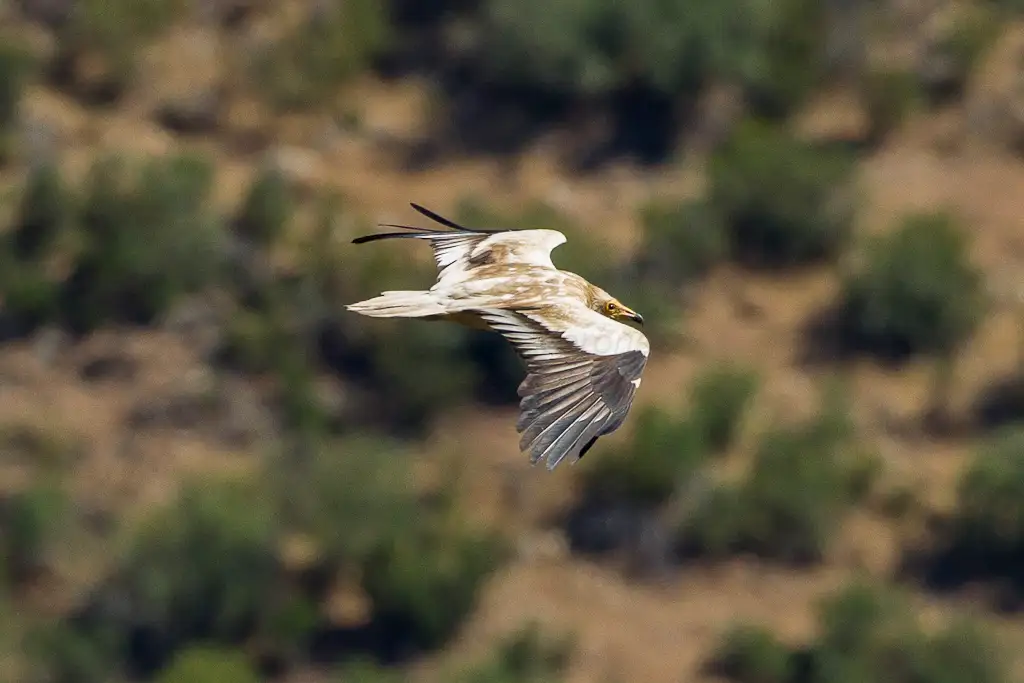
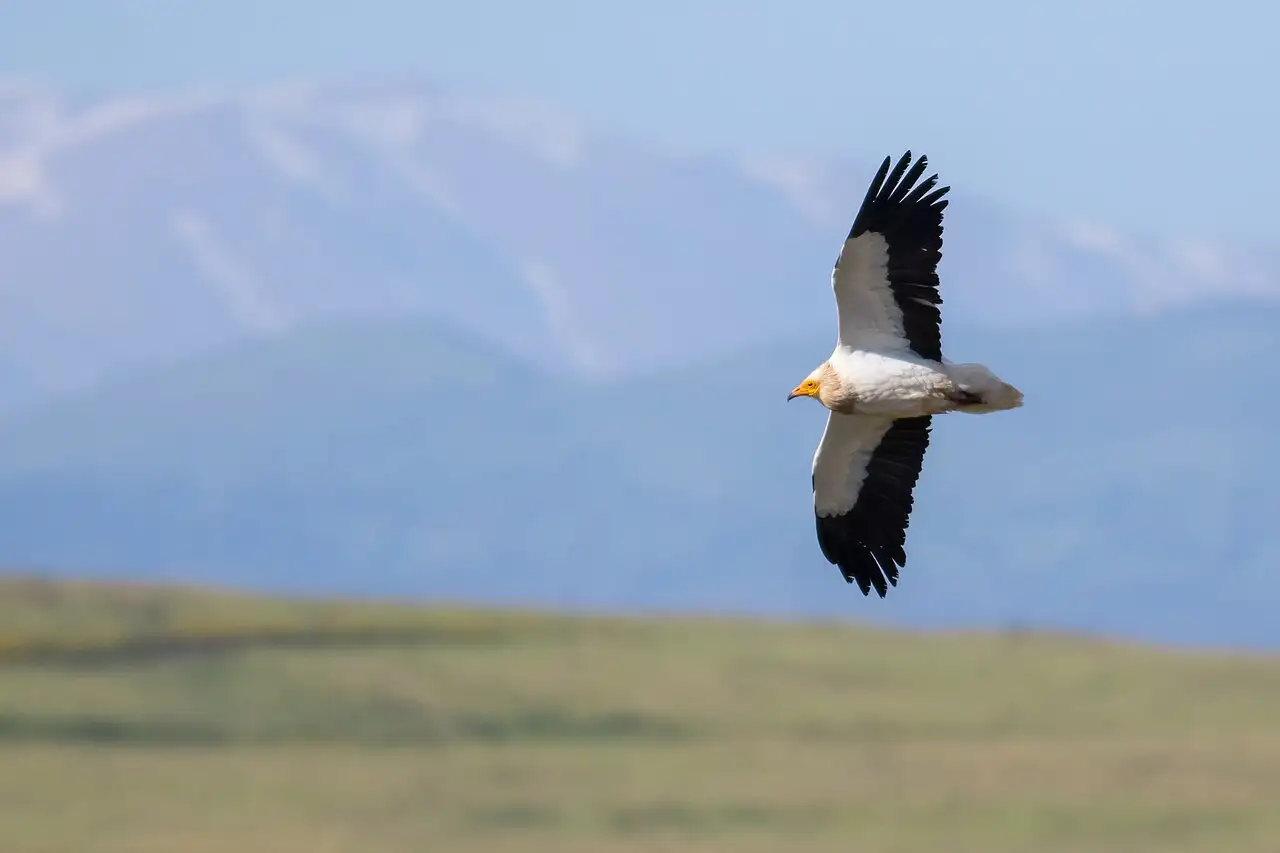
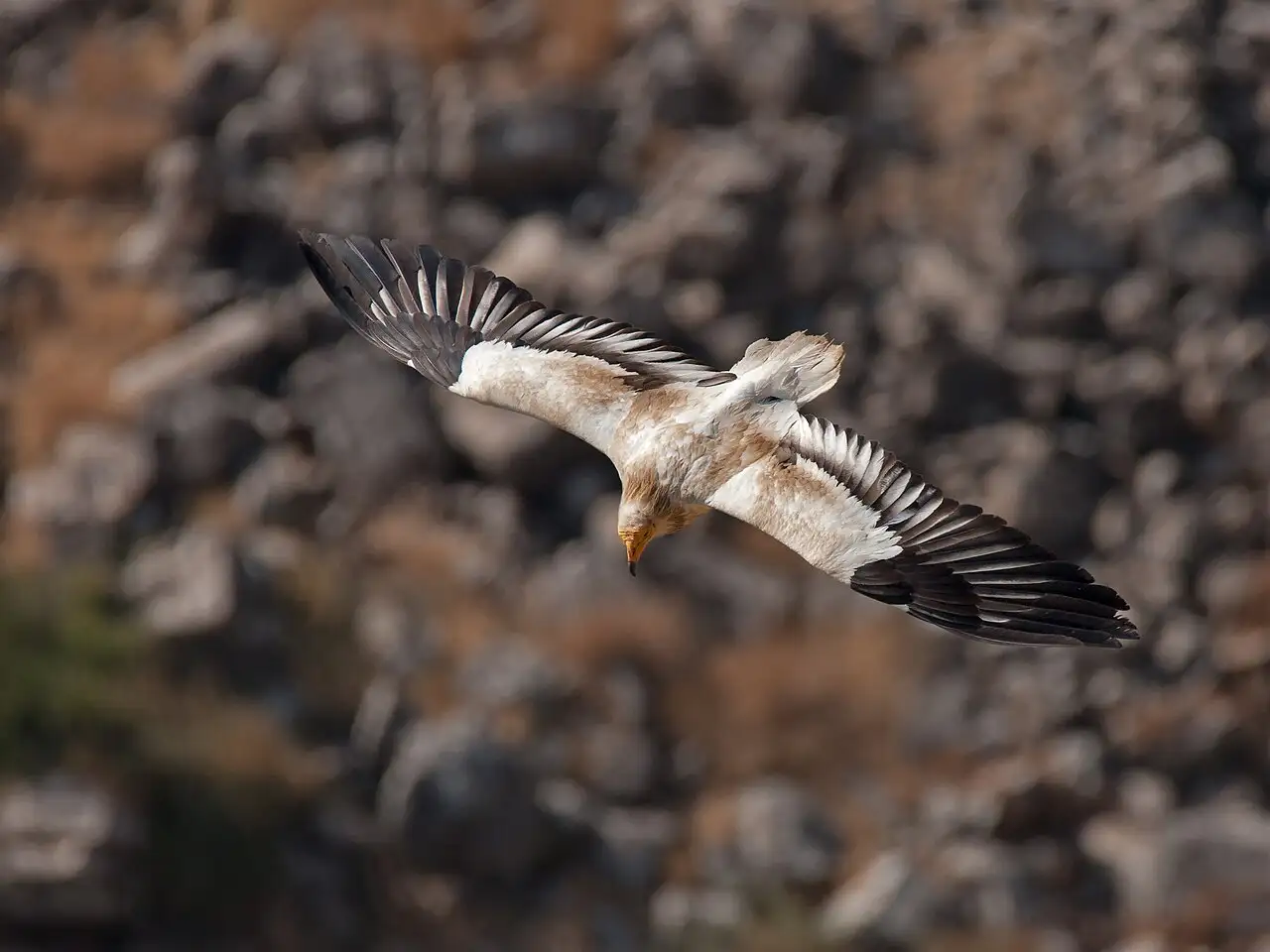
In flight the adult looks very white, and its silhouette is marked by long, narrow wings and a long wedge-shaped tail, which give it great manoeuvrability. The young bird has the same silhouette, but is very dark.
Flight typeGlider, with long, narrow wings and a wedge-shaped tail
It needs a cliff or rocky escarpment, sometimes a very modest one, to breed, near open country with extensive livestock farming, grassland, dehesas and sparse scrub.
In flight the adult looks very white, with long, narrow wings and a long, wedge-shaped tail, which give it great manoeuvrability.
It is usually the first to discover carcasses, but with its thin bill it has to wait for the vultures to tear them apart.
Photo gallery of the Egyptian Vulture
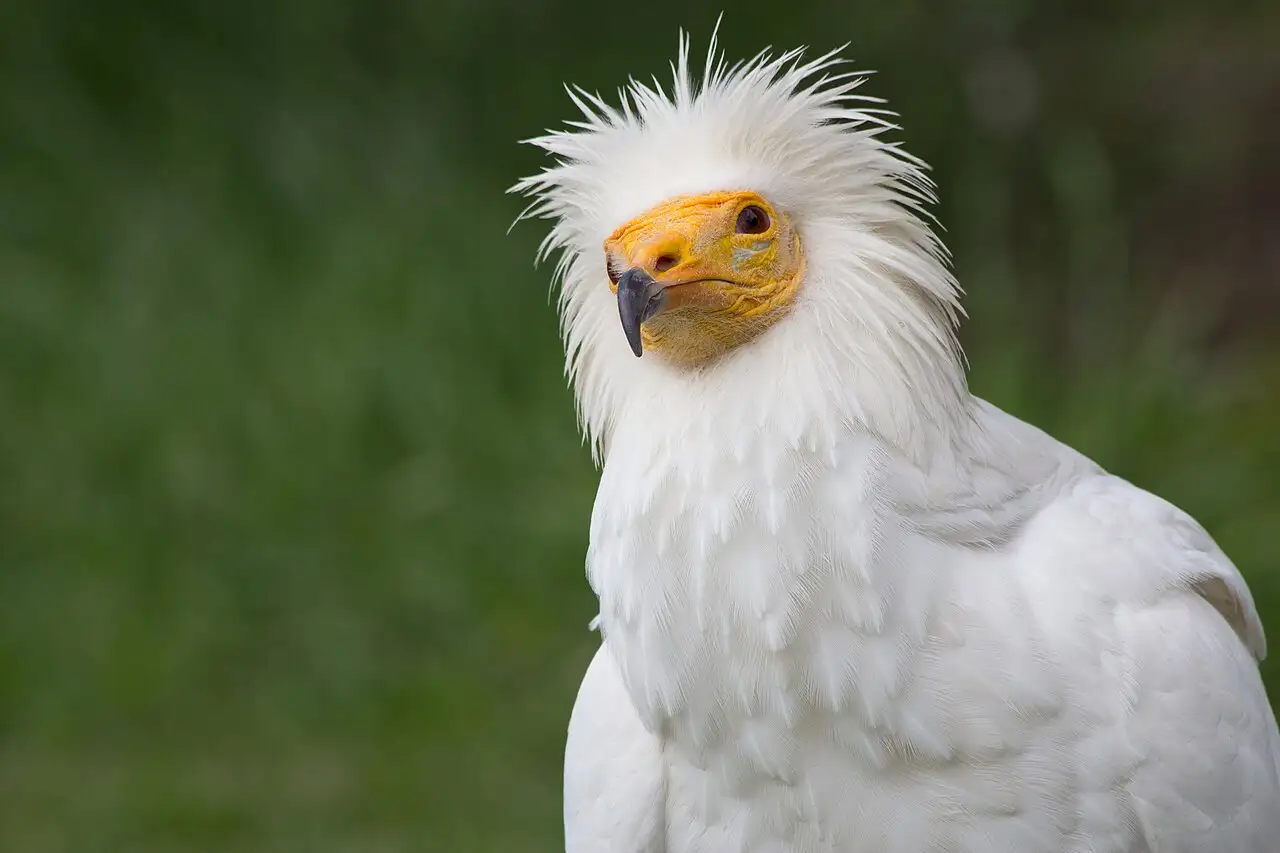
Portrait of an adult Egyptian Vulture, with bare yellow face, thin dark bill and ruff of frayed white feathersPhoto: Carlos Delgado, CC BY-SA 3.0Photo 1 of 4
Egyptian Vulture in flight over a scrubby slope in Monfragüe, with black-and-white wings and wedge-shaped tailPhoto: Francesco Veronesi from Italy, CC BY-SA 2.0Photo 2 of 4
Egyptian Vulture in flight seen from below, white with black flight feathers, in front of some mountainsPhoto: מינוזיג - MinoZig, CC BY-SA 4.0Photo 3 of 4
Egyptian Vulture gliding over a crag, seen from above, with black-and-white wings openPhoto: Artemy Voikhansky, CC BY-SA 4.0Photo 4 of 4
1 / 4
Identification of the Egyptian Vulture
The Egyptian Vulture is a medium to large bird of unmistakable appearance. Adults wear an almost entirely dirty-white plumage, with some areas tinged cream, except the flight feathers, which are completely black. A striking ruff of frayed, somewhat untidy feathers on the head and neck stands out too, and the face is bare and a striking yellow. It has a thin, relatively long bill, which does not let it tear the hide of large carcasses as the bigger vultures do, but gives it great versatility in choosing its food.
Adult
Dirty white with black flight feathers.
Bare yellow face and ruff of frayed feathers.
Long wedge-shaped tail.
Young bird
Much darker, brown, with a bluish-grey face.
It changes plumage through successive moults until the definitive one, at five years.
Habitat and distribution of the Egyptian Vulture
It lives in southern Europe, the Middle East, central and southern Asia and extensive regions of Africa. In Spain there are two subspecies: «percnopterus», that of Europe, Africa and much of Asia, and «majorensis», endemic to the Canaries.
It is relatively well distributed across the Peninsula, above all in mountain areas and their surroundings and in rugged regions. It has six main cores: the Cantabrian range, the Pyrenees, the Central System, the Iberian System and the Ebro valley; the west of the peninsula (Extremadura, Arribes del Duero and Sierra Morena); the Cazorla and Segura sierras; the Cádiz and Málaga sierras; the Balearics, and the Canaries. It is absent from all of Galicia, most of the Levante, the south-east, the whole southern Meseta and the flatter areas of the northern Meseta and the Guadalquivir valley.
It lives in very varied habitats as long as there is some rocky cliff or scarp, sometimes surprisingly modest, to put the nest on, although it prefers broken areas, with crags, gorges and rocky ridges, near open places with extensive livestock farming, grassland, dehesas and sparse scrub.
On the Peninsula it is mainly a summer visitor; the Balearic and Canary populations are resident, and only a few winter in Doñana and southern Extremadura. Spanish birds spend the winter in sub-Saharan Africa: they cross the Strait between mid-July and mid-October and return between early February and mid-April, with the peak in March.
Areas where it is regularly recorded since 2010Squares of about 25 km where it is recorded regularly (occasional passage records are left out). Data from GBIF.org (32,421 records, retrieved October 2026); outline from Natural Earth.
Etymology of the Egyptian Vulture
According to Wikipedia, the genus name comes from Greek mythology: Neophron, who deceived Aegypius, was turned into a vulture by Zeus. «Percnopterus» means «black wings» in Greek, from «perknos», «blue-black», and «pteron», «wing». In some districts it is called «boñiguero» («dung bird»), because it makes use of livestock droppings, and lists its names in other languages: «aufrany comú» in Catalan, «voitre branco» in Galician, «sai zuria» in Basque and «Egyptian vulture» in English1.
Population of the Egyptian Vulture
The 2021 European Red List of Birds estimates between 6,100 and 9,000 Egyptian Vultures on the whole continent, with a decreasing trend, and the IUCN considers it Endangered worldwide. According to the Third Atlas of Breeding Birds, in 2018 there were between 1,490 and 1,567 pairs in Spain, a few more than in the 2008 census, and in the Canaries, 74 pairs. Even so it is considered to be in decline, because in the 1980s it was more common, and that is why the Red Book classes it as Vulnerable.
Its main threats are illegal poisoned baits, to which it is especially sensitive, and the lack of food from the closure of vulture restaurants and rubbish tips and changes in the management of livestock remains. It is also affected by disturbance in breeding areas, direct persecution, pesticides, drugs it ingests with dead livestock and electrocutions and collisions with power lines and wind turbines.
Nest of the Egyptian Vulture
It sets it on rock, in cracks, cavities, ledges or small caves, and usually uses it year after year. The two members of the pair build an untidy platform of sticks and assorted debris, which they line with wool and other materials.
Courtship and breeding of the Egyptian Vulture
The breeding period begins as soon as they reach their breeding areas, around March or April. The female lays one or two eggs, rarely three, yellowish or reddish with reddish-brown spots, which both sexes incubate for 42 days. It is not unusual for only one chick to survive from double clutches. Both adults tend them, above all the female, and their plumage develops in about 70–90 days, although their parents keep feeding them for a while afterwards.
Diet of the Egyptian Vulture
It looks for its food by combing its territory in detail, and so finds a lot of carrion from small and medium-sized animals. It is usually the first scavenger to discover the carcasses of large ungulates, but has to wait for the Cinereous and Griffon Vultures to tear them up before it can use the remains. Although it is clearly a scavenger, it keeps some ability to hunt and sometimes catches small vertebrates and insects or finishes off wounded or sick animals. It frequently visits rubbish tips, vulture restaurants and dumps with slaughterhouse offal, and makes use of livestock droppings.
Curious facts about the Egyptian Vulture
Some areas of the Peninsula, such as the Ebro valley or La Mancha, temporarily host young Egyptian Vultures arriving from France, although the species’ great fidelity to its birthplace means they do not stay1. EURING lists an Egyptian Vulture ringed in Spain that lived 28 years and 11 months.
The Egyptian Vulture in Cabañeros
The habitat pages of this website do not mention it, and we have not found any other published source on it in the Park. It is absent as a breeder across the whole southern Meseta, although La Mancha temporarily hosts young birds of French origin1. GBIF.org records 25 observations of the Egyptian Vulture in Cabañeros and its surroundings.
Where to see the Egyptian Vulture in Cabañeros
In Cabañeros and its surroundings, in spring and summer, over open areas with livestock and on the crags.
When
In spring and summer: it returns between February and mid-April and leaves between mid-July and mid-October.
What time
By day, gliding in search of carrion.
Where
In open areas with extensive livestock farming, grassland, dehesas and sparse scrub, near cliffs and crags.
What to look for
Look for its white silhouette with black flight feathers and wedge-shaped tail, and the yellow face.
It is not clearly similar1. Like the Egyptian Vulture, the Griffon Vulture is a scavenger of the family Accipitridae, and it is one of those that tear up the carcasses the Egyptian Vulture then makes use of.



 Same family
 Same family
 Same family
 Same family
 Same season in the park
 Same season in the park
 Same season in the park
 Same season in the park





