Wingspan compared with a person with arms outstretched.
Length
45–55 cm
Wingspan
0.97–1.18 m
Weight
290–750 g
Social life
In winter it gathers at night in communal roosts in reedbeds, often with Marsh Harriers; the male is sometimes polygamous
Lifespan
Record of 20 years and 8 months in the wild according to EURING (a bird ringed in the Netherlands); AnAge gives 17.1 years
Conservation status
LC
NT
VU
EN
CR
EW
EX
Global (IUCN)
Least Concern
Spain
Endangered (EN) in the 2021 Red Book of the Birds of Spain; on the List of Wild Species under Special Protection, but not in the Spanish Catalogue of Threatened Species
When to see it
Resident
Months of the year when it is present
J
F
M
A
M
J
J
A
S
O
N
D
In Iberia
yes
yes
yes
yes
yes
yes
yes
yes
yes
yes
yes
yes
Song or voice of the Hen Harrier
During courtship the male gives an explosive «iiiiic aiac aiac». The female’s alarm call is a «ki ki ki ki» similar to that of other harriers. The recording, from France, includes begging and flight calls; we have filtered it to remove background noise.
Begging and flight callsHen Harrier
0:00 / 0:29
10 kHz5
The sonogram draws the sound: time runs from left to right, and the higher a trace sits, the higher the note.Recording by Benoît Van Hecke, xeno-canto XC558933 (Vienne, Francia) (CC BY-SA 4.0).
Flight of the Hen Harrier
Like all harriers, it is agile and manoeuvrable, and can move slowly and low, even in bad weather, while it scans the ground with its wings held in a «V».
Flight typeAgile and manoeuvrable, slow and low, with wings in a «V»
In winter it patrols cereal fields, floodplains and wetlands, in slow, low flight, even in bad weather.
Agile and manoeuvrable, it surveys the terrain with its wings in a «V»; the male shows the black tips of the primaries and the white rump.
It hunts voles, mice, birds, reptiles and large insects, and sometimes steals prey from other raptors.
Photo gallery of the Hen Harrier
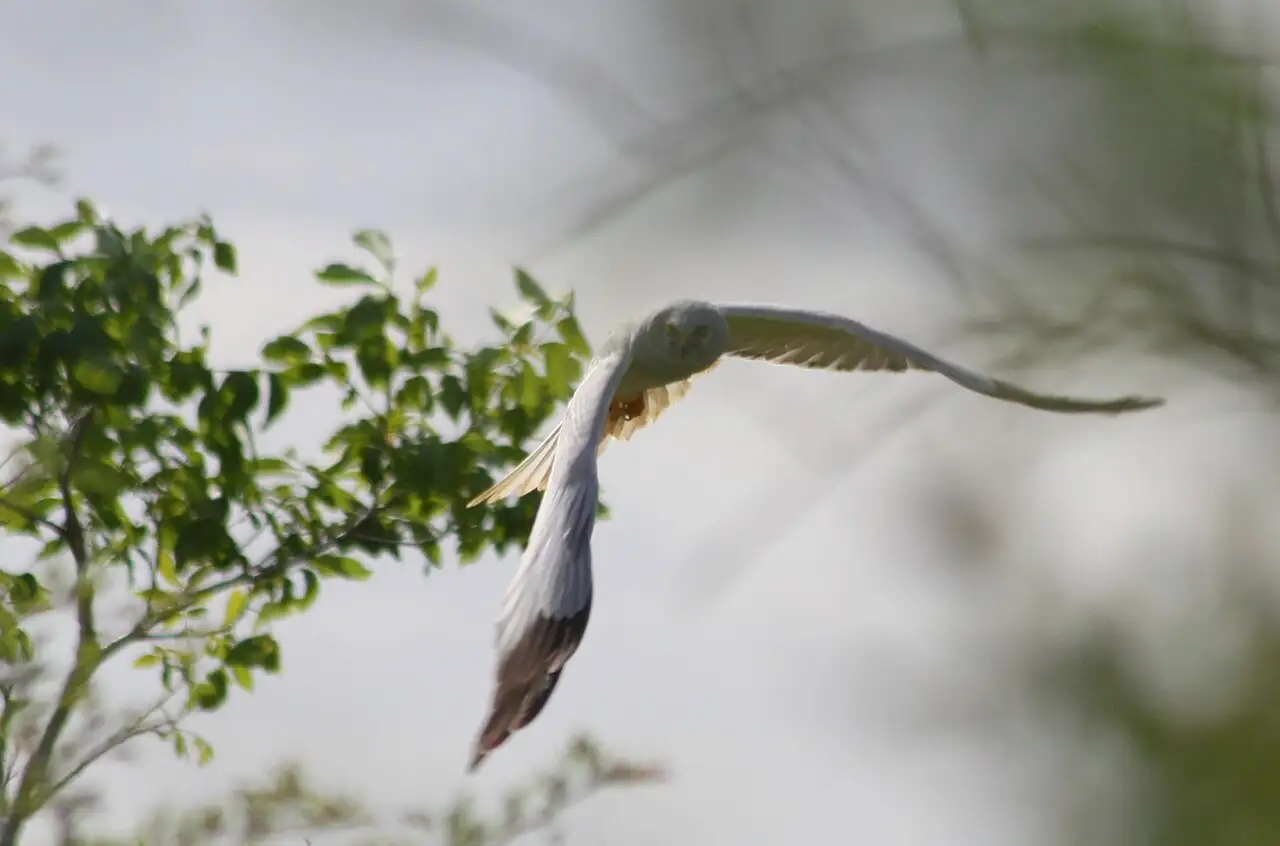
Male Hen Harrier in flight beside some branches, pale grey, with black wingtipsPhoto: sébastien bertru, CC BY-SA 2.0Photo 1 of 4
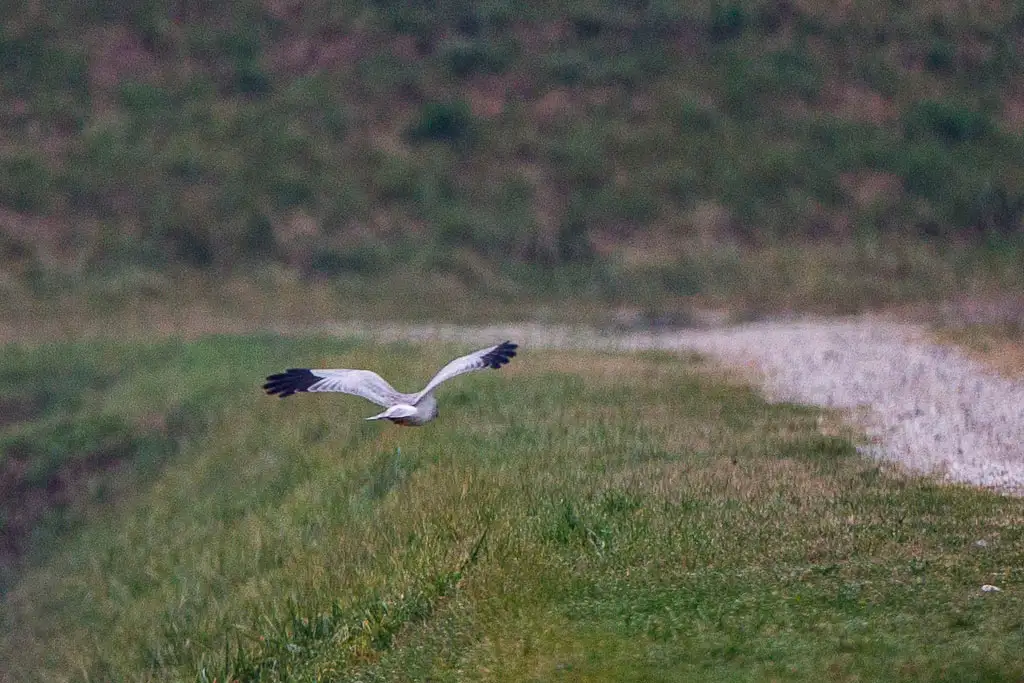
Male Hen Harrier flying close to the ground over a meadow, wings open, white below and with black tipsPhoto: Francesco Veronesi from Italy, CC BY-SA 2.0Photo 2 of 4
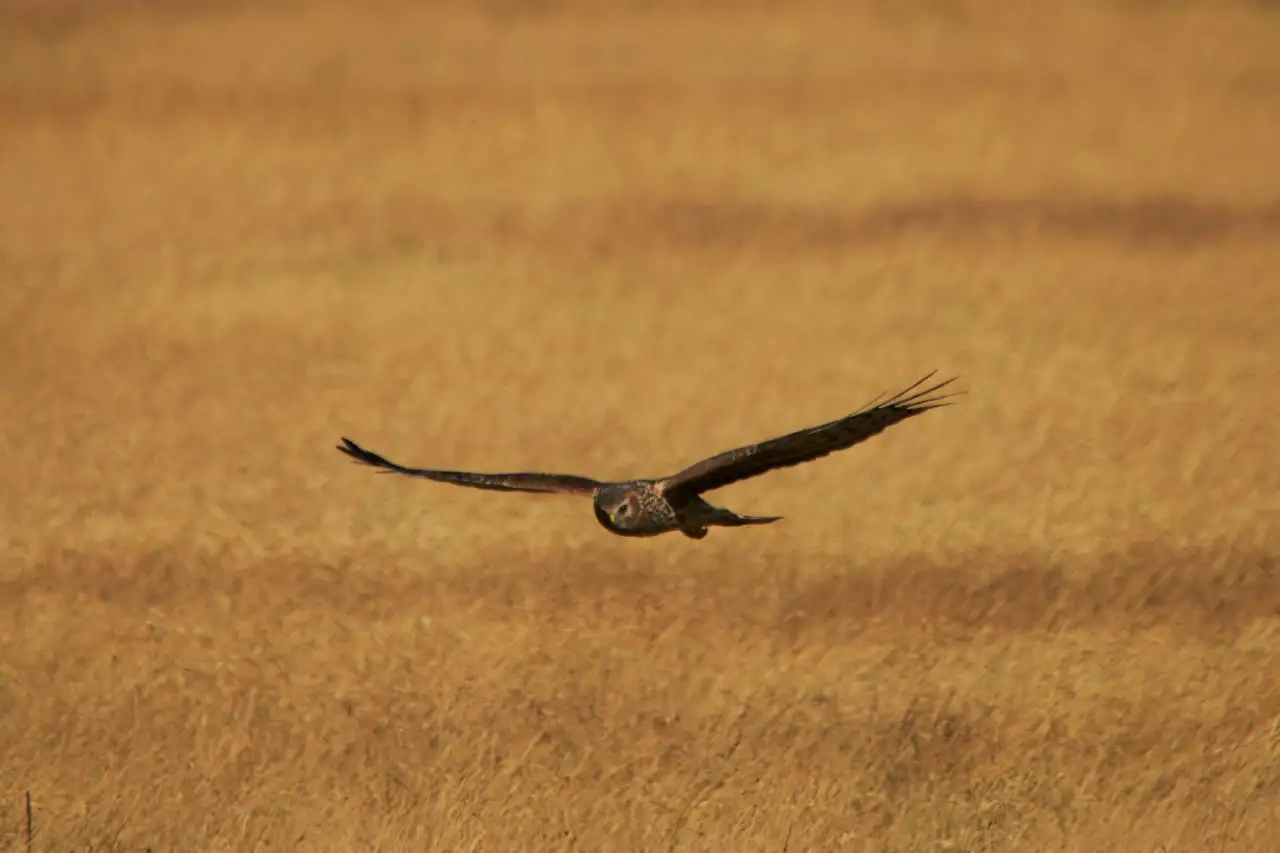
Female Hen Harrier in low flight over a field of golden cereal, in brown tonesPhoto: Radio Tonreg, CC BY 2.0Photo 3 of 4
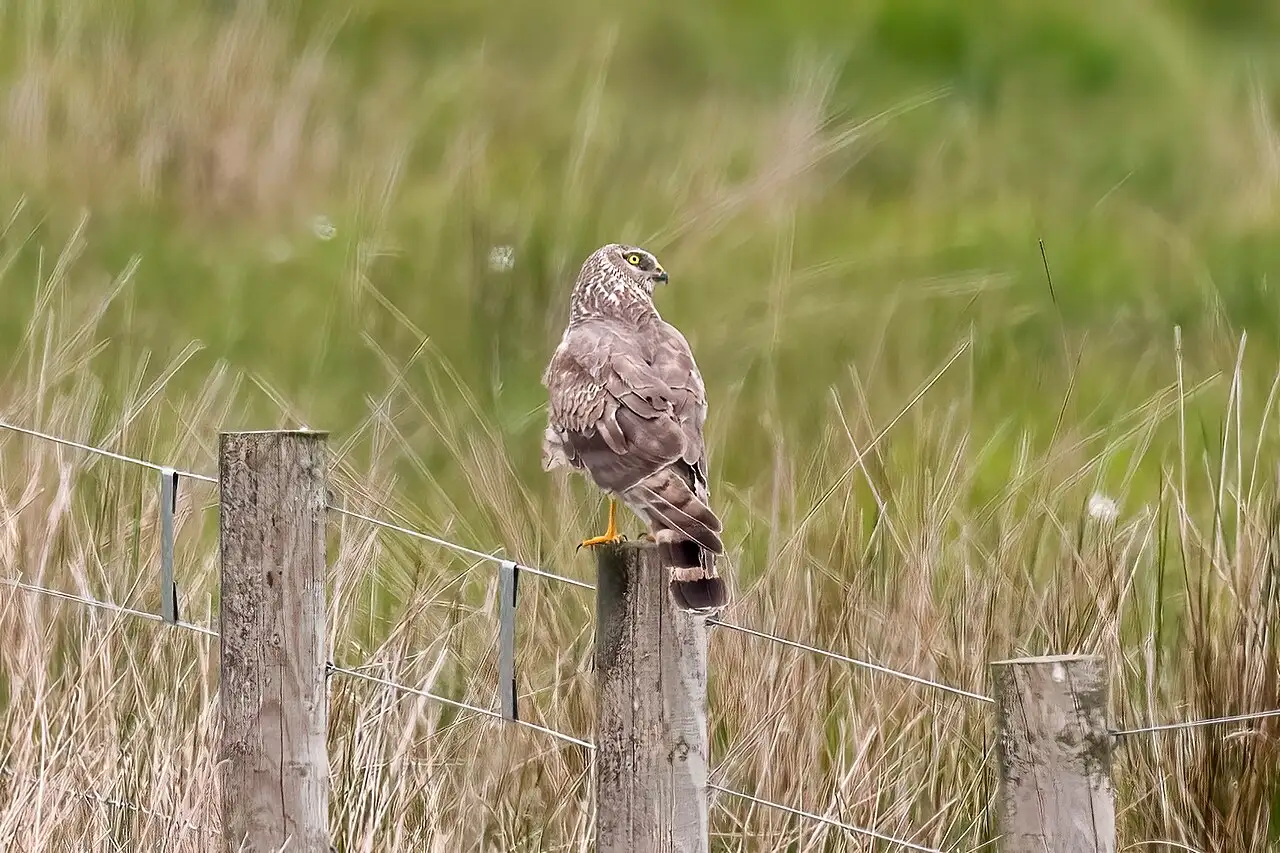
Brown-plumaged Hen Harrier with streaked belly perched on a fence post among tall grassPhoto: caroline legg, CC BY 2.0Photo 4 of 4
1 / 4
Identification of the Hen Harrier
It is a medium-sized raptor with the typical harrier silhouette: long wings and tail, very long legs and a fairly graceful look, though less so than Montagu’s Harrier, from which it differs by being larger and sturdier and by its comparatively broader wings. There is marked sexual dimorphism: females are larger and heavier and have a different plumage. The adult male is pale, with darker grey tones on the back, head and breast and white on the belly, where, unlike Montagu’s, it has no spots or bars. In flight the black tips of the primaries stand out against the white of the underwing coverts, and above, the extensive white rump. The female is earth-toned with grey tints, paler below, where it is heavily streaked with brown, and with the underside of the wings heavily barred; its rump, very visible in flight, is more extensive than that of the female Montagu’s.
Adult
Male: pale grey, white belly with no spots, black wingtips and white rump.
Female: brown and greyish, with a heavily streaked belly and extensive white rump.
Young bird
Brown above and a soft, slightly orange ochre below, with fine lengthwise streaking.
Habitat and distribution of the Hen Harrier
It is a Holarctic species that breeds in the temperate and Arctic latitudes of North America, Europe and Asia. In Spain the subspecies «cyaneus» lives, both in the breeding season and in winter.
As a breeder it is rather northern: it occupies mainly the northern third of the Peninsula, from Galicia and Asturias to northern Aragón. Since the late 20th century it has colonised new regions, and today it breeds across much of Castilla y León, Madrid, Castilla-La Mancha, Catalonia and Extremadura; its southernmost cores are in the province of Ciudad Real1. In winter it spreads much more widely across the territory, although at low densities, and is most frequent in the cereal fields of the north-east quadrant.
In the north it breeds in patches of natural vegetation, such as gorse, heathland, kermes oak scrub, rockrose scrub, mountain meadows, reedbeds and grasslands, from sea level to 1,800 metres. Further south those habitats are replaced by cereals, although in the centre there are also pairs in rush beds and reedbeds. In winter it mainly frequents open, cultivated areas, with large expanses of cereal and fallow, and mosaic landscapes with copses, river plains, groves, scattered trees and scrub.
Those that breed on the Peninsula are fairly resident. In winter many arrive from Europe, above all from France, Germany and Finland, appearing in October and staying until late winter or early spring.
Areas where it is regularly recorded since 2010Squares of about 25 km where it is recorded regularly (occasional passage records are left out). Data from GBIF.org (45,723 records, retrieved October 2026); outline from Natural Earth.
Etymology of the Hen Harrier
According to Wikipedia, «Circus» comes from the ancient Greek «kirkos», the name of a raptor from its circling flight («kirkos» means «circle»), and the epithet «cyaneus» is Latin and means «dark blue». In other languages it is called «arpella pàl·lida» in Catalan, «tartaraña gatafornela» in Galician, «mirotz zuria» in Basque and «hen harrier» in English1.
Population of the Hen Harrier
The 2021 European Red List of Birds estimates a European population of about 112,000–174,000 individuals, with a decreasing trend. According to the Third Atlas of Breeding Birds, in 2017 there were between 500 and 800 pairs on the Peninsula, about 35 % fewer than in the 2006 census. The decline is sharper in Álava, Burgos, Palencia, León and Ourense, while in Salamanca, Zamora, Valladolid, Segovia and Ávila it has increased slightly. That is why the 2021 Red Book of the Birds of Spain considers it Endangered.
Its greatest threats are the destruction and alteration of its breeding habitat through agricultural intensification: pesticides, land consolidation and loss of fallows, wasteland and field margins. Harvesting kills many chicks from nests set in the cereal, and it is also affected by fires, increasingly frequent, poisoned baits, which between 1992 and 2013 may have killed between 300 and 500 harriers, and by power lines and wind turbines.
Nest of the Hen Harrier
It builds it directly on the ground, among dense vegetation, and only occasionally on a bush. It is a rough platform of vegetation prepared by the female, of variable size: in the dampest areas it is bigger and can reach 45 centimetres high and 90 across. The female lines the inside with soft materials.
Courtship and breeding of the Hen Harrier
It returns to the vicinity of its breeding area in March and soon afterwards courtship begins, with acrobatic aerial displays by the pair. The female lays four to six eggs, sometimes up to eight, bluish or greenish white, and incubates them for 29–39 days, while the male, sometimes polygamous, brings her food and defends the territory. The chicks are tended mainly by the female, with the prey the male brings. At barely 15 days they leave the nest for a while to move around the surroundings, but do not finish developing until 20 days later, when they start to fly; they still take one or two weeks to become independent.
Diet of the Hen Harrier
Its diet is very varied and based on small and medium-sized vertebrates: above all rodents, such as voles, mice and rats, and adult birds and chicks, from larks or quails to waders. It also hunts lizards, small snakes and large insects, particularly grasshoppers. Sometimes it steals food from other raptors, such as Montagu’s Harrier, the Common Kestrel or the Short-eared Owl.
Curious facts about the Hen Harrier
In winter Hen Harriers gather at night in communal roosts in reedbeds, often alongside Marsh Harriers. Through the Strait of Gibraltar, on the other hand, few pass: about 100 a year1. EURING lists a Hen Harrier ringed in the Netherlands that lived 20 years and 8 months, more than AnAge gives (17.1 years).
The Hen Harrier in Cabañeros
The habitat pages of this website do not mention it, and we have not found any other published source on it in the Park. The southernmost breeding cores of the species in Spain are in the province of Ciudad Real1. GBIF.org records 33 observations of the Hen Harrier in Cabañeros and its surroundings.
Where to see the Hen Harrier in Cabañeros
In Cabañeros and its surroundings, mainly from October to March, over cereals, fallows and open areas.
When
All year, but above all in winter, from October to late winter, when the Europeans arrive.
What time
By day, patrolling the fields; at dusk, on its way to the reedbed roosts.
Where
In open areas with cereal and fallow, and in mosaic landscapes with river plains, groves and scrub.
What to look for
Look for the pale grey male with black wingtips and the white rump of the brown female.
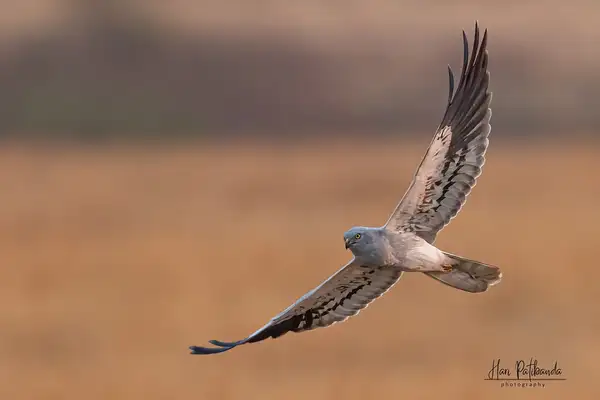
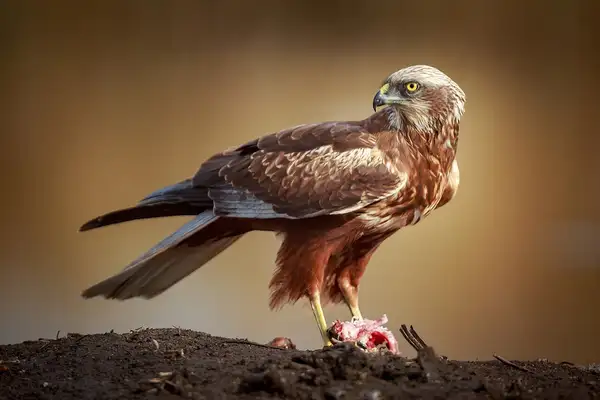
It is similar in song and in physical appearance1. The Hen Harrier is larger and sturdier, with broader wings, and the male has no spots or bars on the belly.



 Same family
 Same family
 Same family
 Same family
 Same order
 Same season in the park
 Same season in the park
 Same season in the park






