Wingspan compared with a person with arms outstretched.
Length
52–59 cm
Wingspan
1.13–1.35 m
Weight
0.6–1.1 kg
Social life
Solitary when breeding; gregarious on migration
Lifespan
Record of 29 years in the wild
Conservation status
LC
NT
VU
EN
CR
EW
EX
Global (IUCN)
Least Concern
Spain
Near Threatened (Red Book of the birds of Spain) and under special protection
When to see it
Passage migrant in Cabañeros
Months of the year when it is present
J
F
M
A
M
J
J
A
S
O
N
D
In Iberia
no
no
no
yes
yes
yes
yes
yes
yes
no
no
no
In Cabañeros
no
no
no
no
yes
no
no
no
yes
yes
no
no
Breeding season
no
no
no
no
yes
yes
yes
yes
no
no
no
no
Song or voice of the European Honey Buzzard
It is usually a silent bird, with a high, drawn-out whistle, clear and slightly melancholy: «flíuu».
CallEuropean Honey Buzzard
0:00 / 0:08
10 kHz5
The sonogram draws the sound: time runs from left to right, and the higher a trace sits, the higher the note.
Flight of the European Honey Buzzard
It flies with deep, springy wingbeats, and glides with wings arched or flat and the tips drooping. On migration it climbs in circles on thermals and launches from the top, in a straight line, to the next one. When in display it claps its wings above its body in mid-air, in a sort of applause.
Flight typeGlides and climbs on thermals
It lets itself be carried by the warm air and circles widely, with flat, slightly drooped wings, hardly flapping them.
From on high it glides in a straight line, losing height little by little, until it finds the next thermal. The groups pass one after another.
Photo gallery of the European Honey Buzzard
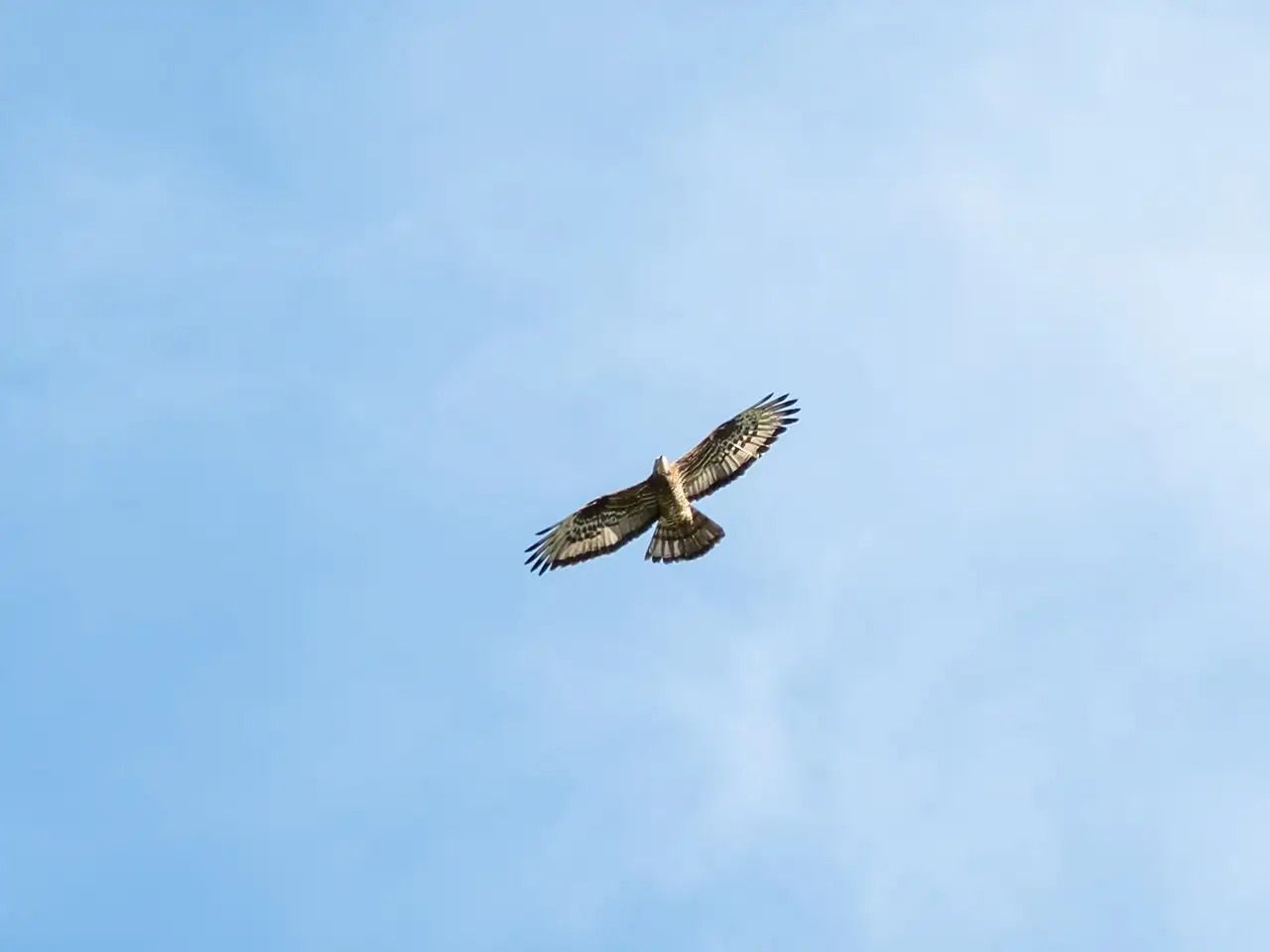
European Honey Buzzard in flight seen from below: long wings, small head and banded tailPhoto: Mvukota, CC BY-SA 4.0Photo 1 of 4
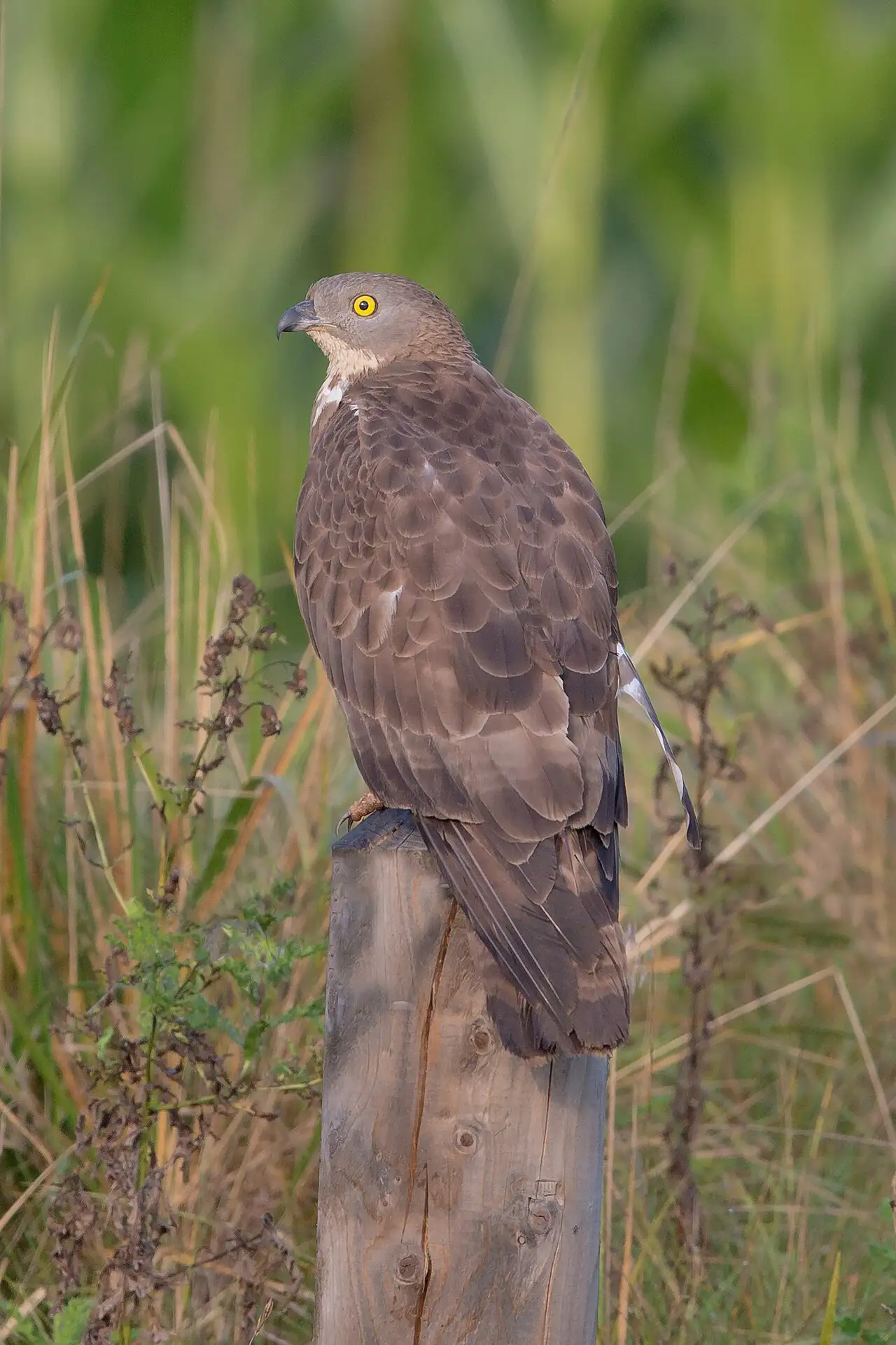
European Honey Buzzard perched on a post: narrow grey cuckoo-like head and brown backPhoto: Andreas Trepte, CC BY-SA 2.5Photo 2 of 4
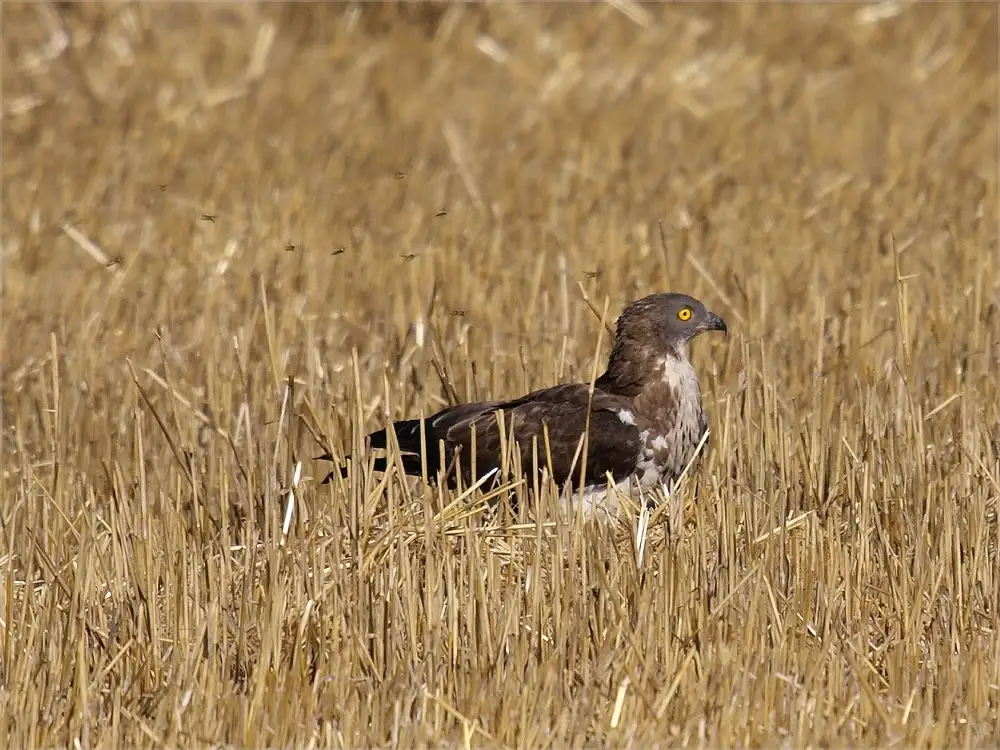
European Honey Buzzard in a stubble field, surrounded by wasps: this is how it looks for the nestsPhoto: Jo Kurz, CC BY-SA 3.0Photo 3 of 4
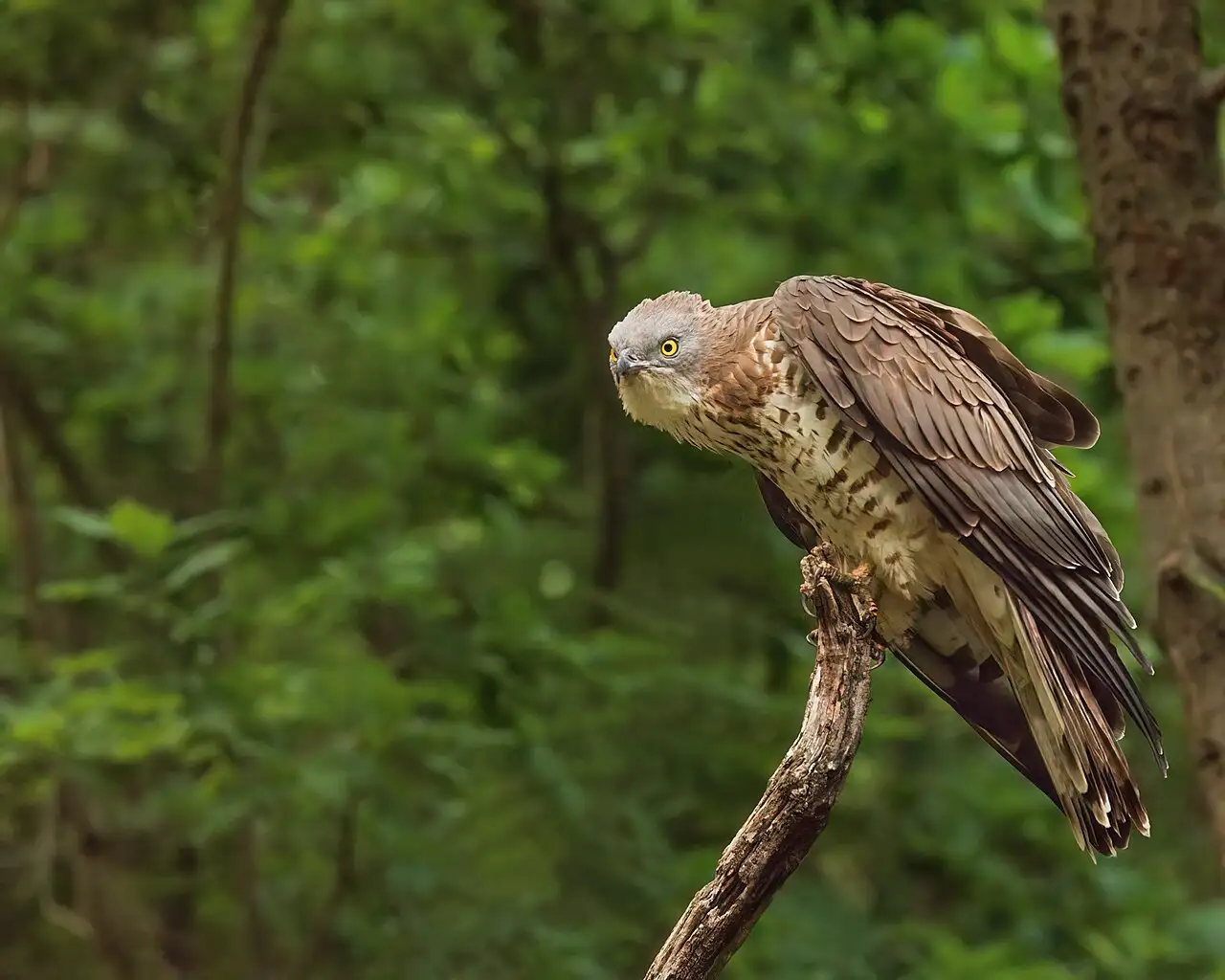
It shows very variable colours that call for care and attention to identify it.
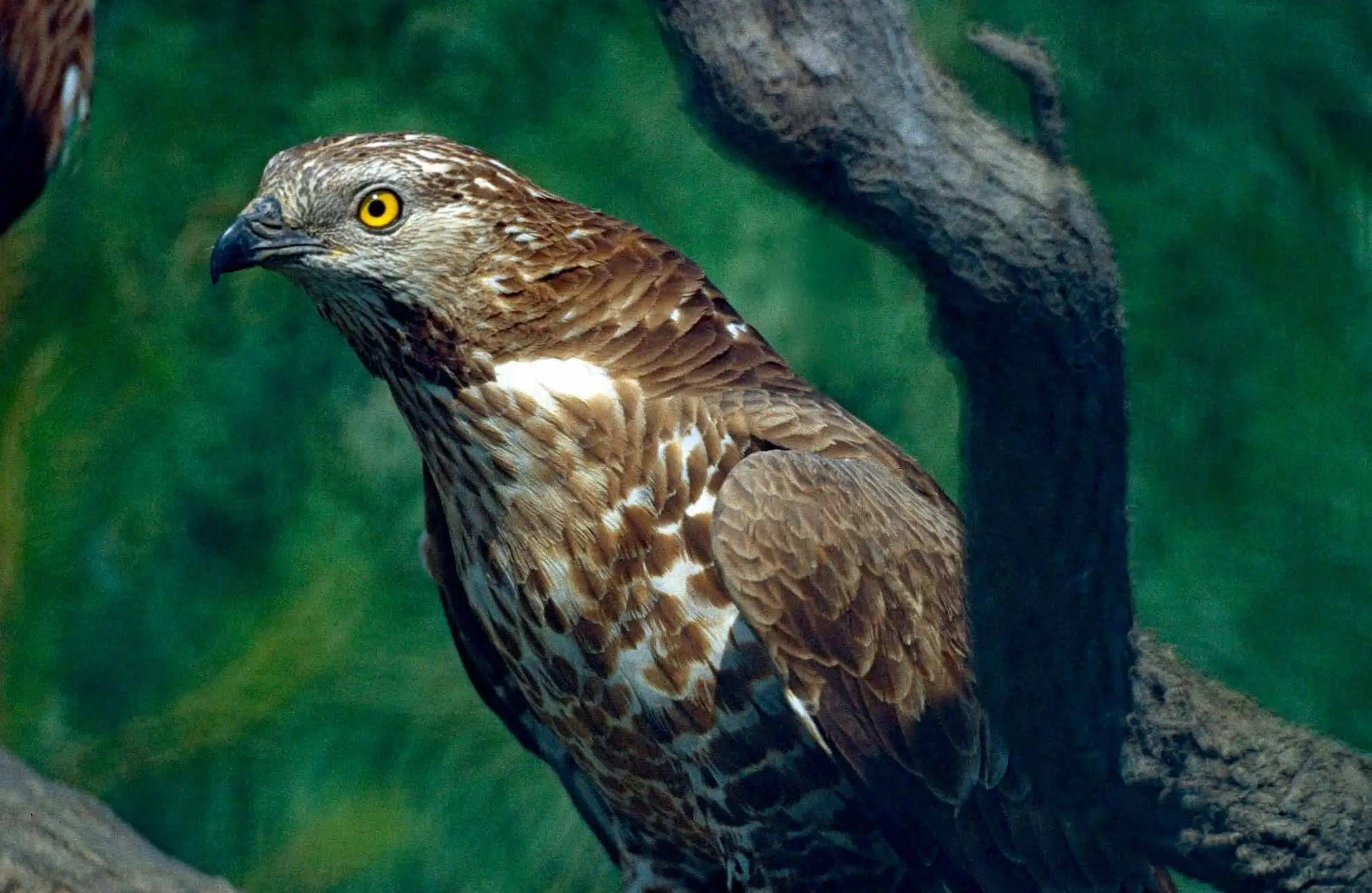
Its head is narrow and dark, cuckoo-like, with a pointed bill, whiter in juveniles. Its eye is yellow, dark in juveniles.
Its underside is barred like a tiger. Although in most birds it is heavily marked, the pattern varies quite a lot and some birds are plainer.
It has long wings with an angled outer edge and can glide with wings drooping or flat.
Its tail is long, longer in the centre, and 3 dark bands can be seen on it.
It looks a bit like the Common Buzzard but with a more protruding head.
Habitat and distribution of the European Honey Buzzard
The European Honey Buzzard ranges across all of Europe except northern Scandinavia and Iceland. Also in western Asia. It tends to settle in extensive woods, above all deciduous ones such as beech woods, Pyrenean oak woods or birch woods, with clearings of shrubs and scrub or grassland. It also appears in hilly wooded areas, from sea level up to about 1,700 metres. It is present from April until it leaves in September. Migrants cross the Mediterranean on regular routes.
The European Honey Buzzard usually hides when breeding. It is easier to see on migration when it concentrates at the straits over the Baltic and the Mediterranean, on its way to tropical Africa.
Areas where it is regularly recorded since 2010Squares of about 25 km where it is recorded regularly (occasional passage records are left out). Data from GBIF.org (61,602 records, retrieved October 2026); outline from Natural Earth.
Etymology of the European Honey Buzzard
The scientific name says almost everything: «Pernis» is a Greek word for a bird of prey, and «apivorus» is «bee-eater» in Latin, from «apis», bee, and «vorare», to devour. In Spanish, abejero, the one in charge of the bees, although the ones it really attacks are wasps.
Population of the European Honey Buzzard
In Spain about 1,850 breeding pairs are estimated, and the trend in Europe is stable1. It is included in the List of Wild Species under Special Protection and appears as Near Threatened in the Red Book of the birds of Spain. In Cabañeros we only see it passing through.
Nest of the European Honey Buzzard
It builds its nests of twigs in the foliage of trees, usually in the upper half of the crown. Sometimes they use old crow nests.
Courtship and breeding of the European Honey Buzzard
They lay a clutch of 1 to 3 eggs between May and July–August, months that coincide with the greatest abundance of their prey. In April and early May the first birds arrive from Africa. These are the males, which when the breeding season comes show a solitary and aggressive attitude, nothing like their gregarious character during migration. The courtship phase begins when the females appear. Afterwards, the pair rebuilds the previous season’s nest.
The eggs are white, speckled with brown, reddish or violet spots, and are incubated for about 37 days by both birds, although the female usually spends more time on them. The chicks take about 40 days to fledge fully and get ready to migrate at 70 or 75 days old.
Diet of the European Honey Buzzard
Its diet centres on wasp nests and honeycombs. The shape of its bill, short and thin, lets it extract the pulp of the combs easily. Its toes are protected by hard scales to avoid the stings of these insects. It eats wasp larvae, bees, honey and wax. It also feeds on adult insects, such as spiders and worms, as well as small mammals and reptiles. Sometimes it even eats fruit.
Curious facts about the European Honey Buzzard
Its common and Latin name comes from its diet: «Pernis» designates a bird of prey and «api-vorus» is bee-eater in Latin.
Be careful with combs and wasp nests attacked by the honey buzzard, they become much more aggressive.
It has been suggested that it could help control the Asian hornet, an invasive pest that attacks bees.
The European Honey Buzzard in Cabañeros
In Cabañeros the European Honey Buzzard is present during its migration. It is quite frequent during the pre-nuptial passage, which lasts from early May to the end of the month, and the autumn one, from 15 September to early October. They are gregarious, forming groups of up to 70 birds that pass through without a break.
Where to see the European Honey Buzzard in Cabañeros
They usually take advantage of the updrafts that rise on the slopes of the Cuerda de Miraflores and the Sierra del Chorito to cross the park from north to south.
When
Only on the migration passages: throughout May, heading north, and from 15 September to early October, heading south.
What time
From midday to early afternoon, when thermals are at their best and the groups climb in circles.
Where
On the slopes of the Cuerda de Miraflores and the Sierra del Chorito, where the updrafts form that they use to cross the park.
What to look for
A bird of prey with a small, cuckoo-like head and a long banded tail, climbing in circles with wings flat or slightly drooping; if there is one, there are usually more behind.
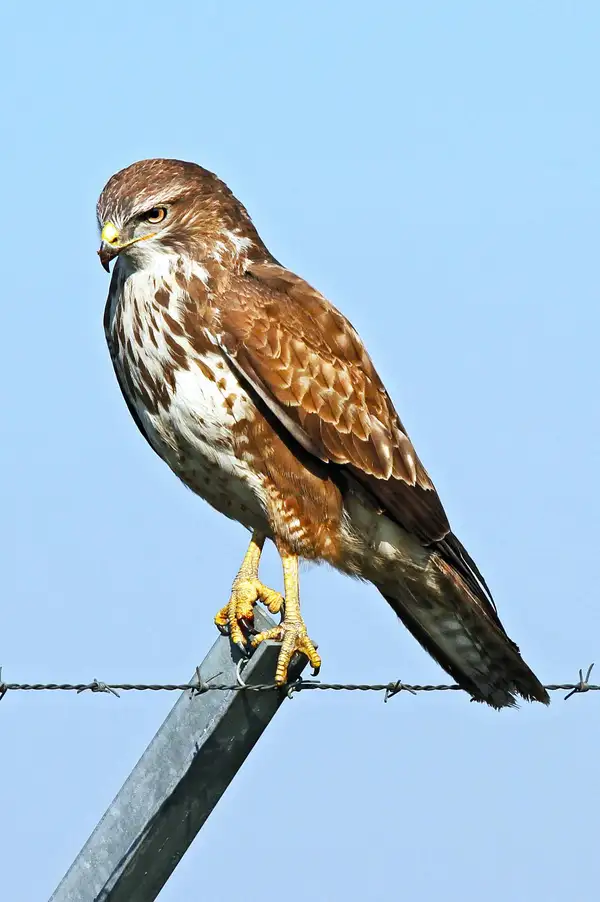
Sturdier, with a round head that does not stick out, a shorter and less barred tail, and a dark patch at the wrist. It glides with its wings in a shallow V and is usually present all year.



 Same family
 Same family
 Same family
 Same family
 Same season in the park
 Same season in the park
 Same season in the park
 Same season in the park






