Small mammals in spring and summer; fruit in autumn and winter
Social life
Solitary; in pairs only in the rut
Lifespan
Record of 18.2 years (in captivity)
Conservation status
LC
NT
VU
EN
CR
EW
EX
Global (IUCN)
Least Concern
When to see it
Mammal · in Cabañeros
Abundant: the second most numerous carnivore in the park, according to the website.
Months of the yearly cycle
J
F
M
A
M
J
J
A
S
O
N
D
Rut
no
no
no
no
no
yes
yes
yes
no
no
no
no
Births
no
no
yes
yes
no
no
no
no
no
no
no
no
Photos of the Beech Marten
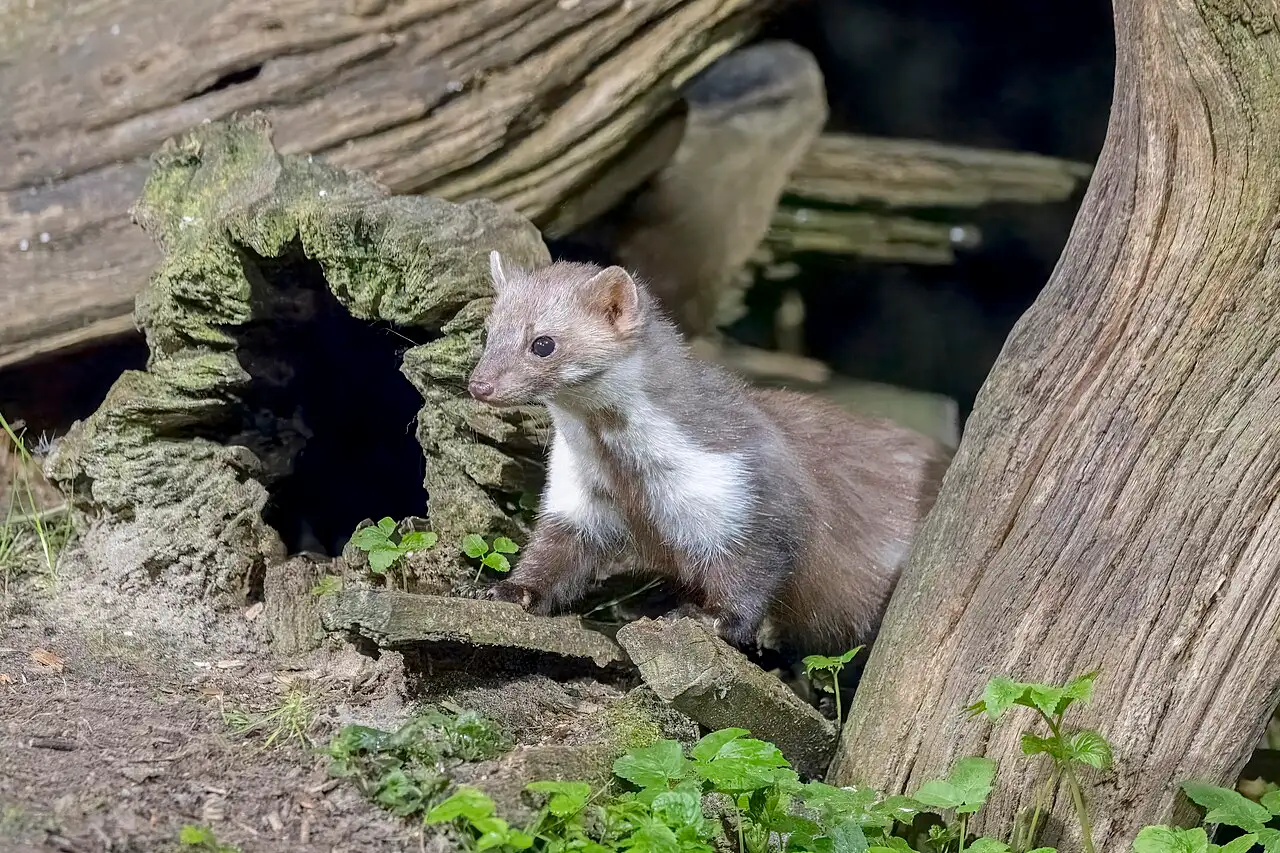
A Beech Marten peeks out between trunks, its white throat in viewPhoto: Charles J. Sharp, CC BY-SA 4.0Photo 1 of 1
1 / 1
Identification of the Beech Marten
It is a mustelid with an elongated body and long tail. Males weigh on average 1.35 kilos and females a little over 1 kilo. The white bib is its trademark.
Habitat and distribution of the Beech Marten
Very adaptable: it lives in woods, rocky outcrops and scrub.
Areas where it is regularly recorded since 2010Squares of about 25 km where it is recorded regularly (occasional records are left out). Data from GBIF.org (5,389 records, retrieved October 2026); outline from Natural Earth.
Breeding of the Beech Marten
It pairs up only in the rut, which is usually in summer, although there is sometimes a second rut in February. Litters, of two to four young, are born in early spring, in March and April.
Diet of the Beech Marten
It is an opportunistic predator: it prefers small mammals in spring and summer and fruit in autumn and winter, and rounds out its diet with birds, insects and reptiles.
The Beech Marten in Cabañeros
According to the website, the Beech Marten and the genet have overtaken in abundance the big carnivores of old, and today the Beech Marten is the second most numerous carnivore in the park, behind only the fox. Like it, it was affected by the canine distemper outbreak that sent the field mouse population soaring.
Can it be seen in Cabañeros?
It is nocturnal and discreet: the most likely thing is not to see it, even though it is nearby.
Mangas, J. G. (2017). Garduña – Martes foina. En: Salvador, A. y Barja, I. (eds.), Enciclopedia Virtual de los Vertebrados Españoles. Museo Nacional de Ciencias Naturales (CSIC). vertebradosibericos.org
OAPN (2011). Guía de visita del Parque Nacional de Cabañeros. PDF
AnAge: The Animal Ageing and Longevity Database. Martes foina