Omnivore: mostly plant matter (acorns, roots, tubers) and a constant animal part
Social life
Females with their young in family groups; adult males more solitary
Lifespan
Up to 10 or 11 years in the wild, although most do not exceed three
Conservation status
LC
NT
VU
EN
CR
EW
EX
Global (IUCN)
Least Concern
Spain
Least concern; game species
When to see it
Mammal · in Cabañeros
Abundant throughout the park, according to the official guide. It is seen crossing the raña and the woodland tracks.
Months of the yearly cycle
J
F
M
A
M
J
J
A
S
O
N
D
Births
no
yes
yes
yes
no
no
no
no
no
no
no
no
Photos of the Wild Boar
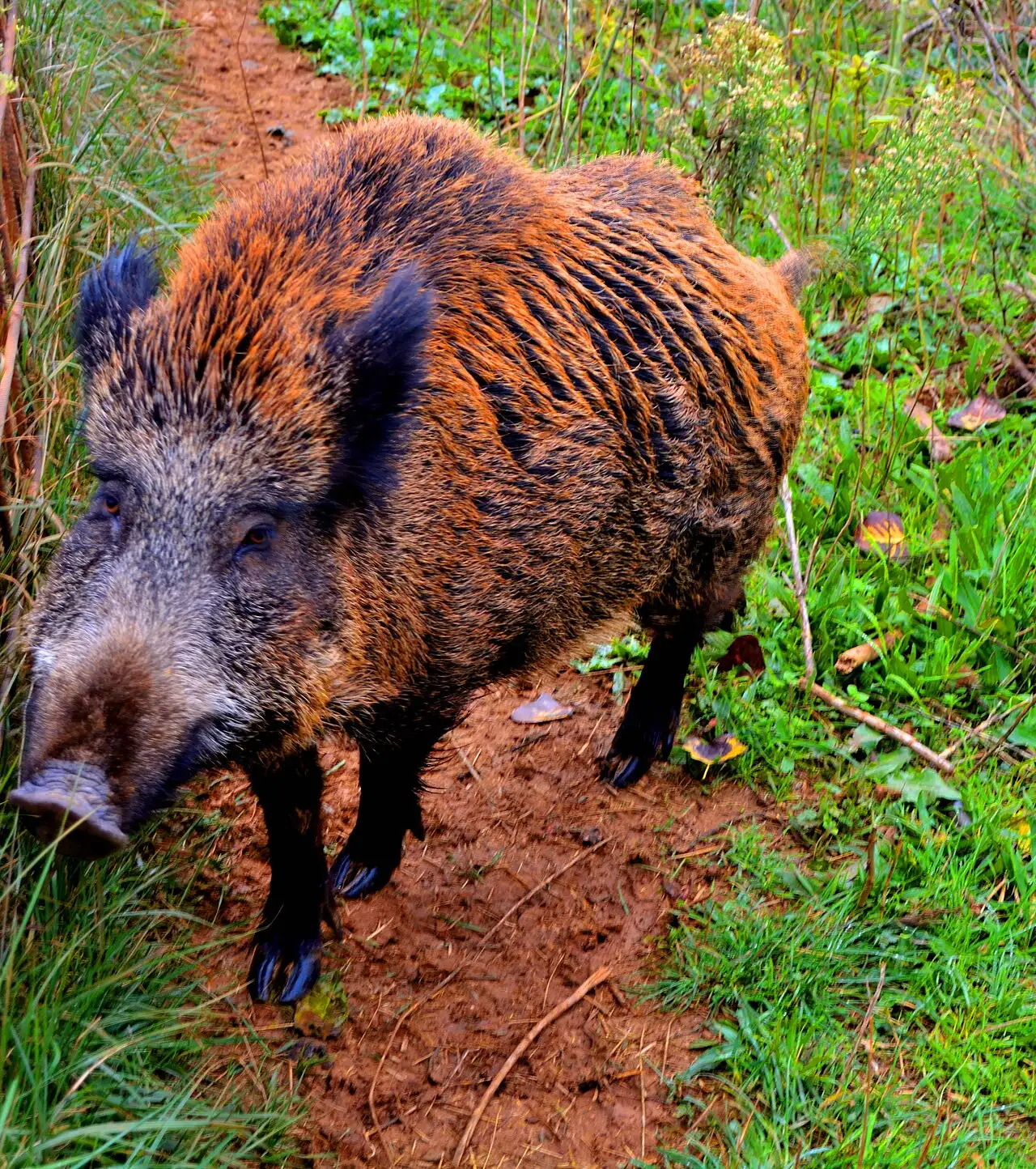
An adult wild boar, with its snout and bristly hair clearly visiblePhoto: Anthiro 57, CC BY-SA 4.0Photo 1 of 3
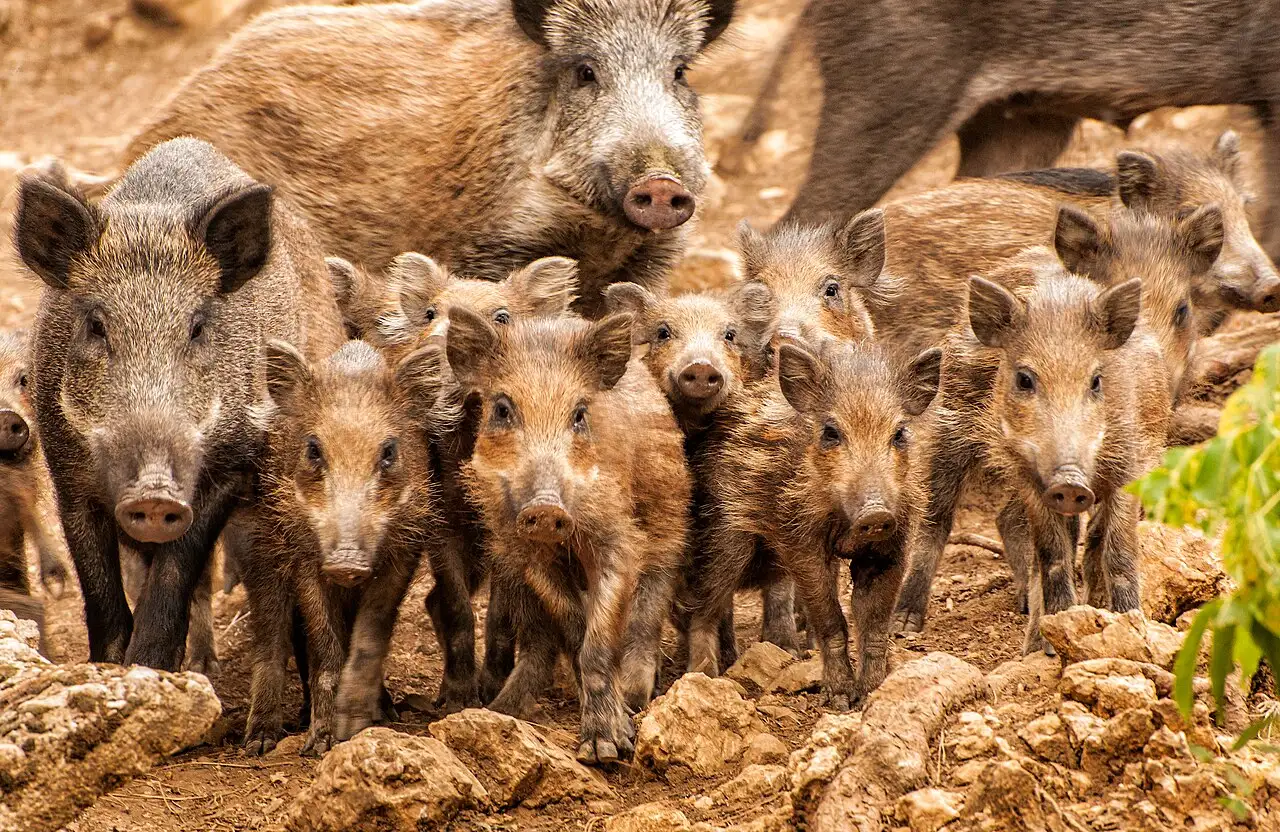
A sow with her litter of striped pigletsPhoto: Dgalan, CC BY-SA 4.0Photo 2 of 3
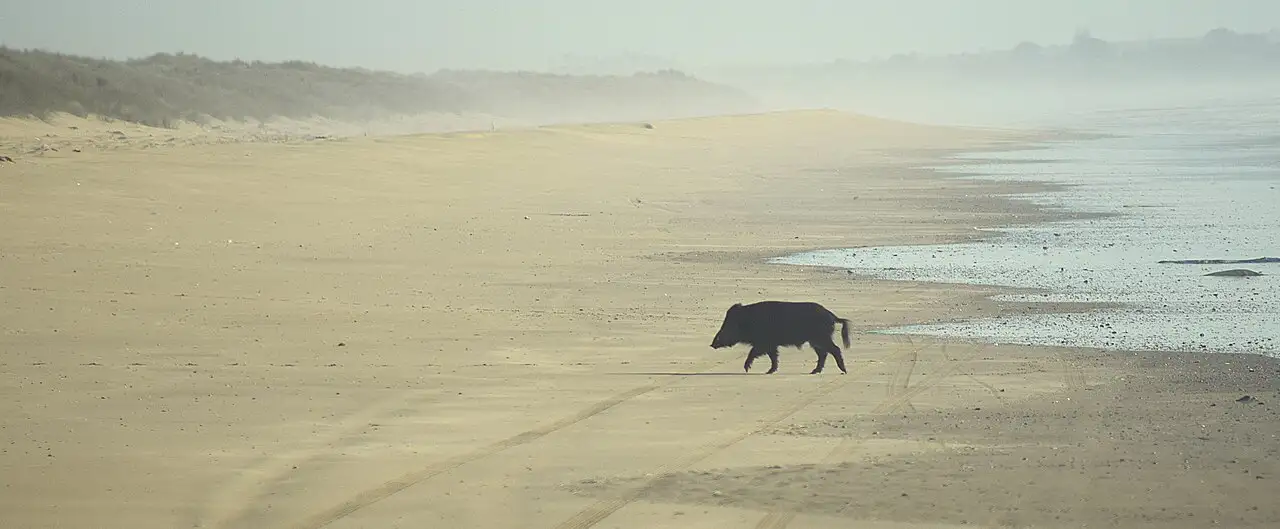
A wild boar crosses a large open plain in the distance in DoñanaPhoto: Patisalva, CC BY-SA 4.0Photo 3 of 3
1 / 3
Identification of the Wild Boar
Males are somewhat bigger than females, by 5 to 10 %. On the peninsula, adult males weigh on average between 75 and 85 kilos and females between 55 and 65. The coat is dark brown, coarse, with long bristles on the back.
Habitat and distribution of the Wild Boar
It lives in almost any environment with cover, from Mediterranean woodland to riverbanks and crops. The map shows how widespread it is across the peninsula.
Areas where it is regularly recorded since 2010Squares of about 25 km where it is recorded regularly (occasional records are left out). Data from GBIF.org (628,197 records, retrieved October 2026); outline from Natural Earth.
Breeding of the Wild Boar
Females come into heat for the first time when they reach about thirty kilos, normally at ten or eleven months. Most births take place between February and April, with litters of one to eight piglets: the bigger the mother, the more young she has. This high breeding rate explains a good part of its success.
Diet of the Wild Boar
It is omnivorous. It eats mainly plant matter (acorns, roots, bulbs and tubers), but always with an animal part that changes according to area and season: invertebrates it digs out of the soil, small vertebrates and carrion. The park guide notes that, in Cabañeros, the wild boar is one of the predators of the rabbits that live on the surface, among the scrub, because the hard soils do not let them dig burrows.
The Wild Boar in Cabañeros
Like the red deer, it increased greatly when people stopped working the woodland. Its very varied diet and its ability to rear many piglets did the rest. The park guide counts it, together with the fox, among the abundant mammals of Cabañeros, and it is not unusual to see it crossing the raña or quickly crossing a track in the woodland.
With its snout it opens deep holes and flips stones looking for roots, tubers and invertebrates: those patches of turned-up earth are its easiest sign to recognise.
On 29 March 2023 the park’s Board of Trustees issued a favourable report on the Ungulate Management Plan, which sets out the measures to manage and control within the park the populations of ungulates, such as the red deer, the fallow deer or the wild boar, according to the newsletter of March–April 2023.
Where to see the Wild Boar in Cabañeros
When
All year. In spring it is easy to see females with striped piglets.
What time
At dusk and at night is when it moves most; by day it hides in the scrub.
Where
On the raña and on the woodland tracks. The park guide cites the raña of El Peral and that of Santiago, which the 4×4 tours cross, among the good places to see red deer and wild boar.
What to look for
Freshly turned earth and flipped stones and, with luck, a sow with her piglets crossing the track.
Newsletter «Desde el parque», Cabañeros National Park (OAPN), March–April 2023 (Ungulate Management Plan; in Spanish). All the newsletters.
Fernández-Llario, P. (2017). Jabalí – Sus scrofa. En: Salvador, A. y Barja, I. (eds.), Enciclopedia Virtual de los Vertebrados Españoles. Museo Nacional de Ciencias Naturales (CSIC). vertebradosibericos.org
OAPN (2011). Guía de visita del Parque Nacional de Cabañeros. PDF